The buzzing started at 0600 hours. Twenty-nine missed calls, all from Illinois. My trigger finger—the same finger that never trembled on an M4 in a live fire zone—froze a quarter inch above the phone screen. A text banner dropped down.
From Hannah, my younger sister. *They lost everything. The business is gone. Come home.
*
I didn’t cry. Crying is a leak in the perimeter. I locked my jaw and pressed both hands flat on the oak desk until my knuckles went white. Ranger pushed his eighty-pound body between my legs and the desk, shoving his cold snout under my palm.
The retired K9 had half his left ear blown off in Kandahar. He growled at the glowing phone like it was an IED. “Stand down, buddy. ” My voice came out rough.
“We’re secure. ”
I didn’t block the number. An intelligence specialist never severs the enemy’s communication lines when the blast radius of their collapse is unknown. I silenced the phone, tossed it in the drawer, and slammed it shut.
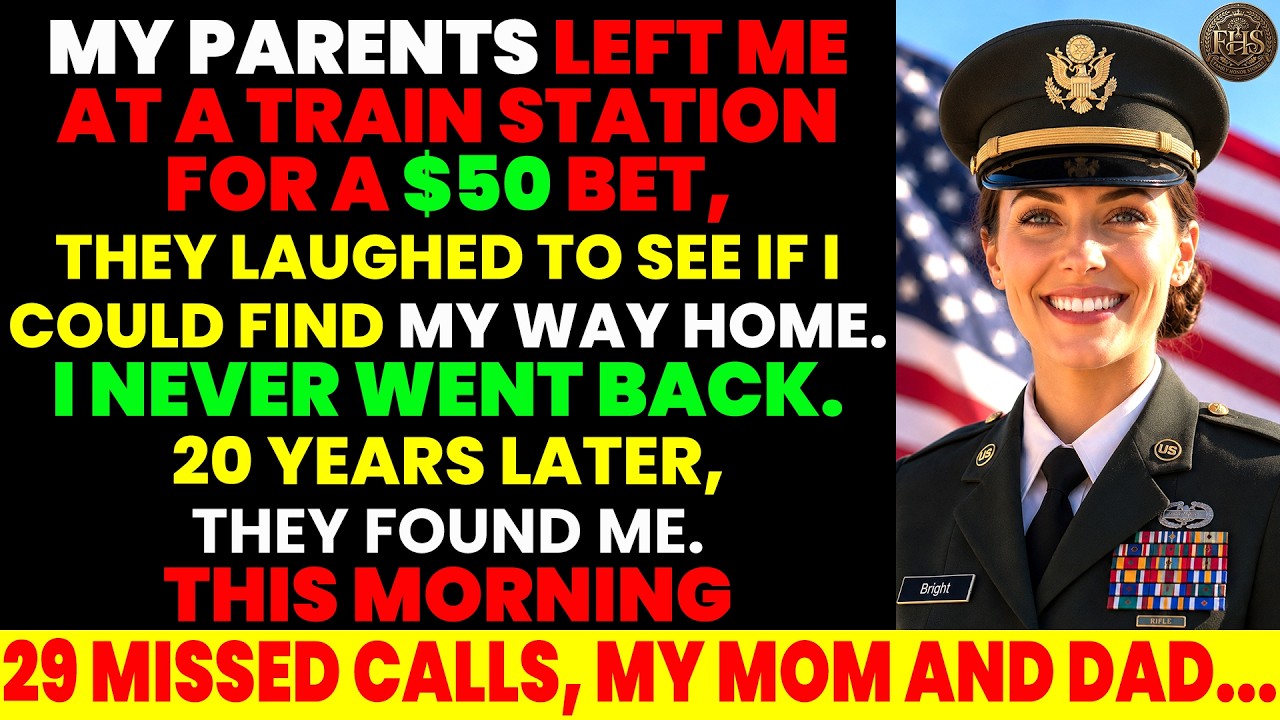
The brass plate on my chest read BRIGHT. But the people calling weren’t looking for Sergeant First Class Malia Bright. They were after Abigail Mercer—the weak girl they used as a human shield. To face the future, I had to dig up the past.
Willow Creek was a postcard of suburban perfection, and Richard and Eleanor Mercer were its gold standard. He ran Mercer Tactical, selling survival gear and paranoid delusions to weekend wannabes. She gave keynote speeches about iron discipline at the veterans club, though she’d never served a day in uniform. Behind closed doors, the show ended.
Every basic need became a weakness to be eradicated. I skinned my knee? “A wounded soldier is dead weight. Get up or get left behind.
” Asked for more bread? “Greed kills the unit. ”
The summer I turned eight, my sneakers blew out at the heel. The hard plastic backing ground into my Achilles tendon until blood soaked into my sock.
At the mall, I pointed to a clearance bin. Eleanor dragged me to the food court and shoved me onto a bench beside the trash cans. “You want to survive out there? Start by sitting here alone.
Nobody owes you a damn thing. ”
They left me there for three and a half hours. When they finally strolled out of a department store—Eleanor carrying three shopping bags, Richard holding a fresh iced coffee—Richard tossed a crumpled $20 bill at her chest. “You win.
I figured the little rat wouldn’t have the guts to move an inch. ”
I wasn’t their daughter. I was a prop. My terror was a Saturday afternoon parlor trick.
Art was my only air supply. I drew in spiral sketchbooks hidden under my mattress—falcons against the wind, soldiers with kind faces instead of dead eyes. When I was twelve, my art teacher selected my charcoal landscape for a state competition. I thought a perfect A could buy me one moment of peace.
Eleanor tore it in half. Then into quarters. She crumpled the pieces and threw them at my chest. “Mercer Tactical is not a soft, daydreaming piece of garbage.
”
Richard nudged the ruined paper with his boot. “You’re embarrassing the bloodline. We need to scrub that trash out of your head. ”
That night, I taped the pieces back together in my bedroom, sealing a corpse.
Through the air vent, I heard them planning. “She needs a field exercise,” Eleanor whispered. “Something she will never forget. ”
The next morning they made breakfast and told me we were going to Chicago.
I convinced myself it was a truce. Desperate kids believe anything. The automatic child safety locks clicked as the car doors slammed. I reached for the handle.
Dead. Disconnected. Eleanor spent the drive firing psychological shrapnel. “You think colored pencils make you valuable?
You’re meat. You’re prey. Weak links get cut. ”
Inside Union Station, she pointed at a spot in the center of the great hall.
“Stand exactly here. We’ll be back in twenty minutes. Do not move. Do not talk to anyone.
Do not embarrass me by crying. ”
They disappeared into the crowd. I stood frozen for hours. Families passed—fathers holding daughters’ hands, mothers tightening coats around small shoulders.
I jammed my hands into my pockets, hiding the shaking. A single crumpled $5 bill was all I owned. Then I spotted the black SUV crawling past the glass walls. A Mercer Tactical decal caught the light.
My heart slammed. They came back. I pressed my palms against the glass and waved, jumping on my toes like a stranded soldier spotting rescue. The passenger window rolled down.
They were staring straight at me. Richard smiled. Eleanor leaned out. “I bet you 50 bucks you don’t have the survival instincts to find your own way home.
”
She laughed. Richard raised a slow, mocking thumbs-up. Then he gunned the engine. My life was worth $50 on a Friday afternoon.
My legs gave out. A transit cop grabbed my shoulder and I bolted, spending three hours as a ghost, brainwashed to believe every uniform was a threat. Then a woman in a security uniform crouched at my eye level. Her name tag read GONZALEZ.
“Have you eaten anything today, sweetheart? ”
That simple question cracked twelve years of reinforced concrete. Between gasping sobs, the truth spilled out—the SUV, the window, the bet. Maria gave me hot chocolate in a security office.
Officer Reed pulled up the external camera footage and watched the SUV slow, the passenger lean out, the vehicle speed away. When he called my parents, Eleanor answered: “Is she crying? Tell her the exercise isn’t over until she figures out the train schedule. ”
Reed slammed his palm on the metal desk.
“Leaving a twelve-year-old girl alone at a major transit hub to win a bet is not a training program. It is child abandonment. ”
I was placed with Arthur and Evelyn Bright. Arthur was a retired combat photographer; Evelyn taught at the military base.
My first night, I dropped my fork at dinner. I squeezed my eyes shut, braced for a backhand, stopped breathing. When I cracked one eye open, Arthur had picked up the fork and was walking to the sink. He came back with a clean one and set it beside my plate.
He didn’t make a big deal out of it. He just ate. In court, their lawyer called it “an advanced independence protocol. ” Judge Vance had seen every monster in a suit.
He gave them a choice: monitored therapy, unannounced CPS visits, a microscope on their lives—or relinquish parental rights. Eleanor gave her lawyer a single sharp nod. They signed. They threw me away to protect the Mercer Tactical brand.
“Abigail, do you have anything to say? ”
“No. ”
That was the last word Abigail Mercer ever spoke. I became Malia Bright.
Arthur taught me drawing wasn’t a hole to hide in—it was a weapon. I brought it to an Army recruiter and became a visual information specialist. I mapped hostile terrain, analyzed drone footage, turned chaos into intelligence. I built a steel perimeter around the state of Illinois and told myself the nightmare was dead.
Trauma doesn’t vanish. It digs a trench and waits. Five years ago at a supermarket in Denver, David—my husband, a former military intelligence officer—pointed to the ice machine. “Wait right here.
I’ll be right back. ” Ten minutes passed. The compressor hummed like the roar of Union Station. The fluorescent lights blazed like the great hall ceiling.
I couldn’t move my feet. I was thirty years old, a decorated non-commissioned officer with clearances most people don’t know exist, suffocating in a grocery store because I’d been told to wait. David walked out, saw my rigid spine, the blood on my lip where I’d bitten through skin. He dropped the coffee into the cart and stepped into my line of sight.
“I’m right here. Stand down. The order is canceled. ”
We adopted Ranger the next month.
A retired bomb dog with half an ear gone. When I looked at that animal, I saw my own reflection. We both bore our teeth for people who earned it. Back in Colorado, I played the voicemail.
It wasn’t Eleanor’s shrieking or Richard’s threats. It was Hannah, hollow and broken. “It’s over. Their empire is gone.
”
Eleanor had late-stage pancreatic cancer. Richard had a stroke that left half his face sagging and his leg dragging. But biology didn’t kill their empire. Arrogance did.
Eleanor posted a condescending rant about modern parenting on Facebook. Richard’s sister dropped a single reply exposing the $50 bet. The internet caught fire. A court clerk leaked the relinquishment records.
A former employee detailed Richard’s abuses. The veterans club severed ties. The business collapsed. The house went to the bank.
And Hannah—the golden child—read the court documents and finally saw her parents for what they were. She had a three-year-old son. She cut them off completely. Twenty-nine missed calls.
They weren’t calling to apologize. Narcissists don’t feel regret. They feel consequences. They were cornered, terrified of dying in a cheap apartment, hoping family obligation would drag me back to serve them.
I powered off the phone. I put on my class A uniform and flew to Illinois. Apartment 4B smelled like lemon antiseptic, stale cigarettes, and decay. Richard slumped in a wheelchair near a foggy window.
Eleanor lay in a rented hospital bed, skin like old wax, a few thin gray strands clinging to her scalp. “Abigail,” she rasped, reaching out a trembling hand. “You came home. ”
“I am Malia.
Sergeant First Class, United States Army. ”
Richard tried to resurrect his authority. “We made some mistakes. An error in our parenting style.
You don’t turn your back on blood over a mistake. ”
“A mistake is reading the wrong coordinates on a map. Driving your twelve-year-old daughter to a transit hub, abandoning her in a crowd, gambling on her life—that’s not a mistake. That’s a calculated attack.
”
Eleanor began to cry. Real tears, but not for me. She was cornered and the bill was due. “Please.
We have nothing left. You have a good job, a husband, a house. You have to take us with you. We’re your parents.
You owe us. ”
There it was. The hook. The entitlement.
The demand for a bailout funded by the blood they used to draw for fun. I let my hands drop to my sides. “You bet $50 I didn’t have the survival instincts to find my own way home. I did.
I used them to make sure I never came back to your hell. ”
I turned and walked to the door. “Is this it? ” Richard croaked.
“Is this goodbye? ”
“I said goodbye twenty years ago. ”
The door slammed behind me. The deadbolt snapped shut.
I crossed the cracked asphalt of the strip mall lot, the Illinois winter air cutting clean through my uniform, washing the stench from my lungs. I stopped beside my rental car. My hands were shaking. But it wasn’t fear.
It wasn’t the cold. Every muscle in my body was letting go of a tension I’d carried for twenty years. It bled out of me into the frozen asphalt.
I was free.