The guard looked at me like I was something stuck to the bottom of his shoe. “Stop. Don’t let that girl inside. ”
I froze on the marble step, my fingers tightening around the strap of my bag.
The sun was barely up, and the city building loomed over me, all glass and sharp angles, nothing like the wooden porch I’d left behind hours ago. “What’s wrong, sir? ” the other guard asked, barely glancing up from his clipboard. “Check her badge first.
Look at her. ”
I felt their eyes crawl over me. The worn blouse I’d ironed three times that morning. The sandals with the strap I’d patched with string because I couldn’t afford new ones.
“What’s your name? ” the first guard barked. “Kinsley. Kinsley Marsh, sir.
”
“What are you here for? ”
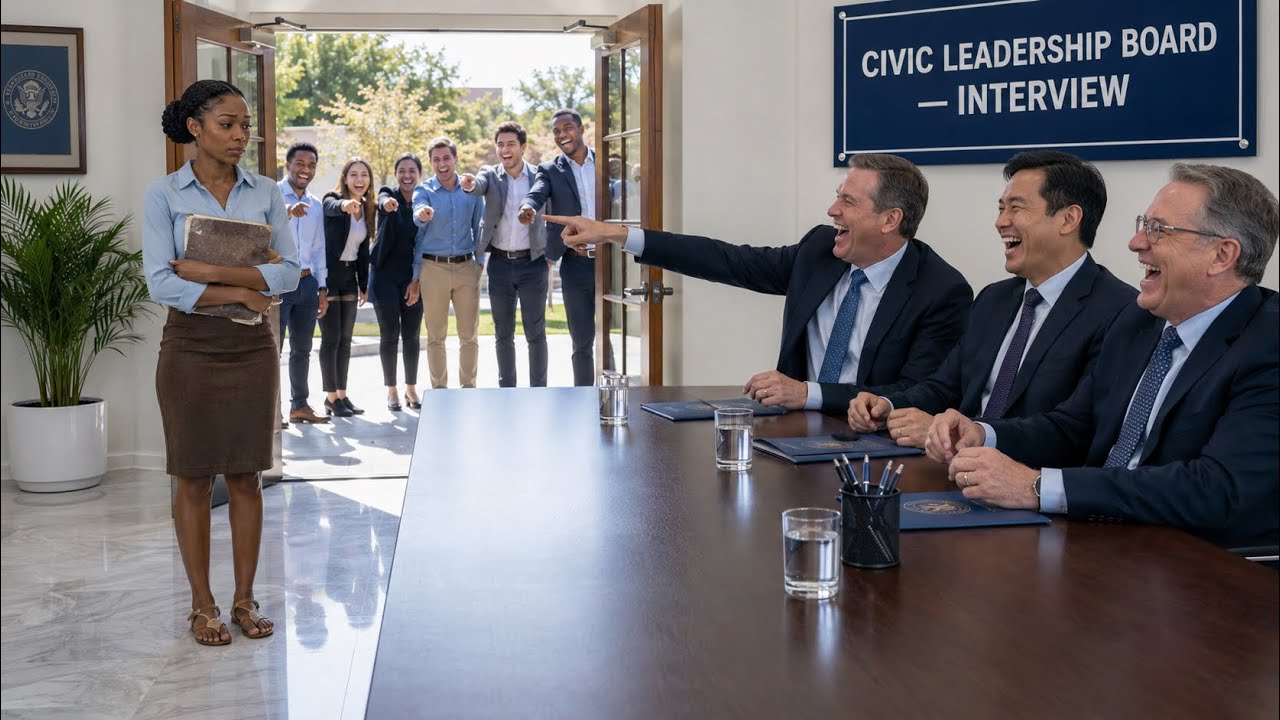
“The Civic Leadership Board interview, sir. Nine o’clock. ”
He let out a laugh that scraped against my skin.
“You? Look at those shoes. One strap’s held on with string. You sure you’re not lost?
”
His partner joined in, a low chuckle that bounced off the lobby walls. I didn’t answer. I just looked straight ahead, the way my mom taught me. Chin up.
Eyes forward. Don’t let them see you flinch. The guard checked the clipboard, scowling like he hoped my name wouldn’t be there. It was.
“Fine. Wait inside. ”
He didn’t say sorry. He didn’t even look at me again.
I walked into the lobby, and behind me, I heard them laughing. “Straight from a warehouse shift to a government interview,” one of them muttered. “This board’s about to waste ten minutes. ”
A girl sitting near the window glanced up from her tablet.
She took in my torn strap, my secondhand blouse, the cheap bag I’d clutched for the entire bus ride. Without a word, she slid her chair a few inches farther away, like my presence might contaminate her. I noticed. I said nothing.
I sat down in an empty seat and folded my hands in my lap so they’d stop trembling. A clock above the door ticked toward nine. Somewhere behind that door, a panel of strangers was about to decide whether all the years of studying by flashlight had meant anything at all. Nobody in that hallway knew where I’d come from.
Nobody knew what it took just to be sitting in that chair. Six hours earlier, my mother had been shaking me awake before sunrise. Her hands were thin, her fingers cool against my shoulder. “Kinsley, baby, the bus won’t wait.
”
“Coming, Mom. ”
She pressed a small roll of bills into my palm. I looked down at the crumpled dollars, my throat tightening. “Mom, no.
That’s your medicine money. ”
“My medicine can wait a week. Your dream can’t. ”
“I’m going to fix everything for you one day.
I promise. ”
She smiled, and the smile reached her eyes in a way it hadn’t in months. “I don’t need fixing, baby. I need people to see you the way I see you.
”
She touched my cheek, her hand cool and thin against my skin. “Go. God’s got you. ”
I paused at the door, one strap of my sandal already loose against my heel.
“What if they laugh at me the second I walk in? ”
“Then you let them laugh. Laughing costs them nothing. Walking through that door costs you everything you’ve got.
Don’t let them win before you’ve even started. ”
I nodded, kissed her forehead, and stepped out into the gray morning before the sun had fully cleared the tree line. The bus driver barely slowed down when he saw me waving. The doors wheezed open.
“Get on. Get on, we’re already late. ”
“One ticket to the city,” I said, counting out crumpled dollars from the roll my mother had pressed into my palm. An older woman across the aisle leaned over.
Her eyes flicked over my clothes, my bag, my patched sandal. “Where you headed, sweetheart? ”
“Government interview. Civic Leadership Board.
”
She snorted. “Everybody wants to be somebody these days. ”
A few riders chuckled. I felt heat creep up my neck, but I kept my eyes on the window.
“Don’t you listen to them,” the bus driver called back without turning around. “I won’t,” I said, but I gripped my bag a little tighter anyway. The bus rattled over a pothole, and my folder of practice notes slid onto the floor. I scooped the pages back together, smoothing out a bent corner.
On one page, in my own handwriting from three weeks earlier, I’d written: *People aren’t their circumstances. Say that if they ask you anything about being poor. *
I hadn’t known yet how soon I’d need those exact words. Outside the window, the fields gave way to gas stations, then storefronts, then the first traffic light I’d seen in months.
The city always felt like a different country. Taller. Faster. Colder.
I checked the time on a stranger’s phone over the aisle. Twenty minutes until my slot. My stomach dropped. The bus was still fifteen minutes from downtown.
Off the bus, two blocks from the building, my sandal strap tore clean through. I heard the snap, felt the sudden looseness around my heel. I looked down. The string I’d used to patch it had finally given out.
I kept walking anyway. One shoe flopping with every step. Sweat soaking through my only good blouse. My heart hammering against my ribs.
A woman near a coffee cart caught me stumbling. She was older, maybe fifty, with kind eyes and a hand that shot out to steady me. “Whoa, you okay, honey? ”
“Fine, ma’am.
Strap just broke. ”
“Where are you trying to get to looking like that’s the least of your problems? ”
“The Civic Leadership Board. Interview room four.
”
She studied me for a second too long. Then she reached down and pulled off her own sandals. “Put these on. ”
“I can’t.
I don’t have money to pay you back. ”
“I’m not selling them. Today. Just let me be your big sister.
”
She pressed them into my hands. They were plain, brown leather, worn at the edges. Still better than anything I’d worn in years. “Promise me something instead.
”
“Anything. ”
“When you’re the one with power one day, help somebody the way nobody expected to be helped. ”
I looked down at the sandals in my hands. My eyes stung.
“I promise. ”
“What’s your name? ” I asked. “So I can thank you properly.
”
“Names don’t matter right now. Just remember. People aren’t their shoes. ”
She smiled and walked off before I could ask again.
I never got the name. I never forgot the sandals. “Candidate Kinsley, please come in. ”
A man’s voice called from the interview room.
I stepped in. Chin up. Torn strap hidden in my bag. Borrowed sandals steady beneath me.
The room was all dark wood and tall windows. Five faces at a long table. They looked up as I entered, and I saw them notice the same things the guards had noticed. The worn blouse.
The secondhand bag. The sandals that didn’t quite fit. “Tell us about yourself. ”
“My name is Kinsley Marsh.
I’m from Caldwell Hollow. A small town most maps don’t bother labeling. ”
“Why public service? ”
“Because I’ve watched people get ignored my whole life.
I want to be the reason somebody isn’t ignored anymore. ”
A woman at the end of the table raised an eyebrow. “If the rules and someone’s suffering ever collide, what do you choose? ”
“I follow the rule that protects people, and I fight to change the rule that doesn’t.
”
The panel exchanged a glance. One of them almost smiled. “What’s the biggest lesson your life has taught you? ”
“That people don’t tell you who they are with their clothes.
They tell you with what they do when nobody’s forcing them to. ”
One panelist leaned forward, testing me. “And if we told you right now that a candidate with better shoes and a better resume was sitting outside waiting to take your spot the moment you gave a wrong answer, would that change anything you just said? ”
“No, sir.
It would just prove my point twice. ”
The room went quiet for a second. Then the same panelist almost smiled and made a note on his pad. “That will be all, Kinsley.
Thank you. ”
“Thank you, sir. Thank you, ma’am. ”
I walked out on legs that felt like jelly.
Outside the room, I heard one board member murmur to another: “That girl has more steel in her than half the candidates we saw all week. ”
I walked out light-headed with relief and starving. I hadn’t eaten since the day before. Counting coins in my pocket, I found fifteen dollars left after the bus fare home.
I stopped at a roadside coffee stand. “Just a coffee, please, ma’am. ”
“Here you go, sweetheart. ”
The first sip brought tears to my eyes.
I thought of my mother, who hadn’t eaten that morning either, just so I could have bus fare. “That’ll be two dollars. ”
“Actually, keep it. ” The woman waved off the coins.
“You’ve got the look of somebody who’s earned more than a free coffee. ”
I didn’t argue. I just squeezed her hand and walked toward the bus stop, carrying a stranger’s kindness like a second set of borrowed shoes. Back in Caldwell Hollow, my mother was waiting on the porch.
The porch light was on, even though the sun had fully risen. She had a blanket over her lap, and her shoulders looked smaller than they had when I left. “How’d it go, baby? ”
I sat down next to her, close enough to feel her warmth.
“I gave it everything I had, Mom. Now we wait. ”
“You’ll do fine. I already feel it.
”
A neighbor across the road was sweeping her porch. She paused, looked over, and muttered just loud enough to carry: “Guess she thinks she’s already somebody important. Poor as dirt and dreaming big. ”
I said nothing.
I just smiled, took my mother’s hand, and walked inside like the words hadn’t landed at all. They had. The next morning, life snapped back into its old shape. I returned to the one-room schoolhouse where I tutored the neighborhood kids for almost nothing.
“Remember,” I told them, pointing at the chalkboard. “Hard work and honesty are worth more than anything money can buy. ”
“I’m going to be a big shot government officer, too, one day. ” A small boy named Elias puffed out his chest.
“Just like you’re going to be. ”
I smiled at him. “That’s the spirit, Elias. ”
Then I heard a cough from the back room.
It was my mother. She’d come to bring me lunch. “Mom, you okay? ”
“Just a tickle in my throat, baby.
”
But it wasn’t just a tickle. Night after night, the cough deepened. It rattled through the thin walls of our house, keeping me awake long after she’d fallen asleep. I’d lie in bed, staring at the ceiling, listening to each breath, counting the seconds between coughs.
Until one night, the cough brought blood to her lips. I didn’t sleep that night. By morning, I had her at the county clinic. “Easy, Mom.
Just breathe. ”
She squeezed my hand but said nothing. Her eyes were closed, her face pale. The doctors had a name for what was wrong, but I couldn’t focus on the words.
I only heard the ones that mattered: *needs medication immediately. *
“That’ll be three thousand, eight hundred fifty dollars for the full round of medication,” the pharmacist said flatly, sliding a piece of paper across the counter. I stared at the number. “Can I take part of it now and pay the rest later?
”
“I’m sorry, ma’am. It’s all or nothing. Partial treatment could make things worse. ”
“Please,” I said, my voice cracking.
“Just give me enough to get her through tonight. I’ll bring the rest by Friday. I swear it. ”
“I wish I could, ma’am.
It’s policy. Half a treatment can do more damage than none at all. ”
I left the counter with empty hands and a heart that felt like it had been kicked. My mother was propped up on a gurney in the hallway, too weak to ask what had happened.
And I couldn’t make myself say the words out loud. I couldn’t get it. Not tonight. That night, back home, I sat on the floor of my room with my mother’s ragged breathing carrying through the thin wall.
And I made a decision I couldn’t undo. I opened an old tin box I hadn’t touched in years. Inside, wrapped in a faded handkerchief, were the only things of value I owned: a silver anklet from my childhood and a small ring my mother had given me on my tenth birthday. “You want to sell these?
” the pawn shop owner asked the next morning, turning them over in his calloused hands. “Yes, sir. Whatever they’re worth. ”
I walked out with cash and the full price of the medication in my pocket.
I didn’t cry on the walk home. I couldn’t afford to. I had no piece of my childhood left to hold on to, except the promise I’d made to a stranger in borrowed sandals. Word spread through Caldwell Hollow that the shoe girl had actually interviewed for a federal leadership post.
Some still snickered. Others started showing up at my door with quiet respect, including my old teacher, Mr. Boone. “Whatever the result, Kinsley,” he said, standing on my porch with his hat in his hands, “you’ve already given the girls in this town permission to dream bigger.
”
I hugged him, and for the first time in days, I let myself believe it might be true. Two weeks crawled by. Every morning I watched the road for the mail truck that would carry my whole future. It finally came.
A government envelope, sealed and official, addressed to me. My hands shook so hard I nearly tore the letter along with the flap. “What is it, baby? ” my mother asked from the porch chair.
I read the first line. Then the second. My breath caught. “Mom.
” I looked up at her, and I was crying before I even finished the sentence. “I made it. I’m in. Civic Leadership Board.
Accepted. ”
The news moved through Caldwell Hollow faster than a wildfire. Neighbors who once mocked my torn sandals now stood outside my door, heads bowed. “We’re sorry, Kinsley,” one of them said, the same woman who’d called me poor as dirt.
“We had no right to talk about you that way. ”
“I don’t hold it against any of you,” I said. And I meant it. But then I reached the bottom of the letter, and my smile faltered.
I had thirty days to report to the National Service Academy in Asheville, hundreds of miles away, for training. Between my mother’s ongoing treatment and a family with nothing left to sell, the trip might as well have been to the moon. But something in Caldwell Hollow had shifted. The same neighbors who doubted me started showing up with what little they had.
“This is a train ticket to Asheville. Take it. ”
“I can’t accept. ”
“You can and you will.
”
An older woman held out a folded bag, refusing to let me wave it off. “These clothes are for you, for the academy. You’ll walk into that place looking like you belong, because you do. ”
A man I barely knew pressed an envelope into my hands, his own eyes wet.
“This is for your mother’s treatment. It isn’t much, but it’s ours to give. ”
Even the neighbor who’d once called me poor as dirt showed up on the porch with a covered dish and nothing to say for herself but: “I was wrong about you. I’m sorry it took this long to admit it.
”
I looked at the dish in her hands, the same hands that had held a broom while she muttered cruel words across the road. I took it. “You never let me feel alone,” I said, my voice breaking. “I won’t forget any of this.
”
The day I left for Asheville, half the town lined the road to see me off. “Make this whole town proud,” Mr. Boone said, gripping my hand. “I won’t let this town down, not ever.
I’ll come back. ”
I turned to my mother, holding her hand at the bus door. “I promise. ”
“We’ll be right here waiting,” she whispered.
The bus pulled away, and I watched her figure grow smaller in the window until she was just a dot on the horizon. “Please introduce yourself,” the instructor said on my first day at the academy. I stood up, facing a hall of strangers. Recruits in crisp uniforms, sharp posture, confident smiles.
“My name is Kinsley Marsh. I’m from a small town most people have never heard of. ”
A senior officer addressed the room. “Remember,” he said, pacing the front of the hall.
“A true public servant isn’t defined by their title. They’re defined by their service. ”
The dorm rooms at the academy were nothing like Caldwell Hollow. Sharp corners, cold marble floors, recruits who name-dropped colleges I’d only read about in brochures.
That first night, I lay awake listening to two roommates compare which prep courses their parents had paid for. “My mother hired a private tutor for the entrance exam. ”
“Mine sent me to a three-week summer intensive in Boston. ”
Neither of them noticed the girl in the third bed who’d gotten there without any of it.
One by one, new recruits introduced themselves throughout the week. When it was my turn again, I spoke without notes. “My name is Kinsley Marsh. My father passed when I was young.
My mother cleaned houses so I could stay in school. I went through public school and a community college with no private tutoring, and I got here through work, not connections. ”
Applause rippled through the hall. “Now tell us,” the instructor said, leaning forward.
“What’s the biggest problem in towns like yours, and how would you fix it? ”
I took a breath. “The biggest problem isn’t laziness. It’s that opportunity never shows up.
If real schools, real clinics, and real support actually reached small towns, no town would be left behind. Poor people don’t need pity. They need a fair shot. ”
“Well said, Kinsley.
That’s the mindset of someone ready to lead. ”
That night, alone in my dorm room reviewing the next day’s material, my phone rang. It was Mr. Boone.
“Kinsley, I need to tell you something. It’s not good. ”
I gripped the phone. “What’s wrong?
”
“Your mother’s condition took a turn. The doctors say you need to come home. ”
“Now? ”
“As soon as you can.
”
The next morning, I stood in front of my commanding officer, my voice steady even though my hands were shaking. “My mother is seriously ill. I need emergency leave immediately. ”
“Go.
Your mother matters more than anything on this schedule. Leave is granted effective now. ”
“Thank you. Please, just keep her safe until I get there.
”
By morning, I was standing in the ICU at the county hospital. My mother was barely conscious, tubes running everywhere. Her face was pale, her hands thin against the white sheets. “You made it,” she whispered.
“I’m here, Mom. Don’t leave me. I still need you. ”
Her grip tightened, then loosened.
The machines around her began to scream. Doctors rushed in. Nurses pushed me into the hallway. I waited, forehead against the cold wall, praying without words.
I didn’t know how to pray anymore. I just pressed my head against the paint and begged whatever was listening to not take her. The doctor came out. His face said it before his mouth did.
“I’m so sorry. She’s gone. ”
“No. ” The word came out hollow.
“She can’t be gone. She can’t leave me like this. ”
The neighbor who used to mock me showed up at the hospital that same hour. For the first time, she didn’t have a single sharp word.
“You’re not alone anymore, baby,” she said, wrapping her arms around me. “This whole town has you now. ”
I don’t remember how long I stood there. I don’t remember what I said.
I only remember the weight of her arms around me, and the sound of my own breath catching. The funeral was small. Half the town showed up anyway, standing quiet in a line that stretched past the gate. The same people who used to whisper about torn sandals now stood with their heads bowed.
I didn’t cry in front of them. I saved that for the bus ride back, forehead pressed to the cold window glass, watching Caldwell Hollow shrink into the distance. I buried her in Caldwell Hollow, then boarded the bus back to Asheville, because my mother’s last words had been a command, not a request. Keep going.
“Welcome back,” the academy director said when I returned. “We trust you’ll finish your training with everything you’ve got. ”
“Yes, sir. I’ll finish this for her.
”
He nodded slowly. “A true public servant is defined by service, not title. I understand, sir. I won’t waste this chance.
”
Months later, I stood on a stage in my graduation uniform as my name was called for the highest honor of my class. The same roommates who’d once compared prep course price tags stood and clapped along with everyone else, because by then, nobody in that hall doubted what I’d earned. In that moment, I saw my mother’s face, smiling the way she used to smile from the porch. “This one’s for you, Mom.
”
I didn’t cry until I was back in my dorm room alone, holding a folded photograph of the two of us from years before either of us had anything worth losing. My first posting came just weeks later. District administrator, assigned to my own home county. The government car rolled into Caldwell Hollow, and the whole road was lined with people waiting to see me.
Kids on their parents’ shoulders. Old classmates who used to walk past me on the other side of the street. The very guards from the interview building were nowhere near, but their laughter felt like it belonged to a different lifetime now. I walked first to my mother’s grave.
I lit a candle and stood there a long moment, the sound of the crowd behind me fading into something distant and unimportant. Everything I am, I owe to you. Then I went to the schoolhouse where I used to teach for almost nothing. “Welcome, Administrator Marsh.
”
I walked the halls where I used to sit on a broken chair to teach kids their letters for almost no pay. I ran my hand along a water-stained ceiling tile that had been leaking since before I’d even sat for the interview. “How long has this been like this? ” I asked the principal.
“Years, ma’am. There was never enough in the budget. ”
“There’s enough now. Send me the full list of everything this building needs.
All of it. ”
At the clinic, I gave the same order. “I don’t want a single family in this county turned away because they can’t pay up front. Fix that today.
”
“Understood, Administrator. We’ll have it sorted by this afternoon. ”
I stopped at the same pharmacy counter where years earlier I’d been told it was all or nothing. The pharmacist behind the register didn’t recognize me.
I didn’t remind him. I just made sure the new policy went into effect before I left the building. An older woman approached me outside the clinic. I recognized her instantly.
The pharmacist’s neighbor who’d once brought me coffee after my interview. “You remember me? ” she asked. “I never forgot you.
Or your coffee. ”
“I always knew you’d go far, sweetheart. ”
Later that same week, a familiar face turned up at a town meeting. The woman from the city sidewalk.
The one who’d handed over her own sandals without a second thought. “You’re the one who saved my interview that day,” I said, stunned, rising halfway out of my chair. “I had a feeling about you,” she said, laughing at my reaction. “I just didn’t expect far to mean this far.
”
“I looked for you for months after that day. I never even got your name. ”
“Then let’s fix that. ” She held out her hand properly this time.
“Marisol. ”
I took it. “Your kindness carried me farther than you’ll ever know, Marisol. ”
“You kept your promise,” she said.
“That’s more than most people manage. ”
She nodded toward the room full of county staff waiting on my next order. “Now go keep it for somebody else. ”
Caldwell Hollow began to change.
A repaired school roof. A clinic that turned no one away. A county government that finally looked people in the eye. The boy who once bragged he’d grow up to be a big shot officer was in the front row the day I cut the ribbon on the new clinic wing, grinning like he’d been right all along.
Word of the shoe girl turned administrator spread beyond the county line, then beyond the state. Reporters came asking for interviews. I gave most of them the same answer, no matter how the question was phrased: the county didn’t need a hero, it needed people who kept their promises. Then I’d go back to work, because promises, I’d learned, weren’t kept with speeches.
They were kept with roofs that didn’t leak and clinics that didn’t turn families away. If people ask what changed everything for Kinsley Marsh, the answer isn’t the interview or the badge or the title. It’s a torn strap, a stranger’s sandals, and a promise made on a sidewalk two blocks from a room that almost didn’t let me in. Ask the guards who once laughed at me if you can even find them now.
Most of them don’t tell that story anymore. Nobody’s future fits in the shoes they walked in wearing.