The telegram arrived in the spring of 1943, and with it came an inheritance no one would have chosen. Admiral Mineichi Koga was summoned to Tokyo to replace Isoroku Yamamoto as commander-in-chief of the Combined Fleet, the supreme position in the Imperial Japanese Navy. The timing felt almost cruel. Yamamoto had been killed in an American ambush over Bougainville, his bomber shot down by P-38 fighters that had been guided by intercepted radio traffic.
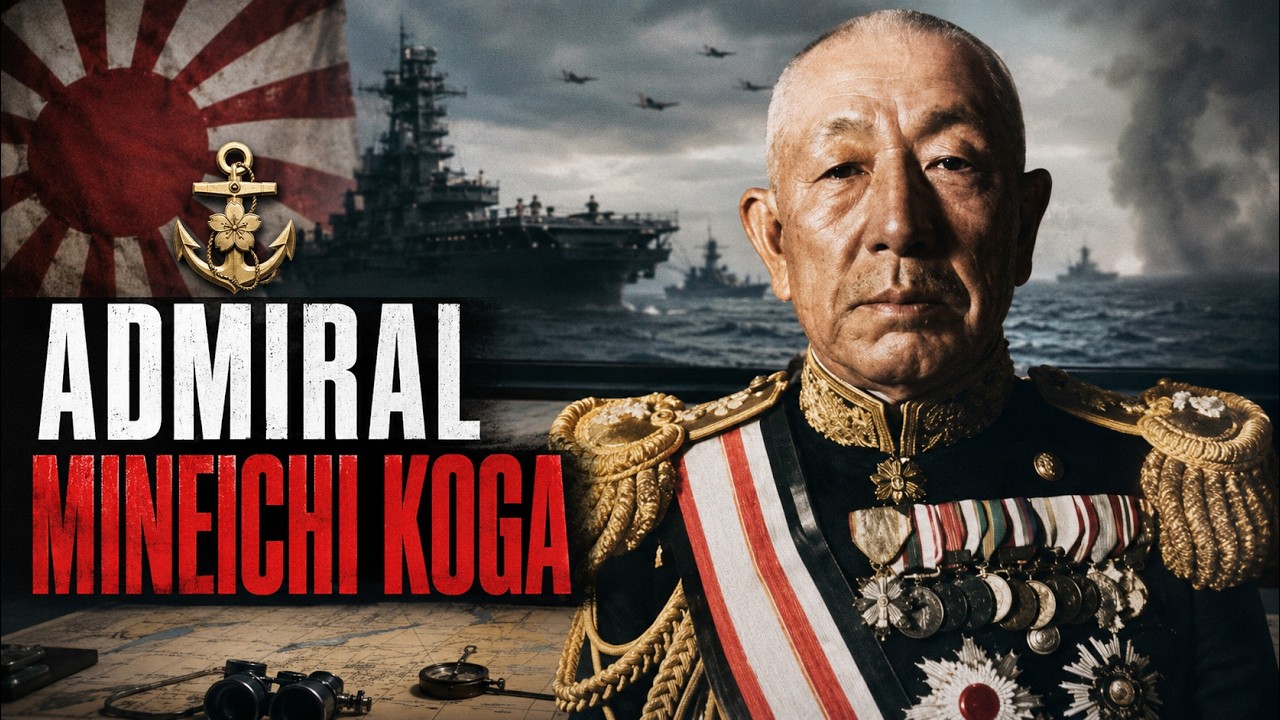
The ceremony was subdued. There were no grand celebrations, no public reassurances for a nation that desperately needed them. Koga understood, as every senior officer understood by that spring, that the moment of Japanese naval ascendancy had passed. The victories at Pearl Harbor and across the Pacific now belonged to another era.
What remained was a fleet in the process of being systematically dismantled by forces that grew stronger each month. The Navy had lost not only Yamamoto but, more importantly, the steady attrition of ships and trained pilots across a Pacific that had become an American lake. At Midway, four irreplaceable fleet carriers had gone to the bottom along with the vast majority of their air crews. Men who could not simply be replaced the way steel hulls could.
The psychological shock of those battles had never fully lifted. Koga was born in 1885 in Saga Prefecture on the island of Kyushu, into a family of samurai descent. Though the samurai class had officially ceased to exist by the time of his birth, the values of that warrior aristocracy, duty, discipline, honor, remained woven deep into his upbringing. His father had held rank in the old order.
The family understood that service to the state was the highest calling, and that a man’s worth was measured by how faithfully he served his larger purpose. As a young man, Koga entered the Naval Academy at Etajima, an isolated island institution in the Inland Sea designed to transform provincial youths into officers of the empire. The routine was methodical and punishing. Days began before dawn, cadets standing in formation while instructors examined uniforms for any deviation.
The curriculum blended two worldviews: the classical military education inherited from samurai traditions, and the relentlessly technical knowledge required to command modern warships. Koga studied mathematics, gunnery calculations, navigation, and the architecture of steel ships. He absorbed both traditions with equal seriousness. His first posting came in 1907 aboard the cruiser Kasuga, a vessel that had already seen action in the Russo-Japanese War.
Here began the true apprenticeship. He learned gunnery and navigation, the rhythm of watches, the unspoken hierarchies aboard a warship. Over the next decade and a half, he moved through a succession of vessels. Gunnery became his specialty, a discipline that demanded exactitude and patient refinement of technique.
By the early 1920s, Koga had developed a reputation not as a brilliant or flamboyant officer, but as something perhaps more valuable in a professional navy: methodical competence that could be depended upon. During the 1920s and into the early 1930s, Koga was assigned to positions that required him to observe and analyze foreign navies. He spent time with the British Royal Navy and observed the United States Navy, which was modernizing with remarkable speed and confidence. He carried these observations with him like ballast.
He understood something his more aggressive contemporaries did not fully embrace: that if Japan went to war with the Western powers, it would be fighting not merely their navies but their economies, their industries, their vast reserves of trained manpower. The Japanese Navy of those decades was caught between two competing philosophies. The battleship faction believed that naval supremacy meant battleship supremacy, and that victory would come through a great decisive engagement. The aviation pioneers argued that aircraft carriers represented the future.
Koga moved through this environment with characteristic caution, occupying a middle position, respected by both sides, fully committed to neither. He rose to Rear Admiral in 1934, then continued his careful ascent. By the late 1930s, Koga found himself commanding the China Area Fleet. It was not a posting for the sort of officer who dreamed of decisive fleet battles.
It was a scattered dominion of smaller vessels tasked with keeping supply lines open, maintaining order across occupied harbors, and presenting a constant presence in contested waters. Koga approached it with the same careful attention he brought to everything. He rationalized supply lines, maintained his ships at high standards of readiness, and learned the grinding reality of holding what had been conquered. When Japan struck Pearl Harbor in December 1941, Koga was commanding the China Area Fleet, removed from the immediate thunder of the great sea battles.
He watched the early victories unfold with a kind of quiet unease. The Japanese press spoke of the Greater East Asia Co-Prosperity Sphere as though it were an accomplished fact. Yet Koga, trained by decades of careful observation, could see certain uncomfortable truths. American industrial capacity was untouched.
American resolve, far from shattering, seemed to be hardening. The capture of vast territories meant Japan now had to garrison, protect, and supply them, obligations that grew heavier each month. The Battle of Midway in June 1942 shattered the myth of Japanese naval invincibility. Four carriers lost.
Thousands of experienced pilots gone. The Japanese pilot training program operated on the philosophy that the most skilled aviators should remain in combat until killed, meaning each loss was a repository of irreplaceable experience. The Americans, by contrast, rotated their skilled pilots home to train new generations. The mathematics of this difference would compound relentlessly.
By the time Koga assumed command of the Combined Fleet, Japan’s strategic situation had deteriorated beyond repair. The pilot corps was largely gone, replaced by younger men with abbreviated training. The shipyards could not replace losses at the rate the Americans were producing vessels. The defensive perimeter that was supposed to be impregnable was contracting almost visibly.
American invasions had pushed north from Guadalcanal. The Australians and Americans were pressing through New Guinea. Koga moved his headquarters to Truk Lagoon in the central Pacific. The anchorage, ringed by coral islands, had become something between a fortress and a tomb.
He understood with crystalline clarity that his primary mission was no longer to win but to endure. To preserve every remaining ounce of steel and fuel and human resolve across an ocean that grew wider with each passing month. The work was unglamorous. There were fuel manifests and damage assessments, calculations about how many ships could be kept seaworthy, decisions about which vessels would be preserved and which left to rot.
Fuel oil became the limiting factor in virtually every decision. To conduct a full-scale fleet operation meant burning through months of reserves in weeks. To remain at anchor meant stretching those supplies across seasons. Koga chose conservation, knowing that some in Tokyo and the fleet itself might interpret this as timidity.
But Koga had spent too many years thinking about naval strategy to confuse gesture with substance. There was no substance to a fleet that could fight for only a few weeks before running out of fuel. The daily life at Truk was shaped by relentless heat and growing scarcity. Food quality degraded.
Fresh vegetables arrived rarely. The men developed the hollow-eyed appearance of those subsisting on rations that sustained life but not vigor. Engineers below decks existed in a fundamentally different temperature regime. Officers and enlisted men waited, knowing danger was approaching but not knowing precisely when it would arrive.
Some men carved small items from wood. Others simply sat and conserved energy. In battle there was clarity. In the waiting at Truk, there was only the knowledge that the American offensive was building beyond the horizon.
In response to the deteriorating situation, Koga and his planning staff formulated what became known as Plan Z. The idea was to establish defensive lines in the Pacific, each constituted by strong naval forces positioned so that an attacking American fleet would be forced to fight under less favorable conditions. The plan echoed the older doctrine of the decisive battle, but with the crucial difference that it would take place under far less advantageous circumstances. Koga understood that the implementation of Plan Z depended on factors increasingly beyond Japan’s control.
It required American commanders to advance along predictable routes. It required communication across enormous distances. It required supply lines that continued to function even as American submarines chipped away at them with relentless persistence. By the autumn of 1943, the war had ground toward its own terrible logic.
The Americans were not trying to win one decisive battle but to accumulate advantages, pushing forward yard by yard, securing airfields and supply depots. The news from various sectors grew progressively grimmer. Islands that had been thought securely held fell to American assault. Supply ships bound for forward outposts failed to arrive.
On the morning of March 31st, 1944, Koga made the decision to relocate his headquarters to Palau, further south and west, as American forces pressed closer to Truk. Two Kawanishi H8K flying boats were prepared for the journey. Koga would travel in one, his chief of staff in the other. Both planes lifted from the calm waters of Truk Lagoon in the early hours, heading southwest.
They had a journey of perhaps three hours across open ocean under a sky that seemed to promise fair weather. But the weather turned. A sudden and violent storm materialized with little warning. The clouds darkened.
Rain swept across the wings. The pilots radioed back to Truk reporting difficult conditions but pressing forward. Koga’s aircraft simply vanished from communication. The trailing aircraft struggled through the turbulence and eventually broke through to clearer weather, managing to complete the journey to Palau.
But Koga’s flying boat never arrived. Hours passed. Search vessels were dispatched, fanning out across the waters where the aircraft should have been flying. The sea was empty.
Day after day, the searches continued, scanning for debris, for wreckage, for any sign of the admiral and his crew. Nothing surfaced. The storm had simply taken them. News of the disappearance rippled through the Japanese fleet with peculiar gravity.
Yamamoto had been ambushed, his aircraft shot down by American fighters, a dramatic end befitting his stature. Koga vanished without drama, without enemy action, simply lost to the sea and the sky. The question that has haunted historians for eight decades is whether his disappearance was truly an accident. Some sources suggested the aircraft had been intercepted by American fighters.
Others whispered of internal factional rivalries within the Japanese military. These theories have persisted, impossible to confirm, equally impossible to entirely dismiss. What we know with certainty is this: the storm was real, the radio messages reporting difficult conditions have been documented, and the aircraft did not arrive at Palau. His replacement was named within days, Admiral Soemu Toyoda, who inherited the same weakened fleet, the same impossible strategic situation.
Koga’s papers were recovered eventually, providing insights into his thinking in those final months, his growing awareness of the Navy’s deteriorating position, his attempts to construct some kind of unified strategy against an American offensive that gathered strength each month. But Koga himself remained suspended in that March morning, in that storm, in the moment when two flying boats lifted from Truk Lagoon, and one of them simply failed to emerge into whatever sky lay beyond the clouds. Why is Koga forgotten while Yamamoto lives in memory? The answer is simpler and more melancholy than we might wish.
Yamamoto died at the moment of Japan’s shift from hope to fear, when his death could be cast as tragedy in a war Japan still imagined it might win. Koga fell from the sky in an ordinary squall at a moment when the outcome was no longer ambiguous to anyone paying close attention. There is no romance in becoming a casualty when defeat has already begun to seem inevitable. Yamamoto’s death was witnessed and recorded, with photographs and reports and medals awarded to the American pilots who killed him.
His death could be told with clarity and closure. Koga’s death was reported but never truly confirmed with satisfying finality. He may have died in a storm. He may have been captured.
Some whispered even then that he had survived. And Yamamoto left behind his famous warning about waking a sleeping giant, a quotable prophecy that crystallized his foresight. Koga was methodical, conservative, competent. He did not issue prophecies.
His value lay in his steadiness, his effort to preserve what could be preserved, his acceptance of an untenable position and his attempt to manage it with dignity. These are admirable qualities. But they do not make for memorable history. We tend to remember the dramatic and the doomed, not the merely competent in the face of inevitable defeat.
History does not linger long over deaths that alter nothing. Koga died at the moment when death had begun to seem ordinary, and the war had moved on before he left it. He was steady and reasonable in an era remembered for its extremes, and there was room in the historical imagination for only one great Japanese admiral. The Pacific stretches on, much as it always has.
The waves that once carried the ships under Koga’s command continue to move with ancient rhythms. The storms that swept his aircraft into the sea and into history’s margins still rise and fall according to laws that care nothing for human rank. Somewhere in the vast archipelago of forgotten figures, Mineichi Koga remains. A man who lived and worked and died in service to something he believed in.
Even when the weight of evidence suggested that the cause he served was in its final declining hours, he remained at his post. He did his duty. He accepted what came. In the end, there is a kind of nobility in this that requires no embellishment.
It is the nobility of the ordinary professional, the person who masters their craft and performs their function without needing to be mythologized in order to matter. History may not remember his name. But the work he did, the steadiness he brought to an impossible position, the decency he extended to those under his command, these things existed. They mattered to the people who lived through them.
And in their mattering, they leave a kind of echo that reverberates even now. Some things matter in the spaces between the noise of history, in the stillness of focused effort and genuine duty. Some things matter most precisely because they ask for nothing in return but the simple fact of having been.