The Dark Shadow Behind Germany’s Most Decorated Pilot: The Rise, Fall, and Hidden Legacy of Hans-Ulrich Rudel
The world remembered him as a legend.
A pilot who flew into storms of steel and fire.
A man who returned from impossible missions with his aircraft damaged, his body wounded, and his enemies destroyed.
Hans-Ulrich Rudel was the most decorated German pilot of World War II. His name became almost mythical inside Nazi Germany. He was credited with destroying hundreds of Soviet tanks, attacking heavily defended positions, and surviving thousands of combat missions when many others never returned from their first.
To his supporters, he was the ultimate warrior.
To his critics, he was something far more complicated: a brilliant soldier who never abandoned the ideology that had created the war.
And decades after the guns fell silent, a disturbing truth emerged.
The man celebrated as a military hero had spent much of his life defending the very regime responsible for one of history’s greatest crimes.
His story is not simply about bravery.
It is about loyalty.
Ambition.
Power.
And the dangerous question that history keeps forcing humanity to answer:
What happens when extraordinary talent serves a destructive cause?
Hans-Ulrich Rudel was born on July 2, 1916, in Konradswaldau, Germany, during a period when the country was still recovering from the trauma of World War I.
As a young man, Rudel was not immediately recognized as a future military icon.
He was quiet.
Disciplined.
Obsessed with physical endurance.
But he was also stubborn.
His instructors often criticized him for lacking the qualities expected of an elite pilot. Early in his flying career, some believed he was too rigid and too independent to become a successful combat aviator.
Flying was not just about courage.
It required judgment.
Speed.
The ability to make decisions in seconds.
Rudel struggled with some of these aspects.
But what he lacked in natural talent, he replaced with relentless determination.
He trained harder.
He pushed himself further.
He refused to accept failure.
When World War II began in 1939, Germany’s military machine appeared unstoppable. The Luftwaffe dominated the skies over Poland and Western Europe, and thousands of young German pilots believed they were part of a historic mission.
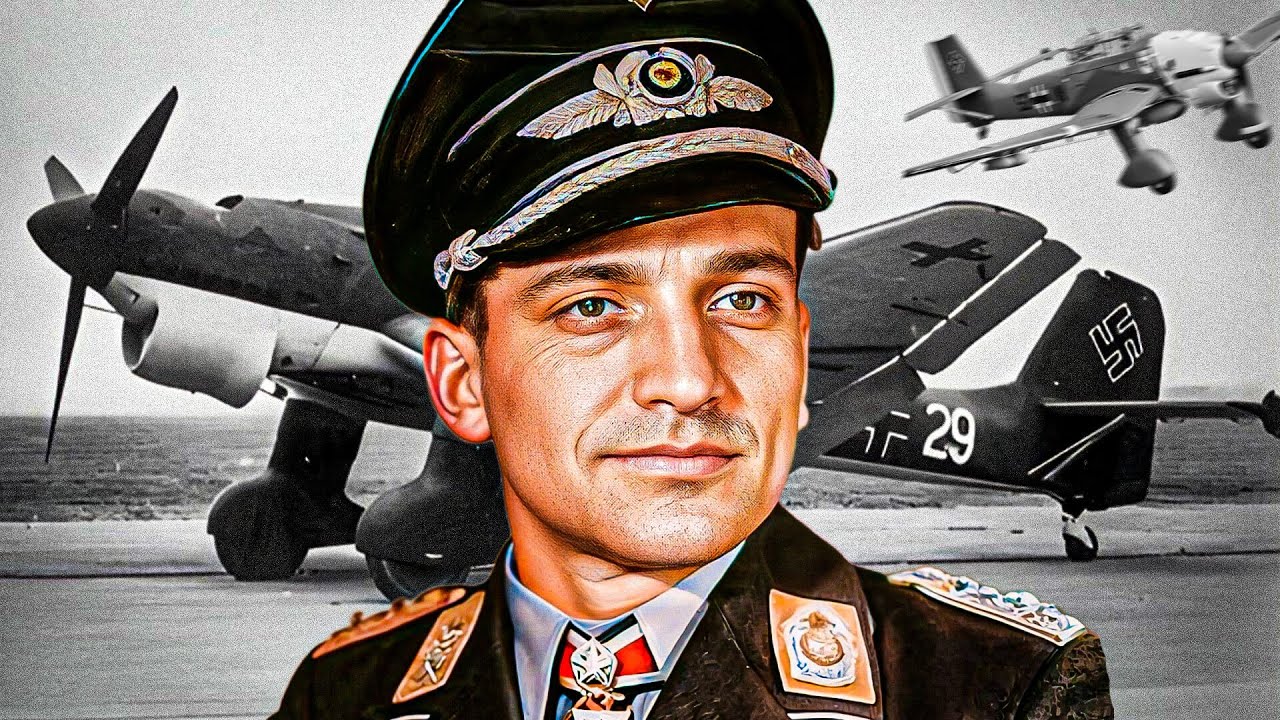
Rudel joined the Luftwaffe and eventually became a pilot of the Junkers Ju 87 Stuka dive bomber.
The aircraft was slow compared with many fighters, but terrifyingly effective in ground attacks.
When it entered a dive, its sirens created a horrifying sound that became one of the symbols of Germany’s early victories.
The Stuka was not designed to fight for glory.
It was designed to destroy.
And Rudel quickly discovered he had a unique ability.
He could attack targets with incredible precision.
In June 1941, Germany launched Operation Barbarossa, the invasion of the Soviet Union.
It was one of the largest military operations in history.
Millions of soldiers crossed into Soviet territory.
Behind them came destruction on an unimaginable scale.
For Rudel, the Eastern Front became the battlefield where his reputation would be created.
His missions were brutal.
He flew through anti-aircraft fire.
He attacked armored columns.
He targeted supply routes and military positions.
According to German military records, Rudel was credited with destroying more than 500 tanks, hundreds of vehicles, and numerous artillery positions.
One of his most famous claims was the sinking of the Soviet battleship Marat during a Stuka attack on Leningrad.
The mission transformed him into a national symbol.
German newspapers celebrated him.
Propaganda officials recognized his value.
The Nazi government needed heroes.
Rudel became one.
In 1941, he received the Knight’s Cross of the Iron Cross.
Later, he received additional decorations that eventually made him the only person awarded the Knight’s Cross with Golden Oak Leaves, Swords, and Diamonds.
No other German serviceman received that exact honor.
Inside Nazi Germany, Rudel was presented as the perfect example of loyalty and sacrifice.
But behind the medals was another reality.
The war he participated in was not simply a conventional conflict between armies.
It was a war of conquest and ideology.
The invasion of the Soviet Union was connected to Nazi racial policies, mass executions, and the destruction of civilian populations.
Rudel’s bombs did not exist separately from that system.
They served it.
And this would become the central contradiction of his life.
As the war turned against Germany, Rudel’s reputation only grew.
The young pilot who once struggled in training became a symbol of determination.
Even after Germany began losing territory, he continued flying missions.
In 1945, when defeat was almost certain, many German soldiers attempted to escape the collapsing front.
Rudel continued fighting.
Eventually, he surrendered to American forces in May 1945.
But unlike many German officers who later distanced themselves from the Nazi regime, Rudel never truly abandoned his beliefs.
That was the moment when the world expected a defeated Germany to confront its past.
The Nuremberg Trials exposed the crimes committed by Nazi leaders.
War criminals were investigated.
Officials were imprisoned.
Millions learned the full scale of the Holocaust and the destruction caused by the Nazi regime.
For many former German soldiers, the postwar years brought shame, reflection, and silence.
For Rudel, something different happened.
He viewed himself not as a participant in a criminal system, but as a misunderstood soldier.
And that belief would shape the rest of his life.
After the war, Rudel moved to Argentina.
At first glance, it seemed like the perfect escape.
South America had become a destination for many former Nazis and collaborators seeking refuge from prosecution.
Argentina under President Juan Perón welcomed some European figures who had connections to the defeated Axis powers.
There, Rudel rebuilt his life.
But he did not disappear.
Instead, he became politically active.
And this was where the image of the heroic pilot began to crack.
Rudel maintained relationships with former Nazi officials and far-right activists.
He helped create networks among former German military figures.
He supported nationalist movements.
He publicly defended aspects of the old German military tradition and rejected attempts to fully condemn Nazi Germany’s actions.
The medals remained.
The ideology remained.
Only the battlefield had changed.
One of the most controversial parts of Rudel’s postwar life was his involvement in helping former Nazis and war criminals.
He used his connections to support people connected to the former regime.
Among those associated with his network were figures who had escaped accountability after the war.
The exact extent of his involvement varied depending on the individual cases, but historians agree that Rudel became an important figure among far-right circles seeking to preserve Nazi-era networks.
The man who once flew above battlefields was now operating in another kind of conflict.
Not with bombs.
With influence.
His supporters saw him as loyal.
His critics saw him as someone unwilling to face the consequences of history.
Then came another shocking chapter.
The decorated war hero became connected to international arms networks.
During the Cold War, weapons deals and military relationships existed in a complicated world where former enemies sometimes became partners.
Rudel used his military reputation and connections to advise and influence military circles.
He became involved with arms-related activities and maintained relationships with governments and individuals interested in military technology.
The same expertise that made him famous during World War II now became a valuable commodity.
But the controversy surrounding him followed everywhere.
How could a man who had served Nazi Germany become accepted in postwar military circles?
How could societies fighting communism ignore his extremist views?
The answer was uncomfortable:
Politics often creates strange alliances.
And history is rarely clean.
Perhaps the most revealing moment of Rudel’s life came not from a battlefield, but from the reactions of those around him.
Many people expected him to eventually acknowledge the destruction caused by the Nazi regime.
They waited for a moment of reflection.
A moment where the legendary pilot would admit that courage and morality were not the same thing.
But that moment never truly came.
Instead, Rudel continued defending his worldview.
He continued portraying himself as a soldier following orders.
He continued criticizing those who condemned him and his former comrades.
The world around him changed.
Germany changed.
Generations changed.
But Rudel remained attached to the beliefs that had shaped his youth.
In the later years of his life, Rudel still attracted admiration from some military enthusiasts.
They focused on his flying ability.
His tactical skill.
His survival.
His discipline.
And those qualities were real.
He was undeniably a skilled pilot.
He displayed extraordinary courage under fire.
He achieved military feats few others could match.
But history demanded a deeper examination.
Because skill does not exist in isolation.
A talented person can make history.
But the purpose behind that talent determines how history remembers them.
A surgeon can save lives.
A scientist can discover medicine.
An engineer can build cities.
But the same human ability can also serve destruction.
Rudel’s life became an example of this uncomfortable truth.
The final years of Hans-Ulrich Rudel’s life were spent in Germany.
He died on December 18, 1982.
When news of his death spread, reactions were divided.
Some former soldiers remembered him as an extraordinary aviator.
Others remembered his refusal to confront Nazi crimes.
The debate continued because Rudel represented a difficult historical question:
Can someone be admired for personal courage while condemned for the cause they served?
The answer is not simple.
History is filled with people whose lives contain contradictions.
Heroes in one chapter.
Symbols of controversy in another.
Rudel’s story survives because it forces people to look beyond medals and victories.
A uniform can hide a belief system.
A record of achievement can hide moral failure.
A legend can contain a warning.
Today, Hans-Ulrich Rudel is remembered not only as Germany’s most decorated pilot, but as a reminder of how dangerous it can be to separate ability from responsibility.
His flying skills were extraordinary.
His dedication was undeniable.
But his refusal to confront the crimes committed in the name of the ideology he supported became the defining shadow of his legacy.
The lesson of his life is not that courage has no value.
It is that courage alone is not enough.
Because history does not only ask:
“Were you brave?”
It asks:
“What did you choose to be brave for?”
And sometimes, the most important battles are not fought in the sky.
They are fought in the conscience of those who survive.