The officers in London and Tokyo never argued about Kohima. Neither did most of the world. But for the men who held that ridge in the spring of 1944, it was the entire universe. The silence that lay over the Naga Hills in early April was the kind that made men speak in whispers.
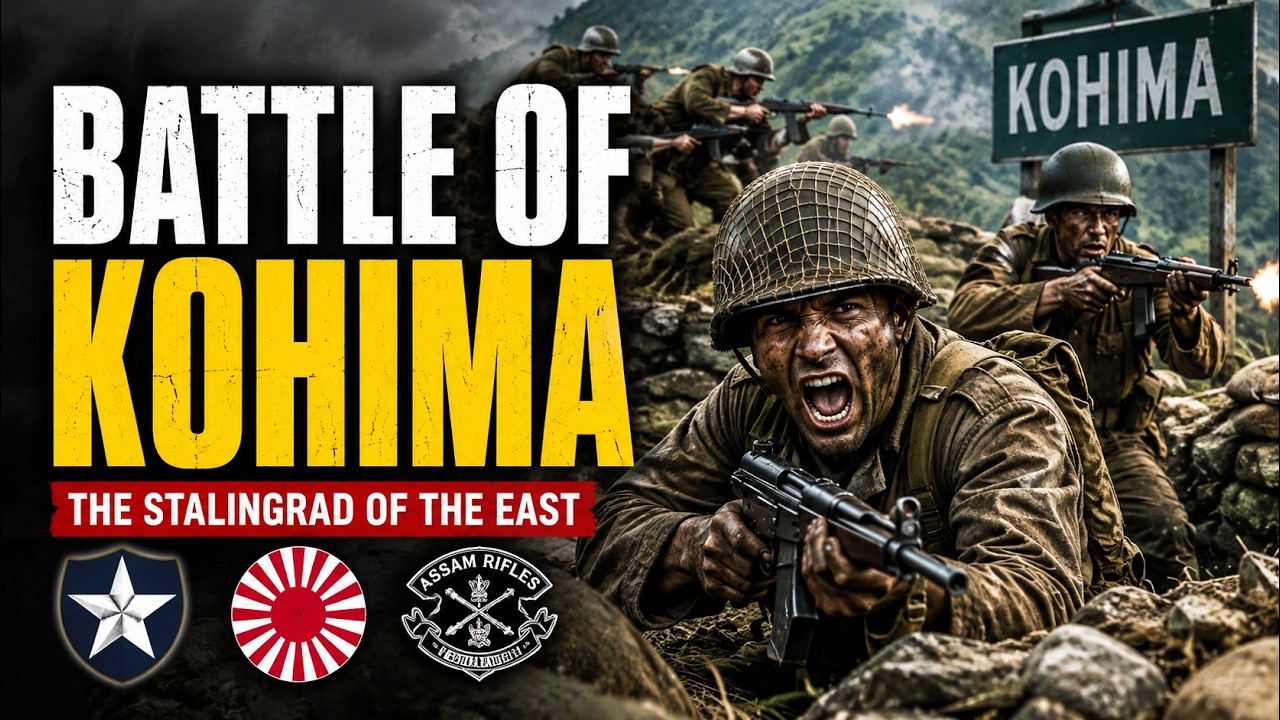
Mist rose from the valleys in the pre-dawn hours, wrapping itself around the high ridges where the pine trees stood in dark clusters. There were no sounds of machinery, no distant truck engines, no voices raised in alarm. Just the occasional shift of stone and the subtle dripping of condensation from the trees. The British garrison at Kohima was not large.
A few hundred soldiers scattered across positions they had only recently begun to fortify. Most were not on high alert. Why should they have been? The Japanese were hundreds of miles away.
Kohima was too remote, too difficult to reach, too insignificant to warrant a major assault. The Japanese believed otherwise. Operation U-Go was born of desperation. By early 1944, Japan had been steadily losing ground across the Pacific.
American submarines prowled the seas, cutting supply lines. The dream of a Greater East Asia Co-Prosperity Sphere was fading. Rather than retreat or consolidate, Japanese command made a choice that spoke to the psychology of losing. They decided to attack.
The target was twofold: Imphal and Kohima. If they could cut the British supply lines flowing north into China, if they could strike deep into India itself and ferment rebellion against the British Raj, they might yet alter the trajectory of the war. The scale of commitment was enormous. Three full divisions, roughly 80,000 men, would march from central Burma, cross the Chindwin River Valley, and claw their way over the Naga Hills.
The journey nearly killed them before they reached a single battlefield. The Chindwin crossing was a feat of organization that military historians have rarely failed to acknowledge. Thousands of soldiers, their boots heavy with supplies, their rifles lashed to their bodies, waded or swam the current. Engineers constructed boats and rafts from bamboo and whatever wood they could fell.
Once the river lay behind them, there would be no retreat. No reinforcement. No supply line except what they carried or what they could take from a hostile land. Then came the hills themselves.
The paths climbed with an almost vindictive steepness. A soldier encumbered with forty kilograms of equipment would find himself ascending for an entire day, sometimes more. The canopy was so dense that midday could feel like twilight. Rain did not simply fall from the sky.
It seemed to drip from every leaf, to rise from the earth itself as mist. Malaria, dysentery, and other fevers claimed soldiers even before any British bullet could. A soldier who could not walk simply fell behind. Still they came.
Meanwhile, on the ridge, the garrison scrambled to prepare. The British command had never anticipated a full siege. The place was conceived as an administrative outpost, a supply depot, a communications hub. When the first serious intelligence reached headquarters about the scale of Japanese movement, there began a quiet scramble to strengthen what was essentially a skeleton force.
The garrison consisted of perhaps 500 men at its core, though that number would swell as reinforcements trickled in. The 4th Royal West Kent Regiment formed one nucleus. Alongside them were Indian Army units, the Assam Rifles, the Manipur State Forces, and Nepalese Gurkhas whose reputation for ferocity had already become legend. These units, thrown together by military necessity, were learning to work as one body in a place that had never seen such a concentration of firepower.
The terrain presented an odd challenge. Kohima Ridge was not a fortress waiting to be occupied. It had to be transformed into one. The elevation gave advantage, granting sight across the valleys and approaches, but there was little natural protection.
The topsoil was thin. Digging trenches meant slow work with picks and shovels. Men stripped to the waist in the humid afternoons, working in shifts to avoid exhaustion. Gradually, a network of positions emerged.
Machine gun nests positioned to create overlapping fields of fire. Mortar pits situated where they could rain fire down on likely approach routes. Rifle trenches connecting the key defensive points. The garrison commander, Brigadier Warren, was not a flamboyant figure.
But soldiers who served under him recalled his habit of walking the positions at dusk, speaking quietly with men about their ammunition supplies, their water, their morale. He understood that a garrison’s strength lay not in speeches, but in the small accumulations of preparation. One more case of ammunition stored. One more water container buried and marked.
By the first week of April, the men holding Kohima Ridge knew with absolute certainty that they were about to be surrounded. Not suspected, not feared. Known. Runners came down from the northern approaches.
Naga guides brought word of the vast columns moving through the hills. The sound of axes on timber, the Japanese cutting supply lines and building siege positions, grew audible even at night. General Sato had achieved something that seemed almost impossible. He had moved nearly 5,000 soldiers with artillery pieces and supplies across one of the most punishing stretches of jungle and mountain in Southeast Asia.
What Sato understood with clarity was that Kohima Ridge itself was the true objective. Not merely as a military position, but as a choke point. Control Kohima and you throttle the entire northeastern front. Starve it and you acquire time.
By April 8th, the first substantial Japanese elements reached the high ground overlooking the garrison from the north. What followed was not a sudden dramatic assault, but something more deliberate and more terrifying. The Japanese began methodically to close the ring. They moved into the surrounding heights.
They cut the road that ran through the valley below, the single lifeline. When the siege began in earnest, the garrison numbered around 2,000 men. They had no certainty that reinforcements were coming. The radio could relay messages, but there was always the possibility that information transmitted into the void would simply disappear.
By April 10th, the siege had become complete. The Japanese had simply surrounded the ridge, cutting it off from the wider world. What had been a military position became quite suddenly a place of profound scarcity. Every ounce of water, every handful of rice, every cartridge of ammunition had to be accounted for with precision.
Water emerged as the most insidious enemy. The Japanese controlled the approaches to the water sources. Every attempt to draw water had to be covered by fire, had to be swift, had to gamble with lives. A soldier’s lips cracked.
His tongue felt thick and foreign in his mouth. He could taste only dust and the iron of old blood from his own gums. The food situation was no gentler. Rations were cut progressively.
A tin of bully beef served to three men became a serving for five. Hard biscuits became thinner slices. Many soldiers spent much of their waking time thinking about food. In a hollow, purely physical way.
The wounded posed their own terrible mathematics. The medical officer worked in conditions that would have horrified surgeons in any hospital. Infection was nearly as deadly as shrapnel. A wound that might have been treated routinely elsewhere became a slowly darkening sentence.
And yet, in the midst of this compression of suffering, something unexpected occurred. Near the center of the garrison position stood the tennis court, where British officers had kept some small semblance of peacetime society before the war consumed it entirely. What made it remarkable was that despite everything, some of the men found moments in which the tennis court became something else. It became a space of defiance, but also of something more tender.
A refusal to let the siege define them entirely. That capacity to let their minds rest occasionally on something other than the next attack was perhaps the deepest resistance they could mount. On April 9th, the battle took on a character that would define the entire campaign. The Japanese 58th Regiment began pressing inward with desperation born of hunger and impossible orders.
The defending soldiers found themselves compressed into smaller and smaller spaces until what had been a sprawling defensive line became something far more intimate and terrible. A matter of yards, then feet, then the distance between one trench and another. The tennis court became the focus of some of the fiercest hand-to-hand combat of the entire theater. It commanded several approaches to the garrison’s central position, so it had to be held no matter the cost.
What followed was not a single moment of combat, but a series of assaults and counter-assaults spanning several days. The Japanese would attack from the west and north. The defenders would repel them with rifle fire, grenades, and bayonets. The Gurkhas became known in whispered accounts from both sides for the ferocity of their hand-to-hand defense.
Their kukris were employed with a precision and speed that left the Japanese deeply wary of close approaches. The court changed hands multiple times. British and Indian soldiers would hold it, then be forced to withdraw. Japanese soldiers would advance onto it, then be driven back.
This grinding back and forth was siege warfare at its most terrible. Captain John Winstanley of the Assam Regiment remembered a moment when the court was held by perhaps a dozen British soldiers and twice that number of Indian soldiers facing repeated charges. After one particularly fierce assault, a strange silence fell. In that silence, a Japanese officer, his uniform torn, blood visible on his shoulder, stood at the far edge of the court and simply watched.
Winstanley watched back. For perhaps thirty seconds, the two men looked at each other across that small, devastated rectangle. Then the Japanese officer bowed very slightly and withdrew. It was not surrender.
It was perhaps acknowledgment. By the second week of the siege, rice rations had been cut to barely two ounces per man per day. Thirst became as much an enemy as the Japanese. Men reported experiencing moments of dissociation.
Their bodies moved and fought while their minds seemed to observe from a distance. The only lifeline left was the sky. The RAF’s Number 31 Squadron began flying supply missions from an airfield in Assam. They flew at 500 or 600 feet, trading the security of altitude for the precision needed to deliver supplies into a small, crowded defensive position.
At that height, a man with a rifle below could reach you. Could damage you. Could kill you. Supply drops happened repeatedly, day after day.
Between 600 and 700 individual drops during the siege. Crates of ammunition, tinned rations, medical supplies, water in jerry cans. Some aircraft never returned. The pilots understood something even if they did not speak it aloud.
A garrison that received supplies, that saw aircraft return again and again, received something more valuable than the contents of the packages. They received a message. Someone somewhere had decided that you mattered. That you would not be abandoned.
Then the monsoon broke. The first rains came as something almost deliberate in their weight and persistence. They fell in sheets that obliterated visibility beyond a few yards, turning the red earth into something closer to clay. Trenches began to collapse.
Rifle pits transformed into shallow pools of cold water and mud. Dysentery spread through both armies. Men who had survived multiple attacks found themselves incapacitated not by bullets, but by the simple biological fact of bodies crowded into wet, unsanitary conditions. The Japanese, increasingly isolated, had almost nothing.
Malaria accelerated in the wet. Soldiers developed fever dreams in their muddy trenches. The mud itself became a form of enemy no one had fully anticipated. In some areas of the perimeter, carrying wounded back became a process measured not in minutes but in agonizing hours.
The Royal Air Force pilots flew through conditions that made navigation nearly impossible. Followed landmarks they could barely see. Dropped supplies they could not accurately aim. Several aircraft were lost, disappeared into the clouds and rain.
Each aircraft that failed to return meant food that would not arrive. For nearly half a century after the war ended, Kohima slipped into a peculiar kind of silence in the Western imagination. In London, in Washington, in the schoolrooms of Europe, the focus fell elsewhere. Stalingrad had become the archetype of urban desperation.
The beaches of Normandy, the horror of the camps. These were the narratives that shaped how the war was remembered. Kohima remained a footnote. Part of this forgetting was simple geography.
Burma, Northeast India, the Naga Hills. These were remote territories. It was easier to forget what happened in places that had never quite felt real to the audiences back home. Beneath this erasure lay a more uncomfortable historical pattern.
The battles of the Far East had been fought not only against a Japanese enemy, but within the machinery of empire itself. The Indian Army had played a vast and crucial role at Kohima. The 4th and 7th Indian Infantries, the 50th Parachute Brigade, the Sikh and Punjabi Regiments whose soldiers died in numbers that rivaled their British counterparts, yet whose names disappeared into aggregate statistics. The Naga peoples, who had inhabited these hills for centuries, found themselves drawn into a conflict that had originated in the boardrooms of distant empires.
There was little choice in the matter. Young men and women began to serve as guides for the Allied forces. Without them, the British and Indian soldiers would have been almost entirely lost in the jungle maze. Beyond the guides came the porters.
Thousands of them, moving up and down the supply lines, carrying ammunition and food on their backs, often under fire. Some were conscripted. Some volunteered. They worked largely unseen by history.
Their labor was the invisible foundation upon which the defense of Kohima was built. What did the porters see when they reached the ridge? They saw British and Indian soldiers thin with hunger. They saw the Japanese positions on the surrounding heights.
Some of the porters were killed. Some were wounded. Some simply disappeared into the fighting, their fates recorded nowhere. The Naga Hills in 1944 became a place of uncertainty and constant danger.
The people who lived there bore the burden of that uncertainty alongside the soldiers. Meanwhile, the British 2nd Division under Major General John Grover had begun advancing from Dimapur with deliberate, grinding momentum. They did not race. They could not afford to.
Every ridge held Japanese defenders. Every saddle harbored machine gun posts and mortar teams dug in with the resignation of men who had already accepted they might not leave the mountains alive. The capture of Garrison Hill came gradually. The perimeter contracted like a living thing, drawing in upon itself.
By early June, the direct siege of Garrison Hill had effectively ended. Japanese forces began to slip away northward in exhausted withdrawals under cover of darkness and fog. The Japanese retreat, when it finally came in earnest, was not a neat military withdrawal. It was chaos tempered by discipline, hunger, and desperation.
The same river they had crossed with such confidence was now swollen by monsoon rains. The journey back would take three weeks or more. Men died by the thousands. Some drowned.
Some simply sat on the banks and watched the water flow past, unable to summon the energy to reach the other side. General Sato had made the choice to withdraw even as headquarters demanded he hold. He knew what his men’s eyes could tell him, that they were no longer a fighting force. They were ghosts keeping the shape of a division.
Japanese records suggest perhaps 3,000 dead or dying during that retreat. Allied observers spoke of far higher numbers. When the last Japanese soldier crossed the Chindwin in late June of 1944, what remained on Kohima Ridge was silence. Not the silence of peace, but the peculiar quietness that follows exhaustion so complete that even grief requires stillness to be felt.
In the weeks that followed, a different kind of labor emerged. Burial parties worked through the humid afternoons, committing the fallen to the earth of the ridge that had claimed them. The military authorities made the decision to formalize what had been begun in those first raw days of mourning. They established a proper cemetery.
On a stone set at the entrance, words were carved that came to define the place and became the voice of Kohima itself. The inscription reads:
“When you go home, tell them of us and say, for your tomorrow we gave our today. ”
The voice in those words is peculiar and haunting. It does not speak in the language of duty accomplished or strategic victory achieved.
Instead, it speaks directly across time and geography, from the dead to the living. It asks to be held in memory. It acknowledges that the people at home will want to know what became of their sons. It honors that need.
In its restraint, it achieves a kind of eloquence that sentimental language might never reach. The cemetery remains today, maintained by the Commonwealth War Graves Commission. The headstones are arrayed in careful rows. The grass is maintained.
There is a quietness that seems almost artificial when set against the memory of combat. The epitaph has taken on a life beyond the cemetery. It has been quoted in books and documentaries, inscribed in museums. It has become a kind of universal statement about sacrifice in war.
Soldiers in other conflicts have found that these words spoke to their own experience. Veterans have wept when reading it, even those with no personal connection to Kohima. Yet it is worth considering what gets lost in this universalization. In becoming a general statement about sacrifice, the epitaph risks losing its specificity.
Its particular location on a ridge in Burma in 1944. The specific circumstances of men from specific regiments facing an enemy under specific conditions. The details of thirst and dysentery and the desperate scramble for high ground. The cemetery is beautiful.
But the battle was not beautiful. The battle was profane and terrible and random in its destructiveness. The cemetery honors the dead, but it cannot fully capture what it meant to be alive in that place during those 73 days. The slow rediscovery of Kohima’s true significance began through the very communities that had been forgotten.
In the 1960s and 1970s, as India asserted its independence and began to reckon with its own military history separate from the British narrative, the battle began to be revisited in Indian historical writing. Then gradually, Western historians began to look again. What emerged was a deeper understanding. Kohima was not secondary to the European War.
The failure of the Japanese to break through to India represented the absolute limit of Japanese expansion to the south and west. The holding of that ridge had sealed the fate of the Greater East Asia Co-Prosperity Sphere. The siege itself placed it genuinely alongside Stalingrad as one of the most brutal, most consequential battles of the entire war. The survivors who began to speak decades later spoke with a kind of reverence that suggested they had always known what the wider world had forgotten.
They had carried the memory with them through all those years of relative silence. The battle of Kohima was their battle. It had defined them. If you walk the ridge today, the monsoon clouds still gather much the same way they did in that terrible summer of 1944.
The air still hangs heavy and damp. The rain still falls with the same insistent rhythm. Nothing essential has changed about the landscape. The ridge is still high.
The valleys below are still green and deep. Perhaps that continuity, that refusal of the world to be transformed by human suffering, is itself a kind of mercy. As dusk falls and the light turns that particular shade of blue-gray that comes just before true dark, the ridge settles into silence. The birds settle into their branches.
The wind dies down. The air seems to hold its breath. In that quiet, there is something that feels almost like forgiveness. Not forgetting.
The dead of Kohima are not forgotten. But there is a way in which the ridge itself has accepted what happened there. The earth has accepted the blood. The stone has accepted the weight of names.
Perhaps that is what peace is at its deepest level. Not the absence of memory, but the integration of it. Not the erasure of suffering, but its placement within.