The boy’s godfather gave him his name, his future, and the weight of a dynasty he never asked for. Adolf Martin Bormann was born on April 14th, 1930, the firstborn son of Hitler’s private secretary. His godfather stood at the baptismal font and watched the priest pour water over his head. That godfather was Adolf Hitler.
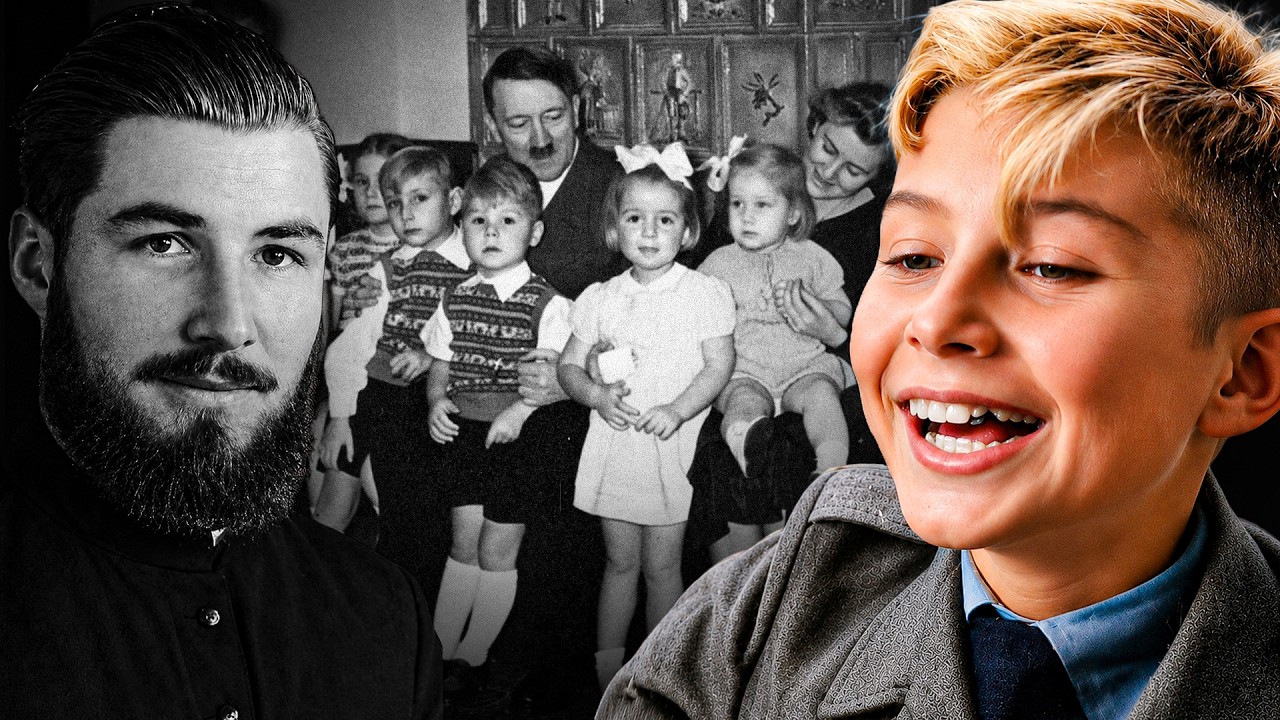
At home, they called him Krüncy—short for Kronprinz, the Crown Prince. For the first ten years of his life, he believed in everything his godfather stood for. He grew up on the Obersalzberg, a private compound in the Bavarian Alps that his father had personally developed around Hitler’s Berghof. Guarded roads, officers’ villas, a kindergarten for the children of the regime’s most senior families.
Hitler lived a short walk from the Bormann house. His mother, Gerda, had married Martin Bormann in 1929 when she was nineteen. Hitler himself had been a witness at the wedding. She was a committed anti-Semite, an admirer of Julius Streicher, the publisher of Der Stürmer.
Over the next fourteen years, she gave birth to ten children. Nine survived infancy. In 1939, she received the Cross of Honor of the German Mother in the Gold Class, awarded to women who produced eight or more children for the Reich. Every child carried an ideological signature.
Heinrich Hugo, born in 1936, was named after Heinrich Himmler, his godfather. A daughter christened Ilse after Ilse Hess was hastily renamed Eika when Rudolf Hess flew to Britain in May 1941. An Adolf born in 1934 became Helmut at the same time. The family adjusted its register as the regime’s reputations rose and fell.
Gerda was no quiet wife. Letters published after the war revealed her advocating a state-sanctioned system of multiple marriage, a Volksnottehe, under which approved men would father children with several women at once. When her husband began an affair with the actress Manja Behrens, Gerda reportedly wrote approving the arrangement, suggesting the two women alternate years bearing his children so he would always have a wife available. Klaus—Krüncy’s formal name—entered Nazi schooling at ten.
From 1940 to 1945, he attended the Nazi Party Academy at Matrei am Brenner in the Tyrol, an institution conceived by chief ideologist Alfred Rosenberg to train a future ruling class. By April 1945, he was fifteen years old, waiting for orders that were no longer coming. The academy closed on April 15th, 1945. Ten days later, the United States Army Air Forces bombed the Obersalzberg.
The raid destroyed much of the complex his father had spent years developing. Within hours, Gerda packed what she could carry and left the mountain with eight of her children, heading south. Klaus was still at the academy. Her husband was in the Berlin bunker.
They made their way over the Brenner Pass into South Tyrol and settled in a property called Villa Stievia near Wolkenstein. Gerda adopted the alias Bergmann. The children were registered at the local school under the same false name. Two streets away, Margarete Himmler was hiding with her daughter under similar pretenses.
Her husband was already dead. Martin Bormann’s last bunker diary entry was a single word: Ausbruchversuch—breakout attempt—written on May 2nd, 1945 as the Soviets closed in on the Chancellery. He left the bunker that night with a small group and was never seen alive again. For decades, sightings would surface across South America.
The truth lay closer to home, but it would take twenty-seven years to surface. Gerda did not stay hidden for long. By mid-1945, she had been identified, arrested, and brought to the Untermais prison in Merano. American and British intelligence officers questioned her for days about her husband’s whereabouts, his contacts, the regime’s final movements.
She had no useful information. As a wife and mother, she had played no role in operational decisions. In the autumn of 1945, she became seriously ill. Doctors at the Bolzano Hospital diagnosed advanced abdominal cancer.
At British insistence, she was transferred to the war hospital in Merano for treatment. Her children were placed under the care of trusted intermediaries while she remained under guard, visits restricted, correspondence blocked. She never recovered. Gerda Bormann died on March 23rd, 1946.
She was thirty-six years old. Her body was buried in the Merano military cemetery in grave 610, sharing the plot with a German soldier named Horst Brüger. The youngest Bormann child, Volker, born in September 1943, died later that same year. Of the nine children who survived the war, eight were left without either parent.
On October 1st, 1946, the International Military Tribunal at Nuremberg sentenced Martin Bormann to death in absentia. The eldest son, sixteen years old, did not yet know his mother was dead. Klaus never reached his mother. When the academy closed, a party functionary in Munich advised him to make his way south to Wolkenstein.
But the roads were collapsing, the front was moving, and by the time he crossed back into Austria, the war was effectively over. He ended up stranded in Salzburg. There, a senior party official supplied him with false identity papers and arranged for him to take shelter with a Catholic farmer named Nikolaus Hoenwarter at the Koglreithnerhof, a remote property halfway up a mountain in the Salzburg Alps. Klaus shed his name and his history.
He worked the farm and attended mass on Sundays with the family. To his neighbors, he was a teenage refugee from somewhere further north. None of them knew who he really was. He lived that way for almost two years.
In 1947, he read in the Salzburger Nachrichten that his mother had died the previous year in an Italian hospital. The article identified her by name. He took the paper to Hoenwarter and confessed his true identity. Hoenwarter informed the local priest of Weißbach bei Lofer, who in turn contacted the rector of the church of Maria Kirchental.
The rector took the boy into his care. Klaus had been baptized Lutheran. He converted to Catholicism. Soon after, American intelligence officers tracked him down, arrested him and an altar boy, and held him at Zell am See for several days of questioning.
They were looking for his father. Convinced he genuinely knew nothing, they returned him to the parish. In Ingolstadt, he joined the religious congregation of the Missionaries of the Sacred Heart and began studies toward the priesthood. The other surviving children followed quieter paths.
A Catholic clergyman in the Rhineland, Theodor Schmitz, took on their care after their mother’s death and gradually received most into the Catholic Church their parents had despised. Eike died in 1958, still in her twenties, without ever knowing a settled adult life. The remaining siblings drifted into careers and marriages under the radar of public attention. None pursued political roles, gave major interviews, ran for office, or wrote memoirs.
The Bormann name in post-war Germany was something to be lived past rather than carried forward. Only Klaus went a different way. On July 26th, 1958, twenty-eight years after his baptism with Hitler as godfather, he was ordained a Catholic priest in Innsbruck. In 1961, the Missionaries of the Sacred Heart sent him, then thirty-one, to the newly independent Congo.
The country had declared independence from Belgium the previous year and was descending into the conflict that would consume it for the rest of the decade. He worked in pastoral care and education at Catholic missions across the region. In 1964, as the Simba Rebellion targeted Western missionaries, he was forced to flee. A return visit in 1966 lasted one year before he left the country for good.
In 1969, he suffered a near-fatal injury. A nun named Cordula, born Rosemary, nursed him back to health. Their relationship deepened during his recovery. The early 1970s were a period of mass departures from religious life across the Catholic Church following the Second Vatican Council.
Both renounced their vows. They married in 1971. He took a teaching post in theology and held it for two decades, retiring in 1992. In the second half of his life, Klaus began speaking publicly about who he had been and who his father was.
He joined Children of Perpetrators, Children of Victims in 1987, a reconciliation group founded by the Israeli psychologist Dan Bar-On. Six years later, he traveled discreetly to Israel for a four-day symposium at Neve Shalom, where eight other children of Nazi war criminals met with nine children of Holocaust survivors. He visited Yad Vashem. He was not recognized.
In a 2000 interview with The Spectator, he said that while he could not acquit his father of his political guilt, he still loved him as a father. Tours of German and Austrian schools followed, walking students through Nazi propaganda texts and explaining how he, as a child, had believed every word of them. The father he had loved had been dead since 1945. Workers digging on a Berlin construction site in December 1972 uncovered two skeletons at the old Ulap fairgrounds near the former Chancellery.
Dental records identified one as Martin Bormann. West German authorities formally declared him dead on April 11th, 1973. In 1998, mitochondrial DNA testing comparing the skeleton with a living maternal relative confirmed the identification beyond dispute. On August 16th, 1999, Klaus scattered his father’s ashes in the Baltic Sea.
Then came the coda. In 2011, a former pupil from an Austrian Catholic boarding school where Klaus had taught in the early 1960s publicly accused him of sexual abuse. Other former pupils alleged severe physical violence. By then, he had advanced dementia and could not coherently respond.
No prosecution followed. Austria’s Klasnic Commission, which investigated abuse within the Catholic Church, awarded the accuser compensation. Klaus died in Herdecke on March 11th, 2013. He was eighty-two.
The question of whether his redemption was real died with him.


