The door opened, and Dex Briggs walked in. Six foot two, suit pressed, phone in hand. In one second, he took in three things: his girlfriend on the floor, Jade; his housekeeper standing over her, Amara; and his mother, Dr. Odette Briggs, sitting in her wheelchair with a fresh handprint across her cheek.
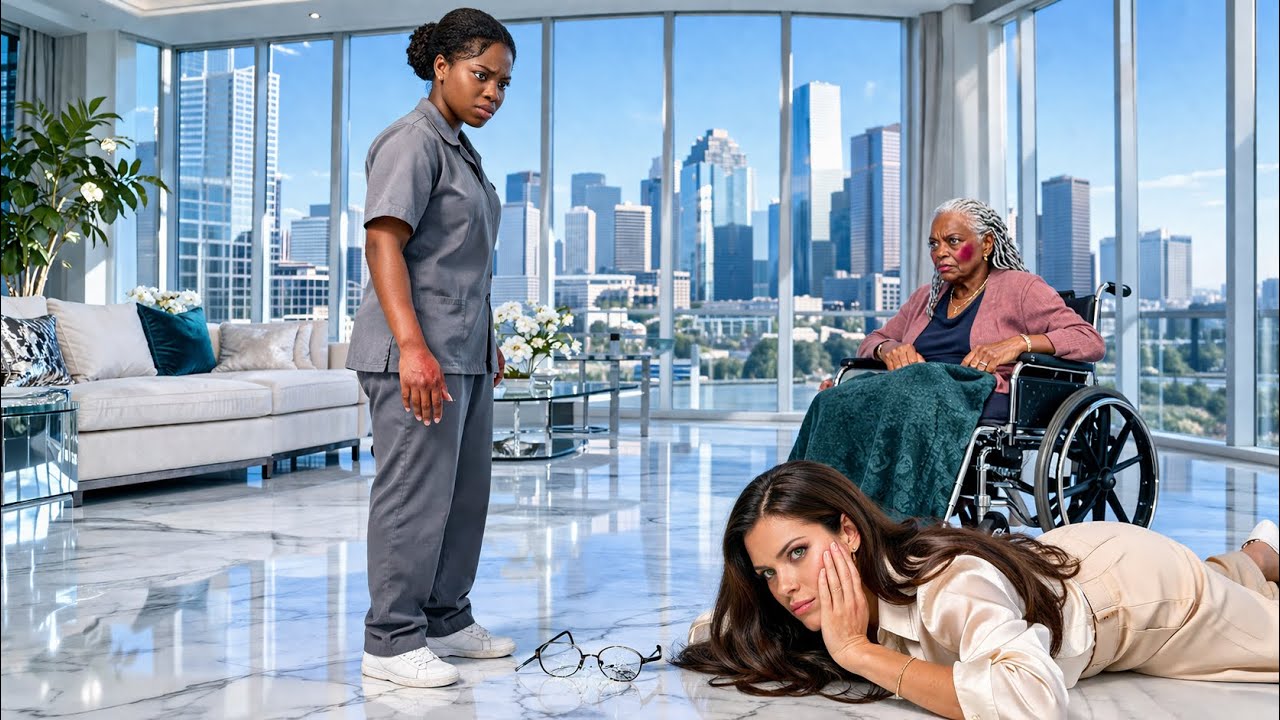
Jade spoke first, as she always did. “She hit me, Dex. Out of nowhere. ”
Amara said nothing.
Her palm was still warm from the contact. “Mom? ” Dex turned to his mother. Dr.
Briggs looked from her son’s face to Jade’s, and then to Amara. Someone had crossed a room for her today. Someone had fought for her. She had carried her silence for two years.
She was done. “She slapped me,” Dr. Briggs said, her voice clear and steady. “Jade slapped me today.
And before today. ”
The room went still. “She pinches my arms,” Dr. Briggs continued.
“She stood on my fingers. She hid my glasses. She turned my wheelchair to face the wall and left me there for hours. She whispered to me that she would put me in a home, that she would tell you I was losing my mind.
”
Jade shook her head. “Dex, she’s confused. I told you, she’s declining. ”
“She just described two years of abuse in precise chronological order,” Dex said.
“That is not confusion. That is testimony. ”
He looked at Jade for a long moment. “Get out.
”
“You’re choosing the housekeeper over me? ”
“I’m choosing my mother. I should have done it two years ago. ”
Jade left, her heels clicking on the marble until they faded.
But she wasn’t finished. That evening, she called the police. “My boyfriend’s domestic worker assaulted me. ” It was technically true, and the law didn’t ask why.
Amara’s work authorization was flagged. Immigration was notified. Jade leaked the story to a blogger she knew: “Billionaire’s housekeeper attacks girlfriend. African immigrant faces deportation.
”
The comments came fast. Deport her. Who does she think she is? Amara read them in her small room at the end of the service hall.
Her hands didn’t shake. Her grandmother had heard worse from church ladies who thought a woman in a wheelchair was divine punishment. A knock at the door. Dex.
“I’ve called a lawyer. ”
“Why? ”
“Because you did what I should have done,” he said. “I hit your girlfriend,” Amara said.
“You hit the woman torturing my mother,” he replied. “Courts won’t see it that way. ” “Courts will see the evidence. ” He paused.
“I had cameras installed after the renovation. Every common room. They upload to a private server. Jade didn’t know.
”
Amara stared at him. Two years of footage. “Why didn’t you check when I told you the first time? ”
He had no answer.
That night, he watched it all alone. Six hours. His office dark except for the screen. He watched Jade hide the glasses, taking them from the table and tucking them into a drawer beneath folded scarves.
He watched her turn his mother’s wheelchair to face the wall, watched his mother try to turn herself back, fail, and give up. He watched her stand on his mother’s fingers, heard the cut-off cry. He listened to the whispered threats, the audio clean. Every word.
Then he watched Amara. Braiding locks with the same patient pattern every week. Finding the glasses. Cleaning the lenses with her apron.
Turning the wheelchair back to the window. Sitting beside it in the middle of the night, not speaking, just being there. Two women in the same room across two years. One shrinking her, one rebuilding her.
He watched the footage from that afternoon last. Jade’s slap. The spinning glasses. Amara crossing the room.
He watched it three times. On the third viewing, he saw something he’d missed. After the hit, after Jade fell, Amara was shaking. Terrified.
But she didn’t move. She planted herself between the wheelchair and the woman on the floor, and she stayed. Dex opened the family trust documents. Then he called his head of legal.
Then he called his private investigator. “The accident two years ago. My mother’s spinal injury. I need the full incident report and vehicle maintenance records.
”
“That case was closed. ”
“Open it. ”
The report came back in 48 hours. The brake inspection scheduled for the morning of the accident had been canceled by a phone call.
The number traced to Jade’s business manager. The brakes. The timing. Dex sat with it for a full day.
His stepfather had died in that crash. His mother had been paralyzed. Because someone canceled a brake inspection. He told Amara.
She went still. “Does your mother know? ”
“She blamed herself for two years. She told me she’s the one who said they were running late.
He skipped the mechanic because of her. ”
“She needs to hear this from you. Not from a lawyer. From her son.
”
They told Dr. Briggs together by the window, the Houston skyline beyond the glass. She listened with a professor’s face, processing, cataloging. “Someone canceled the inspection,” he said.
“Yes. ” “He said they felt wrong that morning. He almost called. I told him we were running late.
” Her voice dropped to almost nothing. “I’ve carried that for two years. ”
“It wasn’t your fault, Mom. ”
She didn’t cry.
She went completely still. Then the professor’s voice returned, clear and absolute, like a verdict. “I want her to know that I know. And I want the world to know.
”
The press conference took place three days later. Dr. Briggs insisted on attending. Wheelchair.
Fresh locks. New glasses—Amara had found an identical pair within a day. The room was full of cameras. Dex spoke first.
“Three days ago, my housekeeper struck my girlfriend. The media reported it as an unprovoked attack. I’m here to show you what actually happened. ”
The screens activated.
Twelve minutes of footage. The room watched in silence. The hidden glasses. The wheelchair turned to the wall.
The heel on the fingers. The gasps were audible. The whispered threats rolled across the screen in subtitles. Then Amara braiding locks, making jollof rice, finding the glasses, turning the chair back to the window, holding a swollen hand in the dark.
Then Jade’s slap. The glasses spinning. Amara crossing the room. “Don’t touch her again.
”
The room erupted. Dex raised one hand. “There’s more. ” The trust documents.
The filing. The phone call canceling the brake inspection. The connection to Jade’s family firm. The accident that killed his stepfather and paralyzed his mother, now under reinvestigation.
Dr. Briggs rolled to the center of the platform. “My name is Dr. Odette Briggs.
I taught African-American literature at Howard University for twenty-two years. I am not confused. I am not declining. I am a woman in a wheelchair who was told to be quiet or lose everything.
”
She looked to the side of the room. Gray uniform, white sneakers, eyes wet. “Today I choose to speak because a young woman, a housekeeper in my son’s house, chose to fight for me when I had stopped fighting for myself. Amara Osei hit my abuser.
And I wish I’d had the legs to stand up and do it myself. ”
Jade was investigated. Elder abuse, fraud, potential criminal conspiracy in connection with the accident. Her wellness brand went dark overnight.
The comments flipped. Protect Amara. She’s the real one. Amara’s charges were dropped by the end of the day.
Three weeks later, in Dr. Briggs’s room, morning. Amara braided locks. Same pattern.
Same hands. The window faced the garden. The wheelchair was in full light. “You’re staying,” Dr.
Briggs said. It wasn’t a question. “I’m staying. Not as a housekeeper.
I’m not sure what else to call it. Companion, reader, lock braider, jollof chef, friend—if that’s not too soft for someone from Kumasi. ”
“We’re sentimental. We just hide it.
”
“So do we. ”
Dex had offered Amara a formal position. Full salary, benefits, visa sponsorship. She accepted with one condition: “I answer to your mother.
Not to you. ”
“That seems to be how everything works in this house now,” he said. “Slow learner. But you’re getting there.
”
That Tuesday, Amara was in the kitchen. Jollof rice. The smell filled the whole floor. Dex sat at the counter and watched her cook.
“You changed everything in this house. ”
“I made rice and braided hair. Your mother did the rest. ”
Silence.
“I don’t know how to do this,” he said. “Feel something for someone who works here without it being wrong. ”
“I don’t work in your house. I work for your mother.
There’s a difference. ”
“Is there? ”
“She thinks so. She told me last week, ‘My son looks at you like you’re a problem he’s hoping never gets solved.
’”
“She said that? ”
“She’s a professor. She notices everything. ”
He reached across the counter—not for her hand, but for the spoon.
He took a bite directly from the pot. Amara stared at him. “You did not just eat from the pot. ”
“I’m learning different ways to earn things.
”
“That’s not how earning works. ”
“Then teach me. ”
She looked at him. He looked at her.
The counter between them. “Tuesday,” she said. “What about it? ”
“Come back next Tuesday.
Sit with your mother for an hour first. Then come here. I’ll make extra. ”
“Is that a date?
”
“It’s jollof rice. Don’t make it weird. ”
From down the corridor, clear and full: “I can hear you both. And yes, it’s a date.
”
Amara laughed. Dex almost smiled. In the morning, Dr. Briggs’s door was open.
Lamplight, books, a window full of light. She sat in her wheelchair, locks braided, glasses on, reading aloud. African-American poetry. The professor’s voice, full and unhurried, unsilenced.
Amara sat beside her. She didn’t understand every reference. She didn’t need to. The sound of this woman’s voice, strong and unafraid, was all the proof she needed that she had done the right thing.
On the windowsill sat two framed photos. One of Dr. Briggs and her late husband. The other, taken by Dex, of Amara and Dr.
Briggs. Neither woman was looking at the camera. Both were mid-argument. Both certain they were winning.
She came to Houston with one rolling bag and a work authorization card. She took a job because she knew how to care for a woman who couldn’t walk. She braided locks. She made jollof rice on Tuesdays.
She argued about books with a professor who hadn’t argued in two years. And when she saw a handprint on that professor’s face, she crossed a room and used her strong hands the way her grandmother taught her. Not to hurt. To hold someone up.
Strong hands don’t ask for credit. They just refuse to let go.


