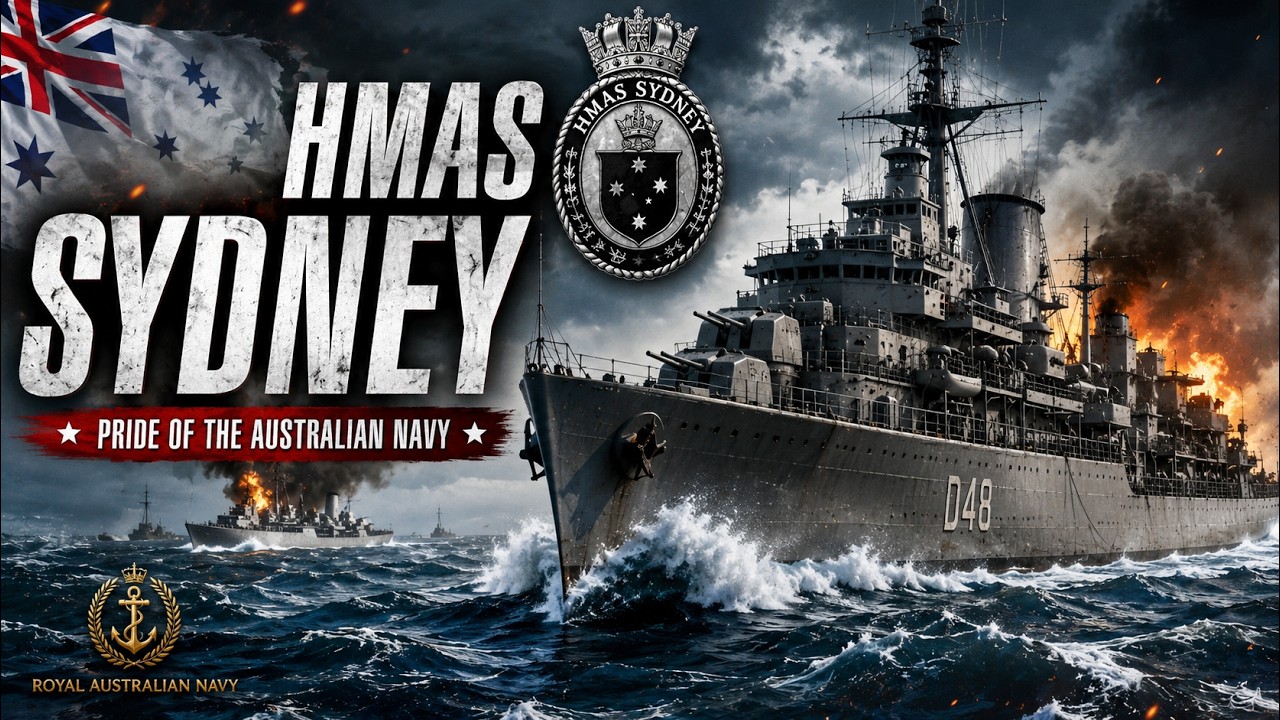
The sister ship of HMAS Sydney had been a symbol of Australian pride since she slid into the water in 1935. Built in Sydney Harbor itself, she was sleek, fast, and armed with eight 6-inch guns, a promise of the nation’s readiness. She had proven herself in the Mediterranean, sinking the Italian cruiser Bartolomeo Colleoni off North Africa in 1940, a victory that filled Australian newspapers and hearts with pride. By late 1941, she was home, patrolling the vast, peaceful-looking waters off Western Australia, her crew of 645 confident after months of war.
Somewhere in that same ocean, another ship was hunting. She was the Kormoran, a German merchant raider disguised as the Dutch freighter Straat Malakka. She was slow and ponderous, but beneath her innocent paint and false name, she carried six 150mm guns and torpedo tubes. Her crew of nearly 300 men lived a constant lie, ready to drop the disguise and strike at any moment.
For months, she had preyed on Allied shipping in the Indian Ocean, and now her captain, Theodor Detmers, was looking for the next target. On the afternoon of November 19, 1941, the lookouts on the Sydney spotted a column of smoke on the horizon. It was a routine sighting, a merchant ship, perhaps Dutch, that warranted identification. Captain Joseph Burnett ordered his cruiser to close the distance, following standard procedure.
As they approached, signals were exchanged. The other ship identified herself as the Straat Malakka, a neutral Dutch freighter. It all seemed correct, but Burnett was uneasy. Something in the responses felt off, and he ordered his ship to come even closer, close enough to visually inspect the vessel.
Aboard the Kormoran, the tension was unbearable. The crew watched the Australian warship approach, their guns loaded and trained. They had been waiting for this moment. As the Sydney drew to within point-blank range, Captain Detmers gave the order.
The false plating covering the gun mounts was dropped away. The disguise was torn off. In a space of seconds, the Kormoran opened fire at a range so close it was almost impossible to miss. The first salvos struck the Sydney with devastating accuracy.
Shells ripped through her bridge, penetrated her hull, and ruptured her fuel tanks. Within minutes, the proud cruiser was enveloped in smoke and flame. The surprise was nearly complete, but the Sydney’s crew responded with training born of battle. Her own guns, despite the shock and damage, began to find their marks.
The return fire was equally ferocious. Shells from the Sydney slammed into the Kormoran, a converted merchant ship not built to withstand such punishment. Her hull was torn open, her engine rooms were flooded, and she began to take on water. The fight was a brutal, compressed exchange of violence, lasting perhaps twenty minutes.
It became clear that neither ship would survive. They were locked in a mutual destruction. In the gathering dusk, Captain Detmers knew his ship was doomed. He gave the order to scuttle her.
Explosive charges were set, and the German crew, those who had survived the battle, scrambled into lifeboats and rafts. As darkness fell, they watched from the water as the Kormoran slipped beneath the waves. Their ship was gone. But the Sydney did not follow the same path.
She was a burning, listing wreck, but she did not sink where the battle had taken place. Instead, she turned away and limped off into the darkness, moving eastward. Her fires were visible on the horizon for a time, and then she was gone. No one aboard her would ever be seen again.
She vanished with all 645 of her crew. The German survivors drifted in the water for days. They had provisions and a desperate hope for rescue. It came on November 23rd, not from a warship, but from a French vessel that picked them up and took them into custody.
When they were interrogated, they could tell the story of the battle. They could describe the approach, the surprise, the exchange of fire. But they could not answer the one question that mattered most to Australia. They had seen the Sydney burning, but they had not seen her sink.
For them, she had simply disappeared into the night. The news of the Sydney’s loss was a shock that rippled through the nation. There was no grave, no wreckage, no survivors. The Navy’s initial statements were vague, wrapped in wartime secrecy.
The families of the 645 men were left in a cruel limbo, unable to properly grieve because there was no final confirmation. The uncertainty became a national wound, and the mystery of what happened to the Sydney began to grow, festering with speculation and theories in the absence of facts. The decades passed, and the wreck remained lost. Fishermen told stories of unusual sonar readings, and amateur historians pored over archives and interviewed aging survivors.
The official silence had created a vacuum, and into that vacuum flowed endless questions. Why had no search been successful? Where exactly had the ship gone down? The mystery became a sacred part of Australian history, a story with a hole in it.
It wasn’t until the early 2000s that technology finally caught up with the questions. Advanced sonar and deep-sea mapping made it possible to search in waters that were previously unreachable. In 2008, an expedition was organized, combining naval historians, oceanographers, and specialist search teams. They methodically swept the seafloor off Shark Bay, guided by survivor testimonies and calculations of ocean currents.
The Kormoran was the first to be found, resting at a depth of around 2,500 meters. Her hull was fractured and twisted, but the shell holes and burn marks visible on the wreckage aligned perfectly with the accounts from her surviving crew. She had been sent down by her own men, just as they had described. The discovery of the enemy ship only intensified the search for the Sydney.
The team expanded the grid, and after days of patient scanning, a signal returned that was unmistakable. There, on the sonar display, was the shape of the HMAS Sydney. She lay at an even greater depth, over 2,400 meters down, far deeper and farther south than anyone had calculated. She had drifted for some time before sinking.
The images from the submersible cameras were haunting. The Sydney lay on her side, her superstructure devastated, her gun turrets twisted at unnatural angles. The damage to her hull told the story of the battle with silent clarity. The pattern of shell impacts and structural failure was consistent with the close-range bombardment from the Kormoran.
She had been overwhelmed, but she had fought back with everything she had. For the families of the lost, the discovery brought a complex kind of solace. There was now a physical location for their grief, a place to direct their remembrance. But it also brought a deeper understanding of the final moments.
The crew had not acted with panic; they had fought their ship until she could no longer be saved. The wreck was their tomb and their monument. As the search concluded, something remarkable began to unfold. The discovery of the wrecks became a shared moment of remembrance between two nations.
Australian and German researchers began to collaborate, understanding that this was not a story of victory and defeat, but one of shared human loss. The wrecks themselves became a common language of damage and courage. Ceremonies were held annually on the anniversary of the sinking, and for the first time, German sailors who had died that day were honored alongside the Australian dead. Decades after the war, the ocean floor became a shared cemetery, a neutral ground where no flag flew.
Australian and German descendants began to speak of making pilgrimages together, standing side by side to honor the men who had been caught in the machinery of a global conflict. The men of the Sydney and the men of the Kormoran, enemies in life, are now remembered together in a tragic duet. The mystery was not fully solved. Questions remain about the exact sequence of events in the Sydney’s final hours, about the decisions made in the darkness.
The wreck cannot speak to the thoughts and fears of the men aboard her. But the finding of the wrecks changed the shape of the mystery. It gave a location to grief and a conclusion to a story that had seemed incomplete.
The ocean holds its secrets with a patient hand, but some of them, at last, have been allowed to surface.