A few months ago, I was walking through the USS Intrepid in New York City, one of America’s preserved aircraft carriers, and a question kept nagging at me. The US has five aircraft carriers preserved as museum ships, not to mention eight battleships. Britain, the nation that actually invented the aircraft carrier, has none of either. I couldn’t shake it.
We had a navy that was every bit as powerful as America’s for most of World War II, and for decades after. We built the world’s first modern battleship. We changed naval warfare forever. And now, there isn’t a single British carrier or battleship left for people to walk through and learn what we achieved.
Britain did get off to a promising start in 1922, when HMS Victory was preserved. Nelson’s flagship at Trafalgar, completed in 1778, she’d fallen into terrible condition over the years, used as a prison ship and then a floating headquarters. The Admiralty wanted to scrap her more than once, but King Edward VII personally intervened, and a generous donation from shipping magnate Sir James Caird finally funded her restoration. She’s sat in dry dock at Portsmouth ever since, a commissioned warship and a museum for a century.
But that’s where the good news ends. Every British battleship from the First and Second World Wars went to the scrapyard. HMS Warspite went in 1946. Queen Elizabeth, Valiant, Malaya, Revenge, and Ramillies all followed in 1948.
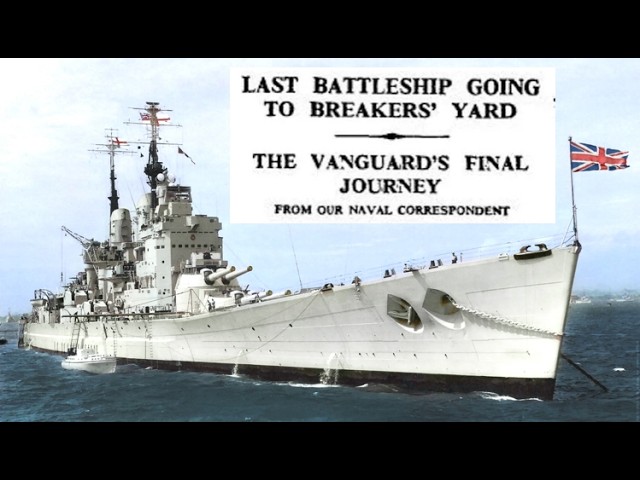
Royal Sovereign, Resolution, Nelson, and Rodney were gone by 1949. King George V, Duke of York, Anson, and Howe disappeared in the late 1950s. Even HMS Vanguard, the last and largest battleship Britain ever built, was cut up for scrap by 1962, bringing the government a mere 560,000 pounds. The Americans kept their Iowa-class battleships through the Cold War and even used them to bombard Iraq in 1991.
We scrapped every single one of ours without a second thought. The story of our aircraft carriers is worse. HMS Vengeance, a World War II carrier that served until 2001, was actually listed on eBay in 2003 after British naval associations failed to raise enough money to bring her home. Bidding reached 4 million pounds before eBay removed the listing.
She was auctioned in Rio de Janeiro in 2004, failed to sell, then was towed to India and scrapped. HMS Ark Royal, the last carrier with a conventional catapult for fast jets, was decommissioned in 1979. There was strong public demand to save her as a museum moored at Greenwich in London, and a private bidder estimated 750,000 people a year would visit. The Ministry of Defense blocked the plan, arguing the ship was worn out and too expensive to prepare.
They scrapped her for a paltry 2. 5 million pounds instead. Then came HMS Hermes, the flagship of the Falklands War. She served that campaign with distinction, operating Sea Harriers.
Sold to India in 1986, she served until 2017. India initially wanted to preserve her as a museum, then decided to scrap her in 2019. British groups tried to raise 100,000 pounds to bring her home, but only managed a tenth of that. In 2021, she was scrapped.
The Invincible-class carriers had no better luck. HMS Invincible, herself a Falklands veteran, was laid up in 2010, offered for sale in 2011, and scrapped in Turkey that same year. HMS Illustrious was decommissioned in 2014, and while the Royal Navy said it was interested in preserving her, the Ministry of Defense judged both preservation bids unworkable. Three months later, she was sold to a Turkish scrapyard and broken up in 2016.
The final attempt to save a carrier came with the second HMS Ark Royal. Decommissioned in 2011 due to defense cuts, she was offered for sale by auction. The MOD said turning her into a museum would require 18 million pounds upfront and 2. 5 million a year in maintenance.
In September 2012, she was sold to a Turkish scrapyard for 2. 9 million pounds. Scrapping began in 2013. What makes it all so maddening is that Britain has saved cruisers and destroyers when it wanted to.
HMS Belfast, the Town-class cruiser that escorted Arctic convoys, fought at the Battle of North Cape, and helped destroy the Scharnhorst, was only saved by pure chance. In 1967, Imperial War Museum staff visited her berth, actually intending to look at another ship, HMS Gambia, hoping to preserve one of her gun turrets. Gambia was in terrible condition, but Belfast looked much better. She’d been used as an accommodation ship, so her hull and machinery had been maintained.
The staff decided to save the whole ship. The Treasury blocked the plan in March 1971, determined to scrap her for 350,000 pounds. But her former captain, now a Member of Parliament, Rear Admiral Sir Morgan Morgan-Giles, stepped in. He established the HMS Belfast Trust and secured a stay of execution just 24 hours before scrapping was due to begin.
The trust raised the funds and gained ownership in July 1971. Belfast was moored on the Thames and opened to the public on Trafalgar Day that year, the first Royal Navy ship saved for the nation since HMS Victory in 1922. HMS Caroline, commissioned in 1914 and a veteran of the Battle of Jutland, was already saved once in 1923 when the government chose her as a static headquarters and training ship for the Royal Naval Volunteer Reserve in Belfast. She served in that role until 2011, when the Ministry of Defense decided to scrap her.
The National Museum of the Royal Navy stepped in with 15 million pounds from the Heritage Lottery Fund and purchased her. She now sits in the Titanic Quarter of Belfast, the last significant British World War I warship still in existence. Even the frigate that witnessed the Argentine surrender of South Georgia in the Falklands War wasn’t safe. HMS Plymouth was preserved as a museum ship in Birkenhead, but when the trust operating her went into liquidation in 2006, she ended up owned by a ports group with no interest in naval history.
A preservation trust tried to raise 250,000 pounds to move her to the city of Plymouth, but the offered berth was withdrawn in 2007. Despite last-minute crowdfunding and legal injunctions, she was towed to Turkey for scrapping in 2014. Britain did manage to save one World War II destroyer. HMS Cavalier, named the fastest ship in the fleet in 1971, was purchased by a trust led by Earl Mountbatten for 65,000 pounds in 1977.
She’s been at Chatham Historic Dockyard since 1999, a museum ship well worth visiting. And there is finally a bit of good news. Another Falklands veteran frigate is coming home. HMS Ambuscade, sold to Pakistan in 1993, served there until 2023.
Rather than scrapping her, Pakistan donated the ship back to Britain. The Clyde Naval Heritage Organization is bringing her to the River Clyde in Scotland, where she will become a museum. So it is possible. It has been done.
The question is why, for so many decades, with so many chances, Britain let its greatest naval achievements be cut apart and sold for scrap, while the nation that once learned from us preserved everything that mattered.