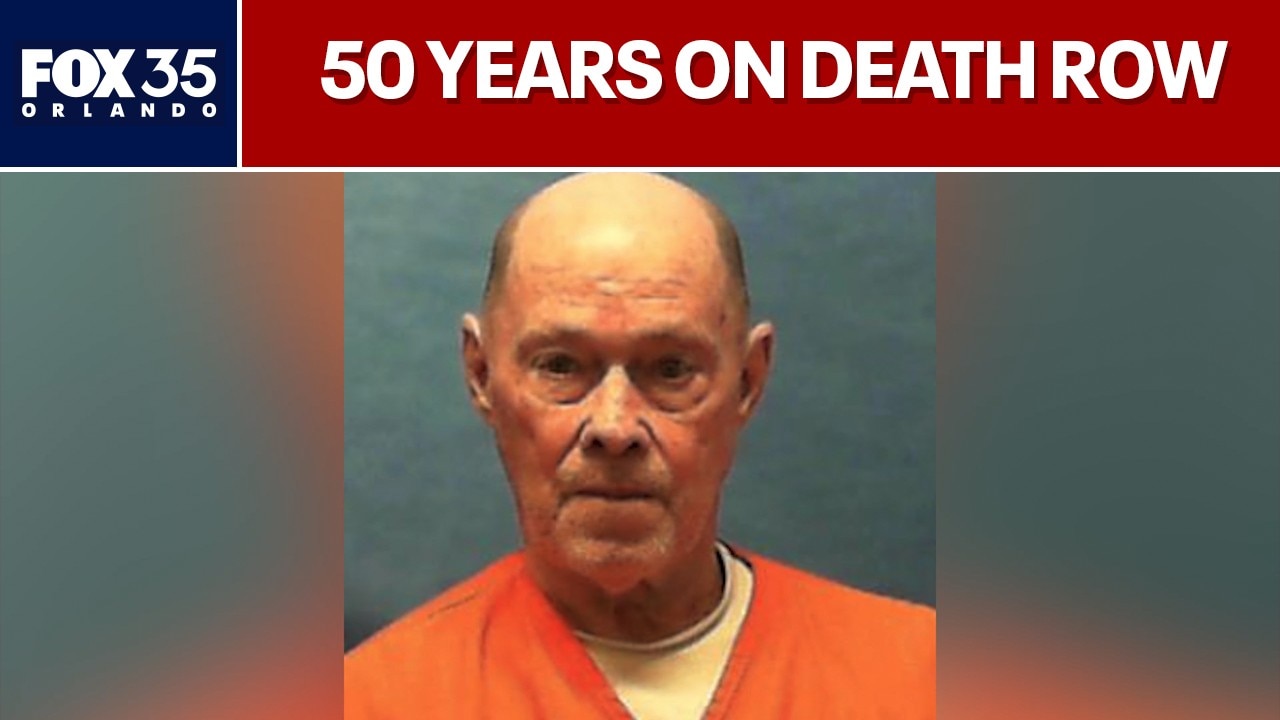
The final gurney was wheeled into the death chamber at the William C. Holman Correctional Facility just after 9:30 PM local time, but for Walter Leroy Moody Jr. , the journey to that sterile room in Atmore, Alabama, had been a fifty-year march of smoldering rage.
At 83 years old, he was not just the oldest inmate on Alabama’s death row; he was about to become the oldest person ever executed in the modern history of the United States. The man who once dreamed of arguing cases before a judge was now lying silently, waiting for the state to administer the very justice he had spent decades trying to destroy.
 The execution was scheduled for 6:00 PM on Thursday, April 19th, 2018, but legal maneuvering delayed the process. Moody, who had acted as his own attorney for years, had filed a flurry of last-minute appeals, including a final plea to the U. S.
Supreme Court arguing that his age and declining health made execution unconstitutional. The justices rejected the appeal without comment, clearing the way for the lethal injection of the convicted package bomber. As the clock ticked past the original time, witnesses were led into the chamber, where Moody lay strapped to the gurney, his expression reportedly flat and unreadable.
When the warden asked if he had any final words, the room fell into a profound silence. Moody, who had spent decades writing lengthy legal diatribes and obsessive letters detailing his grievances against the federal judiciary, simply shook his head. He offered no apology to the families of the men he killed, no admission of guilt, and no final statement of defiance.
His silence was described by witnesses as chilling, a final act of contempt for a system he believed had wronged him since a 1972 conviction for possessing a bomb that exploded in his own home.
The lethal injection protocol began shortly after the final appeal was denied. The first drug, a sedative, was administered to render him unconscious, followed by a paralytic agent and finally a chemical to stop his heart. At 9:47 PM, Walter Leroy Moody Jr.
was pronounced dead. He had requested a final meal of two Philly cheesesteak sandwiches and a Dr. Pepper, a mundane request for a man who had orchestrated one of the most terrifying domestic terror campaigns in American history.
The execution marked the end of a case that had haunted the judicial system for nearly three decades.
Moody’s path to this moment began not in a life of crime, but in a life of thwarted ambition. Born in Georgia in 1935, he was a man of considerable intellect, driven by a dream to become a lawyer. He studied law relentlessly, but his life unraveled in 1972 when a homemade bomb he constructed exploded in his home, injuring his then-wife.
He was convicted of possessing the explosive device, a felony that permanently barred him from ever taking the bar exam. For a man who prided himself on his intelligence, the conviction was a catastrophic blow that he refused to accept, viewing himself not as a criminal, but as a victim of a corrupt system.
Instead of moving on, Moody spent the next seventeen years nursing a grudge that festered into an obsession. He flooded courts with appeals, petitions, and letters, all demanding his conviction be overturned. Every rejection fueled his hatred further.
He began to study explosives with the same meticulous precision he had once applied to legal texts, documenting his experiments in detailed notebooks. He was not just building bombs; he was building a weapon of revenge aimed directly at the 11th Circuit Court of Appeals, the body he blamed for destroying his life.
The quiet suburbs of Birmingham, Alabama, were shattered on December 16th, 1989, when a package delivered to the home of Judge Robert S. Vance exploded. Judge Vance, a respected federal judge on the 11th Circuit, was killed instantly, and his wife was seriously injured.
 The bomb was hidden in a large manila envelope, a device of brutal efficiency packed with explosives designed to maximize lethality. Two days later, another bomb killed Robert E. Robinson, a civil rights attorney, at the NAACP office in Savannah, Georgia.
The nation was gripped by fear as a serial bomber targeted the legal establishment.
The packages were signed with the chilling pseudonym “The Invaders,” and each was addressed with the same mechanical precision. Investigators from the FBI, ATF, and U. S.
Marshals launched a massive manhunt, initially baffled by the lack of a clear motive. The break in the case came when forensic analysts compared the design of the bombs to a device used in a 1972 incident in Georgia. The signature of the explosive construction was too similar to ignore, and the trail immediately led to Walter Leroy Moody Jr.
, the man whose legal career had been destroyed by that exact case.
When federal agents raided Moody’s home in Rex, Georgia, in July 1990, they found a veritable arsenal of evidence. They discovered typewriters that matched the font on the package labels, manuals on explosive chemistry, and diagrams that perfectly matched the devices that killed Judge Vance and Attorney Robinson. They also found his extensive writings, filled with vitriolic hatred for the federal judiciary.
Moody was arrested without resistance, maintaining a calm and arrogant demeanor, insisting that he was the victim of a government conspiracy rather than the architect of a murder spree.
His trial revealed the depth of his bitterness. Prosecutors painted a picture of a man who had meticulously planned his revenge for years, using his intellect not to defend the law, but to wage war against it. The jury found him guilty of multiple federal charges, including murder and mailing explosive devices.
He was later tried in Alabama for the murder of Judge Vance and sentenced to death. Throughout the proceedings, Moody showed no remorse, often berating the court and acting as his own counsel in a futile attempt to prove his superiority over the system that had condemned him.
Moody was transferred to Holman Correctional Facility, where he would spend over twenty years on death row. He adapted to prison life with an unsettling ease, earning the nickname “the old lawyer” among other inmates for his willingness to dispense legal advice. Yet, he remained a cold and manipulative figure, refusing to acknowledge his crimes.
He continued to file endless appeals, using the legal system he hated as a tool to delay his own execution, a final irony that defined his existence behind bars.
 As his age advanced, Moody became the oldest death row inmate in the United States, a statistic that drew attention from death penalty opponents who argued that executing an octogenarian served no purpose. However, for the families of his victims, the passage of time did not diminish the horror of their loss. They waited through decades of appeals, watching as Moody used the courts to prolong his life, a privilege he had so violently denied to Judge Vance and Robert Robinson, who were killed in the prime of their lives.
The execution on April 19th, 2018, was not just a punishment for Moody; it was a reckoning with a dark chapter in American legal history. The date itself held symbolic weight, coinciding with the anniversary of the Oklahoma City bombing, another act of domestic terror that had shocked the nation. For law enforcement officials who had worked the case, the execution was a validation of a painstaking investigation that had successfully identified and neutralized a highly intelligent and patient killer who had vowed to bring down the justice system.
In the aftermath of the execution, the focus shifted to the legacy of the victims. Judge Robert S. Vance was remembered not only as a jurist but as a champion of civil rights, known for his fairness and integrity on the bench.
Robert E. Robinson was honored as a dedicated attorney who fought for equality in the segregated South. Their deaths were not in vain; they served as a stark reminder of the violence that can be unleashed when hatred is allowed to fester unchecked, and their memory galvanized efforts to protect judicial officials from similar attacks.
The case of Walter Leroy Moody Jr. stands as a chilling psychological study of how pride and resentment can corrupt an intelligent mind. He was a man who possessed the tools to succeed in the legal profession—sharp intellect, attention to detail, and a deep understanding of the law—but he lacked the moral compass to use them.
When his ambitions were crushed, he did not seek redemption; he sought destruction. His transformation from a hopeful law student to a domestic terrorist is a cautionary tale about the dangers of allowing a single failure to define one’s entire existence.
The execution protocol itself was not without controversy. Alabama had faced scrutiny over its lethal injection procedures in the past, with several botched executions leading to legal challenges. However, officials reported that Moody’s execution proceeded without visible complications.
The silence of his final words was noted by many as a final act of defiance, a refusal to engage with the humanity of the moment. He entered the death chamber as he had lived his final decades: isolated, bitter, and utterly convinced of his own righteousness.
For the state of Alabama, the execution closed a case file that had been open since 1989. For the nation, it served as a grim reminder of the reach of domestic terrorism. Moody’s bombs were not random acts of violence; they were targeted attacks on the very institutions that uphold democracy.
By killing a federal judge, he sought to intimidate the judiciary. By killing a civil rights attorney, he sought to intimidate those fighting for equality. In both instances, he failed.
The justice system he hated proved resilient, and the civil rights movement he targeted continued to advance.
 Walter Leroy Moody Jr. was pronounced dead at 9:47 PM, but the questions his life raises linger. Was he a product of a system that failed him, or was he simply a man with a pre-existing capacity for evil?
His 1972 conviction, while barring him from the legal profession, was not an unjust punishment for possessing an explosive device. His reaction to that punishment—murdering innocent people—was a choice, not an inevitability. He chose to let his grudge define him, and in doing so, he forfeited any claim to the sympathy he so desperately craved.
The final meal of two Philly cheesesteaks and a Dr. Pepper was a mundane end to a life marked by extreme violence. There was no grand final statement, no dramatic confession, only the quiet hum of the IV pumps and the final breath of an 83-year-old man.
As the witnesses filed out of the chamber, the families of Judge Vance and Robert Robinson were left with a sense of closure that was both profound and hollow. The man who had caused them so much pain was gone, but the void left by their loved ones remained.
The execution of Walter Leroy Moody Jr. will be studied for years to come as a landmark case in the history of the American death penalty. He was the oldest person to be executed since the reinstatement of the death penalty in 1976, a record that highlights the slow and often torturous pace of capital appeals.
His case also underscores the immense resources spent on housing and litigating the cases of elderly inmates, raising questions about the efficacy and morality of capital punishment for the aged.
Beyond the legal implications, Moody’s story is a profound exploration of the human capacity for self-deception. He genuinely believed he was the victim, despite the overwhelming evidence of his guilt. He saw his bombs as instruments of justice, not tools of murder.
This cognitive dissonance allowed him to live with himself for decades, filing appeals and writing letters, all while maintaining the illusion that he was fighting a righteous battle against a corrupt system. It is a terrifying reminder that the most dangerous criminals are often those who believe they are the heroes of their own stories.
As the prison doors closed on the night of April 19th, 2018, the saga of Walter Leroy Moody Jr. came to an end. But the echoes of his bombs continue to reverberate.
They serve as a warning about the fragility of public trust in institutions and the devastating consequences of unchecked anger. In the end, Moody did not destroy the justice system; he became a part of its history, a dark footnote that illustrates the system’s ultimate power to protect itself, even against its most determined enemies. His pride led him to the grave, but the law he hated had the final word.