The Netherlands had just been freed from Nazi occupation, and almost immediately it launched a colonial war of its own in Indonesia. On paper, the Dutch seemed to be winning. Cities fell. Leaders were arrested.
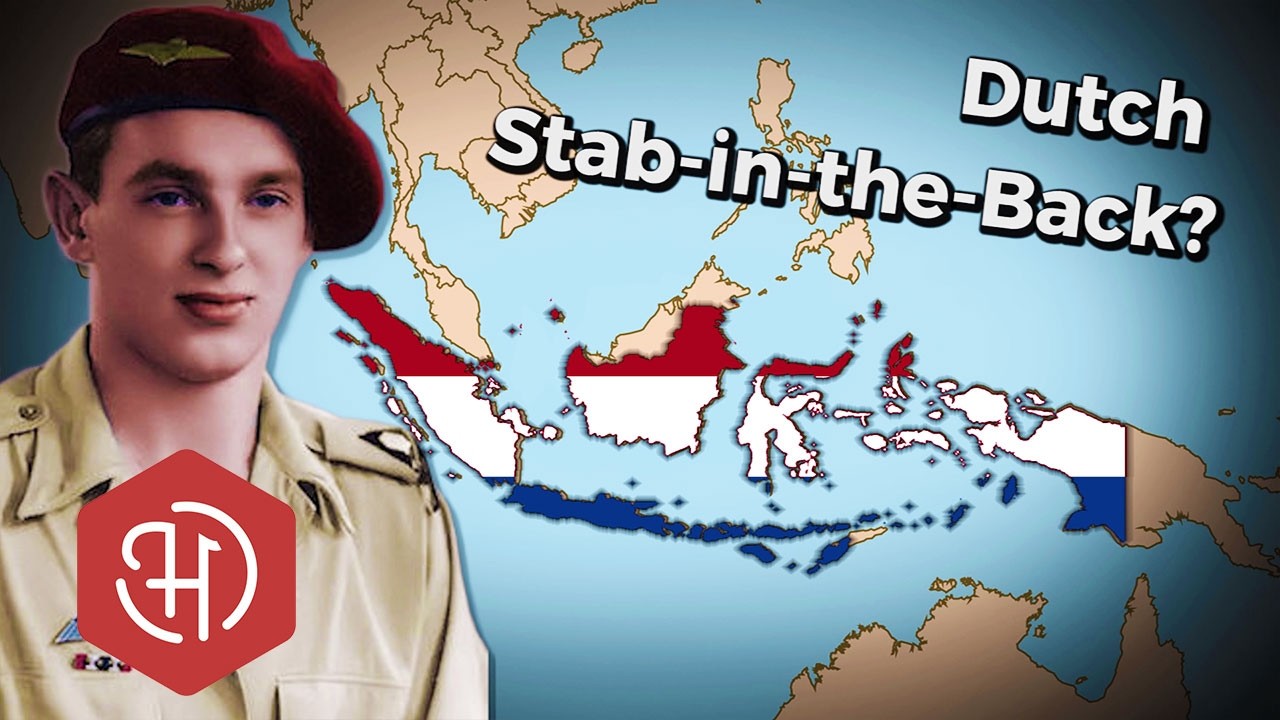
The republic appeared defeated. Yet the Netherlands lost anyway—not on the battlefield, but politically. After the defeat, a bitter story spread among the veterans. They told each other they had been betrayed by their own government.
Politicians, international pressure, weak policy—someone had thrown away their victory. But was that the real truth? Or was it a convenient myth, a way to hide something far harder to face? The year was 1948, and the conflict had already been raging for years.
It had effectively begun in August 1945, the moment Japan surrendered and Indonesian nationalist leaders declared their independence. In those first chaotic months, the Netherlands had almost no military presence in the region. The Dutch army was still being rebuilt after the occupation, and many colonial soldiers were dead or weakened from years in Japanese camps. British troops had temporarily stepped in to disarm the Japanese and evacuate Dutch civilians, but they were quickly dragged into the fighting themselves.
This period was marked by terrible violence—the Bersiap killings, the bloody Battle of Surabaya. A second phase followed, from November 1946 to August 1947, filled with rising tension and broken promises. The Linggadjati Agreement collapsed, and the Dutch launched their first major offensive, Operation Product. It brought large parts of Java and Sumatra under Dutch control, but it did not break the Indonesian resistance.
The fighters simply melted into the jungle and switched to guerrilla tactics. The third phase ran from August 1947 to December 1948. The Netherlands tried to hold what it had taken, but the Indonesian forces refused to give up. Globally, the republic’s position kept improving, and the Dutch came under mounting pressure.
Eventually, the government in The Hague felt it had no choice but to strike again, harder this time. Operation Crow began on December 19, 1948. Its target was the republic’s capital, Yogyakarta, and its goal was to capture the political leadership. General Spoor, the commander of Dutch forces in the Indies, pushed toward the city.
The Indonesian leaders allowed themselves to be taken prisoner. But the military leadership and the bulk of the TNI, the Indonesian fighting forces, escaped into the countryside. This time, the operation was less of a surprise. The Indonesians had learned how to resist.
And the world was watching. Under heavy pressure from the United Nations, the offensive was halted on January 5. On paper, the Netherlands now occupied all of Java and key parts of Sumatra. But the victory was hollow.
The operation cost 113 Dutch lives, while more than 3,000 Indonesians were killed on Java alone. Dutch troops then carried out large clearing operations, backed by artillery, the Special Forces Corps, and the air force. Yet outside the cities, Dutch authority was fragile and contested. Violence escalated.
Dutch casualties rose sharply, from 34 to 155 deaths per month, while Indonesian deaths, by Dutch figures, reached nearly 47,000. The Dutch simply did not have enough experienced soldiers. They were scattered across thousands of isolated outposts, always in danger along the notorious “death roads. ” The strategy of pacification was failing.
Still, General Spoor remained optimistic. Shortly before his death in April 1949, he insisted that the Dutch operations were succeeding, although he now admitted that full pacification would take 18 months instead of a few. The cabinet in The Hague was far less confident. International pressure was relentless, and negotiations with the republic resumed.
On May 7, the Roem-Van Roijen Agreement was signed, followed by a ceasefire. On June 22, the Dutch evacuated Jakarta. That single decision would later become the foundation of the stab-in-the-back legend. Spoor died a few weeks later, exhausted, from a heart attack.
Sukarno returned to Jakarta in early July. A final ceasefire was declared in August. And at the end of 1949, the Netherlands transferred sovereignty, ending its colonial rule in Indonesia—with the exception of Papua New Guinea. So the real question remains: could the Dutch have won?
Or was the war doomed from the very beginning? Even before the major offensives, some people had seen the truth clearly. In November 1945, the Lieutenant Governor-General of the Dutch East Indies, Hubertus van Mook, said he needed 75,000 men. A year later, he asked for 100,000.
But one Dutch officer, Wiebrandus Schilling, had warned far earlier that a military solution would be almost impossible. As a young officer, he had fought in the Aceh War. Now a major general, he explained that the Indonesian forces were far stronger than expected. What they lacked in experience, they made up for in morale.
For Java alone, he estimated, the Dutch would need 200,000 men, and the war could last ten years. He put a brutal question to his government. Could the Dutch population—just 8 million people, still recovering from the German occupation—endure the drain on human and material resources required for a war of reconquest on that scale? A war unlike anything in Dutch colonial history?
Before the Japanese occupation, Dutch colonial authority had been solid. The colonial state had an effective military machine: an air force, armored vehicles, a working communications network. Indonesia was not yet a unified nation. It was an archipelago of hundreds of ethnic groups, different cultures and religions, with infrastructure too poor to allow quick communication over long distances.
The idea of a single Indonesian identity was growing, but it was not deeply rooted. The colonial government had prospered by playing groups against each other, ruling through local elites. It was the Japanese who shattered all of that. They destroyed the Dutch colonial authority and mobilized the Indonesian population on a massive scale.
The Dutch literally disappeared from the streets, interned in camps. Meanwhile, hundreds of thousands of Indonesians were trained in discipline and weapons through organizations like PETA and Heiho. They were drilled with anti-imperialist propaganda, taught that colonial rule must end. The combination of militarization and brutalization was decisive.
One Indonesian veteran, 95 years old, remembered it clearly. When writer David Van Reybrouck asked him why he had taken up arms, the man shouted in Dutch: “Free of everything. ” Those words captured what the whole population felt. The genie was out of the bottle.
Before the war, troublemakers had been jailed or exiled. Now the Netherlands faced an entire people, hundreds of thousands of determined fighters who refused to live under Dutch rule again. What followed was asymmetrical warfare. On one side, the Netherlands had a conventional army with tanks, artillery, and aircraft.
Their strategy was to capture key cities and plantations, believing that controlling the power centers would bring a quick victory. On the other side stood the Indonesian Republic, which knew it could not win a direct fight. Instead, its fighters retreated into the mountains and jungles, where Dutch advantages meant nothing. They did not defend cities; they abandoned them.
Then they struck from the shadows, attacking convoys, destroying infrastructure, and disappearing before the Dutch could respond. They blended into the civilian population for intelligence and supplies. This created a terrifying situation for Dutch soldiers. They won nearly every battle but never gained control.
They were constantly on edge against an invisible enemy, and morale crumbled. Historian Remy Limpach pointed out a key failure. Leaders of the Dutch military kept underestimating the enemy, even after the brutal conquest of the archipelago and the difficult, never-decisive Aceh War. They continued to treat the Indonesian fighters as an inferior native opponent.
That contempt carried straight into 1945. But what about the mood after Operation Crow? The Dutch had captured the republic’s stronghold and arrested its leaders, including Sukarno. For the soldiers on the ground, it felt like the final blow.
They believed they had finally won. Then came the international backlash. The UN Security Council condemned the Netherlands. Under the threat of losing Marshall Aid, the Dutch government was forced to withdraw and release the Republican leaders.
For soldiers who had lost comrades taking Jakarta, this was incomprehensible. They had watched a defeated enemy be restored by politicians. But even without the international pressure, the TNI resistance had not actually been destroyed. Outside the cities, Dutch authority was fragile.
Violence and casualties only increased. Pacification had become a dead end—too few troops, a shrinking budget, an unsustainable strategy. The war was not winnable for the Netherlands. Perhaps, with a different approach, the Dutch could have conceded more to Indonesian demands for autonomy and tried to win hearts and minds.
But that simply did not fit colonial thinking of the 1920s and 1930s. By the time Japan surrendered, the situation had fundamentally changed. Pacification was an impossible task, in hindsight. Schilling had seen it, but he was ignored.
The result was hundreds of thousands of Indonesian deaths, thousands of Dutch casualties, enormous material damage, and a reputation for the Netherlands that never recovered. The unrest did not end in 1949. But that is another story.


