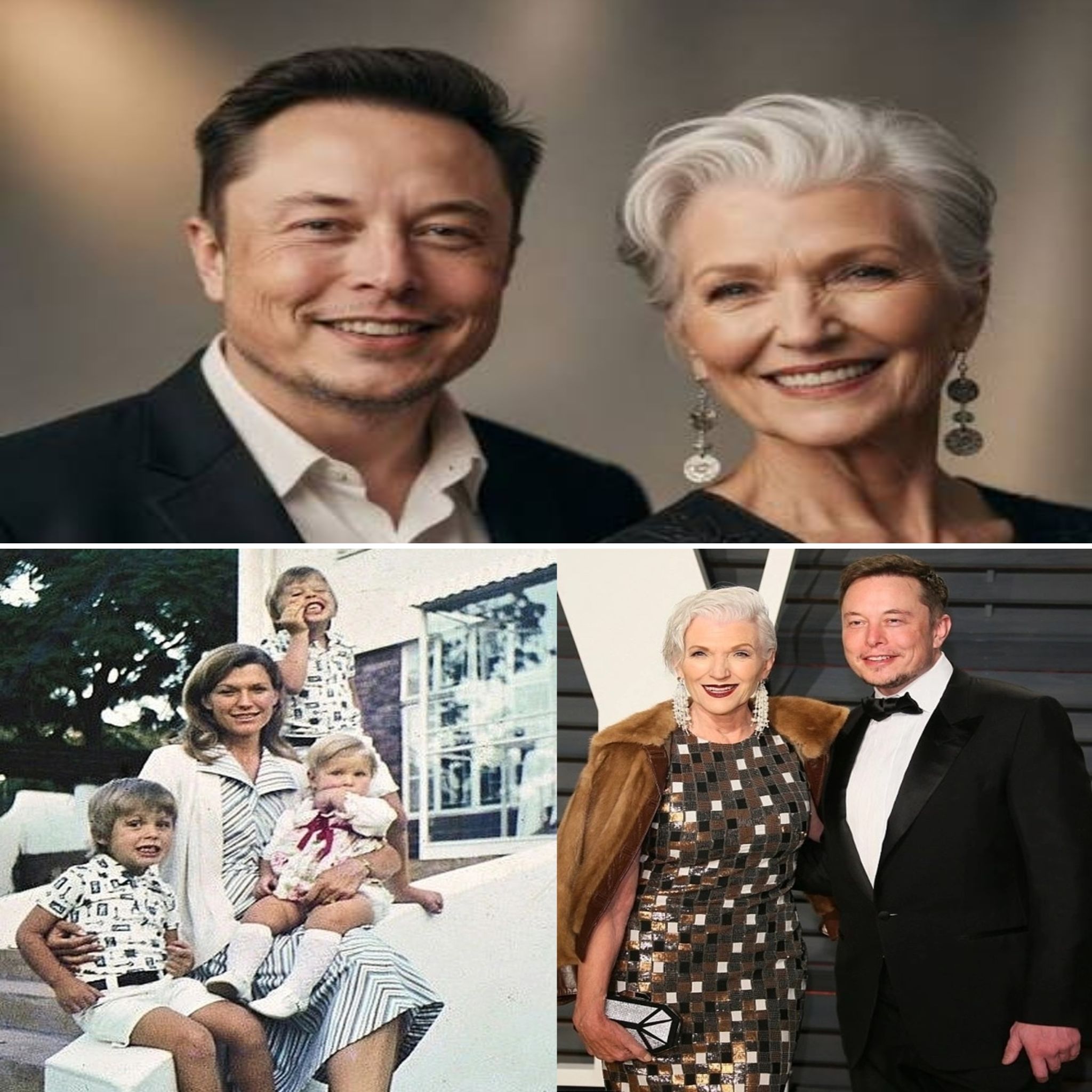
When Elon Musk was three years old, his mother began telling people something that made them look at her strangely.
“My son is a genius.”
The neighbors smiled politely.
Some were amused. Others probably thought Maye Musk was simply doing what proud mothers do—seeing something extraordinary in an ordinary child.
Years later, that same little boy would tell her that he wanted to build rockets.
This time, it was Maye who was stunned.
Not because she thought Elon was incapable of doing difficult things.
But rockets?
Most parents would have responded with a list of reasons it was impossible.
Too expensive.
Too risky.
Too unrealistic.
Too far beyond anything their child had done before.
Maye did something different.
She listened.
And eventually, she supported him.
That response may explain more about the Musk family than all the stories about intelligence, private schools, business instincts, or ambition combined.
Because Maye Musk did not raise one successful child.
She raised three children who went on to build careers of their own.
Elon became the entrepreneur behind companies including Tesla and SpaceX.
His brother, Kimbal, built businesses around restaurants, food, and sustainable agriculture.
Their sister, Tosca, became a filmmaker and founded a streaming platform.
People naturally want to know the secret.
Was there a special education system?
A genius curriculum?
A strict schedule?
Hours of supervised homework?
Some parenting technique copied from a book?
The answer is far less comfortable.
Maye’s children were not raised in a home where someone constantly removed every obstacle in front of them.
They were expected to become capable of dealing with obstacles themselves.
And that began long before anyone knew what the name “Musk” would eventually mean.
Maye’s adult life was far from effortless.
After her marriage ended, she had three children to support and a career to maintain. She worked as a dietitian and model, sometimes taking on multiple jobs and managing an exhausting schedule to keep the family going.
There was no army of assistants organizing the children’s lives.
No parent sitting beside them making sure every school form was completed.
No carefully engineered path designed to guarantee admission to the perfect university.
The children were expected to contribute.
They were expected to think.
And above all, they were expected to take responsibility for themselves.
That mattered especially for Elon.
As a child, he was different in ways that were impossible to hide.
He could disappear so deeply into his thoughts that people sometimes wondered whether he was listening at all.
He read constantly.
Books did not simply entertain him. He consumed them.
Science fiction.
Technology.
Philosophy.
Encyclopedias.
He absorbed information at a rate that confused the people around him.
But intelligence did not make childhood easy.
Elon has spoken publicly about being severely bullied at school. One attack left him badly injured after he was pushed down stairs and beaten.
Home was complicated too. Elon would later speak in extremely painful terms about his relationship with his father.
For a child who already felt different, the message from the outside world could easily have become:
There is something wrong with you.
Maye refused to reinforce that message.
She did not try to make him more ordinary simply because ordinary might have made his life easier.
She noticed what interested him.
Then she gave him room to follow it.
When personal computers were still strange, expensive machines to many families, Elon became fascinated with them.
Maye helped make access possible.
And then she stepped aside.
She did not sit next to him and force him through programming lessons.
She did not map out a future technology career.
Elon taught himself.
At around twelve years old, he created a simple space-themed computer game called Blastar and sold its code to a publication for about $500.
To most families, that might have been a cute childhood achievement.
For Elon, it became evidence of something more important:
An idea in his head could become something real.
Years passed.
The interests became bigger.
So did the risks.
In 1995, Elon arrived at Stanford University to pursue graduate studies.
Stanford represented the kind of opportunity parents dream about.
Prestige.
Security.
A respectable path.
A future almost anyone would have been proud of.
Then, after only a matter of days, Elon left.
The internet was exploding.
He believed something historic was happening, and he wanted to be part of it.
Imagine receiving that phone call as a mother.
Your son has made it into Stanford.
And now he wants to walk away.
Most parents would panic.
Some would threaten.
Others would remind him how hard he had worked to get there.
Maye did not force him back.
Elon and Kimbal instead began building Zip2, an internet software company that helped newspapers create online city guides.
There was nothing glamorous about the beginning.
They worked obsessively.
Money was tight.
The future was uncertain.
Maye herself was still working relentlessly.
And then came one of those moments that reveals what someone actually believes.
It is easy to say you believe in your children when belief costs nothing.
It is different when belief has a price tag.
Maye invested money of her own into her sons’ young company—money she could not casually afford to lose.
She was not investing because success was guaranteed.
It wasn’t.
She was investing because she believed they were serious enough to be allowed to try.
In 1999, Compaq acquired Zip2 in a deal valued at more than $300 million.
Suddenly, the strange decision to leave Stanford didn’t look quite as foolish.
But that was only the beginning.
Because Elon did not take the money, choose a peaceful life, and stop gambling with the future.
He kept going.
He moved into online finance.
Then automobiles.
Then rockets.
And the rockets were where almost everyone finally thought he had gone too far.
Starting an internet company was risky.
Trying to reinvent payments was ambitious.
Trying to challenge the automobile industry sounded almost absurd.
But launching rockets?
That belonged to governments.
National space agencies.
Defense contractors.
Organizations with decades of experience and enormous budgets.
Not a man who had made his fortune on the internet.
SpaceX’s first Falcon 1 launch failed in 2006.
The second failed in 2007.
The third failed in August 2008.
Three launches.
Three failures.
Millions of dollars disappearing in fire, machinery, and shattered expectations.
The jokes became louder.
Critics questioned whether Elon knew what he was doing.
SpaceX was running out of chances.
At the same time, Tesla was fighting for survival during one of the worst financial crises in modern history.
Money was disappearing.
Employees were under enormous pressure.
Elon was pouring much of his own fortune into keeping his companies alive.
From the outside, it looked less like ambition and more like self-destruction.
This was the moment many parents would have finally said:
Enough.
You proved yourself already.
You are risking everything.
Come home.
Stop before you lose the rest.
Maye was around sixty years old by then.
She had spent decades working.
She had already watched her son become wealthy.
She had also watched him put much of that wealth back on the table.
And she knew perfectly well that he could lose it.
But she did not demand that he become more cautious simply to make her less afraid.
That is where people often misunderstand Maye Musk’s parenting philosophy.
They think the lesson is:
“Always believe your child is a genius.”
It isn’t.
They think the lesson is:
“Give your children everything they need to succeed.”
That isn’t it either.
The real lesson is much harder.
Maye supported her children—but she refused to live their lives for them.
She allowed them to own their decisions.
And therefore, she also allowed them to own the consequences.
When they filled out applications, they were expected to handle the work.
When they had ideas, they were expected to pursue them.
When they entered business, nobody promised to protect them from failure.
Maye has spoken about watching parents become consumed with managing every detail of their children’s futures—universities, applications, achievements, opportunities.
Her approach was almost the opposite.
Teach them manners.
Teach them to work.
Give them responsibilities.
Make sure they are safe.
Then allow them to become responsible for the direction of their own lives.
That is the part most people miss.
Because independence looks beautiful after someone becomes successful.
While it is happening, it can look like bad parenting.
A child doing his own paperwork looks like a parent who isn’t helping enough.
A teenager figuring something out alone looks like a parent who isn’t involved enough.
A young adult abandoning a prestigious path looks like a family losing control.
A businessman risking his fortune on rockets looks insane—right up until the rocket reaches orbit.
On September 28, 2008, SpaceX tried again.
Falcon 1 lifted off for its fourth flight.
The previous three attempts had ended in failure.
This time, it kept going.
The rocket reached orbit.
SpaceX became the first privately funded company to send a liquid-fueled rocket into orbit.
For years, people had watched Elon Musk take risks and wondered when reality would finally teach him a lesson.
That evening, reality taught everyone else one instead.
The impossible thing worked.
The dismissive smiles disappeared.
The tone changed.
People who had questioned why anyone would waste money trying to build rockets were now asking what SpaceX might do next.
And imagine being Maye in that moment.
The woman who had once looked at her three-year-old son and told people she thought there was something unusual inside him.
The woman who had watched him get hurt.
Watched him become obsessed with computers.
Watched him walk away from Stanford.
Watched him build companies.
Watched him fail.
Watched him risk enormous sums on an idea that even intelligent people considered ridiculous.
She had been amazed by the rockets too.
But she never demanded that his dreams fit inside the boundaries of her imagination.
That may be the most important thing she gave him.
Not money.
Not connections.
Not a perfect childhood.
Permission.
Permission to be different.
Permission to attempt something embarrassing.
Permission to fail publicly.
Permission to make decisions other people would not understand.
And underneath all of that was something just as important:
Responsibility.
Her children could pursue unusual lives because they had been taught that those lives belonged to them.
There would be no mother following behind forever, correcting every mistake and arranging every outcome.
Support did not mean removing consequences.
Love did not mean control.
Belief did not mean doing the work for them.
That distinction is easy to lose today.
Parents naturally want to protect children from pain.
So they negotiate with teachers.
They complete projects.
They organize schedules.
They chase universities.
They solve conflicts.
They plan careers.
They remove discomfort before the child even has time to experience it.
The intention is love.
But sometimes, without realizing it, the message a child receives is:
“You cannot handle this without me.”
Maye sent a different message.
“You can handle your life.”
That doesn’t mean every child who receives independence will build rockets.
Nor should they.
Success is not measured by whether a child becomes a billionaire, an entrepreneur, or the founder of a famous company.
One child may build a business.
Another may become a teacher.
Another may choose art.
Another may build a quiet family life that nobody writes articles about.
The point is not to raise another Elon Musk.
The point is to avoid shrinking a child simply because their future does not resemble the one their parents imagined.
Maye Musk could not know, when Elon was three, where his strange intensity would lead.
She could not know, when he became obsessed with computers, whether it would matter.
She could not know, when he left Stanford, whether he had just made the worst decision of his life.
She could not know whether the fourth rocket would succeed after the first three failed.
That is what makes the story meaningful.
Supporting someone is easy when you already know the ending.
Parenting happens before you know the ending.
It happens when the strange child is still just strange.
When the business is still just an idea.
When the dream sounds ridiculous.
When the application isn’t finished.
When failure is possible.
When the neighbors are still smiling politely.
Maye’s gift to her children was not that she predicted every success.
It was that she did not require certainty before allowing them to become themselves.
Years earlier, she had looked at a little boy and seen potential where other people simply saw an unusual child.
Years later, the world finally saw what she had been protecting all along—not a guarantee of greatness, but the freedom to find out how far that potential could go.
And perhaps that is one of the hardest lessons of parenting:
Your job is not to build the road your children must walk.
It is to give them enough strength, responsibility, and courage to build a road you may never have imagined.
Because sometimes the child everyone is trying to make more “normal” is simply waiting for one person to say:
“I may not understand your dream yet—but I won’t be the person who teaches you to be afraid of it.”