In 1917, while Europe tore itself apart in the Great War, a small Southeast Asian kingdom made a bold move. Siam, today known as Thailand, declared war on Germany and Austria-Hungary and sent its own soldiers to fight on the Western Front. This is the story of how a nation that had never been colonized chose to join a global conflict to secure its place in the modern world. For the first three years of the war, Siam stayed neutral.
The kingdom watched the fighting from a distance, trying to protect its own interests while surrounded by colonial empires. To the west lay British-controlled Burma, to the east French Indochina. Siam’s independence depended on balancing these two powers, and it had already been forced to give up territory and accept unequal treaties that limited its control over trade and foreign citizens. At home, Siam was an absolute monarchy ruled by King Vajiravudh, also known as Rama VI.
He had been educated in Britain and admired Western culture, but he faced serious challenges. Most Siamese people lived in rural areas, and the economy relied on rice, sugar, tin, and rubber. The government had spent years modernizing the country, building railways, reforming the military, and hiring European advisers, all in an effort to prove that Siam was a civilized, modern state worthy of equal treatment. Germany played a special role in Siam’s modernization.
Unlike Britain and France, Germany had no colonies bordering Siam, so it was not seen as a threat. German businesses thrived in Bangkok, German ships dominated regional trade routes, and German engineers helped build Siam’s railways and communications. When the war broke out in 1914, Siam declared neutrality, a decision that seemed wise at the time. But neutrality became harder to maintain as the war dragged on.
Bangkok turned into a center of diplomatic rivalry, with Allied and German representatives trying to win over Siamese officials. The Siamese elite was divided. Some supported the Allies, while others, who had studied in Germany, admired German military traditions. King Vajiravudh leaned toward Britain but preferred caution.
As the war continued, global opinion turned against Germany. Reports of chemical weapons and attacks on civilian ships shocked the world. The Allies pressured neutral states to join their cause. By 1917, Siam’s leaders saw an opportunity.
The Allies seemed likely to win, so joining them late would involve little military risk but could bring great diplomatic rewards. Siam hoped to renegotiate the unequal treaties and gain recognition as an equal member of the international community. The war also served domestic purposes, uniting the population behind the king and portraying Siam as a proud, modern nation. The entry of the United States into the war in April 1917 further influenced Siam’s decision.
The Americans framed the conflict as a struggle for civilization and justice, and Siam wanted to align itself with those ideals. On July 22, 1917, Siam officially declared war on Germany and Austria-Hungary. The government acted quickly. German and Austro-Hungarian citizens were arrested and interned, German businesses were seized, and German ships in Siamese ports were confiscated.
The move immediately benefited British commercial interests, as German competitors disappeared from the Siamese economy overnight. Then came the bigger question: how actively should Siam participate? Many small countries contributed little beyond declarations of support. But Siam chose a more ambitious path.
It decided to send troops to Europe. This was extraordinary. Few Europeans expected soldiers from an independent Asian kingdom to appear on the Western Front. For Siam’s leaders, the expeditionary force would prove that the kingdom was modern, civilized, and capable of contributing to international affairs.
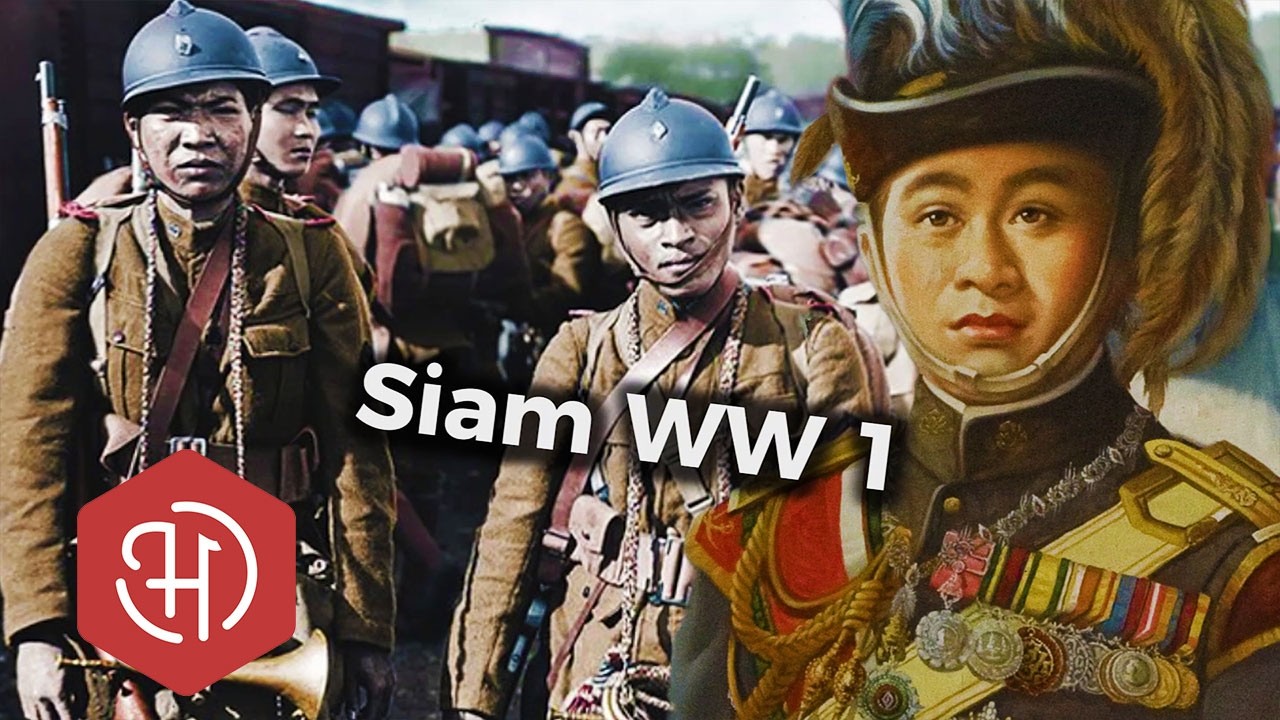
The idea partly came from French suggestions that Siam could provide volunteer ambulance units, drivers, pilots, and mechanics. In September 1917, the Siamese government called for volunteers. The stated goals were to support the Allied war effort, gain military experience, and uphold Siam’s national honor. The resulting Siamese Expeditionary Forces consisted of about 1,300 men.
Around 400 belonged to the Aviation Corps, including pilots and mechanics, while the rest formed a motor transport corps made up of drivers, mechanics, medical personnel, and support staff. Preparation took months. Troops received training and vaccinations while transport was organized. In January 1918, an advanced mission led by Major General Praya Bhya Yan Ridhi traveled to Europe to prepare for the main force.
He had studied military affairs in Europe and spoke fluent French, making him an ideal commander. On June 20, 1918, the main expeditionary force departed Bangkok aboard the SS Empire. The departure was a major national event. King Vajiravudh personally attended the send-off ceremony, and cheering crowds gathered along the Chao Phraya River to watch the soldiers leave.
After traveling through Singapore, Colombo, and Port Said, the Siamese troops arrived in Marseille on July 30, 1918. But their arrival did not go as hoped. French officials initially mistook the Siamese soldiers for colonial troops from French Indochina, deeply offending Siamese diplomats and officers who wanted their kingdom recognized as an independent ally, not a colony. The timing also worked against them.
By mid-1918, thousands of American troops were arriving in France every day, overshadowing the relatively small Siamese contingent. Once in France, the aviation corps was sent to training camps at Istres, Avord, and Pau. The transport corps trained near Lyon before moving closer to the front lines. In October 1918, the Motor Transport Corps began supplying Allied troops in the Champagne region using French military vehicles.
Although the Siamese troops performed their duties effectively, tensions soon developed between Siamese and French officers. Communication problems created difficulties, but the deeper issue was racial prejudice and condescending attitudes among some French officers. Siamese commanders increasingly felt ignored or treated as inferior. French liaison officers often bypassed Siamese commanders and directly ordered the troops themselves.
This deeply offended the Siamese leadership, who believed their soldiers deserved the same respect as European forces. Complaints reached Siamese diplomats in Paris and eventually the king himself. At one point, frustration became so severe that Siamese leaders considered withdrawing the expedition entirely. French diplomats quickly realized the danger this posed to Franco-Siamese relations and tried to improve the situation.
Fortunately for both sides, events soon changed dramatically. On November 11, 1918, the armistice ended the fighting on the Western Front. Following the armistice, Siamese troops were assigned to the Allied occupation of Germany. The Motor Transport Corps crossed into German territory and served mainly in the Palatinate region around Neustadt.
For King Vajiravudh, the moment carried enormous symbolic importance. He later described the entry of Siamese troops into Germany as one of the proudest moments of his life. Although Siamese forces had seen little direct combat, their presence inside defeated Germany allowed Siam to present itself as a victorious allied power. The Siamese troops remained in Germany until mid-1919.
During this period, they participated in the Allied victory parades held in Paris, London, and Brussels. These ceremonies were highly symbolic. For the first time, Siamese soldiers marched alongside the armies of the great European powers under the eyes of kings, presidents, and massive crowds. The image was powerful: an independent Asian nation standing among the victors of the First World War.
The expeditionary force suffered relatively few casualties. Nineteen members died during the mission, mostly from disease, especially the influenza pandemic, or from accidents, rather than enemy action. The aviation corps returned to Siam in May 1919, while the motor corps arrived later that year. Their return was celebrated with massive public ceremonies.
Bangkok held several days of parades, religious events, and official commemorations honoring the soldiers and the kingdom’s role in the war. Siam’s decision to join the First World War had long-lasting consequences. Militarily, its contribution was small, but politically, the impact was enormous.
By sending the Siamese Expeditionary Forces to Europe, the kingdom demonstrated that it was more than just another vulnerable Asian state caught between empires.