The Cold War had been burning for decades, and by the late 1970s, it was about to flare up again. On Christmas Day 1979, the Soviet Union rolled its tanks into Afghanistan, marking the start of a new and brutal chapter. The world watched as the USSR installed Babrak Karmal as president, and the West cried invasion. But the Americans had been quietly funding the anti-government rebels for over a year, and now the Mujahideen were ready to fight.
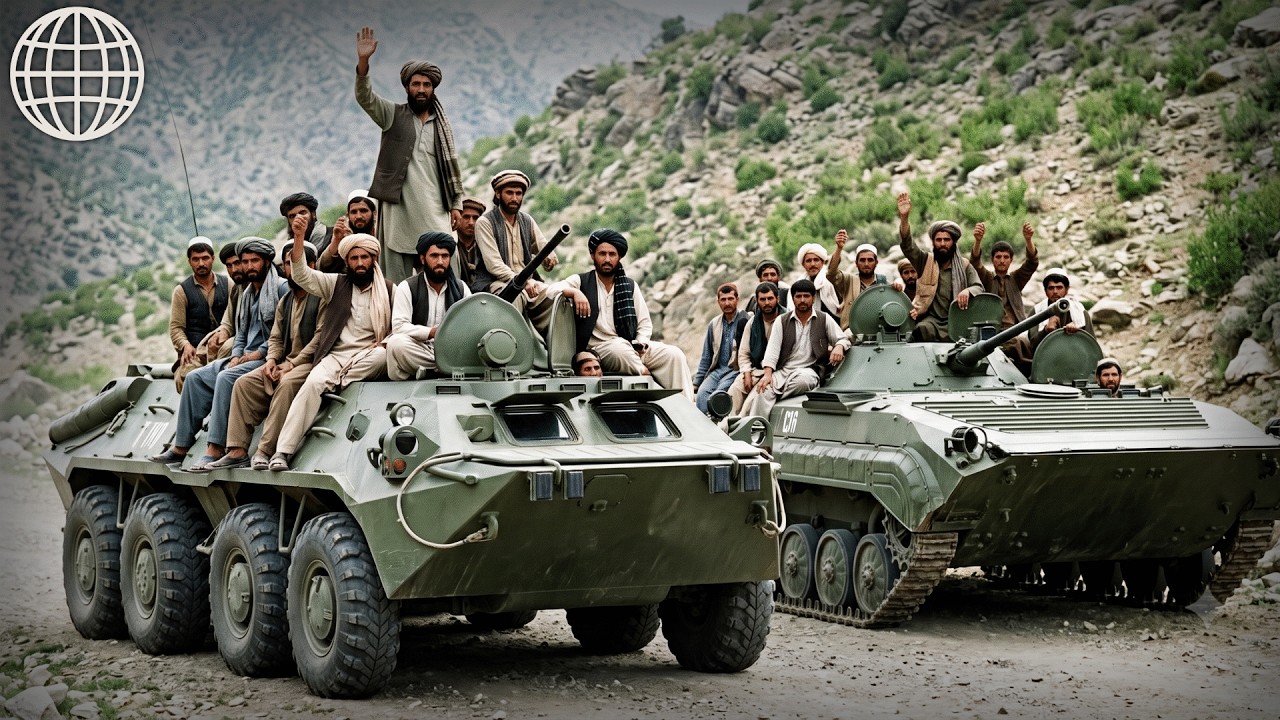
My dad supported the Mujahideen. He was never happy about the Russians coming to occupy our country. My uncles on both sides were fighting against them. We were always fearful that one day the government forces or the intelligence would find out and pick up my dad, and we would never see him again.
It happened to so many people. Overnight, they would come. Some ended up in jail. Quite a few disappeared.
They were killed. I remember around 4 a. m. , there would be the roaring of Russian tanks because our house was not far from the main road in the west of Kabul.
That was the supply route for the Russian soldiers. The war was everywhere. More than 80% of Afghan territory fell under Mujahideen control, but the Soviets kept coming. The Mujahideen were alarmed by the Soviet occupation of other Muslim nations.
They saw what happened in the Central Asian republics. They needed millions of dollars worth of arms to fight the Soviet Army. The US went public with its fight against the communist Afghan government. They figured they weren’t going to go in there and let it become a graveyard for their people.
So they funneled aid to the Mujahideen and made the Soviets pay the price for going into the wrong place at the wrong time. Money and arms poured in from both sides, and the war flared up. The Afghan resistance was so fierce that the country was closed to Western newsmen. The only way in was disguised as an Afghan freedom fighter.
Soviet MIG fighters and helicopter gunships blasted towns and hills. The rebels had no chance. In Asmar, 1,500 inhabitants were believed to have died. More and more villagers evacuated.
In the Northwest Frontier Province of Pakistan, 600,000 Afghan refugees formed the largest concentration of refugees in the world. Most of the men in the camps had been involved in fighting the Russians. They seemed undaunted by the massive Soviet presence. The war was sold inside those camps as a religious war: Islam is under attack, so you need to be mobilized to defend Islam from Russia.
The hospitals patched up the wounded rebels and sent them back to fight. One well-meaning relief organization sent a shipment of contraceptives. As one doctor said, “Not a lot of use. We need more Mujahideen, not less.
”
Rumors grew. The Russian news agency released alarming reports. According to TASS, anti-government rebels had destroyed 1,100 schools, almost a quarter of Afghanistan’s total. These bandits and saboteurs were said to have murdered teachers, beheaded students, and set fire to schools in a campaign of terror.
The war had become much more than a battle of Cold War ideologies. It was a religious war. By the end of 1980, it appeared that Afghanistan would not find peace for some time to come. When asked if the struggle would end if the Russians withdrew, one Mujahideen fighter said, “Till we are not able to establish a pure Islamic system in Afghanistan, we will continue our struggle.
” Chilling words, an omen of unintended consequences. As the conflict reached fever pitch, the world anxiously watched as both sides prepared for a different type of fight. In 1980, Moscow prepared to host the Summer Olympic Games. But before the games even began, the sporting arena became a political battleground.
The USA called for an international boycott, saying it would be a violation of Olympic principles to attend games in a nation engaged in an aggressive war. Robust opposition erupted. The International Olympic Committee insisted that political problems were not the responsibility of sporting bodies. Soviet leader Leonid Brezhnev accused the United States of going into hysterics over Afghanistan.
He implored all those with different opinions not to use the Olympic Games to divide the world, but to unite it. For the boycott to work, the US needed more support. They called on the help of the biggest athlete of all. Muhammad Ali was persuaded to visit a string of African nations.
“I was made to believe Russia is invading a Muslim country which could lead to nuclear war,” he said. Kenya pulled out, and the US considered it a big victory. A total of 50 countries agreed to keep their athletes away from Moscow. Meanwhile, Afghan athletes agonized over whether to participate.
The war victims seemed half forgotten. The flame began its long journey, but could this be the last time? The Cold War had begun almost as soon as World War II ended. In 1979, after a few years of relative calm, it burned hot again over Afghanistan.
The entire planet was on high alert for nuclear war. The Warsaw Pact had arrayed a formidable armory against NATO. NATO estimated the Warsaw Pact had almost three times as many battle tanks as the West. NATO countries could not match the conventional military strength of the Eastern Bloc.
So they came up with a nuclear solution. European defense ministers arrived at a NATO planning meeting in The Hague. At stake was one of the most crucial decisions in the alliance’s history. The Americans wanted their European allies to share the nuclear burden and place medium-range nuclear missiles on European soil for the first time.
The missiles selected were called cruise missiles. Nuclear-armed, they had a range of over 2,000 kilometers. Europe exploded in outrage. There had been no large protests like this for years.
People protested against American missiles planned for the UK, fearing Britain would become a major Soviet target. The cruise missiles were secretly flown to mainland Europe and Britain. The British-based missiles were installed at RAF Greenham Common, a massive Air Force base in rural southern England. The silos were coated with meters of concrete, surrounded by razor tape and armed American military police who were briefed very clearly: “If anybody crosses that line, you shoot them dead.
On British territory. ”
Peace protesters planned to bring 30,000 people to Greenham Common to demonstrate against the missiles and knock the fence down. The government was very embarrassed. They had to stop these women from intruding onto the base.
The perimeter was 14 kilometers long, much of it through woodland, so it was very difficult to see people creeping up to the fence. One officer made a plan of action to defend the site, spending all day in a helicopter. On the day, the protesters destroyed some of the fence but didn’t get in. Remarkably, no guns were fired.
Peace protesters would remain camped on the perimeter for a further 19 years. The Cold War was in full force once again. Many believed nuclear war was almost inevitable. One big question hung in the air: Is it possible to survive such a war?
Early warning radar stations had long been the key to Britain’s home defense. These men could warn of attacks, bomb blasts, and fallout. That information would trigger population alerts through sirens and nationwide media. If a nuclear attack occurred, everything above the ground would be lethally radioactive.
Every nation within reach of Soviet and American missiles had to have a survival plan. In one village, there were regular home defense meetings at the local pub, organized by a retired army officer. Surrounded by swords and history books, he quietly assessed the horrors of nuclear war, fallout radiation, and refugees. As tensions rose, civil defense became a major priority.
Across the Atlantic, the USA had been running war drills since the 1950s. New York tested its civil defense with mock attacks. Children in elementary school prepared for the atom bomb by sitting in the hall and putting their hands over their heads and bending down, as if that would do anything. North America led the way in an essential addition to homes for the nuclear age: fallout shelters.
Do-it-yourself models were open for public inspection, with blueprints for survival in this age of atomic peril. In Vancouver, Canada, a gentleman who preferred to remain anonymous was determined to protect himself against atomic warfare. His bomb-proof shelter had a Geiger counter for checking radioactivity, a door heavily insulated with lead, and an oxygen tank. He was well equipped to see it through.
Switzerland had one of the most advanced public defense plans. Every building less than 15 years old had its own fallout shelter. The government paid half, the house owner paid the rest. They were fully equipped, with air filters, protective doors, and proper sanitation.
For housing developments, the program included communal shelters maintained in spotless condition for any emergency. By the early 1980s, while fallout shelters were calming some nerves around the globe, in Afghanistan, shelter remained a scarce commodity on the new front line of the Cold War. In 1981, three decades into the Cold War, the victims of the Soviet-Afghan War gathered in even greater numbers on the Pakistani border. This was now said to be the largest concentration of refugees in the world, possibly numbering as many as 2 million, or one-seventh of Afghanistan’s entire population.
The war in this mountainous country had been raging for two years. Despite US government support, the anti-government rebellion was not making headway. They found themselves in the front line of the renewed Cold War, to which the Soviet intervention contributed in no small part. Reports from inside Afghanistan revealed what had driven these people from their homes.
As we entered the town of Paghman, 7,000 feet up in the mountains, we heard but could not see shelling. Paghman was a ruined shadow of its once glorious past. Before the Soviet intervention, it was a town of tree-lined streets and villas built by King Amanullah in the ’20s and ’30s. Now the town was ringed by 70 Afghan army posts commanding the surrounding hilltops.
Many injured civilians were sent to a hospital in Kabul. There, victims of a war too young to understand. These children were injured in a rebel rocket attack. According to doctors, the missiles rarely hit their intended targets, government military installations, landing instead in heavily populated civilian areas.
One child, Max, about seven or eight years old, was wounded by a booby trap. There were quite a few neighbors of ours lost due to these rockets. One rocket hit not far from my house, maybe three houses away. I lost a dear friend.
Despite the devastation, some chose not to flee. Hidden in the ruins, some people tried to live a normal life. Inside the town hall, there was some kind of administrative structure working, run by the mayor, 31-year-old Mohammad Akbar, who seemed to be the driving force keeping life in Paghman going. Unannounced, we traveled seven miles to a village apparently deserted and damaged.
Within minutes, a gaggle of children and elders gathered round as if from nowhere. In one dark building, we found a mullah teaching a class of children. Sometimes the street where my grandfather used to live would be really, really bad. There was active war between Mujahideen and government forces.
For a moment, people would hide, but after the fight was over, life would be normal. They would just go on about their life. And now came a new threat: malnutrition. There were up to 2 million people in Kabul, and even daily Soviet airlifts of food couldn’t keep up with demand.
It was extremely difficult, very cold. I’m talking about winter days. I remember craving for bread. The markets were empty.
Not many food items were available. There were incidents where street dogs were too hungry and attacked kids. In the conflict between East and West, there was a large group of Afghan people no one was talking about. Western governments talked of the need to liberate Afghanistan.
But for the country’s women, it could mean the opposite. During Russian time, women in the cities relatively enjoyed freedom. They could go to school, wear whatever they wanted, and enjoy their basic rights. Communism became linked with women’s emancipation.
Under President Najibullah, women enjoyed Western-style freedoms and a certain measure of independence. In the capital, they were able to enter higher education or seek jobs in the civil service or industry. My sisters had no issues going out in the street with Western clothes. But in the other cities and rural areas, it was a very different story.
Not many schools were functioning. Women could only go out if they had burqa or proper hijab. In places where rebels had control, female students came under threat. There were reports that some female students at the university had been attacked by the Mujahideen.
The Mujahideen didn’t like education for girls and women. They attacked the university. They threw acid in the face of the woman. Some decided to fight back.
Women were drawn together by the threat posed by the forces of Islamic fundamentalism. “We join with the militia because we defend women’s rights. We will fight against counter-revolution in our country. ” Although they weren’t fighting in the front line, many had received full military training and were ready to defend to death their newly-won rights.
Fatima joined up five years ago. Her aim was twofold, she said: the fundamentalist government and women’s rights. If the fundamentalists came to power, the future for some women was likely to be a step backward. There were some very strong women who had well understood the virtues of a more secular environment and were deeply unhappy about the support of Islamic extremists by the great powers playing games against each other.
They were certainly a fantastically important group, half the population within the country, that were the real victims of that succession of unhappy interventions. With no end in sight, Afghanistan had become the Soviet Union’s own version of Vietnam. As many began to question if this was a war they could win, the situation went from bad to worse. September 1st, 1983.
Korean Air Flight 007 from New York to Seoul went missing over the Sea of Japan with 269 people on board. At 3:30 a. m. Seoul time, the Korean airliner disappeared.
It had been shot down. Wreckage began to appear along the Japanese coast. After a week, the Soviet Union admitted responsibility. On the night of the disaster, it was dark with gale force winds.
The flight strayed off course and entered Soviet airspace over the Kamchatka Peninsula. The Russians believed the jumbo jet was a US spy plane. Four jet fighters were scrambled from the Sokol Air Force base. In the tapes, it was clear that they were reporting the aircraft destroyed.
You don’t arm and fire a heat-seeking missile as a warning shot. Once that missile is released, it seeks out and hits its target. Two missiles were on target. One exploded just behind the tail of the plane.
The other by the left wing. The cabin of the 747 decompressed. Oxygen masks were deployed. It took 12 minutes for Korean Airlines Flight 007 to crash.
Despite fury in Korea, the Russians claimed the strike was legitimate. But there were tapes of actual radio transmissions by the Russian pilots. It was clear beyond any doubt that the Soviet Union did in fact shoot down this unarmed commercial airliner. The USSR held a press conference.
One of the pilots stated the airliner ignored tracer warning shots. But there was no conversation about warning shots or tracer bullets. What really happened was kept hidden. The USSR found the cockpit voice recorder but did not tell anyone for nine years.
Cold War relations were at an all-time low. If they were willing to shoot down an unarmed commercial plane, they were certainly willing to shoot down an unarmed city. And as if tensions weren’t already high enough after more than 35 years of war fought across the globe, the Cold War entered a new and ever deadly era: the era of the spy. 1985 was known as the year of the spy.
There were five or six significant espionage cases in that single year that the FBI made arrests and got convictions. One of the biggest spy scandals of the ’80s would be handed to FBI special agent Joe Wolfinger. He began as an FBI agent in 1969, when the Cold War was in full bloom. He worked criminal cases for a few years, but then began to work counterintelligence.
John Walker worked in the codes department of the US Navy. His marriage breakdown was about to get him into serious trouble. When his former wife, from whom he was divorced, got drunk one day and called the FBI to report that her former husband had been a spy for 20 years. She said she believed he made a million dollars from espionage over 20 years.
The FBI investigated. They had the National Security Agency send a guy down, and he came out of this little room they had him in, ashen. He said, “If this guy was a spy, the loss is unbelievable. ” Walker was in charge of codes on Navy ships and communicating with Navy ships.
A code protects a message from being understood by the other side. As the agents dug deeper, they discovered Walker may have revealed the plans and positions of troops during the Vietnam War. Wolfinger had no doubt that there were widows in Virginia Beach and Norfolk whose husbands were killed because John Walker compromised naval communications. The challenge was to prove Walker was a spy.
Wolfinger and his team watched Walker day and night. They followed him on May 19th, 1985 from his house. But when he got to Richmond, he turned north, and they knew something was going to happen. The FBI agents believed Walker was on his way to make a drop.
A drop is where a spy would make an exchange, go to a specific place, and put a package down that contained classified information, then go someplace else and pick up a package that would contain money. As the day unfolded, Walker placed a bag under a tree. Around 9:00, Bruce Bray, an FBI agent assigned to Washington, came running out of the woods with a bag under his arms. He shouted into the radio, “I’ve got it.
I’ve got it. I can see it. It’s got secret stuff in it. ” The agents had their evidence.
They tracked Walker to a motel. They knew Walker was armed, but when he was confronted the night he was arrested, he had a gun in his hand. For a moment, they were face to face. Then Walker dropped the gun and was arrested.
Interrogation revealed Walker had been spying for the USSR since 1968. But he was not a communist. His motivation was financial. It was money.
Despite the huge victory, the USA believed John Walker was just the tip of the iceberg. There was no way to know how many John Walkers were out there. The decade of the most intense spying activity in the Cold War ended badly for John Walker. The government wanted Walker to talk.
He ended up with a life sentence and never got out. It is said that the darkest hour comes just before the dawn. There were signs that the great and deadly game of the Cold War might have an end date.
But for a while longer, the world must stand on the brink.


