The funeral home smelled of formaldehyde and dying orchids, and the second I stepped through the heavy glass doors, I felt the weight of twenty years pressing down on my shoulders. I had come back to Ohio for my mother’s funeral, and every single relative in the room knew exactly who I was, the pregnant sixteen-year-old who had been thrown out into the freezing rain like a piece of trash. I had barely taken three steps past the entrance when I saw him. Richard.
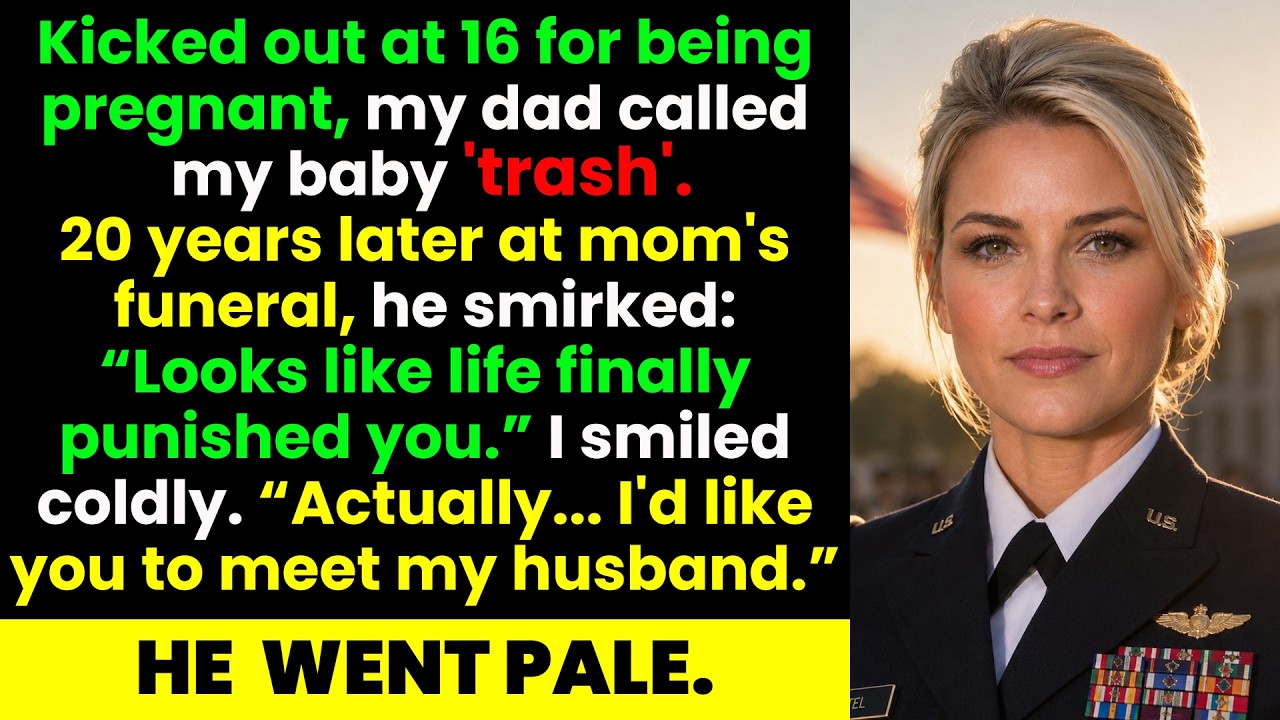
My biological father. He stood near the casket, arms crossed over his chest, surrounded by the same blue-collar neighbors he’d drank beer with every Sunday for as long as I could remember. Twenty years had thinned his gray hair and slumped his shoulders, but that cruel, rigid jawline was exactly the same. He looked up, caught my eye across the room, and held my gaze for a long, cold moment.
No recognition. No warmth. Just that familiar smug smirk curling at the corners of his mouth. Then he deliberately turned his back to me and reached out to shake a neighbor’s hand, a calculated dismissal meant to humiliate me in front of everyone.
I did not flinch. I kept my spine straight and walked directly to the casket. Helen looked small lying there, her pale hands folded over her chest. The funeral makeup had done its best, but she still looked exhausted, like she had spent her entire life holding her breath.
I leaned in close to the cold satin interior and whispered, “I hope you knew. Every crumpled twenty-dollar bill you sent became the ammunition I needed to survive. ”
A hand landed on my shoulder. Aunt Denise.
She gestured toward a narrow hallway with a sharp jerk of her chin. “Come here. There’s something your mother wanted you to have. ”
I followed her into a cramped back office that smelled of old paper and dust.
Three heavy cardboard boxes sat stacked in the corner, and Denise pointed at them with a sour, annoyed look on her face. “She made me promise to hand these directly to you. Don’t make a mess. ” Then she turned and walked out, leaving me alone.
I crouched down and pulled the brown packing tape off the top box. I had expected old sweaters, maybe faded photo albums. I was wrong. Inside was a carefully organized intelligence cache: hundreds of local newspaper clippings, printouts of military promotions from public army databases, a grainy blown-up photo of me pinning on my silver eagle rank.
Helen had never been cut off from my life. While Richard spent two decades trying to erase my existence, my mother had built a covert surveillance network and tracked every single move I made, every rank, every deployment, every victory, hiding it all in these boxes right under his nose. Resting on top of a stack of commendation papers was a sealed white envelope with my name written in her shaky, slanted handwriting. I tore it open and pulled out a single sheet of lined notebook paper.
It was not a tearful goodbye. It was a razor-sharp psychological profile of the enemy. “Elena,” the letter began. “Pride is a terrible thing to abandon, especially for a man who believes being right is more important than being loved.
Richard thinks he’s been punishing you all these years. The truth is he just chopped off his own limbs and wonders why he’s bleeding. He’s terrified of you because you survived without him. ”
The final line was not a mother’s dying wish.
It was a direct tactical order from my underground ally. “When the truth comes out today, use grace to break his anger. ”
I folded the paper into a tight, perfect square and slid it into the inner pocket of my suit jacket, right over my heart. When I walked back into the main hall, the murmuring crowd had gone completely silent.
The space around the casket was empty. Richard had detached himself from his circle of friends, his hands shoved deep into his pockets, his jaw clenched so hard the muscle twitched under his skin. He was walking straight toward me. He stopped exactly eighteen inches in front of me, a deliberate invasion of my personal space.
The low buzzing of the crowd died instantly. Pin-drop silence. He crossed his thick arms over his chest, slowly dragged his eyes up and down my plain black suit, and let his mouth pull back into that sick, satisfied smirk. “Looks like life finally caught up with you.
” His voice carried loud enough for the first three rows of folding chairs to hear perfectly. I did not take a single step back. I locked my knees and kept my breathing regulated, one steady breath after another, resting heart rate. My silence acted like gasoline on his temper.
“You brought this on yourself,” he fired. “You dragged this family through the mud when you were sixteen. You smashed your own future to pieces with your bare hands. ” He glanced over his shoulder, scanning the room, gathering approving nods from his old drinking buddies.
Then he turned back to me, emboldened. “And look at you now. Standing here completely alone. You have absolutely nothing to your name.
My wife enabled you for far too long, and this is how you repay her, by showing up here looking like a nobody and embarrassing me all over again. ”
His narrow, arrogant mind had seen the plain suit, no flashy jewelry, no man holding my hand, and calculated the sum. He was right. I was a failure.
The trash he threw out into the freezing rain had remained trash. “You don’t know anything about me,” I said. My voice was flat, low, sharp as a surgical scalpel. Richard scoffed, a burst of stale air and cheap mints hitting my face.
He took another half step forward, crowding me. “I know exactly what you are. Where’s your husband? Huh?
Who the hell would ever want to keep a piece of garbage like you? ”
For a fraction of a second, a sharp spike of pain pierced my chest. I had bled in the desert sand. I had earned the salutes of thousands of combat-hardened soldiers.
I carried the weight of national security on my shoulders. Yet the man who shared my DNA was standing over my mother’s casket, practically begging to drink my blood. He was using the death of the woman who birthed me to prove a point to his neighbors. But then I felt the weight of the folded notebook paper in my jacket pocket.
Helen’s final intelligence report. He is terrified of you because you survived without him. Richard was not attacking me. He was violently defending his own massive insecurities.
If I was successful, it meant his cruelty was completely unjustified. He needed me to be a broken victim so he could sleep at night. “You still think you’re something special, don’t you? ” he snarled.
A tiny fleck of spit flew from his lip and landed on my lapel. “You have nothing. ”
I did not raise my voice. I did not clench my fists.
I remembered the order from my underground ally. Use grace to break his anger. Instead of reacting to his rage, I smiled, a quiet, freezing smile that held absolutely no warmth. “No, Dad,” I answered, dropping the word like a heavy stone.
“Actually, I’m just waiting here to introduce you to someone. ” I paused, letting the silence stretch tightly between us. “My husband. ”
The exact second the final syllable left my lips, the air outside the building shifted.
A massive heavy-duty diesel engine roared to life in the gravel parking lot. The deep guttural vibration rattled the thin window panes. Blinding white LED headlights slashed through the frosted glass of the double front doors, casting sharp elongated shadows of several men across the carpet, pointing straight at Richard’s boots. The heavy glass doors were violently shoved apart, hitting the rubber wall stops with a sharp, echoing crack.
A gust of freezing Ohio wind ripped into the suffocating room. Six men strode through the doorway, not in the cheap, ill-fitting dark suits worn by the rest of the men in this town, but in immaculate, pressed United States Army class A dress uniforms. The sharp rhythmic clack of their hard leather dress shoes striking the floor sent a visible shiver through the crowd. Leading the formation was a man with a broad chest, rigid spine, and eyes like a hawk.
Pinned to his shoulders were three silver stars catching the sickly yellow light of the parlor. Lieutenant General David Walker. My husband. The crowd physically parted, shrinking back into their folding chairs like a school of fish dodging a shark.
No one dared to breathe loudly. The arrogant smirk plastered across Richard’s face just seconds ago completely melted. David ignored the room, swept his gaze past the gaping mouths of my aunts and uncles, found me standing near the casket, and closed the distance. He pulled me into his solid chest.
“I’m sorry I’m late,” he said, his voice low but carrying to the back walls in the dead silence. “Traffic off the base was backed up. ”
He let me go and turned his head slowly to look at the man standing eighteen inches away. I took a half step back and read the sentence like a judge reading a final verdict.
“Dad, this is my husband, General David Walker. ”
Richard’s face drained of all color, turning the gray ashen hue of wet cement. His jaw went slack, dropping open in an ugly, terrified gape. David extended his large, calloused right hand, a perfectly professional, icy gesture.
“Hello, Richard. ”
The silence stretched. One second. Three.
Five. The blue-collar conservative men in this room practically worshiped military authority. It was their ultimate measure of a man. And right now, a three-star general was demanding respect from a retired factory worker who had just been caught verbally abusing his wife.
It took ten agonizing seconds for Richard to move. He wiped his thick, sweaty palm against his slacks, his hand visibly trembling as he reached out. The handshake was weak, defeated. But that was not the kill shot.
A younger officer, a captain wearing a Ranger tab on his shoulder, stepped out of the formation. He walked directly toward me, completely ignoring Richard. He stopped, squared his broad shoulders, and snapped a razor-sharp salute. The loud smack of his leather heels cracking together broke through the silent room like a rifle shot.
“Colonel,” his voice boomed with absolute respect. “We are deeply sorry for your loss, ma’am. ”
He dropped his hand. The officer behind him stepped up.
Smack. Another salute. “Colonel Patel. My condolences.
” Then the next. And the next. Five highly trained combat officers stepped forward, saluted, and loudly repeated that exact title. Colonel Patel.
Colonel Patel. Each sharp syllable swung like a sledgehammer into Richard’s eardrums. He flinched with every single salute, his eyes wide, bulging, filling with bloodshot lines. This moment was not about my husband’s rank.
It was not about hiding behind a powerful man. It was about me, the pregnant sixteen-year-old garbage he threw onto the porch. I was standing in front of him as a full-bird colonel in the United States Army. I did not ride David’s coattails.
I commanded these officers with my own blood, sweat, and tactical expertise. They answered to me. Everything Richard had stubbornly believed for two decades was annihilated in less than sixty seconds. He had spent twenty years guarding a hollow fake narrative.
While he drank cheap beer and cursed my name, I had crawled through the dirt, picked up the broken pieces of my life, and forged them into a fortress of steel. Richard stumbled backward, his heavy boots dragging across the carpet. His hip collided hard with the edge of the wooden guest book stand. His knees buckled, and he dropped like a sack of concrete into a cheap red velvet folding chair.
The metal frame groaned under his weight. The arrogant, puffed-up Ohio factory worker was gone. What was left in that chair was just an old, shriveled man, a deflated balloon. The parlor was dead silent.
The aunts and uncles who had been buzzing like angry wasps moments ago were now intensely studying the toes of their shoes. Aunt Denise kept her hands clamped over her mouth, refusing to look in my direction. Nobody moved. Nobody dared to utter a single syllable to defend him.
Richard looked up, his lips parted, his chest heaving. When he finally spoke, his voice was cracked, thin, pathetic. “You… you never told anybody.
”
It was a desperate, scrambling attempt to salvage a single shred of dignity. Blame the victim. Play the fool. If I had just told him I was an officer, he would have acted differently.
That was the lie he was trying to spin. I looked down at the thinning gray hair on his head and felt absolutely nothing. “Tell who? Aunt Denise, so she could spread the gossip around the local hair salon?
Tell the guys at the hardware store in this dying rust-belt town that I’d spent the last two decades surviving in the dirt, carrying forty-pound rucksacks and bleeding in the desert? I don’t owe this town a damn thing. ”
I squared my shoulders and looked down at him, my voice stripped completely of emotion. “A commanding officer has no obligation to submit an after-action report to a deserter.
”
That sentence severed the last invisible thread between us. It stripped him of his title. He was no longer my father. He was just a man who walked off the battlefield twenty years ago when the fight got hard.
I reached into the inside pocket of my jacket, pulled out the white envelope Helen had left behind, and dropped it directly onto his lap. Richard stared at it like it was a live grenade. His thick fingers were violently shaking as he picked it up, fumbled with the flap, and pulled out the lined notebook sheet. I watched his eyes dart back and forth across the slanted handwriting of the wife he had silenced and bullied for decades.
He snagged on the middle paragraph. He thinks he has been punishing you. The truth is he just chopped off his own limbs. And then the final psychological kill shot from the grave.
Every birthday he missed was his loss, not yours. He’s terrified because you survived without him. Helen’s silent, unsaid words acted like a rusted blade carving out the toxic infection in his brain. He could argue with me.
He could yell at his neighbors. But he could not gaslight a ghost. A single drop of water welled up in the corner of his wrinkled, bloodshot eye, spilled over, and tracked slowly down the deep grooves of his weathered cheek. Then a second drop.
In thirty-six years of living, I had never seen this man shed a tear. Not when his parents died. Not when the local plant laid off half the town. Not when he threw his pregnant teenage daughter onto the freezing concrete.
The ironclad armor cracked and shattered into a million pieces right there on the red velvet chair. Richard slowly lowered the piece of paper, his hand trembling on his knee. He looked up at me, his eyes swimming in a desperate, suffocating panic. His jaw quivered.
“I… I thought I was teaching you a lesson. ”
I did not gloat. A commanding officer does not laugh over the body of a defeated enemy.
I stood perfectly still and watched that single drop of salt water roll down his cheek. “You taught me a massive lesson, Dad,” I said, my tone steady, devoid of any lingering childhood anger. I turned my head slightly, looking past his slumped shoulder to David and the five combat officers standing behind me, a rigid wall of olive drab, brass, and hardened discipline. Then I snapped my eyes back to Richard.
“You taught me that family is not defined by who shares a last name. ” I let the words hang in the heavy floral-scented air for a second. “It’s defined by who decides to stay when the storm hits. ”
Every relative standing near the casket swallowed hard.
Some shifted their weight, their cheap shoes scraping against the floor. With two sentences, I had completely stripped them of their bloodline privileges. They thought sharing DNA meant they were automatically owed my respect. They were dead wrong.
Not a single one of them had ever offered me their loyalty when I was starving. They had traded my survival away for cheap town gossip. David stepped up beside me and placed a heavy, reassuring hand on the small of my back. A silent signal that the objective was secure, the perimeter was held, time to pull out.
I gave a slight nod, and we turned our backs to the casket and the broken man in the red velvet chair. We took two steps. “Elena. ” The voice came from behind me, a pathetic high-pitched whimper like a stray dog begging at a rusted screen door.
I stopped but did not turn my head. Richard was curled inward, clutching Helen’s folded notebook paper against his chest like a bulletproof vest. He choked on his own uneven breath, then forced out three words I had desperately craved to hear twenty years ago. “I was wrong.
”
Those words carried a thousand pounds of weight. If he had said them while I was scraping burning grease off diner plates or throwing up in a freezing alley behind the dumpsters, they might have saved us. But they were twenty years too late. Their expiration date had passed the exact second that heavy deadbolt clicked shut in the freezing rain.
They meant absolutely nothing to me now. I slowly turned around and walked back toward him. The room held its collective breath. I did not point a finger in his face.
I did not demand an apology. I executed the final, most brutal form of grace. I leaned down over him, the smell of stale black coffee and cheap mints mixing with the scent of his nervous sweat. I pressed my lips against his cheek.
His skin was cold and slick with clammy moisture. It was not a kiss of reunion. It was not forgiveness. It was the physical closing of a casket, the absolute burial of a relationship that had died on a concrete porch two decades ago.
I pulled back, keeping my face inches from his, and looked directly into his terrified eyes. “Hold on to that letter, Dad,” I whispered. “It’s the only thing you have left. ”
I stood up straight and turned on my heel.
I hooked my arm firmly through David’s, and the five officers instantly parted, creating a clear path to the exit. They fell into step behind us, their heavy boots hitting the floor in perfect rhythm. I pushed the heavy glass doors open, and the cold Ohio night wind slapped me in the face, howling through the gravel parking lot with the first stinging drops of a coming winter storm. It felt exactly like the night I was thrown out into the dark to freeze.
Except this time, I was not shivering. I was not a terrified sixteen-year-old girl begging for a warm bed. I was walking out with a fully armed, fiercely loyal battalion behind me. The family I had chosen.
The heavy glass doors swung shut behind us, slicing off the sound of Richard’s pathetic, ragged sobbing. I had won the hardest war of my life, and I never had to fire a single bullet. In the truck, David kept his left hand steady on the wheel and reached across the center console with his right, wrapping his thick, calloused fingers around mine. He did not say a word.
He just slowly ran his rough thumb back and forth across my knuckles. That quiet, grounding physical contact anchored me to the leather seat. It was worth a thousand cheap apologies. I pulled my phone out of my purse.
Three missed calls, all from Laura. Let them panic. Let them chew on the bitter reality of their own irrelevance. I ignored the notifications and scrolled through my contacts until my thumb hovered over the letter R.
Richard Patel. For a fraction of a second, a tiny irrational whisper from a terrified sixteen-year-old girl standing in the freezing rain begged me to keep the line open, just in case. I shut it down completely. I swiped left, tapped block contact, and tossed the phone into the dark glove box.
The digital execution took less than two seconds, but it cost me two decades of blood, sweat, and combat boots to earn the right to do it. Miles back in the dark, Richard Patel was left entirely alone to face the total blackout of his remaining years. There would be no holiday visits, no grandchildren running across his lawn, no legacy. He was locked inside a psychological prison he had built with his own two hands, clutching a piece of notebook paper from a dead woman.
Six months later, I stood on the second-story metal catwalk outside my command office at Fort Liberty, both hands wrapped around a thick ceramic mug of black coffee. The sky above me was massive, brilliant unbroken blue from horizon to horizon. Down below, a platoon was running morning physical training. At the front of the formation, calling out the cadence, was Ethan.
He was twenty years old, his olive drab shirt soaked with sweat, pushing his squad harder, leading entirely by example. Richard Patel had looked at my flat stomach twenty years ago and called this boy a mistake. He called him a piece of garbage. But looking down at the disciplined, fiercely loyal young man leading American soldiers in the dirt, I knew the absolute truth.
I had taken the heavy, rusted iron chain of generational abuse and snapped it completely in half. There would be no gaslighting in my bloodline. No screaming over spilled glasses of water. No throwing terrified pregnant kids out into the freezing rain to save face with the neighbors.
I had replaced the toxic cycle of my father with iron discipline and unconditional love. I turned away from the railing and stepped back into my office. My heavy wooden desk was covered in classified folders and tactical maps, but sitting right at the top corner in plain sight was the battered wooden ammunition box. I had taken the crumpled, faded twenty-dollar bills and Helen’s final letter and placed them securely inside a heavy black wooden frame.
It sat dead center on my desk, right next to my brass command coins. It was no longer a painful reminder of a life I was violently excluded from. It was a permanent monument to a covert intelligence network. My mother never wore a camouflage uniform.
She never pinned on rank. But she was the absolute hero of my personal war. Three sharp knocks rattled the solid oak door. “Come in,” I commanded.
A young captain stepped over the threshold, squared his shoulders, and snapped a textbook salute. “Colonel, the regional strategy briefing is ready for you in the war room. ”
“I’m on my way, Captain. Thank you.
”
He dropped his hand, executed a flawless about-face, and marched back down the hallway. I set my coffee mug down next to Helen’s framed letter and reached up to adjust the collar of my uniform. My thumb brushed against the solid silver eagle pinned securely to my shoulder. It was just a small piece of cold, lifeless metal, but it carried the staggering weight of twenty years of brutal survival.
Forged in the freezing Ohio rain, hammered out in the sweltering heat of the desert sands, and cooled in the blood and sweat of a woman who simply refused to lay down and die. I turned and walked toward the open door. I was stepping out to face massive global military operations. But for the very first time in my entire life, I was walking completely light.
The heavy, suffocating ghost of Richard Patel was no longer strapped to my back. I lost my biological family. But I took the broken, shattered pieces they threw away and cast them into a fortress of solid steel for myself. Family is not the people you are stuck with by an accident of birth.
Blood only makes you related. Family is the structure you build from the ground up, using the heavy bricks of absolute loyalty, mutual respect, and unconditional love. It is the people who stand shoulder-to-shoulder with you when the sky goes completely dark and the bullets start flying. If you are standing on a freezing concrete porch right now, shivering in the rain while the people who are supposed to love you lock the deadbolt from the inside, stop knocking.
Do not beg them to open that door. Turn your back to the porch. Walk out into the storm. Bite down hard and survive.
Build your own castle, so tall and so heavily armored that those toxic people will never, ever be able to step foot inside.


