She never fought a single fleet battle. She never sank an enemy warship. For most of her wartime life, she sat moored inside a Norwegian fjord, wrapped in camouflage, hidden beneath artificial fog, and protected by steel netting. And yet, for more than three years, she paralyzed British naval strategy, drove governments to spend bombing campaigns, carrier strikes, and submarine raids on her destruction, and consumed resources on both sides of the war out of all proportion to anything she ever actually did.
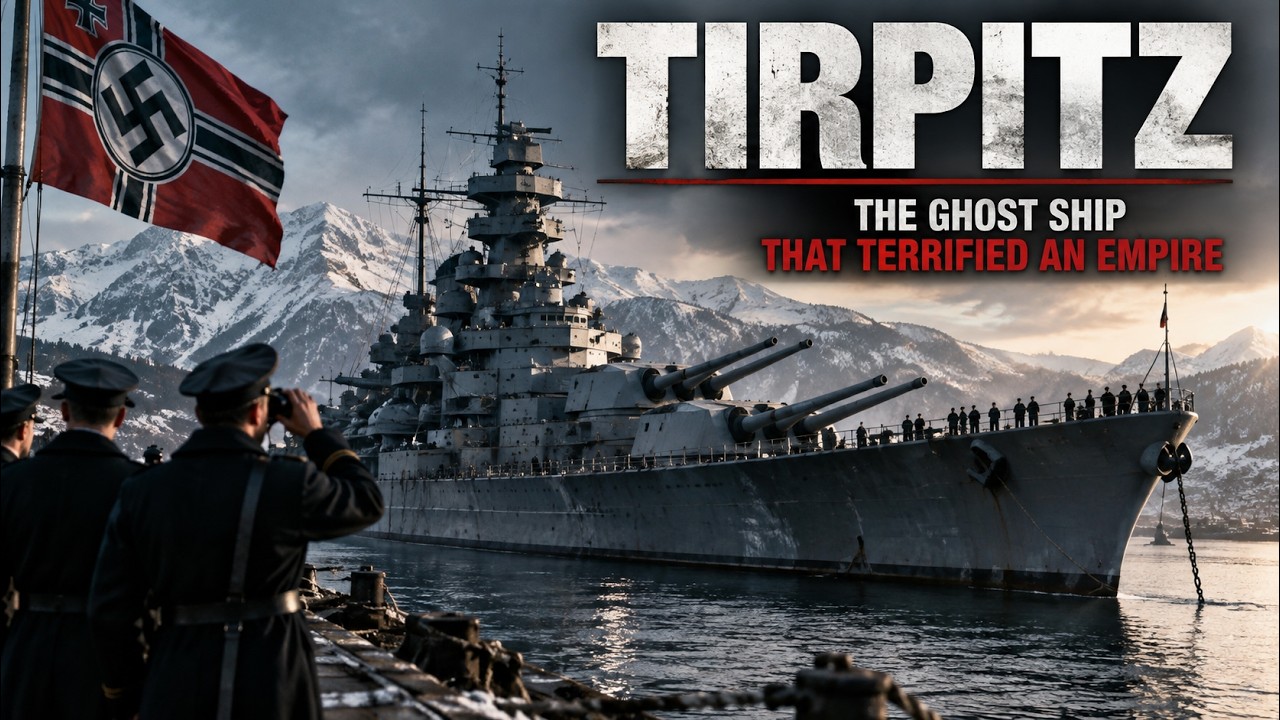
She was the most feared ship in the world, and she almost never moved. Her name was Tirpitz. The story of that ship begins with a man. Alfred von Tirpitz was born in 1849 in the Prussian town of Küstrin, into a Germany that did not yet fully exist.
He entered the Prussian navy as a midshipman in 1865, joining a service that was, by any honest measure, an embarrassment next to the Royal Navy it quietly envied. Britain had centuries of naval tradition, an empire built on the water, and the institutional confidence that came with it. Germany, still assembling itself from dozens of fractured states, had no such confidence. Its navy was underfunded, underequipped, and uncertain of its own purpose.
Young Alfred took note of all of this and filed it away with the patient, methodical mindset of a man who understood that change at this scale does not happen in months, but across decades. By 1897, he had risen to Secretary of State of the Imperial Naval Office, the most powerful position a naval officer could hold in Wilhelmine Germany. Working closely with Kaiser Wilhelm II, a man whose admiration for British sea power was matched only by his jealousy of it, Tirpitz pushed through a series of naval building acts that expanded the German fleet at a pace that alarmed the British. He was building a risk fleet, a force large enough that any power, including Britain, would face unacceptable losses if it attacked.
The logic was deliberately provocative. If Germany built enough warships, Britain would be forced to negotiate rather than fight. It was a theory of deterrence almost a century before that term became common in nuclear strategy. Whether it would have worked was never proven, because Britain responded not by negotiating but by building faster.
The launch of HMS Dreadnought in 1906 made every existing capital ship in the world obsolete overnight, including every ship Tirpitz had spent the previous decade building. The naval arms race that followed consumed the treasuries of both nations and helped create the hostile atmosphere that made the First World War possible. Tirpitz became Grand Admiral in 1911, and when war broke out in 1914 he was appointed commander of the German Navy, but the great fleet battles he had planned for never materialized. Jutland in 1916 was the one major fleet action of the war, a massive, inconclusive collision that solved nothing.
Tirpitz pushed for unrestricted submarine warfare, but his influence eroded, his strategies were repeatedly blocked, and in March of 1916 he resigned. He lived until 1930, long enough to see the country he had helped shape descend into chaos and begin rearming under entirely different leadership. He died without seeing the ship that carried his name laid down, but the shipyards were already taking measurements. There is a strange irony in the fact that the ship named for him would spend her operational life doing exactly what he had theorized, threatening, existing, forcing the enemy to divert resources and attention simply by being present.
The building contract for the ship was placed on the 14th of June, 1936. The keel was laid on the 2nd of November that year at the Kriegsmarinewerft in Wilhelmshaven. What the workers there were assembling was a ship of the Bismarck class, the most powerful class of battleships Germany had ever produced, designed for genuine offensive blue water capability rather than the defensive role of an earlier generation. The Tirpitz was the second ship of the class and, as it turned out, the last.
She spent 29 months on the slipway, then another 23 in fitting out. She was launched on the 1st of April, 1939, christened by Frau von Hassel, the daughter of Admiral Tirpitz himself. The daughter of the man who had spent his life trying to build German naval power now presided over the launching of the largest warship her country had ever produced, carrying her father’s name. She was commissioned on the 25th of February, 1941, under the command of Kapitän zur See Friedrich Karl Topp.
At that moment, 2,608 men took up their stations aboard the largest warship in Europe. What none of them fully knew was how little of what the ship had been built to do she would ever actually accomplish. The guns that took years to mount would fire in anger only a handful of times. The engines that could drive her across oceans would, for most of her operational life, remain idle in cold Norwegian water.
She was designed for the kind of ocean battle where her guns, speed, and armor would be tested against an equal opponent in open water. What she got instead was a fjord, a set of anti-submarine nets, and years of waiting. In January of 1942, the Tirpitz sailed north to Norway. The strategic logic was straightforward.
If she could be based in Norwegian waters, she would threaten the North Atlantic supply route, force the British to keep capital ships in home waters as a counterweight, and menace the Arctic convoys carrying supplies to the Soviet Union. She did not need to fight. She needed only to exist in a position where fighting was possible. She arrived at the Trondheimsfjord and anchored in Fættenfjord, where she was surrounded by anti-submarine nets, anti-torpedo booms, a permanent escort of destroyers, and shore-based anti-aircraft batteries.
In strategic terms, it was also a kind of trap, because once she was anchored and protected this way, moving her became a complex operation in itself, and the instinct of German High Command was increasingly to leave her where she was rather than risk her in open water. The first test of her operational value came in March of 1942, when she sortied with a German surface force to intercept Allied convoys PQ 12 and QP 8. The British, using Ultra decryption, learned of the sortie almost immediately and dispatched a fleet built around three battleships to intercept. The two forces maneuvered in the Arctic waters north of Norway for several days, never making contact.
By the 13th of March, the German force had returned to harbor without having engaged anything. It was a failure by any measurable standard. But it demonstrated something important. Hitler, still shaken by the loss of the Bismarck in May of 1941, was deeply reluctant to risk his capital ships in actions where they might be sunk.
This tension between the Kriegsmarine’s desire to use the Tirpitz offensively and Hitler’s determination to preserve her would define the ship’s entire operational history. The RAF mounted its first bombing attacks on the Tirpitz in late April of 1942, sending waves of Halifax and Lancaster bombers against her anchorage. They lost seven aircraft without significantly damaging the ship. Hitting a ship from altitude was technically demanding work, and the Tirpitz sat within a ring of defenses that made low-level approaches exceptionally dangerous.
The pattern that would define the next two and a half years was already forming. The Tirpitz sat in Norway, the Allies threw forces at her, she absorbed the attempts, survived, and continued to do what she had been doing since January, existing, threatening, tying down British resources simply by being present. Of all the things the Tirpitz did during the war, none had consequences as catastrophic or as paradoxical as the one operation in which she barely participated at all. Convoy PQ 17 departed from Iceland on the 27th of June, 1942.
It was the largest and most valuable Arctic convoy assembled to that point, 35 merchant ships carrying hundreds of tanks, hundreds of aircraft, and more than 100,000 tons of supplies destined for the Soviet Union. The Germans knew the convoy was coming, and in Altafjord in northern Norway, the German surface fleet had assembled, including the Tirpitz. On the 5th of July, with Hitler’s reluctant approval, the German force sortied, heading north toward the convoy. British naval intelligence, aware that the Tirpitz had put to sea, concluded that a major surface attack was imminent.
The First Sea Lord, Admiral Dudley Pound, made the deeply controversial decision to scatter the convoy and withdraw the close escort. The logic was that if the Tirpitz engaged the convoy, the merchant ships would be obliterated, and scattering them gave some a chance to escape independently. The problem was that the assessment was wrong. The Tirpitz never engaged PQ 17.
Before the German surface force had even made contact, word came that British carrier forces were in the area and conditions were not favorable. The German fleet turned around and returned to Altafjord. The Tirpitz had gone to sea, threatened, and come back. She had fired nothing.
She had sunk nothing. But the convoy had already scattered, and what followed was a slaughter. The merchant ships, stripped of their escort, were hunted individually by submarines and aircraft. Of the 35 ships, 24 were sunk, carrying with them 430 tanks and 100,000 tons of cargo to the bottom of the Arctic Ocean.
More than 150 sailors died. The Tirpitz had not fired a single shell. She had simply sailed north, triggered a chain of decisions that led to the convoy scattering, and then gone home. She did not need to fight.
She needed only to move. The one genuine offensive action the Tirpitz ever conducted came in September of 1942, when she participated in Operation Zitronella, an attack on the Norwegian archipelago of Svalbard. It was the only shore bombardment she ever carried out, and it was a modest achievement for a ship of her capabilities. It was something.
It was the one occasion when her main batteries fired in anything approaching an operational purpose. By late 1942, the strategic situation was changing. Allied convoys had resumed, the war on the Eastern Front was reaching a crisis at Stalingrad, and the Tirpitz was beginning to accumulate fuel shortages that increasingly restricted even her training schedules. She was about to become a target in a way that would test every aspect of her protection and survival.
The X-craft program had been developed precisely because conventional submarines and conventional air attacks had both failed to put the Tirpitz out of action. The craft were small enough to pass under the anti-torpedo nets, capable of placing explosive charges against the target’s keel, and then withdrawing before detonation. Operation Source was designed to neutralize three German warships simultaneously, the Tirpitz, the Scharnhorst, and the Lützow. Six X-craft were allocated to the operation.
The towing approach was necessary because the X-craft were too small to make such a journey independently. The passage into Kåfjord, where the Tirpitz was moored, was an extraordinary feat of navigation and nerve. X9 was lost while under tow, and X8 developed mechanical problems and was scuttled. By the time the operation approached its culmination, the weight of the entire operation was falling on three small submarines and their crews.
X6 and X7 both encountered difficulties with the nets but managed to reach the hull and lay their charges. X5 spotted and attacked before her charges could be confirmed placed, was almost certainly destroyed near the ship. The charges detonated on the morning of the 22nd of September, 1943. The explosions, concentrated beneath the hull, damaged the Tirpitz’s machinery, caused flooding, and bent her propeller shafts and rudder mechanisms in ways that could not be repaired in Norwegian waters.
The ship was not sunk, but she was incapacitated. The men who led those X-craft crews, Lieutenant Place and Lieutenant Cameron, were eventually awarded the Victoria Cross. For the crew of the Tirpitz, the explosion beneath their hull was a profound shock. Something had gotten through.
The fjord was no longer a sanctuary. The 3rd of April, 1944, began with cold gray light over Altafjord. The Tirpitz had nearly completed her repairs, and her crew was preparing for sea trials. It was a good day, right up until it wasn’t.
What arrived over Altafjord was one of the most precisely executed carrier air strikes the Fleet Air Arm had ever mounted. Operation Tungsten involved two fleet carriers and a supporting force, with 21 Fairey Barracuda dive bombers escorted by 40 fighters. The attack was launched in two waves. The first wave achieved complete tactical surprise.
The Barracudas scored 12 direct hits on the Tirpitz, causing serious damage to the upper works and killing and wounding several hundred men. The armor of the main belt and turrets, however, was not penetrated. The Tirpitz did not sink, but she was put out of action again. What was needed, Allied planners concluded, was either a weapon that could penetrate the armor directly from above, or a way to get explosives underneath the hull.
The X-craft had demonstrated the second approach. The first required something that did not yet exist in operational service, and that would not exist until a scientist named Barnes Wallis finished developing his next design. Between April and October of 1944, the Allies carried out six bombing attacks on the ship, none of which put her permanently out of action. The Tirpitz was turning gradually into a fortress rather than a warship, absorbing attacks and repairs in an endless cycle.
By the autumn of 1944, the weapon that would finally end her long vigil was nearly ready. Barnes Wallis had designed the Tallboy, a 12,000-pound bomb engineered to penetrate hardened targets from high altitude before detonating deep inside or below them. Operation Paravane was launched on the 15th of September, 1944. 27 Lancaster bombers flew from a forward base in the Soviet Union to attack the Tirpitz in Kåfjord.
The attack achieved one direct hit on her bow and two near misses. The direct hit punched through the deck and caused significant damage to the forward section. The near misses stressed and warped the hull. The bow damage was serious enough that German engineers concluded the forward watertight integrity could not be fully repaired in Norwegian waters.
The Tirpitz would not be going back to Germany for a dry dock. The decision was made to move her to Tromsø, where she could be positioned in shallow water, grounded on a sandbank if necessary, and used as a fixed artillery platform. It was, in retrospect, a choice that traded one vulnerability for a different and ultimately more lethal one. Tromsø was significantly closer to the RAF bases in Scotland than Altafjord had been.
A stripped-down Lancaster carrying a Tallboy could just barely reach Tromsø and return. A second attack, Operation Obviate, was carried out on the 29th of October with 32 Lancasters, but cloud cover foiled it. The Tallboys could not be aimed accurately, and the bombs caused no hits. The Tirpitz survived, but the protective infrastructure at Tromsø was substantially less comprehensive than what had protected her at Kåfjord.
The defenses that had been built over years at Altafjord had not followed her south. The 12th of November, 1944, began with cold clarity over northern Norway. The sky above Tromsø was pale, transparent, entirely without cloud. For the crew of the Tirpitz, riding at anchor off Håkøy Island, it was a morning that looked like any other.
The sandbank beneath her keel was not yet complete. The additional anti-aircraft batteries had not yet fully arrived. The smoke-generating equipment was in place, but the wind conditions would prove less cooperative than the defenders needed. At roughly 09:35 that morning, 32 Lancaster bombers of number 9 and number 617 Squadrons crossed the coast of Norway and began their run toward the anchorage.
They had flown from Lossiemouth in northern Scotland, each aircraft stripped of non-essential weight to accommodate the Tallboy and the fuel load. As they crossed the Norwegian mountains, the sky ahead was clear. The smoke generators began to produce their obscuring cloud, but the wind carried it in the wrong direction. The Tirpitz was visible.
Her gunners opened fire as the Lancasters began their bombing runs. It was the most intense anti-aircraft fire the attacking crews had faced from her, but the Lancasters were flying at altitude on precise headings, and the fire was not enough to break the attack. The first Tallboy struck the Tirpitz amidships between the aircraft catapult and the funnel. It entered through the deck, drove deep into the ship’s structure, and detonated, tearing a large hole in her side and bottom and initiating flooding on a scale the damage control teams could not contain.
A second bomb hit near turret Anton. A near miss alongside transmitted shock through the water into the already compromised structure. The sandbank beneath the keel had not been built up sufficiently, and as flooding increased the ship’s list to port, it was not in the right position to provide the stabilizing contact the planners had intended. Within 10 minutes, the list had reached between 15 and 20 degrees.
The captain gave the order to counter flood, but the damage was too extensive. The list continued to increase. Twenty degrees became thirty. At approximately 09:50, the list reached 60 degrees, and the order came to abandon ship.
At approximately 09:58, turret Caesar, one of the after main battery turrets, exploded. The turret roof was thrown roughly 25 meters into the air and came down into the water among men attempting to swim ashore. The Tirpitz rolled past 90 degrees and continued until her superstructure struck the shallow bottom of the fjord. She came to rest inverted, her keel above the surface.
Approximately 1,000 men died in the sinking, and roughly 800 survived. The attacking Lancasters suffered no losses. They turned south and flew back toward Scotland, the mission complete. The Tirpitz had achieved in her lifetime approximately what Alfred von Tirpitz had theorized almost 50 years earlier, the strategic effect of a threat without the test of battle.
Whether that constituted success or failure is a question her history leaves open. She had fired her main guns in anger exactly once. She had not sunk a single enemy vessel. She had not fought a single fleet engagement.
And yet she had tied down British Home Fleet resources for most of three years, had directly caused the disaster of PQ 17 without firing a shot, and had consumed Allied bombing and carrier resources on a scale that represented a significant investment. The most powerful warship in Europe had spent most of her operational life doing almost nothing, and in doing almost nothing, she had shaped the war in ways that direct action could not have replicated. The wreck of the Tirpitz lay off Håkøy Island through the remainder of the war. After the German capitulation, a Norwegian salvage company took on the contract to dismantle the wreck in place, beginning work in 1948 and continuing into the 1950s.
A significant portion of the wreck was not recovered and remains in place beneath the waters. The Strategic impact of the sinking was felt almost immediately in the redeployment of British naval forces. The battleships and fleet carriers maintained in home waters specifically to counter her threat could now be released for other duties. The survivors of the sinking carried their experience through the rest of the war and into the decades that followed.
Of the roughly 2,600 men aboard when the first Tallboys struck, approximately 800 survived. They lived with the knowledge that roughly a thousand of their shipmates had not. The Norwegian men and women who watched the Tirpitz from the hills above the fjords and sent their reports southward through clandestine channels took risks that the comfortable distance of historical record should never make seem routine. The crews of the X-craft submarines, the Fleet Air Arm pilots, the Lancaster crews who dropped Tallboys from altitude, all of them were doing, in their different ways, what human beings do when the machinery of war places them in extraordinary circumstances.
The name Tirpitz connects two stories across time, the story of the Grand Admiral who spent his life building German sea power and failed to achieve the decisive confrontation he sought, and the story of the ship that carried his name and lived out a version of the same ambition and the same failure on a compressed and specific scale. Both had been built for decisive action. Both had been prevented from achieving it by the strategic logic of the situation they found themselves in. Both had exerted influence primarily through the threat of what they might do rather than what they actually did.
The lonely queen of the north earned her title not through isolation of her own choosing, but through the strategic logic of a war that had no use for her in the role she was built for. She rests now in the cold, dark, beautiful water of the Norwegian north, in the silence that follows ambition, in the deep and patient memory of the sea.


