The last significant foreign policy act of Sir Keir Starmer’s time in Downing Street was a piece of old-fashioned sabre-rattling. He ordered one of Britain’s two giant aircraft carriers to sea, sending it north as a deterrent against increasingly aggressive Russian posturing in the Arctic. The ship chosen was HMS Prince of Wales, the second of the Queen Elizabeth class, displacing close to 80,000 tons fully loaded and carrying a crew of 1,600 sailors. On paper, with her sister ship HMS Queen Elizabeth, the two carriers were meant to project British power anywhere on the globe.
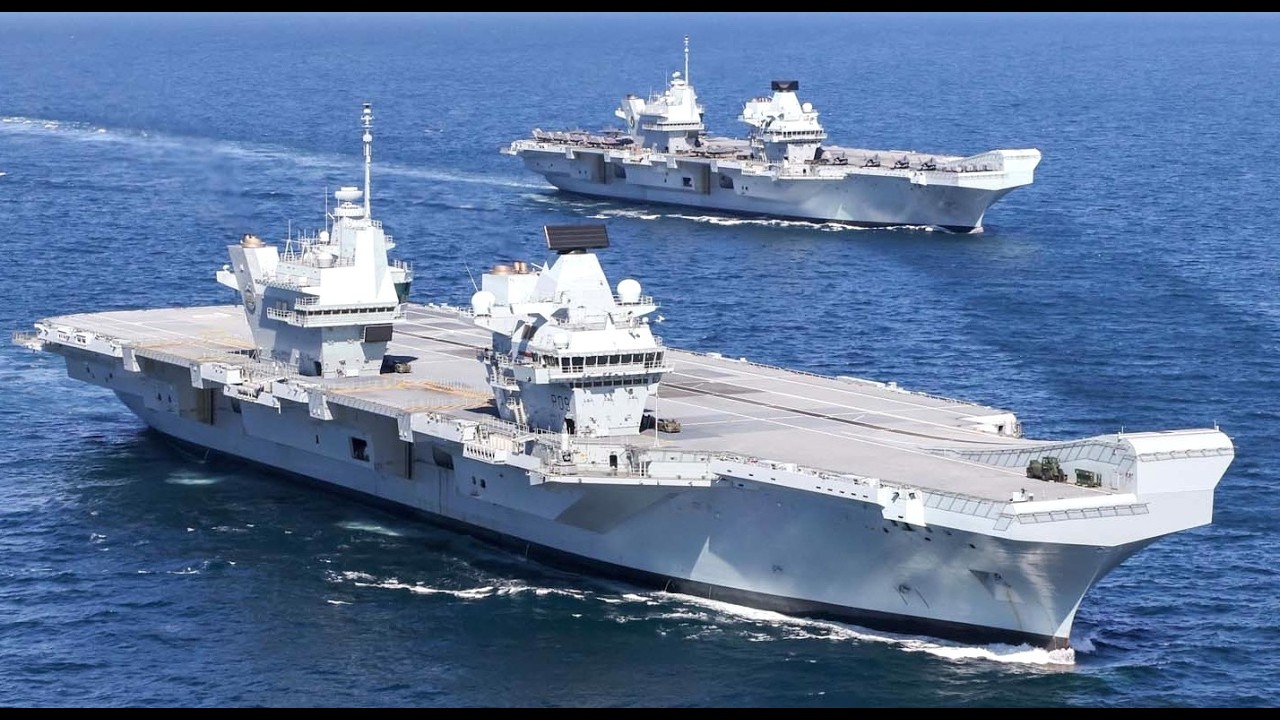
Between them, they account for a staggering ten percent of the Royal Navy’s entire manpower. That manpower is massively overstretched. Poor recruitment and poor retention have left the service hollowed out. For years, serious questions have been asked about how such massive warships can be maintained by a navy that has shrunk to almost nothing.
Yet in July 2026, Prince of Wales was to sail north as the centrepiece of Operation Firecrest. The task group needed escorts, of course. That is vital for any carrier. But putting together a carrier battle group made up entirely of Royal Navy ships is now impossible.
There simply are not enough escort vessels left. Successive governments and the Ministry of Defence have followed what appears to be an illogical plan, reducing the fleet of destroyers and frigates to nearly nothing while still telling the public that the Royal Navy is a modern fighting force stuffed with state-of-the-art ships. The Admiralty had to dig deep to supply just two escorts for Prince of Wales. The destroyer HMS Duncan was somehow made operational from a class of six ships, three of which were in long-term maintenance at the time.
A single old frigate, HMS Somerset, also joined the task group. She is one of only four such vessels still active. The dispatch of these two escorts must have left the country practically undefended for the duration of the deployment, with just eight offshore patrol boats left to guard the realm. The third British ship in the group was a tanker, RFA Tidespring.
By way of comparison, an American aircraft carrier always sails with between five and eight escorting cruisers, destroyers, and nuclear attack submarines. Because of Britain’s naval weakness, the Prince of Wales task group had to be thickened out with escorts from foreign navies, including the French frigate FS Aquitaine. But that is not the most embarrassing part of the story. There is something almost hilarious about the deployment.
When Prince of Wales sailed from Scotland bound for the Arctic, the one thing the aircraft carrier left behind was aircraft. Prince of Wales is designed to carry an air group of up to thirty-six F-35B Lightning II jets. The problem is that the Royal Navy is forced to share its American-purchased F-35s with the Royal Air Force. The entire British fleet currently numbers just forty-seven aircraft, and the Royal Navy is not allocated enough to fill even one carrier, let alone two.
So when Prince of Wales sailed to the Arctic to demonstrate British naval power, she carried an air group of only eight F-35Bs. The ship that can accommodate thirty-six jets also carried six helicopters. It is hardly the kind of sight to make the Russians tremble in their fur boots. Back in the late 1970s, when Britain operated proper aircraft carriers, we routinely deployed full air groups.
The last catapult-equipped carrier, HMS Ark Royal, carried up to forty aircraft, including twelve Phantom FG. 1s, fourteen Buccaneer S. 2s, and five Fairey Gannets, plus Sea King and Wessex helicopters. And Ark Royal displaced only about 54,000 tons fully loaded, compared to Prince of Wales at close to 80,000 tons.
So we have a giant aircraft carrier with hardly any aircraft sailing to the Arctic to show British resolve against Russian aggression. The operation would have been better dubbed Paper Tiger. So how did we get here? Why does Britain have two enormous aircraft carriers it cannot afford to properly stock with aircraft, ships that are mechanically unreliable and that absorb so much of the navy’s manpower that other ships cannot be crewed and are scrapped instead?
As with so much that is wrong with Britain today, we have Tony Blair to thank for the two white elephants. Blair signed off on the carriers in 2006, at an estimated cost of 3. 9 billion pounds for the pair. The idea of Britain having no aircraft carriers at all was too much to bear in some quarters.
Carriers are the battleships of today. Without them, you are just a third-rate navy. One senior naval officer of the period described the project as a combination of naval vanity and pork barrel politics. At the time, Britain had three small aircraft carriers in service, the Invincible class, each displacing about 20,000 tons fully loaded with an air group of up to twenty-four aircraft, usually with about nine Harriers as the main strike force.
Not very impressive compared with the older carriers of the 1970s, but adequate for the shrinking and increasingly impoverished Royal Navy of the 1990s and 2000s. The new carriers were to be built primarily at Rosyth in Scotland, which conveniently happened to be next door to the constituency of Gordon Brown, then Chancellor of the Exchequer. Nothing to do with pork barrel politics then, of course. Brown would in due course succeed Blair as Prime Minister, and he continued the aircraft carrier project.
By 2008, the costs had grown to 6. 2 billion pounds. When David Cameron became Prime Minister in 2010, he tried to cancel the carriers. But the Ministry of Defence told him that it would cost more to cancel the contracts with the shipbuilders, led by BAE Systems, than to continue building.
Rory Stewart, then a Conservative minister, later wrote in his memoirs that Cameron pushed ahead with buying two aircraft carriers that we did not need, had no carrier groups to escort, and for which we could not afford any planes. Desperate to reduce costs, the Ministry of Defence made some truly terrible decisions. Both carriers were originally designed to be like the Royal Navy’s carriers of old and the current American ones, equipped with catapults and arrester gear, cats and traps, to enable the launch of heavily armed and fuelled aircraft. Instead, the Ministry of Defence changed them to STOVL carriers, short takeoff and vertical landing.
That is less efficient and made the new carriers basically giant versions of the tiny Invincible carriers already in service. But then the Invincibles were all scrapped, and with them went the Harriers, flogged off cheap to foreign navies or sold to our American ally for spare parts to keep their own Harriers flying. To replace the Harriers, Britain was forced by the Ministry of Defence’s cost-cutting to purchase the STOVL version of the expensive and fragile F-35, the F-35B Lightning II. These aircraft cost a fortune to buy and a fortune to run, up to $35,000 per flight hour.
They have less weapon and fuel capacity than the American F-35A and F-35C versions. The Royal Navy suffers a shortage of spare parts. The planes are full of software bugs and require huge amounts of maintenance. They also require constant updates from the Pentagon.
Without those updates, they become non-operational. That means, in effect, the United States actually controls these aircraft and how they are used, despite all the official protestations to the contrary. The fact that we ended up with American aircraft also says a great deal about how far Britain’s aviation industry has declined over the past fifty years, and about our increasing dependency on American-made equipment in the defence sector. The F-35B Lightning II is certainly not a Harrier or a Phantom when it comes to durability at sea.
The eventual cost to British taxpayers of the two Queen Elizabeth class aircraft carriers was an eye-watering 7. 6 billion pounds. That had a detrimental effect on the entire naval budget. So what did we get for our 7.
6 billion? Two carriers. Only one of them ever seems to be operational, sometimes neither of them, and never with sufficient aircraft to justify their existence and their running costs. In short, two white elephants that the navy cannot even defend properly when they are at sea.
Exercise Paper Tiger in the Arctic has demonstrated exactly that. The navy cannot use its horrendously expensive toys properly, and the deployment simply revealed to our enemies just how weakened the service has become. This is not the fighting force it was fifty, forty, or even thirty years ago, and it will not get better until the escort fleet is completely rebuilt. In 1979, when Britain operated HMS Ark Royal for the last time, the last proper cat and trap carrier with fast jets and all the works, the Royal Navy had plenty of escorts to protect such a valuable vessel.
There were fifty-five destroyers and frigates. Today, we have two enormous aircraft carriers and just eleven escorts, most of them non-operational. You do the maths. It is clearly an unsustainable situation.
It is also a national disgrace that successive governments have been allowed to destroy the Royal Navy in this manner. What was once a very fine and capable fleet, respected across the globe, has become a joke. None of this is any reflection on the men and women serving in the Royal Navy. The blame should be laid where it belongs, with the ministers and the civil servants responsible for this farce.
And as for all this talk of aircraft carriers, perhaps the biggest carrier of them all is the United Kingdom itself, certainly from the perspective of the United States. America has more F-35 fighter aircraft based at a single airfield in Suffolk than the entire Royal Air Force and Royal Navy possess combined. That is a fact worth thinking about the next time someone claims the Royal Navy can still project British power across the world.