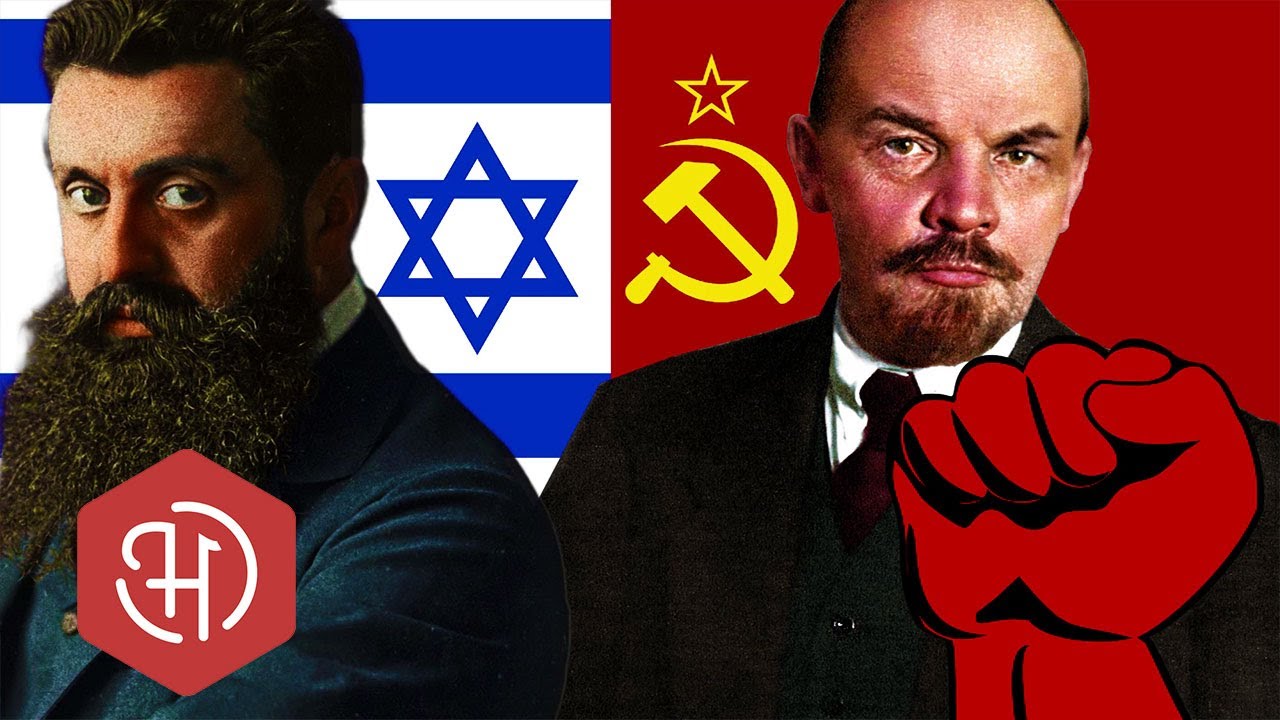
The 20th century’s greatest ideological battles are usually told as capitalism against communism, fascism against liberal democracy, Nazism against communism. But inside the revolutionary movements themselves, there were deeper tensions, and none cut sharper than the antagonism between the Bolsheviks and the Zionists. Both movements drew heavily from the same Jewish intellectual circles of Eastern Europe, and by the 1920s they stood on opposite sides of a divide that would only widen with time. In the 19th and early 20th centuries, the Russian Empire held the world’s largest Jewish population, roughly five million people, most of them confined to the Pale of Settlement, a stretch of territory across modern Poland, Ukraine, and Belarus.
The Pale had been established after the partitions of Poland as a way to keep Jews in a specific western region, and living outside it was mostly forbidden. Jewish life there was a mixture of deep religious tradition, poverty, discrimination, and revolutionary fervor. Pogroms, economic hardship, and exclusion from public life pushed many Jews toward socialist and anarchist movements. Nearly every revolutionary group had Jews in its ranks, from the Mensheviks and Bolsheviks to the Bundists and Zionists.
The Mensheviks and Bolsheviks came from the same party, the Russian Social Democratic Labor Party, founded near the end of the 19th century. At their second congress, held in Brussels in 1903, a split occurred. Winning by a narrow margin, the Bolsheviks took the name meaning “majority,” while the losing side became known as the “minority,” the Mensheviks. With hindsight, accepting that label was a mistake, because it saddled the Mensheviks with a permanent image of weakness.
Leon Trotsky, interestingly, started with the Mensheviks before siding with the Bolsheviks. The Mensheviks played an important role in the creation of the workers’ councils, the Soviets, and they were generally more tolerant of other factions than the Bolsheviks were. The Bund, formally the General Jewish Labor Bund, was the most prominent Jewish socialist group. Founded in 1897, it advocated for Jewish workers’ rights, Yiddish culture, and political autonomy within a socialist Russia.
By 1905 it had 35,000 members, making it Russia’s first mass-based Marxist party. The Bund declared Jews a nation and demanded full national autonomy, with Yiddish as the official language, inside a Russian federation. The Russian Marxists rejected those demands, including Yuly Martov and Leon Trotsky, who were themselves Jews but put class interests above nationalist ones and deeply opposed the Bund’s Jewish nationalism. Georgy Plekhanov mocked the Bundists as Zionists who were afraid of seasickness.
The two movements went their separate ways. The Zionists took an entirely different route. Inspired by Theodor Herzl, the father of modern political Zionism, they promoted Jewish immigration to Palestine in hopes of forming a Jewish state. The Tsarist authorities had allowed a Russian Zionist movement to develop after the early 1880s because it encouraged Jewish emigration in response to the pogroms, though it too was banned in 1903 for serving as a vehicle for Jewish nationalism inside Russia.
For the Bolsheviks, led by Lenin, nationalism of any kind was an enemy. The working class had no nation, they insisted. National identity was a fiction the ruling class used to divide workers, and Zionism fell into the same category. In 1903 Lenin called the Zionist idea entirely false and reactionary in its essence.
Two years later he wrote that the idea of Jewish nationality had a clearly reactionary character and contradicted the interests of the Jewish proletariat, creating a mood hostile to assimilation, the mood of the ghetto. During the February Revolution of 1917, the Bolsheviks played only a minor role. Lenin was in exile, and the party’s members were scattered among the factories. Lenin returned to Russia on April 3rd, arriving at the Finland Station in Petrograd on a trip authorized by the German authorities, who were still at war with Russia.
A crowd greeted him, and on his way to Bolshevik headquarters he gave speeches at every intersection. He used simple words and simple messages, repeating them constantly, and in that way he won over his audience. The Bolsheviks’ methods were agitative. Their tone was fierce, and they made full use of the existing communication channels of the former Empire: telephones, newspapers.
Their paper was called Pravda, truth. After the failed Kerensky Offensive, a desperate attempt by the Provisional Government to defeat the Germans on the Eastern Front, the July Crisis erupted. Radicalism spread, and Bolshevik slogans that had once seemed too extreme became common. It was during these days that Lenin’s call for “Peace, Land, and Bread, and All Power to the Soviets” went mainstream.
After the failed Kornilov Affair, when a Russian commander tried to seize power, the Bolsheviks gained more and more support. Party members tirelessly promoted their ideas, and by October they made their move. Once in power, they signed the Brest-Litovsk Peace Treaty and later renamed themselves the Communist Party of the Soviet Union. From the start the Bolsheviks were ruthless and uncompromising.
Leading members argued over tactics, and key decisions met resistance, particularly the timing of the October coup and the exact terms of Brest-Litovsk, but discipline held. Lenin remained the center of authority even when challenged. The Socialist Revolutionaries split, the Mensheviks split, but the Bolsheviks, though often divided, did not split. Not long after seizing power, the Bolsheviks began arresting Zionists.
Interestingly, Felix Dzerzhinsky, the head of the Cheka, opposed the persecution. In a letter to his deputies in March 1924 he wrote that he did not understand at all why Zionists were persecuted. Their attacks on the regime, he said, were based on the persecution they suffered. Persecuted, he argued, they were a thousand times more dangerous than they would be if left alone.
Nevertheless, persecuted they were, and more each year. The Bolsheviks carried out the Red Terror, in which countless so-called enemies of the revolution were arrested, tortured, and killed by the secret police. The Cheka had many Jews in its ranks, but it should never be forgotten that while many revolutionaries were Jews, relatively few Jews were revolutionaries. The notion that all Jews were Bolsheviks was a myth of the anti-Semites.
During the Civil War, many Jews lost their lives in violent pogroms carried out by the Whites and by Polish and Ukrainian nationalist forces. Around 150,000 died from direct violence and disease, another 500,000 were left homeless, and 300,000 were orphaned. The pogroms threatened the physical survival of the Jews in Russia, while the Bolshevik abolition of Jewish communal institutions, the kehillot, and their attacks on Hebrew education and organized religion threatened their national and religious existence. The situation paralyzed the Zionist organization and its affiliates, but Jewish despair about surviving in Russia and the search for salvation elsewhere only grew.
Despite internal ideological and organizational differences, from 1923 to late 1925, and in some areas into mid-1926, Zionist influence expanded quickly in regions with large Jewish populations and in major cities across the former Pale of Settlement, as well as in Southern and Central Russia. By 1925, around ten different Zionist parties and organizations claimed a combined membership of several tens of thousands. Those numbers, along with the movement’s steady rise, showed how attractive Zionism was to many young Jews and how much unexpected freedom Zionist groups enjoyed during those years. But they were operating inside a political system that openly defined itself as a dictatorship.
Conditions began to worsen in 1924 and drastically so in the middle of 1925. One significant factor was the radicalization unfolding within the Zionist youth movements. Throughout their years of expansion, those movements competed with the Yevsektsiya. By 1919 the Soviet government had strengthened this special body, the Jewish section of the Communist Party.
The section’s goal was to spread communist ideology and atheism among the Jewish masses, and it published a Yiddish-language magazine. Many Jews viewed the Yevsektsiya with contempt, seeing its members as traitors to their own people, because its purpose was to eliminate Zionism, Judaism, and other bourgeois elements within the Jewish community. The section actively opposed traditional Jewish culture, religious institutions, Zionism, and other Jewish political parties like the Bund. It promoted a secular Yiddish culture that fit communist ideology.
Hebrew schools were banned. The Yevsektsiya was officially dissolved in 1929 because the Soviet authorities felt its work was complete and separate Jewish organizations were no longer necessary. Many of its leading members, including Chairman Semyon Dimanstein, were later executed during Stalin’s Great Purge in the late 1930s. Under Stalin, the repression intensified.
Zionism was no longer just an ideological threat; it was treated as a form of espionage. Many Zionist activists were arrested, sent to labor camps, or disappeared entirely. Any hint of Jewish nationalism became grounds for suspicion. Even speaking Hebrew or possessing Zionist literature could be fatal.
Near the end of the 1920s, Stalin briefly considered creating a Jewish state in the Russian Far East, a strange and half-hearted alternative that never came to anything. The Bolsheviks had built their revolution on the promise of class unity above all else, and anyone who insisted on a separate Jewish identity, a Jewish homeland, or even a Jewish language was standing in the way of that vision. Two movements had risen from the same oppressed communities, the same poverty, the same pogroms, the same desperate hope for a better life. One believed liberation meant dissolving into a universal working class.
The other believed liberation meant leaving, building a homeland where Jews would never again depend on the mercy of others. In the end, the Bolsheviks won the immediate battle, crushing every trace of organized Jewish nationalism in the vast territory they controlled. But the tension they helped create would outlive them. The question of whether Jews belonged to one nation or to all nations, whether salvation lay in revolution or in return, never really went away.
It simply moved elsewhere, and it burned on.