In the nineteen thirties, unemployment was climbing across Britain and the Great Depression had shaken the whole world’s faith in democracy. On the streets of London, men in black shirts marched beneath the lightning bolt symbol of a new movement. They called themselves the British Union of Fascists. They were led by Sir Oswald Mosley, a man who promised to make Britain strong again, inspired by the example of Mussolini’s Italy.
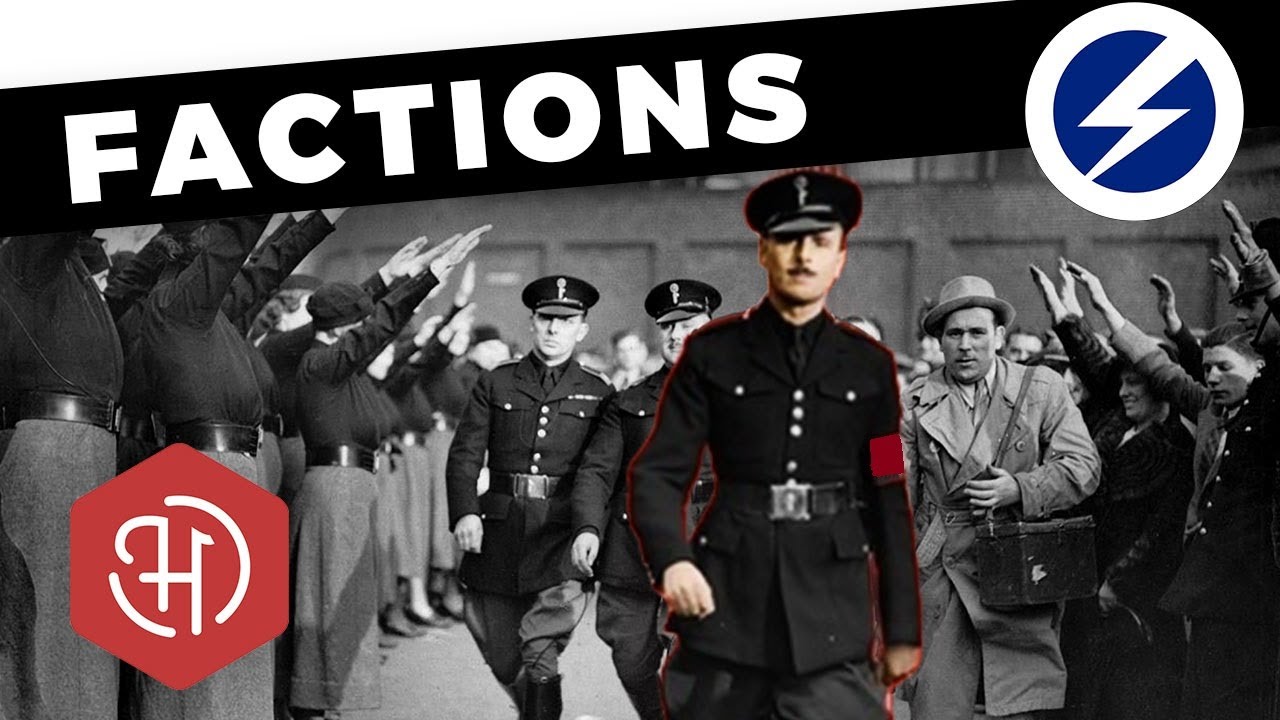
This is the story of how fascism came to Britain, how it almost took root, and why it ultimately failed. Britain’s mainstream parties had their own version of crisis agreements to combat the economic collapse, and the system managed to hold. The first political organization in the country to claim the label of fascism appeared early, in 1923. It was called the British Fascists, and it was founded by a woman named Rotha Linton Orman.
The group was strongly tied to British conservatism, but apart from a shared hatred of socialism, its members had very little in common. A splinter group broke away to form the National Fascists, later renamed the British National Fascists, but that organization dissolved in the late nineteen twenties. A former member, Arnold Leese, founded the Imperial Fascist League in 1929, a small outfit that quickly disintegrated when the Second World War began. The largest fascist party in Britain, however, would be the British Union of Fascists, led by Oswald Mosley.
Mosley was born in London on the sixteenth of November 1896, the eldest of three sons of Sir Oswald Mosley, the fifth baronet. Through his father, he was distantly related to the British nobility, and the family could trace its lineage back to the twelfth century. His parents had a troubled marriage. His father was a gambler and a heavy drinker, often absent from home.
Mosley was raised mainly by his mother and his grandfather. He admired his mother deeply, but he modeled his sense of masculinity on his grandfather. He was an intelligent but restless student, excelling in boxing and fencing and becoming a public school champion in both foil and sabre. He carried a lifelong passion for the sport.
In January 1914, he entered the Royal Military College at Sandhurst, which he later described as one of the happiest periods of his life. It ended abruptly when he was expelled in June after what was described as a righteous act of retaliation against another cadet. When the First World War broke out, Mosley was commissioned into the 16th Queen’s Lancers and served on the Western Front in France. Later he joined the Royal Flying Corps as a pilot and observer.
During a demonstration flight in front of his family, he crashed, leaving him with a permanent limp and a reputation for reckless courage. In May 1920, Mosley married Lady Cynthia Curzon, the daughter of George Curzon, the first Marquess Curzon of Kedleston, a former Viceroy of India and Foreign Secretary. The marriage initially boosted his social and political standing, though it was shadowed by gossip. Mosley’s private life soon turned scandalous.
He carried on long-term affairs with both Cynthia’s sister, Lady Alexandra Metcalfe, and their stepmother, Grace Curzon. In 1928, after his father’s death, Mosley inherited the family baronetcy and the estate that came with it. The way Britain managed its crisis in the interwar years gave ordinary people confidence that problems could still be solved within the existing political system. Because of that, fascism in Britain never seemed truly necessary.
Mosley, the founder of the British Union of Fascists, had started his political journey inside the very institutions he later came to reject. He was first elected as a Conservative MP in 1918. He joined the Labour Party in 1924 and left it in 1930, frustrated by what he saw as a lack of ambition. He formed the New Party in 1931, and the British Union of Fascists the following year.
This shifting political path led many to accuse Mosley of pure opportunism, of seeking power for its own sake just like Mussolini. Yet his evolution followed a certain logic. Mosley viewed the crisis of the First World War and the Great Depression as part of a single collapse of Western civilization. To him, fascism was the only real solution.
Influenced by the disillusioned trench generation, he believed the war had destroyed faith in progress, religion, and democracy. The Britain that emerged from the war, far from being a land fit for heroes, was plagued by high unemployment and stagnant politics. Mosley saw this as proof of the failure of liberal democracy and laissez-faire economics. During the nineteen twenties, Mosley developed his own economic ideas, drawing on lessons from wartime state planning, early Keynesian theory, and imperial economics.
He argued that the state should take an active role in stimulating demand, creating jobs, and rebuilding Britain’s economy through public investment and protectionist trade within the empire. His proposals were rejected by his colleagues in the Labour government, which led Mosley to break away and try to implement his ideas through his own movements. In his 1932 book, The Greater Britain, Mosley outlined what he saw as a rational plan to end unemployment and revive national prosperity. His approach was similar in spirit to other interwar thinkers such as Keynes, William Beveridge, and the neo-socialists in Europe who called for a planned economy that balanced capitalism with social welfare.
Many of these ideas would later become central to the post-1945 welfare state. What made Mosley’s vision distinctively fascist, however, was not the economics themselves but the authoritarian political system he believed was required to enforce them. Convinced that Britain’s democratic leaders lacked the courage to act, he came to see a one-party dictatorship as the only means to achieve national revival. Mosley envisioned replacing Britain’s elected parliament with a corporatist assembly.
Decisions about the economy would be made not by politicians but by a technocratic elite representing producers and industry. Whether power was gained through elections or by force, he believed a fascist government should first rule by emergency decree, suspending parliament temporarily, and then abolish it altogether. For Mosley, Britain’s decline was ultimately a moral failure of leadership. The so-called old gang of traditional politicians had, in his eyes, failed to preserve Britain’s role as a global power.
Only the new man of fascism, energetic, visionary, and ruthless, could restore civilization’s vitality. In reality, however, the political crisis Mosley hoped would bring fascism to power never materialized. When Britain faced severe economic instability in 1931, the political system managed to stabilize itself. The National Government, a coalition of Conservatives, Liberals, and a few Labour members under Ramsay MacDonald, restored confidence and steered the country through the depression.
By 1932, the Conservatives dominated parliament. Yet the coalition’s national label reassured voters that this was a united response to the crisis, proof that the parliamentary system could still work. Ironically, the government even implemented some moderate protectionist and reflationary policies echoing parts of Mosley’s own economic plan. These moves showed that Britain’s establishment could adapt in hard times, undermining Mosley’s argument that only fascism could save the nation.
The British Union of Fascists reached its peak in 1933, when it gained around fifty thousand members and the backing of Lord Rothermere’s Daily Mail, a newspaper that admired Mussolini’s supposed success in Italy. The movement followed the Italian example and ran holiday camps, which were heavily advertised in the party’s publications and strongly imitated the Italian fascist ones. At these seaside camps, a full range of fascist symbols were displayed alongside the British Union Jack. Members wore uniforms, and Oswald Mosley himself inspected the camps.
The excursions also served to foster transnational contacts, as fascist movements across Europe organized them so that members could meet adherents of foreign fascist groups. But this support vanished after the violent rally at Olympia in June 1934. Clashes with protesters there revealed the movement’s thuggish character. Unlike Mussolini’s Blackshirts, Mosley’s men failed to create the illusion of restoring order.
Instead, they became seen as the source of the disorder. Mosley himself reflected on this differently in an interview in 1967. When asked about the pictures of him in uniform, he said the meetings drew enormous crowds. Thirty thousand people came to listen, and the events were kept in perfect order because his men had stopped the troublemakers from breaking them up.
He said he was proud to have organized and led the Blackshirt movement to restore free speech, because the protesters had denied free speech to others in Britain. He described his young men as magnificent, and he insisted it had been a right and proper thing to do to put the disrupters out of the meetings. Frequent brawls between fascists and anti-fascists led to the Public Order Act of 1937, which banned political uniforms and allowed the police to restrict marches. Constant opposition from both the state and grassroots anti-fascist groups kept the British Union of Fascists marginal.
Membership fluctuated through the nineteen thirties, but by then it had become a minor extremist group, attracting social outsiders rather than serious political figures. Between 1935 and 1938, Mosley tried to revive his movement through local campaigns, particularly among unemployed workers in South Wales, Lanarkshire, and East London. Only in London’s East End did the British Union of Fascists gain real traction, exploiting anti-Jewish resentment in poor white neighborhoods. By this time, roughly half of the movement’s remaining members were concentrated there.
The party’s antisemitism, which became overt after 1934, remains a subject of historical debate. Mosley depicted Jews not through racial theory, but as a cultural nation within a nation that profited at the expense of others. He later claimed his antisemitism was merely a reaction to opposition from Jewish and communist groups. That was a self-serving explanation that ignored how his own propaganda had provoked the resistance in the first place.
In a 1975 interview, Mosley denied ever being antisemitic. He defined an antisemite as someone who attacks Jews on account of race or religion. He said his quarrel was not with some Jew or with all Jews, only with some of them, over a single subject, whether there should be a second world war. Coming back from the First World War, after losing so many friends in the air and in the trenches, he was strongly against another war.
And it seemed to him, rightly or wrongly, that certain Jews were trying to provoke a second world war because their compatriots and co-religionists were admittedly having a very bad time in Germany. In practice, antisemitism isolated and weakened the British Union of Fascists. It alienated the wider public and tied the movement’s image to Nazi Germany. Rather than becoming a national force, the party was reduced to a local, discredited sect, trapped by the hatred it had itself unleashed.
From 1934 onward, British intelligence agencies, MI5, closely monitored Oswald Mosley and his movement. They had infiltrated the organization and even bugged Mosley’s communications, fearing that his powerful speeches might win public sympathy and funding. Although some admired his charisma, the government’s patience ran out when the Second World War began. In May 1940, as Mosley urged Britain to accept Hitler’s peace offer, he was arrested and interned under Defence Regulation 18B without trial.
His wife Diana was also imprisoned, and the British Union of Fascists was officially banned. During his confinement, Mosley read extensively on politics and history. His detention sparked public debate, though most Britons supported it. He was released in 1943 due to illness and lived under house arrest until the war ended.
After the war, Mosley tried to revive his political career by founding the Union Movement in 1948, promoting the idea of a united Europe. His postwar rallies faced constant opposition, leading him to leave Britain for Ireland and later France. In his later years, Mosley became notorious for denying the death camps of the Second World War and for running anti-immigration campaigns. Despite brief political comebacks in the nineteen fifties and sixties, he remained a deeply discredited figure until his death.
He passed away in 1980, a man who once promised to make Britain strong again and ended his life as a reminder of how close the country had come to falling, and how firmly it had turned away.


