
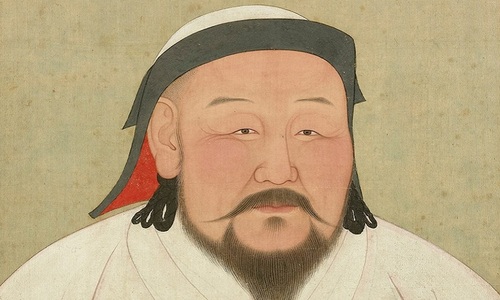
Genghis Khan and his family left a mark on history unlike any other. During his lifetime, their conquests were so vast and deadly that they may have killed as much as 10% of the world’s population, even affecting the carbon footprint of humanity. For over a thousand years, the final resting place of Genghis Khan was intentionally hidden. This was not a forgotten tomb—it was a deliberately erased secret. Rivers were rerouted, landscapes reshaped, and those tasked with his burial disappeared without a trace. Even stories passed down through generations were crafted to mislead o
Countless historians and explorers searched for his grave, but every expedition failed—until recently, when modern investigations have begun to shed new light.
Genghis Khan, born Temüjin, rose from exile, betrayal, and hardship to unite the fragmented Mongol tribes under one banner by the early 13th century. His military organization was revolutionary. He structured his army using a decimal system, with units of 10, 100, 1,000, and 10,000 men, each led by commanders chosen on merit rather than bloodline. This meritocratic system created loyalty, coordination, and efficiency. Trained from childhood, his cavalrymen employed tactics unlike anything seen before: lightning-fast charges, feigned retreats to trap enemies, and psych
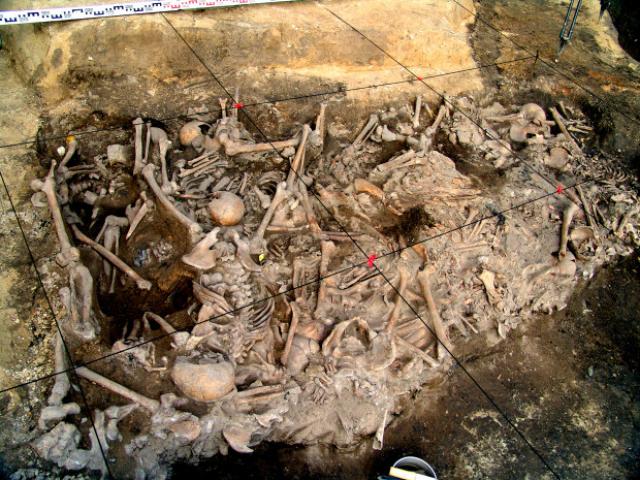
Between 1207 and 1225, Genghis Khan’s campaigns devastated entire regions. He swept across western Asia and northern China, leveling cities, and his campaigns against the Khwarezmian Empire were particularly brutal after the execution of his trade delegation. Cities like Samarkand and Bukhara were besieged and destroyed, with few survivors. His strategy combined terror and precision: entire regions surrendered at the mere sound of Mongol hooves.
Yet conquest alone did not define him. Genghis Khan was also a shrewd statesman. His legal code, the Yasa, maintained order, protected diplomats and merchants, and even allowed religious freedom—a radical approach for the time. He recruited administrators, scholars, and artisans from conquered territories, including Muslims, Persians, and Chinese, building a merit-based bureaucracy, secure trade routes, and the legendary Yam postal system that connected the empire from the Pacific to the Caspian. This created the Pax Mongolica, a rare era of peace and prosperity across vast Eurasian lands, fostering trade, innovation, and cultural exchange. Silk Road commerce flourished under Mongol protection, with ideas, religions, and technologies flowing freely across borders.
When Genghis Khan died during a campaign against the Western Xia dynasty in northwestern China, the exact date of his death remains uncertain, with sources citing either August 18 or August 25. The circumstances of his death are equally unclear: some suggest illness, others an enemy arrow, a hunting accident, or even a lightning strike, adding an almost supernatural aura to his passing. Regardless, his death was kept secret to prevent unrest and maintain morale during ongoing military campaigns.
The Khan’s body was transported in absolute secrecy to the Mongolian heartland. Legends claim that all who handled his burial were executed to ensure the location remained unknown. Rivers were diverted, land flattened, and trees planted to disguise any evidence. The region, particularly around Burkhan Khaldun in northeastern Mongolia, was heavily guarded by elite hereditary warriors known as the Darkhad, preserving both the sanctity and secrecy of the area. Even permafrost helped conceal the tomb, sealing it under frozen soil and ice.
Modern efforts to locate the tomb have leveraged cutting-edge technology. National Geographic Explorer Albert Lin Yu-Min employed satellite imagery, magnetometry, and ground-penetrating radar to survey the Kenti Mountains in northeastern Mongolia. His team, working respectfully with local Mongolian volunteers, carefully analyzed the terrain to identify anomalies without disturbing the sacred land. Though no confirmed tomb was found, the project established new standards for ethical, non-invasive archaeology..

Earlier expeditions, such as the Three Rivers Expedition (1989–1992), surveyed vast areas around the Onon, Kherlen, and Tuul rivers, documenting over 1,300 potential aristocratic burial sites. While this expanded understanding of Mongol burial practices, Genghis Khan’s tomb remained elusive. Mory Kravitz, an American adventurer, dedicated decades to locating it, blending historical research, local knowledge, and field exploration. His expeditions yielded strange accounts—unexplained equipment failures, sudden illnesses, and other anomalies—that suggested the tomb was protected not only by geography but by spiritual or cultural forces.
Alan Nichols, a later American explorer, proposed a radical idea: the tomb might not be near the traditionally associated Burkhan Khaldun, but instead hidden in a remote, little-explored peak he called “Mountain X” closer to the Yellow River in Inner Mongolia. Using ground-penetrating radar and magnetometers, Nichols detected unusual subsurface formations indicative of concealed chambers. The details of these findings have largely been kept confidential due to political and cultural sensitivities.
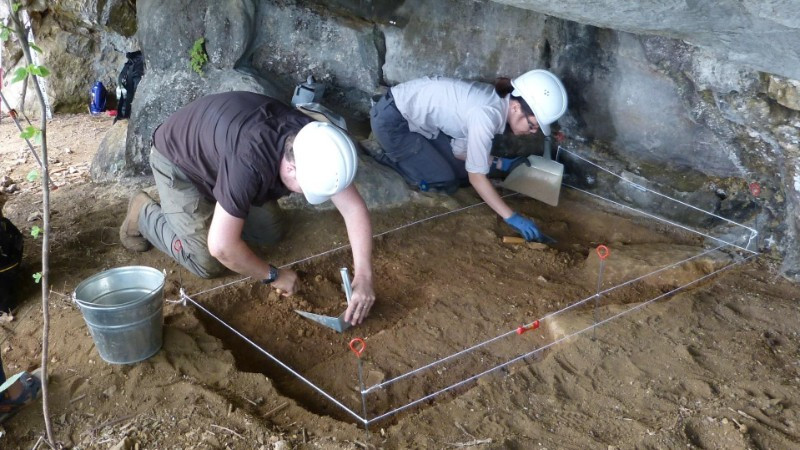
To this day, Genghis Khan’s burial site remains one of history’s greatest unsolved mysteries. The meticulous secrecy surrounding it—including ritual protections, the Darkhad guardians, and deliberate alteration of the landscape—has preserved the tomb for centuries. Even today, the world continues to search for clues, combining historical records, legends, and modern technology in a pursuit that blends archaeology, anthropology, and respect for Mongolian cultural traditions