For nearly 180 years, the fate of the men aboard Sir John Franklin’s doomed Arctic expedition has remained one of history’s most haunting exploration mysteries. The disappearance of the British ships H.M.S. Erebus and H.M.S. Terror in the frozen Canadian Arctic became a symbol of ambition, endurance, and catastrophe in the age of exploration.
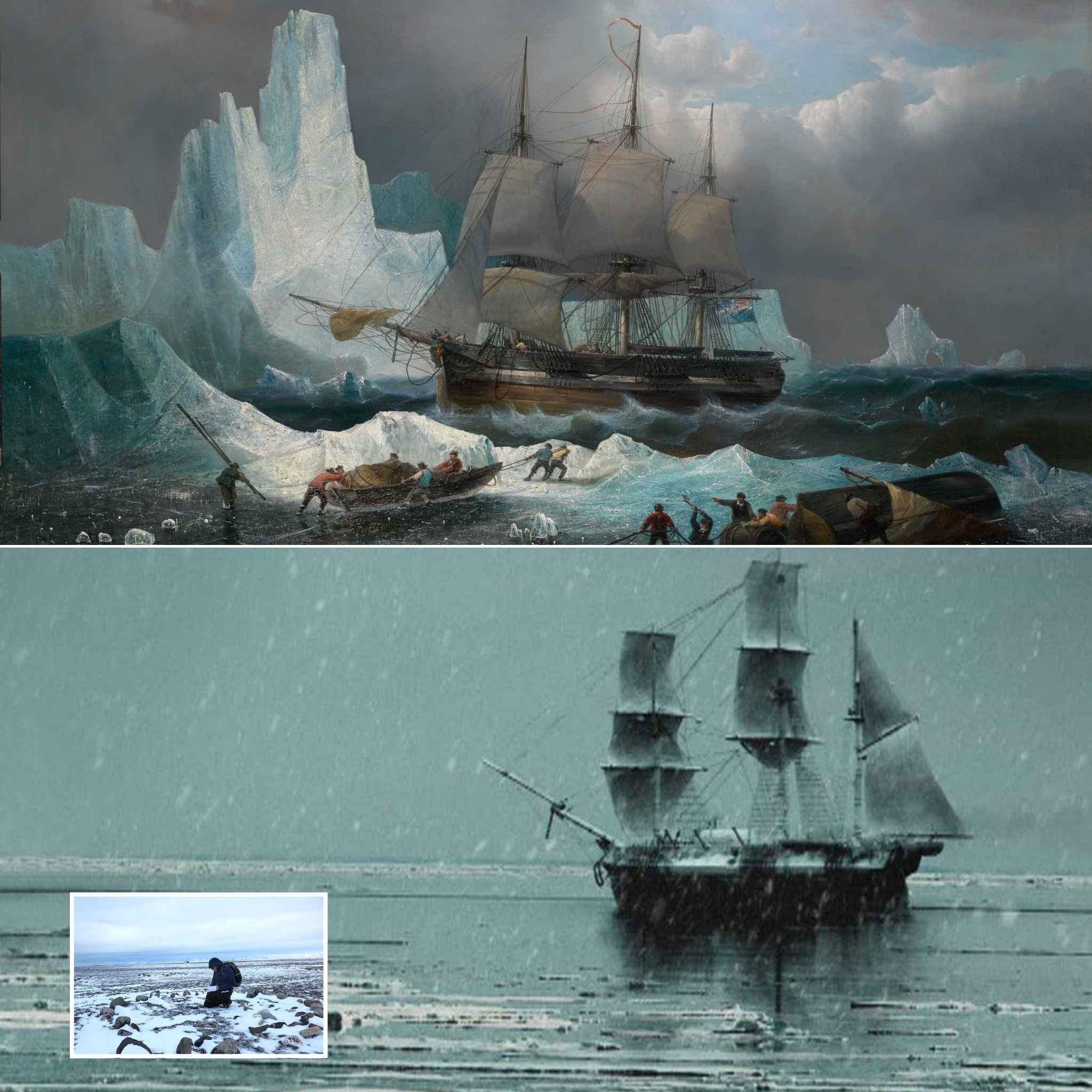
Now, modern science has brought researchers one step closer to understanding what happened during the ill-fated voyage. Using advanced ancient DNA analysis, scientists have identified four more members of the Franklin expedition, helping piece together the final days of the men who vanished while searching for the legendary Northwest Passage.
The breakthrough not only increases the number of conclusively identified expedition members but also resolves a longstanding mystery connected to one of the men involved in the disaster.
The Franklin Expedition: Britain’s Deadly Quest for the Northwest Passage

In 1845, British naval officer Sir John Franklin led what was supposed to become one of the greatest achievements in maritime exploration. Franklin commanded two state-of-the-art ships, the H.M.S. Erebus and the H.M.S. Terror, carrying a crew of 129 men on a mission to locate and navigate the Northwest Passage — a sea route through the Arctic that would connect the Atlantic and Pacific Oceans.
At the time, the Northwest Passage existed more as a dream than a proven route. European powers believed discovering it would dramatically shorten trade voyages between Europe and Asia. For centuries, explorers attempted to find a navigable path through the Arctic ice, but nearly all failed.
Franklin’s expedition was considered exceptionally prepared. The ships were heavily reinforced for polar conditions and stocked with years’ worth of provisions. Confidence in the mission was high.
But after entering the Arctic waters near present-day Nunavut, Canada, both ships became trapped in thick sea ice in the Victoria Strait. The crews never returned.
The disappearance shocked Britain and much of the world.
Robert W. Park, an anthropologist at the University of Waterloo and senior author of the new research, compared the disaster’s cultural impact to the 20th-century Space Shuttle Challenger tragedy.
“It was a completely unexpected catastrophe when it happened,” Park explained.
A Mystery That Haunted the Arctic for Generations

When Franklin’s ships vanished, search parties were dispatched repeatedly over the following decades. Explorers combed the Arctic for evidence of the expedition’s fate, discovering scattered artifacts, graves, skeletal remains, and occasional clues left behind by the desperate crew.
Inuit oral histories proved especially important. Indigenous communities in the Arctic passed down stories describing starving British sailors dragging boats across the ice and traveling south in hopeless conditions.
For years, many Western researchers dismissed these accounts. But over time, archaeological discoveries confirmed that Inuit testimonies were remarkably accurate.
The eventual discovery of the wrecks of the Erebus in 2014 and the Terror in 2016 transformed the investigation into one of the greatest archaeological breakthroughs in polar history.
Yet many mysteries remained unanswered.
Who survived longest?
How far did the men travel?
Who attempted to escape?
And which remains belonged to which crew members?
DNA Technology Unlocks New Answers

Modern advances in ancient DNA analysis are now helping answer some of those questions.
Researchers recently analyzed skeletal remains recovered from sites connected to the Franklin expedition and successfully identified four additional crew members. The findings raise the total number of conclusively identified expedition victims from two to six out of the original 129 men aboard the ships.
The identifications were made by comparing DNA extracted from bones and teeth with DNA provided by living descendants and relatives connected to Franklin crew members.
The work represents one of the most significant uses of genetic genealogy in Arctic archaeology.
Scientists say the achievement is especially remarkable because Arctic remains are often heavily degraded by time, weather, and environmental exposure. Despite these challenges, researchers were able to recover enough genetic material to establish clear identities.
The new findings also solved a lingering question involving one member of the expedition whose fate had long been uncertain.
Though many aspects of the catastrophe remain unknown, every confirmed identity helps researchers reconstruct the final movements and conditions faced by the men.
The Desperate Escape Attempt

Evidence gathered over decades shows the trapped sailors eventually abandoned both ships and attempted to walk south toward mainland Canada across brutal Arctic terrain.
This escape effort became one of the deadliest survival marches in exploration history.
Archaeological evidence suggests many crew members were already severely weakened before they abandoned the ships. Earlier studies found signs of malnutrition, illness, and physical deterioration.
For years, one theory suggested lead poisoning from canned food or shipboard water systems caused the disaster. Modern studies confirmed elevated lead levels among the crew, though researchers now believe lead poisoning alone likely did not directly kill the men.
Instead, the expedition appears to have collapsed due to a combination of starvation, exposure, disease, exhaustion, and extreme Arctic conditions.
The environment itself became the crew’s greatest enemy.
Temperatures plunged far below freezing, sea ice blocked movement, and food supplies dwindled rapidly. As the men attempted to travel over ice and tundra, many died along the route.
Evidence of Cannibalism Confirmed
One of the darkest discoveries connected to the Franklin expedition came through forensic analysis of skeletal remains recovered from Arctic sites.
Researchers identified cut marks and breakage patterns on bones consistent with cannibalism, confirming long-circulating Inuit accounts describing desperate sailors consuming human remains during the expedition’s final phase.
The evidence shocked many historians when it was first confirmed scientifically, though researchers emphasized that the behavior reflected extreme survival desperation rather than brutality.
The Franklin expedition gradually transformed from a celebrated imperial mission into a tragic story of human endurance pushed beyond its limits.
Why the Identifications Matter

The identification of four additional crew members may seem small compared to the 129 men who vanished, but for researchers and descendants, the breakthrough carries enormous importance.
Each identified individual helps reconstruct the expedition’s timeline and movement patterns. By determining where specific remains were found, researchers can better understand how the escape unfolded and how long different groups survived.
The discoveries also bring emotional closure to families connected to the crew.
For generations, many descendants had no definitive knowledge of what happened to their relatives aboard the expedition. DNA technology is finally providing some answers.
Researchers believe additional identifications may still be possible in the future as forensic methods continue improving.
The Discovery of the Ships Changed Everything
The discoveries of the Erebus and Terror wrecks dramatically advanced Franklin expedition research.


The wrecks were astonishingly well preserved beneath Arctic waters. Items recovered from the ships included dishes, navigational equipment, clothing, tools, and personal belongings left behind when the crews abandoned the vessels.
The findings offered a rare frozen time capsule from the mid-19th century.
Archaeologists hope future investigations of the wrecks may reveal written records or additional clues explaining exactly how the disaster unfolded.
So far, however, no final journal or definitive explanation has emerged.
Why the Franklin Expedition Still Fascinates the World
The Franklin expedition continues to capture public imagination because it combines so many compelling elements:
- ambitious exploration
- extreme survival
- mystery and disappearance
- human tragedy
- Arctic isolation
- scientific discovery
For Victorian Britain, Franklin’s disappearance became a national obsession. Newspapers followed every search attempt, families demanded answers, and stories of the Arctic disaster spread across the world.
Today, the expedition remains one of history’s greatest unsolved exploration mysteries — though modern science is steadily uncovering more truth from the ice.
The combination of archaeology, forensic anthropology, DNA analysis, and Inuit oral history has transformed understanding of the disaster in ways earlier generations could never have imagined.
A Frozen Puzzle Slowly Comes Together
Even after nearly two centuries, the Franklin expedition continues revealing new secrets.
The latest DNA breakthroughs demonstrate how modern technology can recover identities and histories once believed permanently lost. Every bone fragment, artifact, and genetic sample helps researchers rebuild the story of the men who vanished searching for a passage through the Arctic.
While many questions remain unanswered, scientists now understand more than ever before about the expedition’s final days — a catastrophic journey marked by suffering, endurance, and desperation in one of the harshest environments on Earth.
And as research continues, the frozen silence surrounding the doomed voyage of the Erebus and Terror may slowly give up even more of its long-hidden truths.