Buried in a Colonial Church Cemetery: The Complex Identity of an 8-Year-Old Boy in 17th-Century Maryland
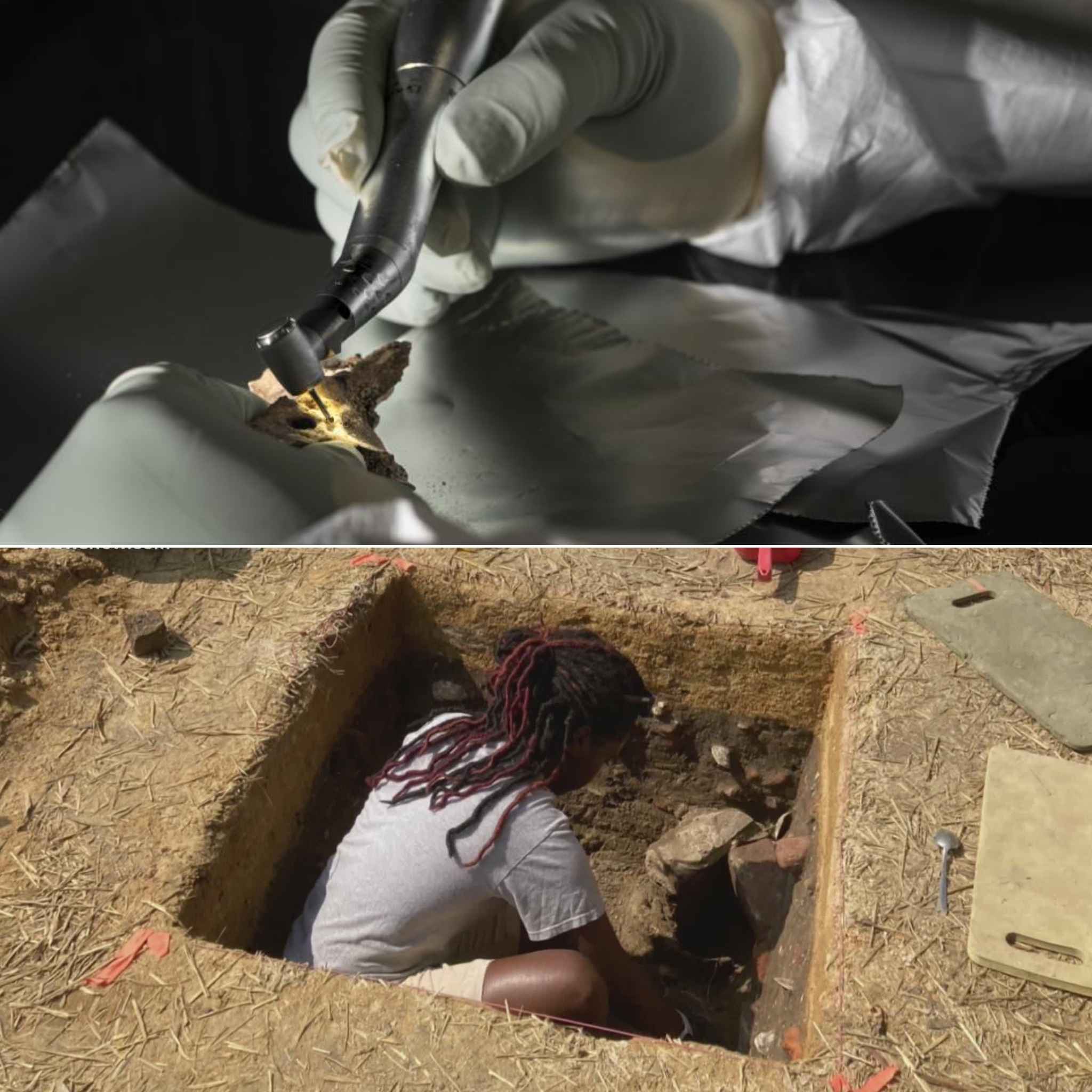
In the quiet landscape of early colonial America, archaeologists working at one of the oldest English settlements in the region of St. Mary’s City have uncovered a burial that is reshaping what scholars understand about race, status, and social boundaries in the 17th century.
Among the graves inside and around the Brick Chapel cemetery, researchers identified the remains of an 8-year-old boy of predominantly African ancestry—buried in a manner consistent with European Christian traditions and placed alongside individuals linked to elite colonial families. The discovery challenges long-held assumptions about how rigidly society in early colonial Maryland separated people based on origin, status, and legal condition.
What makes the case especially striking is not only the boy’s ancestry, but the ambiguity surrounding his social identity. Was he enslaved? An indentured servant? Or part of a more fluid system of labor that existed before racial slavery became fully institutionalized in the region?
Even after extensive genetic and isotopic analysis, the answer remains uncertain.
A cemetery tied to Maryland’s earliest colonial elite


The burial site is located at Brick Chapel, part of the early colonial settlement established in 1634 as the capital of the Province of Maryland. This small but politically significant town was home to English settlers, many of whom fled religious conflict in Europe and sought refuge in the New World.
Excavations over several decades have revealed dozens of burials, including those of prominent colonial figures such as governors Thomas Greene and Philip Calvert, along with members of their families. Some of these elite individuals were interred in lead coffins, signaling high social status and wealth.
Yet among these clearly high-status European burials, archaeologists also found individuals of very different origins and life histories—including indentured servants and the young boy of African ancestry.
The 8-year-old boy: ancestry, burial style, and mystery
The child died sometime between 1667 and 1704, during a period when colonial society in Maryland was still evolving its systems of labor and racial hierarchy.
Genetic analysis revealed that he had roughly 70% to 75% African ancestry and 25% to 30% European ancestry. Isotope testing further showed that he was born in the Americas, rather than arriving from overseas.
Despite his ancestry, the boy was buried in a Christian-style coffin lined with a shroud and placed within a cemetery reserved largely for individuals associated with English colonial society.
This burial position is unusual. In many later colonial contexts, individuals of African descent—particularly enslaved people—were often buried in separate, unmarked, or peripheral grounds. Yet this child was placed within a formal church cemetery, alongside individuals of European descent.
This raises a key question that researchers cannot fully resolve: what was his legal and social status in life?
Indentured servants, enslavement, and blurred boundaries
Alongside the child, archaeologists also identified the remains of two young men in their 20s who showed signs of physical labor, poor health, and recent immigration from Ireland. These individuals were not buried in coffins, suggesting lower status or different burial customs compared to elite settlers.
Researchers interpret these men as likely indentured servants—laborers who worked under fixed-term contracts, typically lasting several years, in exchange for passage to the colonies.
In contrast, slavery was also present in the region during this period, but its legal and racial structures were still evolving. Historians emphasize that in the 17th century, the distinction between indentured servitude and enslavement was not always sharply defined in practice, particularly for people of African descent.
Some individuals of African ancestry were treated in ways that resembled long-term servitude rather than lifelong hereditary slavery, although conditions varied widely and could be extremely harsh.
The presence of the boy in a formal cemetery associated with colonial elites may suggest that his status was not fully equivalent to later forms of chattel slavery—but it does not provide definitive proof.
DNA, genealogy, and a reconstructed colonial population


The broader study analyzed the genomes of 49 individuals buried at Brick Chapel between the 17th and early 18th centuries. Researchers identified clear ancestral ties to western England and Wales among many of the colonial settlers, confirming historical records of migration.
In a surprising development, genetic analysis also allowed researchers to identify historically significant individuals, including colonial governors Thomas Greene and Philip Calvert. In Greene’s case, DNA comparison and genealogical data were used together to confirm identity—a rare example of ancient DNA directly identifying historical figures.
The study also revealed that more than a million living people today may be genetically related to this early colonial population, demonstrating the long-term demographic impact of early settlement patterns in North America.
Migration, labor, and early colonial society
The cemetery reflects a society structured by multiple overlapping systems of labor:
- Wealthy English colonial families occupying positions of power
- Indentured servants, often recent immigrants from Europe, working under contracts
- Individuals of African descent with unclear legal status
- Children and families embedded in rapidly changing social hierarchies
This mixture highlights how early colonial Maryland was not yet fully rigid in its racial and labor systems. Instead, it functioned as a transitional society where different forms of servitude and dependency coexisted.
Over time, however, these systems would become more stratified, particularly as hereditary racial slavery became increasingly codified in law during the late 17th and 18th centuries.
Burial practices and what they reveal about status
One of the most important clues in interpreting social status comes from burial treatment.
Elite individuals were placed in coffins—some even lined with lead—indicating wealth, status, and formal burial rites within the church cemetery.
In contrast, the indentured servants discovered in the same cemetery were buried without coffins and showed skeletal signs of physical strain and malnutrition, consistent with labor-intensive lives.
The 8-year-old boy’s burial stands somewhere in between. His coffin and shroud suggest inclusion within Christian burial practices, but his ancestry raises questions about how he was socially classified during life.
This ambiguity is central to the study’s significance: it demonstrates how identity in early colonial societies cannot always be neatly categorized using modern definitions of race and legal status.
Scientific discovery and historical uncertainty
The research combines ancient DNA analysis, isotope chemistry, and historical records to reconstruct a fragmentary picture of early colonial life. Yet even with advanced technology, some questions remain unresolved.
Was the boy enslaved? Possibly. Was he an indentured servant? Also possible. Could he have occupied a unique social position that does not fit modern categories? That too remains a strong possibility.
Historians emphasize that legal definitions of slavery and servitude in the 17th century were not yet standardized, particularly for people of mixed ancestry or those born in the colonies.
As one researcher noted, the discovery is “significant and warrants additional consideration,” precisely because it challenges assumptions about rigid racial separation in early colonial burial practices.
A fragile human story beneath colonial foundations


The burial at Brick Chapel is ultimately more than a scientific case study. It is a reminder that colonial societies were complex, uneven, and often contradictory in how they defined human value and belonging.
Within a single cemetery, archaeologists uncovered governors and servants, immigrants and locally born individuals, people of European and African ancestry, and children whose life stories remain partially hidden.
The 8-year-old boy sits at the center of this uncertainty. His burial reflects both inclusion and ambiguity—evidence of a society in transition, where systems of labor and identity were still being formed.
Reconstructing the past, questioning the categories
As genetic science continues to refine our understanding of historical populations, discoveries like this force a reconsideration of how we interpret identity in the past.
They also highlight a key limitation: biology can reveal ancestry, movement, and relationships—but it cannot fully explain lived experience, social status, or personal identity.
In the end, the boy buried at Brick Chapel remains both present and unknowable. His bones tell a story of migration and ancestry, but the social meaning of his life is still open to interpretation.
And that uncertainty may be the most important finding of all.