The Mummy and the Epic: How Homer’s Iliad Was Sealed Inside an Egyptian Body for Eternity
In the ancient city of Oxyrhynchus, where the desert has preserved forgotten libraries beneath centuries of dust, archaeologists have uncovered something almost impossible:
A Roman-era Egyptian mummy carrying part of Homer’s Iliad inside its abdomen.
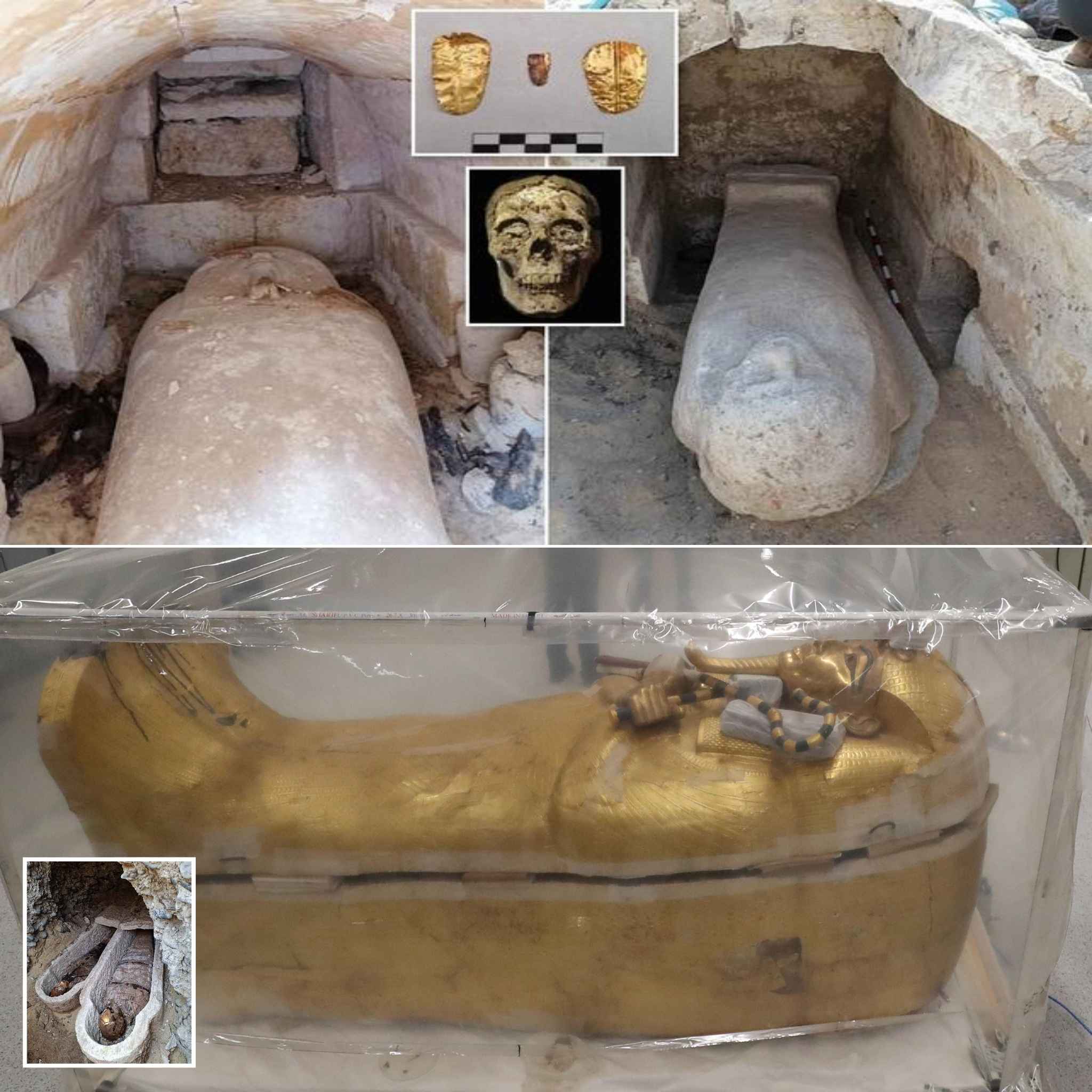
Not beside the body.
Not buried nearby.
Inside it.
The discovery is being described as unprecedented—the first known case in which a Greek literary text was deliberately incorporated into the mummification process itself. And in a civilization obsessed with survival after death, the implications are extraordinary.
I. THE CITY THAT NEVER STOPPED WRITING
The modern town of Al-Bahnasa sits quietly in central Egypt today, but in antiquity it was known as Oxyrhynchus—a city where language accumulated like sediment.
Founded centuries before Roman rule and later absorbed into the empire after the death of Cleopatra VII Philopator, Oxyrhynchus became one of the most important centers of written culture in the ancient Mediterranean.
For more than a century, archaeologists have been recovering papyri from the site by the hundreds of thousands.
Tax receipts.
Private letters.
Religious spells.
Official decrees.
Fragments of lost plays.
Pieces of forgotten histories.
The city functioned almost like an archive machine, preserving texts that vanished elsewhere in the ancient world.
But no discovery quite resembles this one.


Because this papyrus was not stored in a library.
It was embedded into a human body during preparation for eternity.
II. THE EPIC INSIDE THE DEAD
The papyrus contains lines from Book 2 of The Iliad, the section describing the legendary coalition of ships assembled against Troy.
Known as the “Catalogue of Ships,” the passage is one of the most famous military inventories in ancient literature—a sweeping account of kingdoms, commanders, and vessels gathered for war.
To modern readers, it may seem an odd choice for burial ritual.
But to the ancient world, texts possessed force beyond narrative.
Words could protect.
Names could preserve identity.
And epic poetry carried authority that transcended entertainment.
According to archaeologists from the University of Barcelona, the papyrus had been deliberately placed within the mummy’s abdomen during embalming.
That detail changes everything.
Because this was not accidental reuse of recycled papyrus.
It was ritual insertion.
III. WHEN GREEK MYTH ENTERED EGYPTIAN DEATH RITUAL
By the Roman period, Egypt was no longer culturally isolated.
Greek language, Roman administration, Egyptian religion, and local traditions existed simultaneously in a layered civilization where identities blended rather than replaced one another.
The result was a strange hybrid world:
Egyptian embalming practices continued.
Greek literature circulated widely.
Roman political authority governed both.
The mummy from Oxyrhynchus appears to emerge directly from that intersection.


Researchers note that papyri were sometimes inserted into mummies during Roman-era embalming. Usually, however, those texts were magical formulas or funerary spells.
A literary masterpiece like the Iliad is something entirely different.
It suggests that literature itself may have acquired ritual power.
Not merely as story.
But as protection.
IV. THE BODY AS ARCHIVE
Ancient Egyptian mummification was always about preservation.
Not symbolic preservation.
Literal preservation.
The body needed to survive because survival in the afterlife depended upon continuity of identity.
But the insertion of a Greek literary text introduces a new possibility:
That memory itself could be embedded into the corpse.
The mummy becomes more than preserved flesh.
It becomes a container of cultural synthesis.
Egyptian ritual technology wrapped around Greek intellectual tradition under Roman political control.
Three civilizations compressed into one body.
V. WHY THE ILIAD?
Archaeologists still do not fully understand why this specific text was chosen.
But several theories are emerging.
The “Catalogue of Ships” is fundamentally a passage about organization, destiny, and collective movement toward a final confrontation. In antiquity, lists and invocations often possessed ceremonial significance beyond their literal meaning.
Another possibility is that the papyrus was valued not for its narrative content but for its prestige.
Homer occupied a status in the ancient Mediterranean comparable to sacred authority. His works were foundational educational texts across the Greek-speaking world.
To place Homer inside a mummy may have been seen as embedding wisdom, prestige, or protective cultural power into the deceased himself.
Or perhaps the answer was simpler:
The papyrus was available.
Ancient recycling practices often reused old texts for practical or ritual functions.
Yet archaeologists emphasize that this example appears intentional—not casual reuse.
Which means someone chose Homer deliberately.
VI. THE MAN WITH THE EPIC IN HIS STOMACH
So far, researchers know remarkably little about the mummy itself.
The individual was male.
An adult.
Still under investigation.
That uncertainty creates a strange imbalance in the story:
We know the text more clearly than the person carrying it.
The dead man’s identity has faded.
But the words inside him survived.
In a sense, the Iliad outlived its reader by nearly two thousand years.
VII. THE GOLD TONGUES OF OXYRHYNCHUS
The cemetery where the mummy was discovered has already produced one of the most unsettling funerary traditions ever uncovered in Roman Egypt:
Mummies with gold tongues.
Archaeologists previously found more than a dozen examples, and the latest excavations uncovered three more gold tongues along with one made of copper.


For the ancient Egyptians, gold represented divine flesh—the material associated with gods and immortality.
A golden tongue may have been intended to allow the dead to speak before divine beings in the afterlife.
The copper tongue remains more mysterious.
Perhaps a substitute for gold.
Perhaps symbolic in a different way.
Perhaps evidence of status differences within the burial community.
Whether the Iliad mummy also possessed such a tongue remains unknown.
But the convergence is striking:
A body equipped both with speech technology for the afterlife and literary text embedded internally.
As though the deceased was being prepared not merely to survive death…
…but to participate in eternity intellectually.
VIII. THE PAPYRUS AS FUNERARY TECHNOLOGY
Modern readers often separate literature from ritual.
Ancient civilizations rarely did.
In Egypt, written words were active forces.
Hieroglyphs on tomb walls fed the dead.
Spells from the Book of the Dead guided souls through cosmic dangers.
Names preserved identity against oblivion.
The Iliad papyrus may represent an extension of that logic into the Greco-Roman world.
A literary object transformed into funerary technology.
And perhaps this is the most important aspect of the discovery:
It reveals that ancient people did not classify texts the way modern scholars do.
To them, epic poetry, sacred ritual, memory, and protection could overlap.
IX. THE CITY OF FRAGMENTS
Oxyrhynchus continues to produce discoveries because it operated as a civilization-sized storage system.
Its dry climate preserved papyri in extraordinary numbers.
But preservation alone does not explain why this city matters so deeply to historians.
What makes Oxyrhynchus unique is that it preserves transition.
Egyptian becoming Greek.
Greek becoming Roman.
Religious systems overlapping rather than disappearing.
Languages coexisting inside the same funerary practices.
The mummy with Homer in its abdomen is perhaps the clearest physical expression of that fusion ever discovered.
X. WHEN STORIES ENTER THE BODY
The modern world treats books as external objects.
Ancient civilizations often treated texts as extensions of human existence.
Words could alter fate.
Writing could survive death.
And in rare cases, literature itself could become part of the embalmed body.
That is what makes this discovery so haunting.
Not simply that a papyrus survived.
But that someone believed the Iliad belonged inside a human being preparing for eternity.
XI. FINAL OBSERVATION: THE AFTERLIFE OF EPIC
For nearly two millennia, the mummy remained sealed underground while empires rose and vanished above it.
Inside the body rested a fragment of one of humanity’s oldest surviving epics—a story already ancient when the papyrus was inserted into the corpse.
And now, after centuries of silence, the text speaks again.
Not from a library.
Not from a scholar’s desk.
But from the interior of the dead.
A reminder that in the ancient world, stories were never merely read.
Sometimes, they were carried into eternity itself.