 The night Carrie Bennett drove down Industrial Route 17, she was running on exactly two things: caffeine and stubbornness.
It was 12:43 a.m.
Rain hammered the windshield so hard it felt like someone was throwing buckets of water at the car.
She had just finished a sixteen-hour shift at Memorial Hospital in Chicago.
Her ten-year-old daughter, Zoe, sat in the passenger seat wrapped in a hoodie, fighting sleep.
Carrie normally avoided that stretch of road.
Everyone did.
Old warehouses. Empty lots. No traffic.
But exhaustion makes people take shortcuts.
And that decision changed all three of their lives forever.
“Mom.”
Zoe pressed her face against the window.
“I think something’s burning.”
Carrie barely looked up.
“Probably trash.”
“No.”
Zoe pointed.
“Over there.”
Through the rain, Carrie saw it.
A thin stream of smoke curling into the night sky from an abandoned warehouse marked:
HOLIDAY STORAGE.
She slowed the car.
Then she heard it.
A scream.
Not loud.
Not dramatic.
Just desperate.
Help.
Carrie instantly sat up.
Every ounce of exhaustion disappeared.
“Stay here,” she said.
The scream came again.
Help me.
Carrie looked around.
No other cars.
No security.
No emergency vehicles.
Nothing.
Just rain.
Smoke.
And a voice inside.
She opened the trunk.
Years earlier, her husband Sam had packed emergency equipment into every vehicle they owned.
Crowbar.
Flashlights.
Fire extinguisher.
Medical kit.
At the time she thought he was paranoid.
Tonight she silently thanked him.
“Mom.”
Zoe stood beside her.
“You said stay in the car.”
“I know.”
“I heard him too.”
Carrie looked toward the warehouse.
Then back at her daughter.
Every instinct as a mother told her to leave.
Every instinct as a doctor told her someone was dying.
The conflict lasted about three seconds.
“Three minutes,” Carrie said.
“If I’m not back, call 911.”
Zoe crossed her arms.
“No.”
Carrie stared.
“No?”
“If someone is trapped in there, you need help.”
“You are ten.”
“You taught me helping people matters.”
The answer irritated Carrie because it sounded exactly like something she would say.
A minute later they were both standing at the warehouse door.
Rain dripping off their jackets.
A flashlight in Zoe’s hand.
Crowbar in Carrie’s.
The lock shattered.
The door swung open.
Smoke exploded outward.
Inside was darkness.
And somewhere deep within it, a man was coughing.
“Keep close,” Carrie said.
They wrapped cloth over their mouths and moved forward.
Every step felt heavier.
The air was thick.
The heat was growing.
Then the flashlight beam found him.
A man chained to a steel support column.
Blood everywhere.
Bruises covering his face.
One shoulder soaked red.
His head lifted weakly.
For a second he looked shocked to see them.
Then confused.
Then relieved.
“You actually came.”
Carrie dropped beside him.
Doctor mode took over instantly.
Gunshot wound.
Broken ribs.
Severe dehydration.
Signs of prolonged restraint.
Whoever did this hadn’t just wanted him dead.
They wanted him to suffer first.
“My name is Carrie.”
She pointed.
“My daughter is Zoe.”
“We’re getting you out.”
The man laughed painfully.
“You picked a terrible night to become heroes.”
Carrie attacked the chain with the crowbar.
Nothing.
The lock didn’t move.
The man’s eyes shifted toward an office in the corner.
“Desk drawer.”
“What?”
“Key.”
Carrie froze.
The key was nearby?
Almost as if whoever imprisoned him wanted him to know freedom was always close but impossible to reach.
Psychological torture.
Zoe was already moving.
“I’ll get it.”
“Zoe—”
But she was gone.
The smoke thickened.
Flames appeared near the ceiling.
Carrie kept pressure on the gunshot wound.
“Who did this?”
The man looked directly at her.
“You should leave.”
“Not happening.”
“They’ll come back.”
“Who?”
His jaw tightened.
“People who don’t like loose ends.”
A moment later Zoe returned holding a key ring.
“I found it!”
Carrie unlocked the chain.
The man nearly collapsed.
Together they dragged him through the warehouse.
Flames spread across wooden shelving.
Metal groaned overhead.
The rear exit appeared through the smoke.
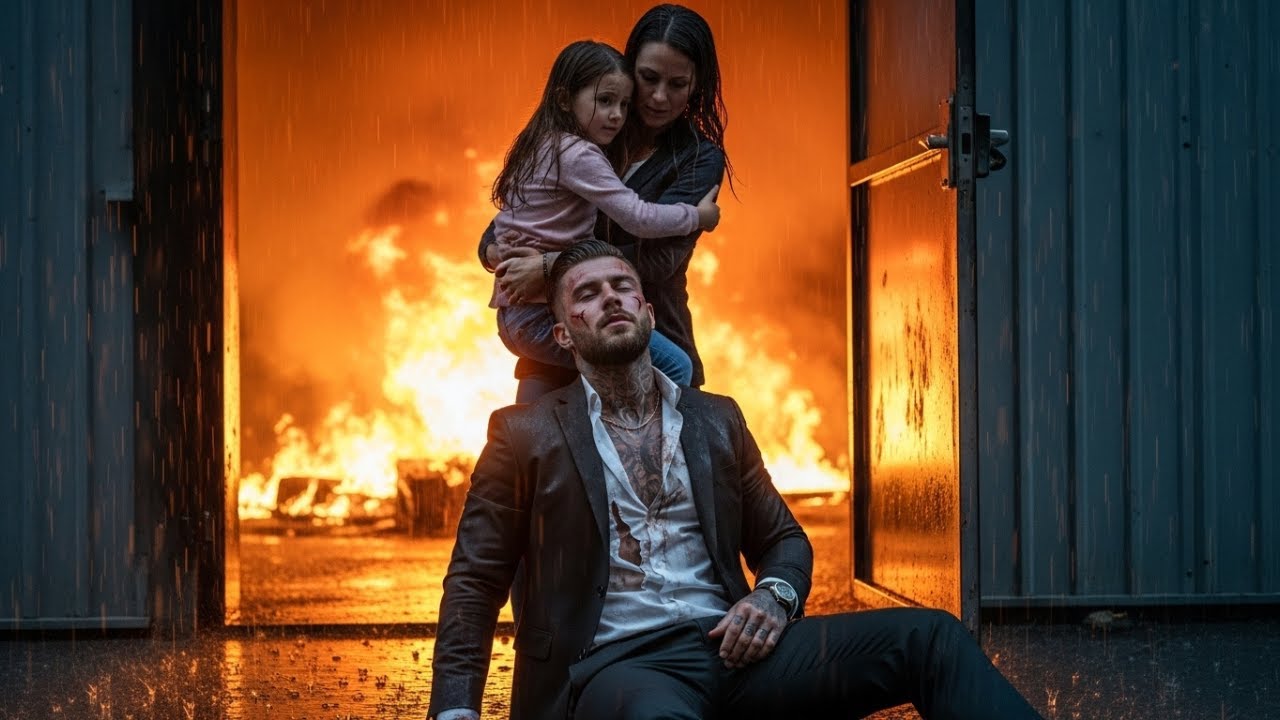
They burst outside into an alley just as a deafening explosion ripped through the building.
The warehouse disappeared in fire.
For several seconds nobody spoke.
Rain poured.
The rescued man stared at the burning structure.
Then he looked at Carrie.
“You have no idea what you’ve just done.”
His name was Lucas Montgomery.
Carrie wanted to take him straight to a hospital.
Lucas refused.
“Absolutely not.”
“You’ve been shot.”
“I know.”
“You need surgery.”
“I know.”
“Then stop arguing.”
Lucas looked at her.
“If I enter a Chicago hospital, we all die.”
The certainty in his voice was unsettling.
Not fear.
Knowledge.
Eventually Carrie made a decision she would later question a thousand times.
She drove him to a remote cabin near Lake Geneva.
The cabin belonged to Sam.
A place nobody knew about.
Inside, Carrie cleaned the wound.
Removed fragments.
Closed tissue.
Stabilized bleeding.
Lucas watched silently.
“Military?”
Carrie glanced up.
“What?”
“You’ve done this before.”
“Afghanistan.”
Something changed in his expression.
Respect.
For the first time, he stopped looking at her like a civilian.
By morning he had enough strength to sit up.
He made a phone call from a hidden phone.
Twenty words.
No names.
No explanations.
Just instructions.
A few hours later black SUVs arrived.
Men stepped out.
Disciplined.
Armed.
Organized.
One of them, Gabriel, treated Lucas like a king.
That was when Carrie realized the truth.
Lucas Montgomery wasn’t merely a victim.
He was someone powerful.
Very powerful.
The television confirmed it.
News channels showed footage of the warehouse fire.
Then a photograph appeared.
Lucas Montgomery.
Alleged head of the Montgomery organization.
A criminal empire operating across multiple states.
Carrie’s stomach dropped.
Then came the second shock.
Her own photograph appeared.
And Zoe’s.
Authorities wanted to question the witnesses.
Lucas muted the television.
“There it is.”
“There what is?”
“The moment your old life ends.”
Carrie stared at him.
“You lied to us.”
“I omitted details.”
“You’re a criminal.”
Lucas nodded.
“Yes.”
The honesty somehow made it worse.
Then Gabriel entered.
“Rossini’s people are asking about the doctor.”
The room went silent.
Lucas closed his eyes.
“Pack,” he said.
“We leave immediately.”
The journey lasted two days.
Multiple vehicles.
Different routes.
A helicopter.
Enough precautions to make Carrie realize this wasn’t paranoia.
It was survival.
Their destination was an isolated estate hidden in Wisconsin.
Carrie expected a fortress.
Instead she found something resembling a private ranch.
Beautiful.
Quiet.
Almost normal.
An older woman named Martha welcomed them.
Everything had been prepared.
Rooms.
Clothes.
Supplies.
Even books Zoe liked.
The efficiency was unsettling.
Nothing about Lucas’s world happened by accident.
Weeks passed.
Then months.
For the first time since the warehouse, life became almost calm.
Almost.
Carrie learned more than she intended.
Lucas inherited a transportation company from his father.
Later he discovered it was a money-laundering operation connected to organized crime.
Instead of escaping, he expanded it.
Built influence.
Built power.
Built an empire.
Then came the tragedy.
A wife.
A son.
Both dead.
Officially an accident.
Lucas believed otherwise.
He believed Franco Rossini arranged it.
That belief had fueled a war spanning years.
One evening Carrie found old family photographs in Lucas’s office.
For the first time he looked tired.
Not dangerous.
Not powerful.
Just tired.
“Why tell me all this?” she asked.
Lucas studied the photographs.
“Because Rossini already knows who you are.”
“And?”
“You stopped being a bystander the night you opened that warehouse door.”
Carrie had no answer.
Because deep down she knew he was right.
Zoe adapted faster than anyone.
She rode horses.
Helped Martha in the garden.
Treated the entire situation like the strangest adventure ever created.
Lucas surprised Carrie too.
He was patient with Zoe.
Protective.
Attentive.
Nothing like the monster she expected.
One afternoon she asked him something she had been wondering for weeks.
“If you could start over, what would you be?”
Lucas smiled faintly.
“An architect.”
Carrie laughed.
“You’re serious?”
“Northwestern. Economics degree. Loved architecture.”
“What happened?”
“My family happened.”
Silence followed.
Then Lucas added:
“In my world there are only two exits.”
“What are they?”
“Prison.”
He paused.
“Or death.”
The answer stayed with her.
Because he didn’t say it dramatically.
He said it like weather.
Like a fact.
Like something he’d already accepted.
The peace ended at the Art Institute of Chicago.
A neutral location.
A peace negotiation.
At least that was the official story.
Carrie attended as Lucas’s physician.
Franco Rossini arrived surrounded by expensive suits and expensive smiles.
Everything about him felt performative.
Lucas was controlled.
Rossini was theatrical.
Then Carrie noticed a server.
A glass.
A subtle exchange.
A hesitation.
Medical training kicked in.
She grabbed Lucas’s wrist.
“Don’t.”
The room froze.
Carrie tested the drink.
Minutes later she proved it contained a nearly undetectable toxin capable of causing rapid cardiac arrest.
Chaos erupted.
Negotiations collapsed.
Weapons appeared.
Security scattered.
People ran.
Gunfire echoed through marble halls.
By the time everyone escaped, the truce was dead.
Rossini stood across the room smiling.
“You think you’ve won?”
Lucas didn’t answer.
Rossini turned toward Carrie.
“Tell her.”
Lucas’s face hardened.
Rossini continued.
“I have footage of the warehouse rescue.”
Carrie’s blood ran cold.
“If authorities see it, she’ll become part of everything.”
Then he looked directly at Lucas.
“And the child?”
Silence.
“Custody battles can be very unpleasant.”
For the first time since meeting him, Carrie saw Lucas lose.
Not physically.
Emotionally.
Rossini had found the weakness.
It wasn’t territory.
It wasn’t money.
It wasn’t power.
It was them.
That night they fled again.
Another safe location.
This time in the Pacific Northwest.
Carrie finally asked the question.
“When does this end?”
Lucas stared out a window for a long time.
Then he handed her a folder.
Thousands of pages.
Financial records.
Corporate structures.
Evidence.
“What is this?”
“My exit.”
Carrie frowned.
“I don’t understand.”
“I’m dismantling everything.”
She looked up sharply.
“What?”
“Eighteen months.”
“You built an empire.”
Lucas nodded.
“And now I’m ending it.”
The room fell silent.
“Why?”
For a moment she thought he wouldn’t answer.
Then he did.
“Because I’m tired of being the man I became.”
Carrie’s chest tightened.
Lucas looked toward the mountains.
“I spent years believing survival required becoming something worse than my enemies.”
He smiled sadly.
“Turns out that’s a terrible way to live.”
“You’ll lose everything.”
“No.”
His eyes found hers.
“I’ll lose the wrong things.”
That was the plot twist nobody saw coming.
The feared crime boss wasn’t fighting to protect his empire.
He was destroying it himself.
Piece by piece.
Before anyone else could.
The transition took years.
Investigations.
Agreements.
Federal cooperation.
Asset transfers.
Public scandals.
Courtrooms.
Headlines.
Enemies falling.
Allies disappearing.
The process was messy.
Painful.
Incomplete.
But it worked.
Eventually Lucas stepped away from the world that had defined him.
Not without consequences.
Not without scars.
But he stepped away.
One afternoon, years later, he placed a final folder in front of Carrie.
Every document was signed.
Every agreement complete.
Every remaining tie severed.
Lucas sat back.
“That’s it.”
Carrie opened the folder.
Then closed it.
“You did it.”
“No.”
He smiled.
“I survived it.”
Outside, Zoe laughed while planting flowers with Martha.
The sound drifted through an open window.
Lucas watched quietly.
“Funny thing,” he said.
“What?”
“I spent years building an empire.”
“And?”
He looked toward the garden.
“The thing I actually wanted was right there.”
Carrie reached across the table and took his hand.
No speeches.
No grand declarations.
Just a choice.
The same kind of choice that began everything years earlier in a burning warehouse.
Outside, flowers grew where nothing had existed before.
And sometimes that’s how redemption looks.
Not clean.
Not perfect.
Just a person brave enough to stop building what destroys people—and start building what saves them instead.