Naupa Huaca: Exploring the Mystery of Peru’s Ancient Rock-Cut Sanctuary
Hidden High in the Andes
Peru is home to some of the world’s most celebrated archaeological sites. Millions of visitors travel each year to Machu Picchu, Sacsayhuamán, Ollantaytambo, and the Sacred Valley to witness the achievements of the ancient civilizations that flourished in the Andes.
Yet beyond the famous ruins lies a lesser-known site that has captured the imagination of archaeologists, historians, travelers, and spiritual seekers alike.
Nestled high in the mountains near the Sacred Valley of Peru is Naupa Huaca, also known as Naupa Iglesia, a small but remarkable rock-cut sanctuary whose origins and purpose continue to inspire debate.
Unlike the vast stone cities of the Inca Empire, Naupa Huaca consists primarily of a natural cave enhanced by extraordinary stonework. At first glance, the site appears modest. But a closer examination reveals carefully carved surfaces, geometric precision, and architectural features unlike anything found in ordinary mountain shelters.
For some visitors, Naupa Huaca is simply an impressive example of ancient Andean craftsmanship.
For others, it represents one of the most mysterious sacred sites in South America.
The truth likely lies somewhere between those extremes.
A Sacred Site Above the Sacred Valley
Naupa Huaca is located in the mountains overlooking the Sacred Valley, not far from the town of Ollantaytambo.
Reaching the site requires a steep climb along rugged trails that wind through rocky terrain and sparse vegetation. The journey itself contributes to the site’s aura of mystery. Unlike major archaeological attractions, Naupa Huaca remains relatively isolated and receives far fewer visitors.
The sanctuary sits at an altitude of nearly 3,000 meters (9,800 feet) above sea level.
Its position provides sweeping views of the surrounding mountains, valleys, and agricultural terraces that have supported human communities for thousands of years.
The location was almost certainly chosen deliberately.
Throughout Andean history, mountains were regarded as sacred entities known as apus—powerful spiritual beings believed to influence weather, fertility, and human destiny.
Sacred sites were often positioned in locations that connected people to these revered landscapes.
Naupa Huaca appears to fit this tradition perfectly.
The Remarkable Stonework
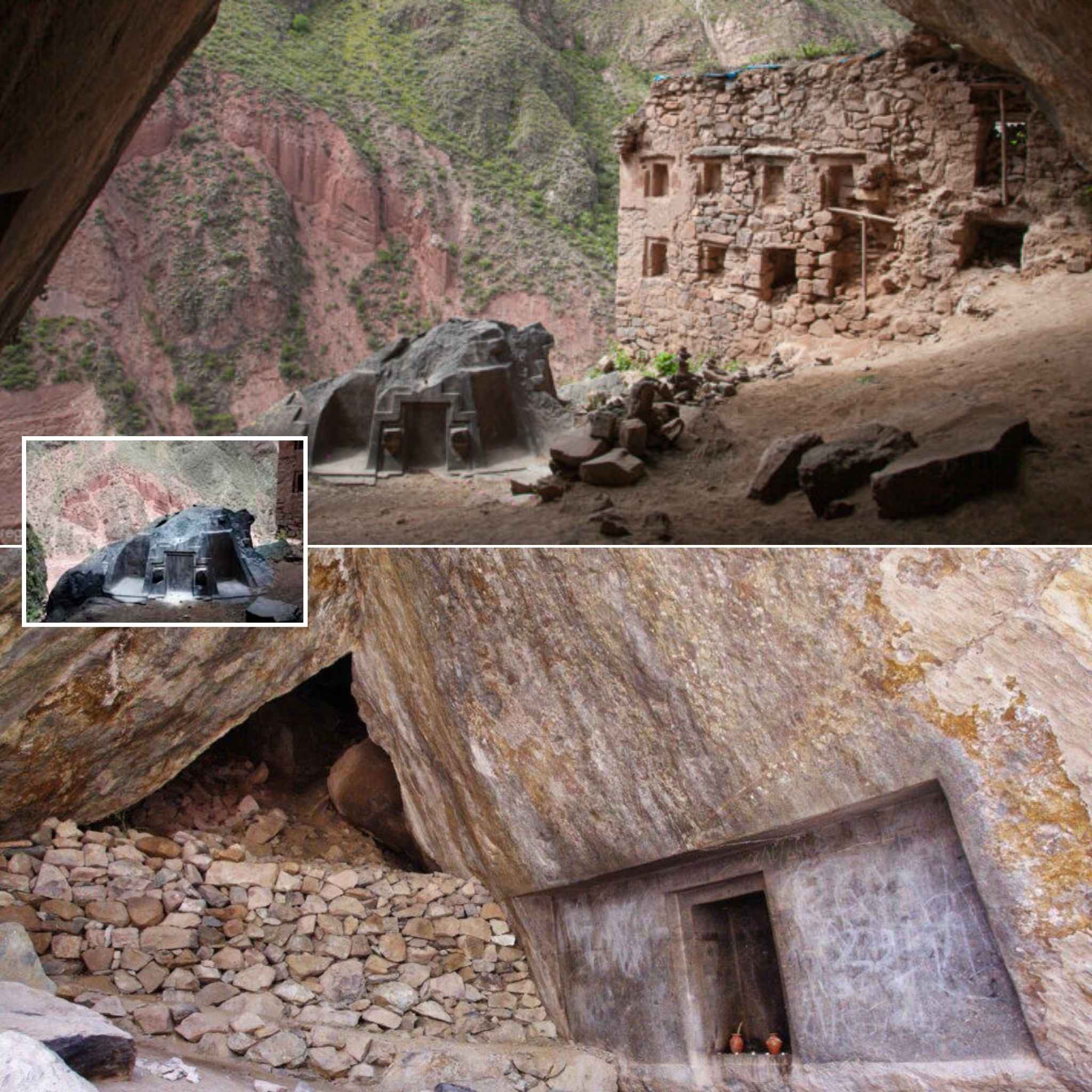
The most striking feature of Naupa Huaca is found within a naturally formed cave.
Near the entrance sits a large block of finely carved stone that immediately stands apart from the surrounding geology.
The stone has been shaped into a complex architectural form featuring:
- Perfectly flat surfaces
- Sharp internal angles
- Smooth polished faces
- Carefully proportioned recesses
- Symmetrical geometric lines
The craftsmanship is remarkable.
Visitors often compare the stonework to that found at famous sites such as:
- Ollantaytambo
- Sacsayhuamán
- Machu Picchu
- Puma Punku in Bolivia
Like these sites, Naupa Huaca demonstrates a sophisticated understanding of stone shaping and finishing.
Although some popular writers describe the cuts as “impossible,” archaeologists note that ancient Andean builders were highly skilled stoneworkers capable of achieving extraordinary precision using techniques developed over centuries.
The site nevertheless remains impressive because of the level of refinement visible in such a remote location.

The Enigmatic False Door
Perhaps the most intriguing element of Naupa Huaca is the so-called “false door.”
Carved directly into the rock face, this recessed rectangular feature resembles a doorway.
Yet it does not lead anywhere.
The doorway opens onto solid stone.
False doors are not unique to Peru.
They appear in numerous ancient cultures around the world, often carrying symbolic rather than practical significance.
In ancient Egypt, for example, false doors were commonly installed in tombs. Egyptians believed these portals allowed the spirit of the deceased to move between the physical world and the spiritual realm.
The presence of a similar feature at Naupa Huaca has led some researchers to suggest that it may have served a ritual or symbolic purpose.
Rather than functioning as a literal entrance, it may have represented a threshold between worlds.
Within Andean cosmology, concepts of transition between different realms of existence were extremely important.
Many sacred locations were viewed as points of contact between:
- The world of humans
- The world of ancestors
- The world of divine beings
The false door may have embodied such beliefs.
The Sacred Geography of the Andes
To understand Naupa Huaca, it is essential to understand the worldview of the people who inhabited the Andes.
For many ancient Andean cultures, the landscape itself was sacred.
Mountains, caves, rivers, springs, and unusual rock formations were considered living entities imbued with spiritual power.
Caves held particular importance.
Across the Andes, caves were associated with:
- Origins of ancestral groups
- Birthplaces of deities
- Entrances to the underworld
- Ritual initiation spaces
The Inca believed that some of their ancestors emerged from sacred caves during the creation of the world.
As a result, caves frequently became pilgrimage destinations and ceremonial centers.
Naupa Huaca’s natural cavern may have possessed spiritual significance long before any stone carving took place.
The builders may have selected the location because it was already considered sacred.
Who Built Naupa Huaca?
The question of who built Naupa Huaca remains a subject of debate.
Mainstream archaeology generally attributes the site to the Inca period or to cultures that immediately preceded the Inca.
However, there is no definitive inscription identifying the builders.
The architectural style shares characteristics with other elite Andean stonework.
These similarities suggest connections with traditions that flourished in the Sacred Valley during the Late Intermediate Period and the Inca Empire.
Some researchers have proposed that Naupa Huaca may have been a ritual sanctuary used by priests, nobles, or pilgrims.
Others suggest it served as a ceremonial stop along sacred routes connecting important religious centers.
Unlike popular claims circulating online, there is currently no evidence that the site was constructed by a lost global civilization or by technologically advanced prehistoric cultures unknown to archaeology.
What the site does demonstrate is the extraordinary sophistication of ancient Andean engineering.
Sound, Acoustics, and Ritual Experience
One of the most fascinating aspects of Naupa Huaca is its acoustic environment.
Visitors frequently report unusual sound behavior inside the cave.
Voices echo differently than expected.
Certain tones resonate strongly.
The stone surfaces appear to reflect and concentrate sound waves.
This has led some researchers to investigate whether the site was intentionally designed to enhance ritual experiences.
Ancient cultures around the world often incorporated acoustics into sacred architecture.
Examples include:
- Egyptian temples
- Greek theaters
- Mayan ceremonial complexes
- Prehistoric stone circles
Sound played an important role in religious ceremonies because it could create powerful emotional and psychological effects.
At Naupa Huaca, chanting, music, and ritual speech may have been amplified by the natural geometry of the cave.
Such experiences could have reinforced the perception that participants were entering a sacred realm.
Legends of Viracocha
Many discussions of Naupa Huaca involve the legendary Andean creator deity Viracocha.
According to Inca traditions, Viracocha emerged after a primordial flood and brought order to the world.
He taught people various skills and traveled across the Andes performing miraculous acts before disappearing toward the Pacific Ocean.
Some local legends describe ancient builders possessing extraordinary abilities to move and shape stone.
These stories have inspired speculation about forgotten technologies.
However, myths should not automatically be interpreted as historical accounts.
Instead, they offer valuable insight into how ancient peoples understood their world.
The association of Naupa Huaca with Viracocha highlights the site’s spiritual importance rather than providing direct evidence of its construction.
Comparisons with Other Ancient Sites
Naupa Huaca is often compared to several famous archaeological locations.
Among the most frequently cited are:
- Puma Punku in Bolivia
- Sacsayhuamán in Peru
- Ollantaytambo in Peru
- The Valley Temple at Giza in Egypt
These comparisons usually focus on similarities in stoneworking precision.
While such parallels are interesting, archaeologists caution against assuming direct connections.
Different cultures can independently develop similar architectural solutions when working with stone.
The desire for smooth surfaces, right angles, and durable construction naturally leads skilled builders toward comparable techniques.
Nevertheless, the comparisons underscore an important point:
Ancient civilizations were often far more technologically capable than they are sometimes given credit for.

Modern Research and Ongoing Questions
Despite growing interest, Naupa Huaca remains understudied compared to Peru’s larger archaeological sites.
Modern technologies such as:
- 3D scanning
- Photogrammetry
- Geological analysis
- Acoustic mapping
could help researchers better understand the site’s construction and function.
Several important questions remain unanswered:
- When was the site first created?
- Was it used continuously over centuries?
- Which groups conducted ceremonies there?
- What role did it play within regional religious networks?
- Why was such precise stonework employed in a relatively small sanctuary?
Future research may provide clearer answers.
For now, many aspects of Naupa Huaca remain open to interpretation.
A Monument to Ancient Andean Knowledge
The mystery of Naupa Huaca has inspired countless theories.
Some are grounded in archaeology.
Others venture into speculation about lost civilizations, hidden technologies, or forgotten global connections.
Yet even without extraordinary explanations, the site remains remarkable.
Naupa Huaca demonstrates the skill, creativity, and spiritual sophistication of the peoples who once inhabited the Andes.
Its carefully carved stone surfaces, symbolic architecture, and dramatic mountain setting reveal a culture deeply engaged with both the physical and sacred dimensions of the landscape.
Rather than evidence of a lost technological civilization, Naupa Huaca may offer something equally fascinating: a glimpse into how ancient societies transformed natural places into powerful centers of ritual and meaning.
Thousands of years after its creation, the sanctuary continues to inspire wonder.
Standing before its mysterious false doorway, visitors are reminded that some of the most profound archaeological discoveries do not provide simple answers.
Instead, they invite us to ask better questions about the people who came before us and the worlds they imagined among the mountains of the Andes.