Pompeii, the ancient Roman city buried by the eruption of Mount Vesuvius in 79 CE, has fascinated scholars and the public for centuries because the volcanic ash preserved buildings, artifacts, and even the forms of people who died in the disaster. Traditionally, archaeologists and restorers interpreted the plaster casts made from the voids left by decomposed bodies based on physical appearance, positioning, and contextual clues such as jewelry or who was near whom.

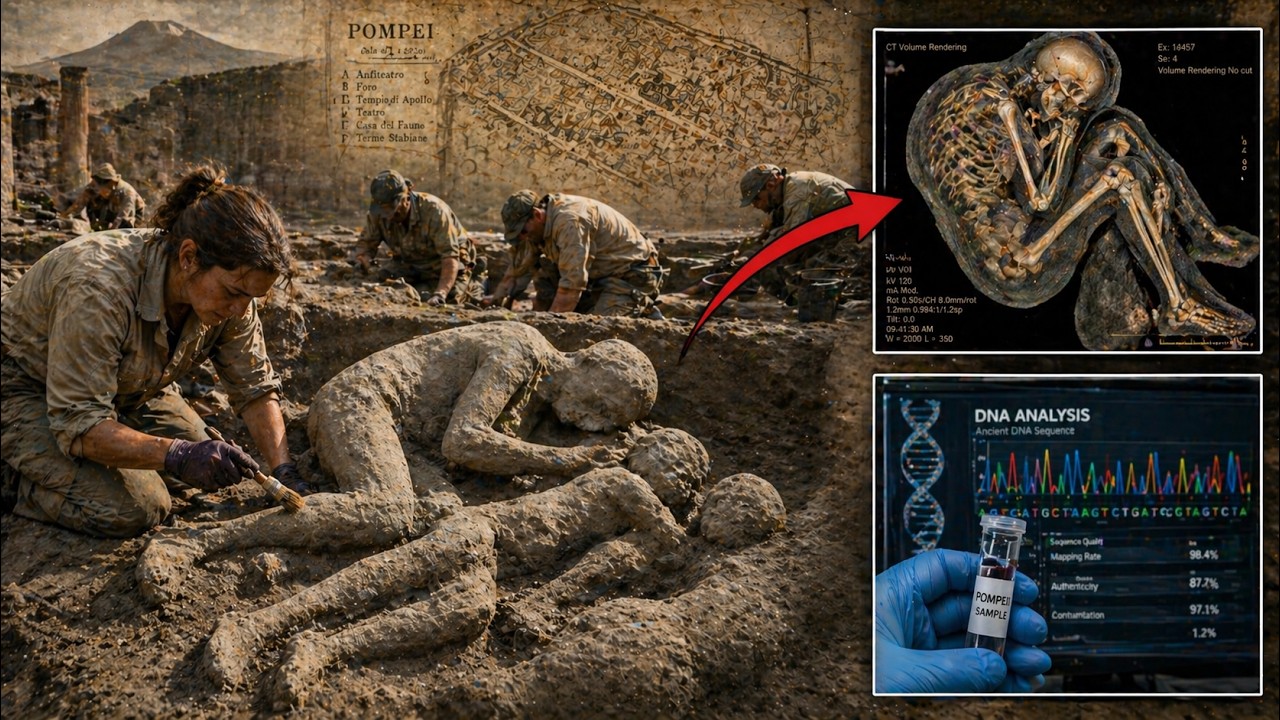
However, a study published in Current Biology in late 2024 used ancient DNA extracted from skeletal remains encased within these plaster casts to test assumptions about sex, relationships, and ancestry. The team, including scientists from the University of Florence, Harvard University, and the Max Planck Institute for Evolutionary Anthropology, recovered genetic material from several individuals and found results that challenge many previous narratives.
For example, an adult once thought to be a mother because she wore a golden bracelet and appeared to hold a child was genetically identified as a male and unrelated to that child. Other groupings assumed to be family units — like two individuals lying close together interpreted as sisters or a mother and daughter — were shown to include at least one genetic male, contradicting those long‑held interpretations.
These findings illustrate how visual assumptions based on casts and context can be misleading without genetic data to confirm sex and kinship. They also highlight the cosmopolitan nature of Pompeii’s population, showing diverse genomic backgrounds typical of a city connected to trade and mobility within the Roman Empire.
Importantly, scientists stress that the DNA results do not rewrite the broad historical narrative of Pompeii’s destruction by Vesuvius, but rather refine our understanding of the individuals who lived and died there. The research underscores the value of integrating genetic analysis with archaeological interpretation to build more accurate pictures of the past.
Overall, ancient DNA from Pompeii is reshaping how researchers reconstruct identities from archaeological evidence, reminding us that assumptions about gender roles, family ties, and social status based solely on physical context may be incomplete without genetic confirmation