Officials Enforce Controversial Preferred-Lies Rule as Weather Creates Chaos at Hazeltine National
The 2026 KPMG Women’s PGA Championship at Hazeltine National Golf Club in Chaska, Minnesota, entered its final day under circumstances few could have predicted. Heavy rainfall combined with gusty winds transformed the pristine fairways and greens into a soggy, unpredictable test of skill. For Nelly Korda, world No. 1 and two-time major winner this season, the third round had already proved challenging, and the deteriorating conditions set the stage for a dramatic conclusion.

A Soaked Course and an Unusual Ruling
Broadcasts from Hazeltine on Saturday morning showcased a scene reminiscent of the toughest days on tour. Rain had saturated the fairways, puddles collected in strategic and unstrategic locations, and the normally quick greens had slowed dramatically. Broadcasters highlighted the sheer effort of course maintenance teams.
“There are 25 maintenance staff absolutely grafting to get water removed,” one announcer remarked during live coverage, noting the intensity of the clean-up operation. “This is what you don’t see very often. But listen, it is going to be preferred lies today, but obviously, the condition, they’ve had a ton of rain, it’s kind of just all soaking around everywhere, it’s very, very wet.”
With conditions this severe, tournament officials announced a delay of three hours and 30 minutes for the final round. Practice ranges opened late, and tee times were pushed back. More notably, the officials implemented the preferred-lies rule, allowing players to lift, clean, and replace their ball in designated areas, circumventing the traditional principle of playing the ball as it lies.
This temporary measure, sometimes referred to as “winter rules,” is often controversial because it alters the fundamental test of skill in golf. Purists argue that players should always contend with the lie they are given, and the use of preferred lies can diminish the challenge, particularly for those relying on precision shots from tight or tricky spots.
Why Preferred Lies Became Necessary
The decision at Hazeltine was not unprecedented, but the timing and impact sparked debate among fans and analysts alike. During the 2026 Zurich Classic in New Orleans, preferred lies were similarly implemented, while at the Chevron Championship earlier in the year, officials opted not to enforce it, resulting in muddied golf balls and erratic shots that affected play and outcomes.
At Hazeltine, the choice to allow preferred lies made logical sense. The course was no longer in conditions conducive to fair play, and without this rule, players risked making errant shots due to water-laden turf rather than misjudgments or lack of skill.
“It’s a controversial rule because it violates the fundamental golf rule of playing the ball as it lies,” one analyst noted. “But in these conditions, it becomes almost necessary to maintain a level playing field.”

Nelly Korda’s Struggle on Moving Day
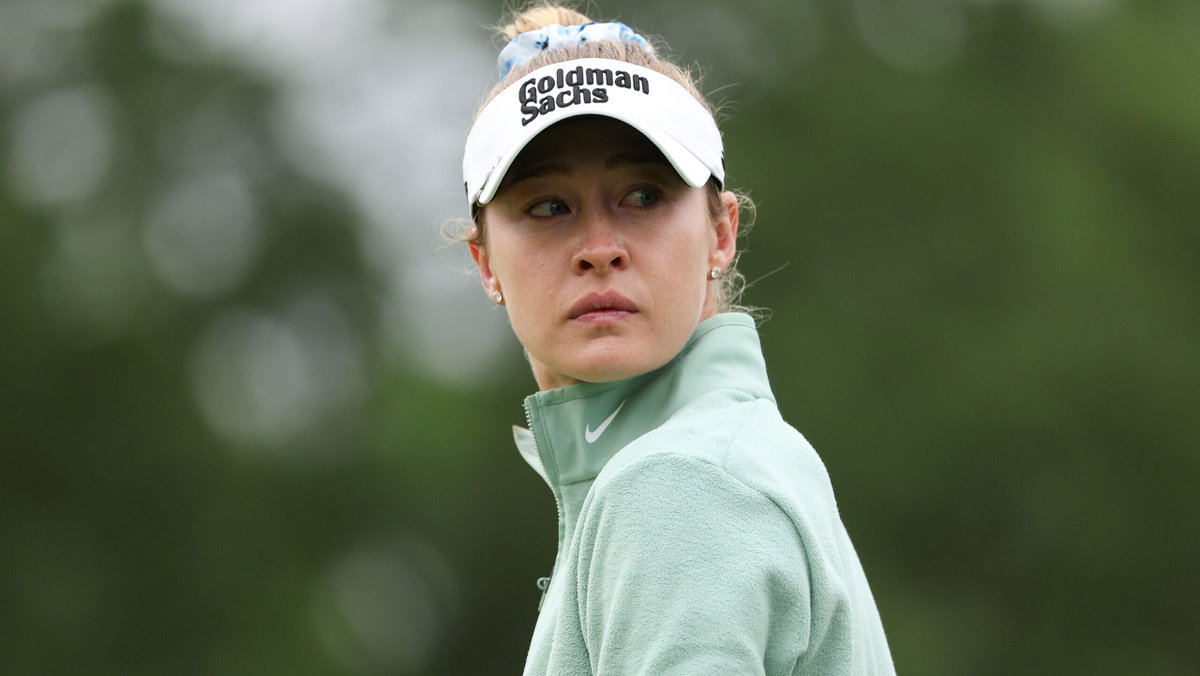
Korda, who had looked poised to contend, was among those impacted by the worsening weather. On Saturday, the World No. 1 posted a three-round total that reflected both her skill and the challenges she faced. Despite managing three birdies on the day, two bogeys combined with blustery winds resulted in a one-under 71. Her Strokes Gained (SG) metric for the round registered -1.170, placing her 55th among the field — a stark contrast to her dominant performances earlier in the season.
“The wind was off the right, and the ball wasn’t behaving as it usually does,” Korda said after her round. “You just have to adapt. It’s a different kind of challenge, and everyone has to deal with it equally.”
Even with the use of preferred lies, subtle inconsistencies in turf, wetness affecting spin, and unpredictable bounces created a tournament-wide challenge. Approach shots, normally a strength for Korda, became less predictable, while putting on greens softened by rain required adjustments in pace and line that threw off rhythm.
The Broader Impact on the Field
While Korda experienced difficulties, she was far from alone. Ina Yoon, the leader after the first two rounds, struggled to maintain her advantage, carding a three-over 75. Several players found that shots that would normally have rolled safely to the green now skidded or stopped abruptly. The leaderboard fluctuated dramatically as the day progressed, and fans watching on television saw familiar contenders suddenly fighting just to make pars.
“Hazeltine has shown its teeth today,” a commentator said. “This is the kind of day where even the best players have to reassess everything — club selection, stance, swing speed, even mental approach.”
The implementation of preferred lies added a layer of strategy. While it reduced the outright penalties from water-logged lies, it also required careful judgment about where to drop, how to approach pin positions, and which shots could be risked versus played conservatively.
Preferred Lies and Controversy
Historically, preferred-lies decisions are met with mixed reactions. Golf purists question the integrity of the competition when the ball is moved and cleaned, while others argue that extreme conditions necessitate these interventions. Hazeltine’s choice follows that line: prioritizing fair competition while challenging players to adapt in real time.
Korda’s competitors, including Hye-Jin Choi, Charley Hull, and Jeeno Thitikul, were all subject to the same rule. Analysts noted that it could level the playing field, giving those with slightly weaker approaches or putting under wet conditions a chance to maintain parity. At the same time, it allowed strong ball-strikers like Korda to mitigate some of the randomness caused by standing water or slippery turf.
“It’s not perfect, but at least it’s consistent,” a coach commented. “Everyone gets the same benefit, so the leaderboard reflects skill rather than luck with puddles.”
Strategic Implications for Korda
For Nelly Korda, the key will be staying mentally resilient. She has already won two majors in 2026 and has displayed remarkable composure under pressure. Yet conditions like Hazeltine’s moving day demand adjustments to both technique and mindset. Players must balance aggression with caution, factoring in how the ball might react differently than expected.
“It’s about keeping focus, trusting your preparation, and accepting what you can’t control,” Korda said. “I just have to stay in the moment and make smart decisions.”
Her performance under these circumstances is a testament to her growing mastery of professional golf. Maintaining concentration, course management, and technical execution in soggy, unpredictable conditions is a skill few players consistently master.
Looking Ahead
As the final round approaches, the preferred-lies rule will remain in effect until the course dries sufficiently. This places added importance on strategy, mental toughness, and adaptability. Leaders must capitalize on their strengths while mitigating the risks introduced by weather and course conditions.
For Korda, the opportunity remains. She is within striking distance of the lead, and a composed, calculated approach could see her claim yet another major. Her ability to adjust to extreme conditions, combined with her technical skill, makes her one of the few players capable of navigating the challenges Hazeltine presents on a day like this.
Conclusion
The 2026 KPMG Women’s PGA Championship at Hazeltine has become a test not only of golfing ability but of resilience and strategic thinking. With heavy rains, blustery winds, and the implementation of the preferred-lies rule, the final day presents challenges that extend beyond swing mechanics.
Nelly Korda, as world No. 1 and two-time major winner, faces these obstacles with focus and poise. While her third-round score shows the impact of conditions, the course’s challenges have set the stage for an exciting and unpredictable conclusion. How she adjusts, capitalizes on preferred lies, and navigates Hazeltine’s soaked fairways may determine not only the outcome of this major but also her place in the history of women’s golf.
In a week defined by weather, controversy, and opportunity, one thing is certain: every decision, every swing, and every putt matters.


