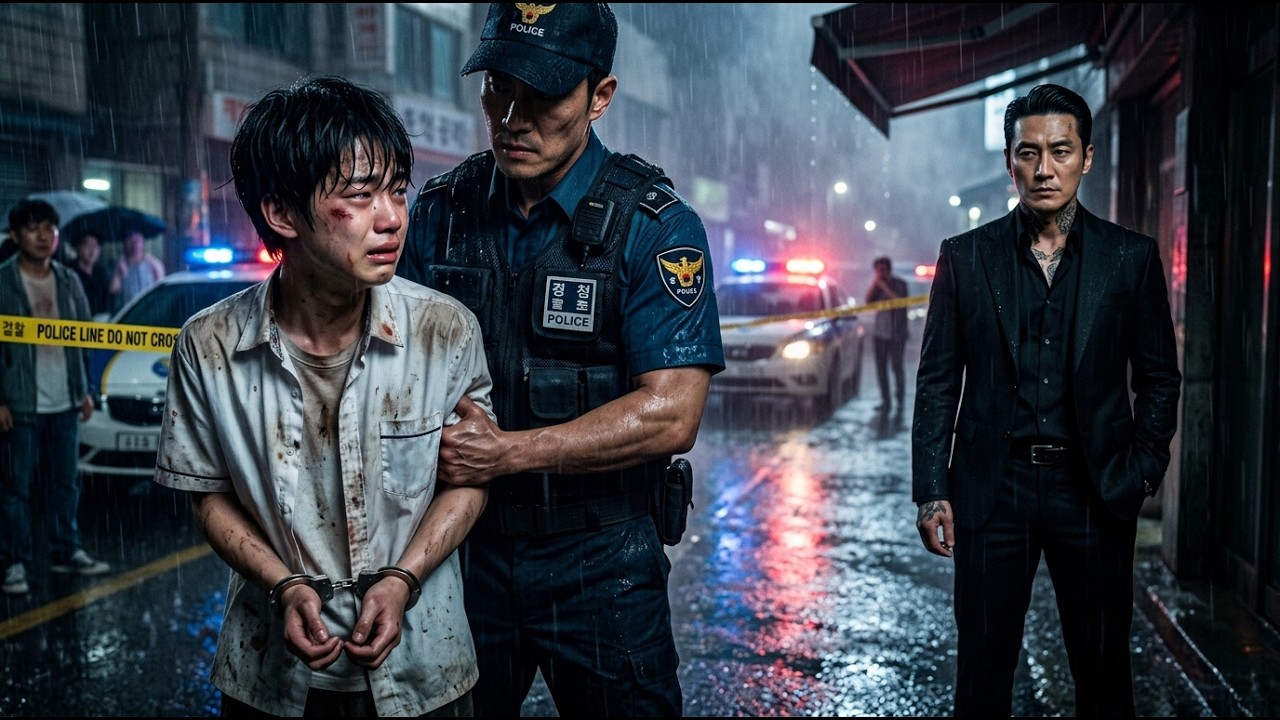
The first crack in the system wasn’t a gunshot.
It was a scream that got cut off too quickly.
Inside Precinct 47, officers later said they didn’t hear anything unusual that night—just routine noise, paperwork, radios, the hum of a building that had learned how to ignore its own guilt.
But outside, in the rain-soaked alley behind the old transit station, a teenager lay on the ground with his hands zip-tied behind his back.
His name was Seo Jun.
And by sunrise, the city would believe he was a murderer.
Captain Ryker Vance arrived at the scene before anyone else.
He always did.
Not because he was efficient.
Because he liked control.
The body had already been staged—positioned just close enough to make Jun look guilty, just messy enough to make it believable. The victim was a mid-level informant tied to three different investigations that were quietly being buried.
Perfect setup.
Perfect scapegoat.
And a perfect storm for someone like Vance, who didn’t solve cases so much as assign endings to them.
When Jun tried to speak, Vance’s boot met his ribs before the words could form.
“You think this is a game?” Vance hissed, leaning down so only Jun could hear. “You’re done before you ever started.”
Jun coughed, blood mixing with rainwater.
But he didn’t beg.
That was the first mistake Vance made.
He assumed silence meant weakness.
By morning, Seo Jun was everywhere.
On police reports.
On digital bulletins.
On news screens with red banners and carefully edited footage.
“MURDER SUSPECT IN CUSTODY”
“TEENAGE KILLER LINKED TO UNDERGROUND NETWORK”
The footage showed him being dragged into a patrol car.
Head down.
Face blurred just enough to be recognizable to anyone who wanted him to be.
And behind the cameras, Captain Vance smiled like a man watching a problem solve itself.
What no one knew was that the entire arrest had been processed in under twelve minutes.
No proper investigation.
No forensic confirmation.
No witness verification.
Just a signature on a file that had already been prepared before Jun was even taken in.
Because Vance didn’t arrest people.
He placed them.
Seo Jun sat alone in Interrogation Room 3 for six hours.
No lawyer.
No water.
No questions that mattered.
Just silence between bursts of pressure.
Every so often, Vance would enter, say nothing, and leave again—like a man checking whether his construction was still standing.
Jun’s face was swollen by the third visit.
But his eyes didn’t change.
That unsettled Vance more than anything else.
Because fear was predictable.
Defiance was manageable.
But calm—calm meant something underneath.
Something unseen.
Something waiting.
What Vance didn’t know was that Seo Jun had stopped being just a teenager the moment the cuffs clicked.
He had become a signal.
And signals are never alone.
The call came at 3:17 a.m.
Not to the precinct.
Not to the media.
Not to any official channel.
It came directly to Captain Vance’s private encrypted line.
He hesitated before answering.
That was unusual for him.
The voice on the other end was quiet.
Controlled.
Almost polite.
“Release my son.”
Vance frowned. “Who is this?”
A pause.
Then the answer:
“Kang Jae-min.”
The name didn’t need introduction.
But Vance still smiled.
Not because he was brave.
Because he thought names were equal to leverage.
“You’re too late,” Vance said. “Your son’s already been processed.”
Silence followed.
Not empty silence.
Measuring silence.
Then Jae-min spoke again.
“I’m not asking.”
And the line disconnected.
The first sign that something was wrong came ten minutes later.
The precinct communications went dark.
Not offline.
Not malfunctioning.
Just… absent.
Radios stopped working mid-sentence.
Servers froze without crashing.
Phones displayed service but refused to connect to anything inside the building.
It was as if the precinct had been cut out of the world without touching a single physical wire.
Then came the vehicles.
Black SUVs forming a silent perimeter around the entire block.
No sirens.
No announcements.
Just engines idling like patient threats.
By the time Captain Vance stepped outside, the building no longer belonged to him.
It belonged to distance.
Inside the command room, panic tried to organize itself into procedure.
It failed.
Because every attempt to contact external units returned nothing.
No backup.
No jurisdictional override.
No command escalation.
Just blank silence.
And then the screens changed.
One by one.
Replacing police data with live footage.
Footage from inside the precinct.
From cameras no one remembered installing.
And at the center of every feed—
Seo Jun.
Being beaten.
Being dragged.
Being framed.
Every angle.
Every moment.
Unedited.
Unavoidable.
Captain Vance felt something he hadn’t felt in years.
Not fear.
Disruption.
Because systems were supposed to obey hierarchy.
And this system was no longer responding to him.
He turned slowly.
And saw the door open.
Not kicked in.
Not forced.
Just open.
As if it had decided it no longer needed permission to exist.
And through it walked Kang Jae-min.
There was no dramatic entrance.
No entourage.
No shouting.
Just a man who looked like he had already finished the conversation everyone else was still preparing for.
He glanced at Vance.
Then at the room.
Then at the screens.
“You used my son,” Jae-min said quietly.
Vance tried to recover control through tone.
“This is a legal matter—”
“No,” Jae-min interrupted. “It’s a correction.”
And that was when the precinct’s financial systems began collapsing.
Not metaphorically.
Literally.
Bank accounts tied to Captain Vance froze first.
Then dissolved access.
Then reclassified.
Then vanished.
Years of “unexplained wealth” evaporated in under sixty seconds.
Properties.
Shell accounts.
Offshore holdings.
All of it flattened into nothing that could be legally recognized.
Vance reached for his phone.
Dead.
He turned to his officers.
None of them met his eyes.
Because they were watching the screens.
And on the screens, they were watching themselves.
Seo Jun was not in his cell anymore.
That realization came too late for everyone inside the building.
Because Jun had never been held where they thought he was.
The interrogation room had been part of the performance.
A controlled space inside a controlled system.
But systems can be mapped.
And systems can be rerouted.
What the precinct thought was custody was actually extraction.
And what they thought was control was actually surveillance reversal.
Every confession Vance believed he had extracted…
Had been recorded.
Every threat.
Every strike.
Every falsified report.
All of it had already been transferred outside the system before Jun ever touched the interrogation chair.
The twist didn’t announce itself.
It unfolded in pieces.
First: a security feed showed Jun standing—not restrained—inside a secondary holding corridor.
Second: officers realized the “victim” in the alley had been alive when recovered.
Third: forensic data began correcting itself in real time.
Autopsy reports changing.
Time of death recalculated.
Evidence logs reclassified.
Captain Vance’s narrative wasn’t being disproven.
It was being overwritten.
And then the final piece arrived.
A recording.
Jun’s voice.
Clear.
Unbroken.
“I’m sorry it had to reach this point,” he said.
Vance froze.
Because that wasn’t the voice of a victim.
It was the voice of someone participating.
Jun continued.
“But I needed you to show who you really are.”
Silence in the precinct shifted.
Not confusion anymore.
Recognition.
Kang Jae-min finally stepped closer to Vance.
Not aggressively.
Not hurried.
Just close enough for authority to stop pretending it was equal.
“You didn’t frame my son,” Jae-min said softly.
A pause.
“You helped prove a pattern.”
Vance’s expression tightened. “This is entrapment.”
Jae-min looked at him.
For the first time, something like exhaustion crossed his face.
“No,” he said. “This is documentation.”
And then the screens shifted again.
Not to surveillance.
But to history.
Cases.
Names.
Reports.
Dozens of them.
Hundreds.
All linked.
All connected.
All traced back to Captain Ryker Vance’s decisions.
Not isolated misconduct.
A structure.
A pattern of targeting vulnerable individuals and fabricating narratives to protect higher interests within the precinct.
Vance took a step back.
“No…” he whispered. “That’s not—”
But even he could hear it now.
The room was no longer denying it.
Only confirming it.
The moment of recognition didn’t belong to Vance alone.
It belonged to everyone watching their own complicity become visible.
One officer dropped his radio.
Another stepped back from the console.
No shouting.
No rebellion.
Just the slow realization that the building they worked in had been serving something other than justice.
And that something had just been removed from power.
Captain Vance turned sharply.
“You think this is justice?” he snapped at Jae-min. “You’re just another criminal playing god with systems you don’t understand.”
Jae-min didn’t react immediately.
Then he said:
“I don’t need to understand your system.”
A pause.
“I just needed to remove it from mine.”
That was worse than anger.
Because it wasn’t emotional.
It was final.
Outside, the black SUVs began to withdraw.
Not in retreat.
In completion.
The perimeter dissolved like it had never existed.
No violence.
No pursuit.
No spectacle.
Just absence.
And absence, in systems built on control, is the most terrifying consequence of all.
Seo Jun was brought into the room moments later.
Not dragged.
Not escorted in chains.
But walking.
His wrists were free.
His posture steady.
And his eyes—no longer those of a boy accused of murder.
But of someone who had already seen the entire shape of the lie built around him.
He stopped when he saw Vance.
For a moment, neither of them spoke.
Vance looked at him like he was trying to find the version of reality that still made him right.
But there wasn’t one.
Jun spoke first.
“You didn’t break me,” he said quietly.
A pause.
“You just exposed yourself faster.”
Vance’s jaw tightened.
But nothing came out.
No defense.
No denial.
Because everything had already been spoken on his behalf.
Kang Jae-min stepped beside his son.
Not above him.
Not behind him.
Beside him.
And placed a hand on his shoulder.
Not possessive.
Not controlling.
Anchoring.
“Are you hurt?” he asked softly.
Jun hesitated.
Then shook his head.
“No.”
A pause.
Then:
“But I understand things now.”
Jae-min nodded once.
“That was the point.”
Captain Vance was not arrested in the traditional sense.
There were no handcuffs.
No courtroom spectacle.
No dramatic resistance.
Because by the time external authorities arrived, there was nothing left for him to control.
His assets were gone.
His authority was voided.
His records were rewritten into evidence chains he could not escape.
He wasn’t taken away as a powerful man.
He was processed as an empty one.
A name without structure.
A role without system.
A ghost created by the removal of everything that once gave him weight.
The emotional landing didn’t come from revenge.
It came from correction.
Kang Jae-min didn’t burn the precinct.
He didn’t destroy the city.
He didn’t turn violence into spectacle.
He removed the illusion that power and corruption were the same thing.
And in doing so, he exposed how fragile both actually were.
Months later, Seo Jun stood outside a rebuilt precinct facility.
Not as a suspect.
Not as a symbol.
But as a witness in a case that had rewritten multiple departments.
Media tried to frame it as mafia intervention.
Authorities tried to frame it as illegal interference.
But neither narrative stuck for long.
Because too many records had been changed.
Too many systems had been exposed.
Too many people had seen what actually happened.
And somewhere inside all of it, Captain Ryker Vance became something worse than infamous.
He became irrelevant.
Not remembered.
Not feared.
Just absent from every structure that once gave him identity.
The final truth wasn’t about a mafia boss.
Or a corrupt captain.
Or a framed boy.
It was about what happens when a system believes it is untouchable.
And discovers, too late, that it was only ever being observed.
Because in the end, Kang Jae-min didn’t destroy the precinct.
He simply proved it could be turned off.
And Seo Jun—standing beside him in silence—had already learned the most dangerous lesson of all:
Sometimes justice doesn’t arrive as punishment.
Sometimes it arrives as correction so complete… that nothing broken is allowed to remain the same again.
And the question left hanging in the air wasn’t about Vance.
It was about every system still operating on the belief that no one is watching closely enough to rewrite it.


