 The billionaire owner walked into his own hotel dressed like a homeless man, and the first thing his manager said was, “Stop. This hotel is not a shelter.”
The lobby of The Royal Marcellus was full that evening.
Golden chandeliers glowed above polished marble floors. A pianist played softly beside the lounge. Guests in tailored suits and silk dresses moved between velvet chairs, glass elevators, and a reception desk trimmed in brushed gold. Bellmen guided designer luggage across the lobby like it was precious cargo.
Everything looked perfect.
That was the problem.
Perfection can hide rot.
The old man entered quietly through the revolving doors just after 6 p.m.
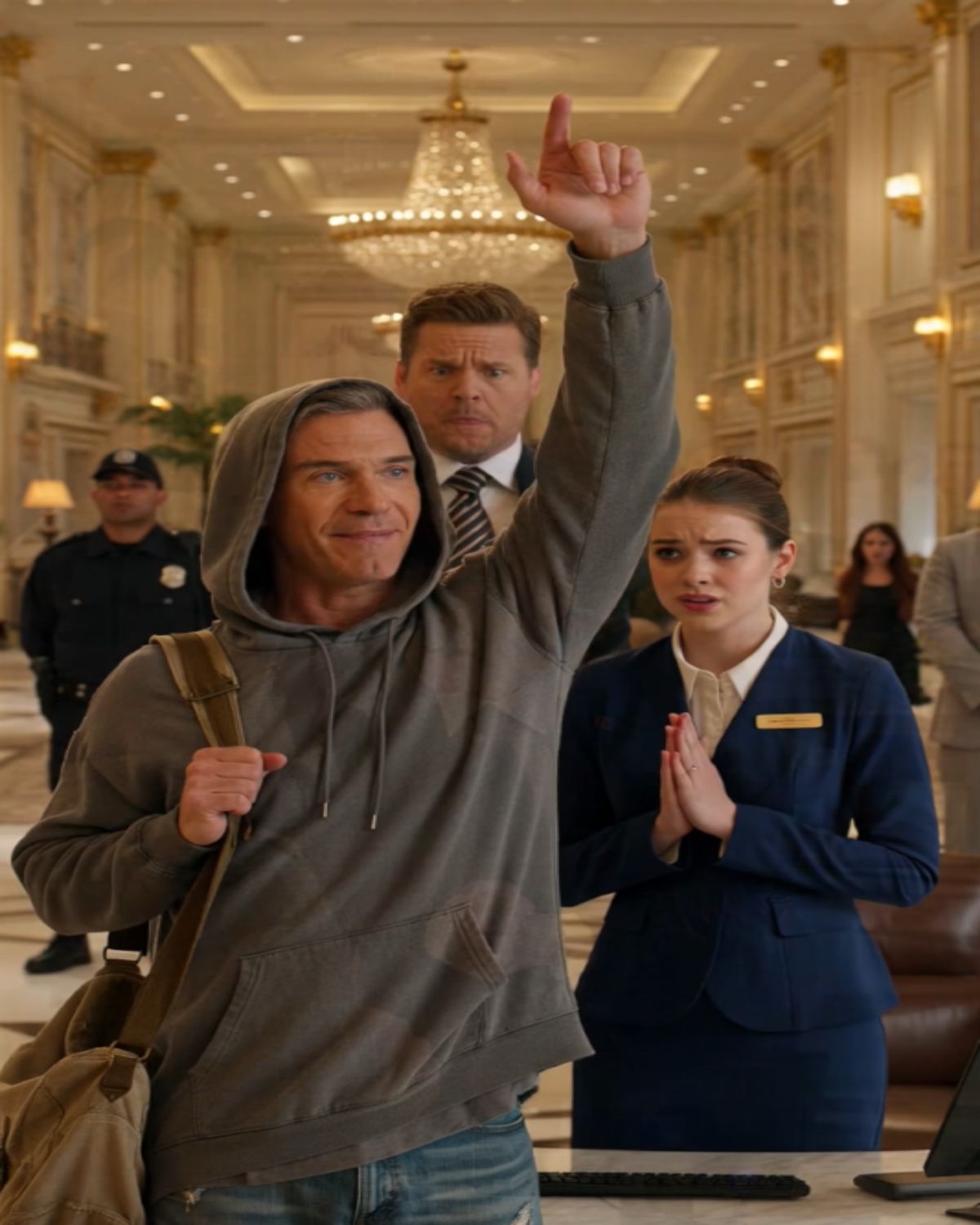
His gray coat was torn at the sleeve. His shoes were dusty. A faded hood covered most of his face, and in his hand, he carried a worn-out brown bag that looked as if it had been dragged across half the city.
Several guests noticed him immediately.
A woman near the fountain pulled her purse closer.
A man at the concierge desk frowned.
One security guard placed a hand near his radio.
Behind the reception desk, a young receptionist named Lily Park saw him and stepped forward.
“Good evening, sir,” she began gently. “May I help—”
“Stop.”
The voice came from the center of the lobby.
Victor Harlan, the hotel’s general manager, walked toward the old man with the slow confidence of someone who believed the building belonged to him.
Victor was immaculate.
Black suit. Silver tie. Polished shoes. A gold name badge. His hair was perfectly styled, and his expression was cold enough to make junior staff lower their eyes before he even spoke.
He looked at the old man’s dirty coat.
Then at the worn-out bag.
Then at the muddy shoes standing on his marble floor.
“This hotel is not a shelter,” Victor said.
The lobby quieted.
Not completely.
But enough.
The pianist’s music suddenly felt too loud.
The old man stood still.
“I just need to speak with the manager,” he said softly.
Victor laughed.
A short, sharp laugh.
The kind meant to humiliate, not entertain.
“You’re looking at him,” Victor said. “Now leave before you scare our guests.”
A few people near the lounge turned away, pretending not to hear.
Lily’s face tightened.
She had worked at The Royal Marcellus for only seven months, but she already knew the rhythm of Victor’s cruelty. He never shouted unless there was an audience. He never insulted people unless he believed they could not answer back. And he always used the same words afterward.
Protecting the brand.
Maintaining standards.
Managing guest experience.
But Lily had learned that some people used polished language to hide ugly behavior.
She looked at the old man’s hands.
They were steady.
Not trembling.
Not begging.
Just steady.
“Sir,” she whispered to Victor, “maybe we should help him.”
Victor turned slowly.
His smile disappeared.
“Help him outside.”
Lily swallowed.
The old man looked at her for a second, and something in his eyes softened.
He had come to The Royal Marcellus expecting answers.
He had not expected to find one so quickly in the face of a frightened receptionist.
His name was Arthur Kingsley.
Most people in the hospitality world knew him as Chairman Kingsley, founder and majority owner of the Kingsley Grand Collection, a luxury hotel group worth billions. The Royal Marcellus was its crown jewel, a seven-star property known for presidents, movie stars, billion-dollar negotiations, and weddings where flowers cost more than family homes.
But Arthur had not always lived around marble and chandeliers.
He had grown up above his parents’ laundry shop. His first job was carrying towels up three flights of stairs in a small seaside motel. At seventeen, he learned that people were at their most vulnerable when they traveled. They were tired. Lost. Delayed. Grieving. Celebrating. Alone. Afraid.
His mother used to tell him, “A hotel is not a building. It is a promise that someone will be treated with care while they are away from home.”
Arthur built his company on that sentence.
For decades, it worked.
Staff were trained to greet delivery drivers as respectfully as diplomats. Housekeepers were paid properly. Guests were judged by conduct, never clothing. Security was there to protect people, not intimidate them.
But over the past year, reports from The Royal Marcellus had changed.
Not the official reports.
Those were beautiful.
Revenue was up. VIP ratings were strong. The lobby had been renovated. Influencers posted videos beneath the chandelier. The board praised Victor Harlan for “restoring exclusivity.”
But Arthur had received different messages.
A retired teacher wrote that she had been ignored because she arrived in a raincoat and old shoes.
A delivery driver said he was forced to enter through the basement even when bringing medicine to a guest.
A former bellman wrote, “Mr. Harlan says kindness should be reserved for guests who improve the image of the hotel.”
Then came the message Arthur could not forget.
It was from an employee who did not sign their name.
“Chairman, your hotel still looks rich, but it no longer feels human.”
Arthur printed that email and placed it in his coat pocket.
Then he did something his executives would have tried to stop.
He put on old clothes.
He borrowed a worn-out bag.
He told his driver to drop him three blocks away.
And he walked into his own hotel through the front door.
Now Victor Harlan was standing in front of him, proving the email true.
Victor raised a hand toward security.
“Escort him out.”
The security guard near the elevator hesitated.
His name was Daniel Reyes, and he had worked in hotels long enough to know when an order felt wrong. The old man had not shouted. He had not threatened anyone. He had simply asked to speak with the manager.
But Daniel also knew Victor.
One wrong move, and Daniel would lose the best shift schedule. Maybe his job.
“Sir,” Daniel said quietly to Arthur, “please come with me.”
Arthur looked at him.
“Have I broken a rule?”
Daniel’s jaw tightened.
Victor snapped, “He is disturbing guests.”
Arthur glanced around.
“I have spoken only to you.”
A few guests shifted uncomfortably.
Lily looked down, then back up again.
Something in her face changed.
Fear was still there.
But so was anger.
Victor stepped closer to Arthur.
“You people always come in here with a story,” he said. “A sick relative. A lost wallet. A room you supposedly booked. I know the game.”
The words hit the lobby harder than he expected.
Even a man near the bar stopped raising his glass.
Arthur’s voice stayed calm.
“What game do you think I am playing?”
Victor looked him up and down.
“The one where you hope someone feels sorry for you.”
Arthur nodded slowly.
“And would that be so terrible?”
Victor blinked.
Arthur continued, “Would it damage this hotel if one employee felt sorry enough to ask my name?”
Victor’s face hardened.
He did not like questions that made him look small.
“This conversation is over,” he said.
He reached for Arthur’s bag.
Lily suddenly stepped out from behind the desk.
“Mr. Harlan, please don’t touch his belongings.”
Victor turned on her.
“Go back to your station.”
“But he hasn’t done anything.”
The room froze.
Everyone heard it.
Lily seemed shocked by her own courage, but she did not move.
Victor’s eyes narrowed.
“You are one sentence away from unemployment.”
Arthur looked at Lily again.
He would remember her name.
Before Victor could say more, the private elevator at the far side of the lobby opened with a soft chime.
A man in a navy overcoat stepped out quickly, followed by two assistants.
It was Martin Crowe, Senior Executive Vice President of Kingsley Grand Collection.
He had been in a meeting upstairs when Arthur’s driver called him in a panic.
“The chairman is not answering his phone,” the driver had said. “He told me not to interfere, but I think he went into the hotel dressed… strangely.”
Martin understood immediately.
And his stomach dropped.
Now he moved through the lobby fast, scanning faces until he saw the old man in the torn gray coat standing near the front desk.
Martin stopped.
His eyes widened.
For one second, he looked like he had forgotten how to breathe.
Then he walked directly to Arthur and bowed his head deeply.
“Mr. Chairman,” Martin said, voice tight with shock. “Why are you dressed like this?”
The lobby went silent.
Completely silent.
The pianist’s hands stopped above the keys.
Lily covered her mouth.
Daniel, the security guard, stepped back.
Victor stared at Martin.
Then at Arthur.
Then back at Martin.
“Mr… Chairman?” Victor whispered.
Arthur slowly removed his hood.
The gray-haired man beneath it was not a beggar.
Not a wanderer.
Not a threat to the hotel’s image.
He was Arthur Kingsley, the billionaire chairman whose portrait hung in the executive corridor upstairs.
The owner of the building.
The founder of the company.
The man whose name was printed on Victor Harlan’s employment contract.
The color drained from Victor’s face.
It began at his cheeks, then his lips, then his eyes.
The arrogance that had filled his body moments earlier seemed to leak out of him until only panic remained.
He opened his mouth.
Nothing came out.
That was the moment everyone saw him recognize the truth.
Not just that the old man was powerful.
But that Victor had revealed himself before knowing who he was insulting.
Arthur folded the hood back from his coat and looked around the lobby.
At the guests staring in shock.
At the staff who looked frightened, ashamed, and relieved all at once.
At Lily, standing a few feet from the desk with tears in her eyes.
At Daniel, whose hand had finally fallen away from his radio.
Then Arthur looked at Victor.
“I came to see the truth,” he said calmly. “And now I have.”
Victor swallowed.
“Chairman Kingsley, I didn’t know it was you.”
Arthur held his gaze.
“That is the problem.”
Victor blinked quickly.
“I would never have spoken that way if—”
“If you knew I was rich?” Arthur asked.
Victor went silent.
The question exposed him more completely than an accusation could have.
Martin Crowe looked like he wanted to disappear into the marble floor.
Arthur turned slightly toward him.
“Martin, how many complaints have reached your office about this property?”
Martin hesitated.
Arthur’s expression did not change.
Martin answered.
“Several, sir.”
“How many involved appearance-based treatment?”
Martin looked down.
“More than several.”
Victor quickly stepped forward.
“Sir, those complaints were exaggerated. We have a responsibility to protect the atmosphere of a seven-star property. Certain individuals enter just to loiter, disturb guests, and create problems.”
Arthur looked at Lily.
“Did I create a problem?”
Lily shook her head.
“No, sir.”
Her voice was small, but clear.
Arthur looked at Daniel.
“Did I threaten anyone?”
“No, sir,” Daniel said.
“Did I refuse a reasonable instruction?”
Daniel swallowed.
“No, sir.”
Arthur turned back to Victor.
“Then what were you protecting the hotel from?”
Victor’s mouth tightened.
He glanced at the guests.
At Martin.
At the staff.
At the chandelier above him.
But there was no good answer.
Because the honest answer was simple.
He had been protecting the hotel from people who looked poor.
Arthur took one step closer.
“My mother cleaned hotel linens until her hands cracked in winter,” he said. “My father wore the same coat for twelve years so he could pay wages on time. The first guests who kept this company alive were construction workers, nurses, widows, drivers, and families who counted bills at the front desk.”
The lobby did not move.
“And you stood in my lobby and decided a man in old clothes was not worthy of a question.”
Victor’s face tightened.
“Sir, I apologize.”
Arthur studied him.
“No. You are embarrassed.”
Victor flinched.
“There is a difference.”
The sentence landed with quiet force.
Martin stepped forward carefully.
“Chairman, we can move this conversation upstairs.”
Arthur looked at him.
“No. This began in the lobby.”
Martin stopped.
Arthur turned back to Victor.
“Public disrespect does not deserve private accountability.”
A woman near the lounge nodded slowly.
A bellman lowered his eyes.
Lily wiped one tear quickly, hoping nobody noticed.
Arthur noticed.
“Miss,” he said gently, “what is your name?”
She straightened. “Lily Park, sir.”
“How long have you worked here?”
“Seven months.”
“Were you trained to send people outside before asking their names?”
Lily’s lips trembled.
“No, sir.”
Victor’s head turned sharply.
“Lily.”
Arthur’s voice cut through the air.
“Do not speak to her.”
Victor froze.
For the first time that evening, he obeyed instantly.
Arthur looked back at Lily.
“Tell me the truth.”
The entire lobby seemed to hold its breath.
Lily clasped her hands in front of her.
“Mr. Harlan tells us to protect the visual standard of the lobby,” she said. “He says guests pay for exclusivity. If someone looks homeless, poor, or out of place, we are supposed to redirect them before they reach the desk.”
Martin’s face darkened.
Arthur remained still.
“Is that written policy?”
“No, sir. But everyone knows it.”
Arthur looked at Daniel.
“Is that accurate?”
Daniel nodded once.
“Yes, sir.”
Victor’s voice cracked. “This is being taken out of context. We have had incidents.”
Arthur turned to him.
“Security handles behavior. Hospitality does not punish appearance.”
Nobody spoke after that.
Because it was the kind of sentence that did not need decoration.
Arthur reached into the inside pocket of his torn coat and removed a folded paper.
He opened it slowly.
“This email came to me three weeks ago,” he said. “It says, ‘Your hotel still looks rich, but it no longer feels human.’”
Several employees looked up sharply.
Someone had written it.
Everyone had lived it.
Arthur folded the paper again.
“I wanted to know whether it was true.”
He looked around the lobby.
“Tonight, I do.”
Victor’s face had gone gray.
“Chairman, please. I have increased revenue by eighteen percent. VIP retention is the highest in five years. We have won awards under my management.”
Arthur nodded.
“Yes. You polished the surface.”
Victor looked hopeful for half a second.
Then Arthur said, “And poisoned the foundation.”
The hope disappeared.
Arthur turned to Martin.
“Secure all lobby footage from tonight. Pull every guest complaint dismissed by this management team in the last twelve months. Pull staff turnover, disciplinary actions, security removal records, and internal messages referencing lobby standards.”
Martin nodded quickly. “Yes, sir.”
Victor stepped forward.
“Chairman Kingsley, please. This can be corrected. I can retrain the staff.”
Arthur looked at him with quiet disbelief.
“You trained them to be afraid.”
Victor had no answer.
Arthur pointed toward the entrance.
“You’re fired.”
The words were not shouted.
They did not need to be.
They traveled across the marble floor with more force than anger ever could.
Victor stared at him.
“Sir…”
“Effective immediately.”
Martin signaled to the senior security supervisor, who had just arrived near the elevators.
Victor looked around the lobby one final time.
Only minutes earlier, he had stood in the center of it like a king.
Now the room gave him nothing back.
No loyalty.
No defense.
No sympathy.
The receptionists watched him with tight faces.
The bellmen watched silently.
Daniel stood still near the elevator.
Lily looked down, not out of fear now, but because she did not want to enjoy someone else’s fall.
That was the worst part for Victor.
He had mistaken obedience for respect.
He had mistaken silence for agreement.
He had mistaken a title for character.
The senior security supervisor approached him.
“Mr. Harlan, please come with us.”
Victor removed his gold name badge slowly.
His hand shook.
He placed it on the reception counter, where it made a small metallic sound.
Then he walked toward the same revolving doors he had ordered Arthur to use.
No one stopped him.
No one followed him except security.
When the doors closed behind him, the lobby remained silent.
Arthur did not look pleased.
He looked tired.
He bent down, picked up his worn-out bag, and turned to the staff.
“I said I came to see the truth,” he said. “But the truth is not only one cruel manager.”
A few employees stiffened.
Arthur’s eyes moved across the room.
“The truth is also the people who stayed quiet because they were afraid. The people who followed orders they knew were wrong. The leaders who read complaints and protected results instead of values.”
Martin lowered his head.
That sentence was meant for him too.
Arthur continued, “Tonight, one man has been fired. The investigation will decide whether others should follow.”
No one moved.
“But I want to be clear about something,” he said. “Fear explains silence. It does not excuse it forever.”
Lily wiped her cheek.
Daniel stared at the floor.
Arthur turned to Lily.
“You tried to help when it could have cost you your job.”
She looked startled.
“I should have done more.”
“You did more than those with more power.”
The words made her eyes fill again.
Arthur turned to Daniel.
“You hesitated.”
Daniel nodded, ashamed. “Yes, sir.”
“But you told the truth.”
“Yes, sir.”
“Then become the kind of security officer who never needs a chairman’s presence to do the right thing.”
Daniel nodded firmly.
“I will.”
Arthur looked toward the guests.
“I apologize to everyone who witnessed this. The Royal Marcellus failed tonight. Not because a poor-looking man entered the lobby, but because the hotel forgot that dignity is not reserved for people who can prove they can pay.”
A few guests lowered their heads.
One man near the concierge desk, who had frowned when Arthur entered, looked genuinely ashamed.
Arthur turned to Martin.
“Move waiting guests to the lounge. Offer refreshments. Then gather all department heads in the ballroom in one hour.”
Martin nodded.
“Yes, Chairman.”
Arthur looked back at Lily.
“Please check me in.”
The lobby shifted.
Lily blinked. “Sir?”
“I asked for a room.”
She quickly returned behind the desk.
Her hands trembled as she typed.
“Of course, Chairman. The Imperial Suite is available.”
Arthur shook his head.
“A standard room.”
Martin looked up. “Sir, the Imperial Suite is always reserved for you.”
“I know,” Arthur said. “Tonight I want to see what ordinary guests see.”
Lily nodded and completed the check-in.
When she handed him the keycard, she did it with both hands.
“Welcome to The Royal Marcellus, Mr. Kingsley.”
Arthur accepted it.
For the first time that evening, he smiled faintly.
“Thank you, Lily.”
One hour later, every department head stood in the grand ballroom.
Some had been pulled from dinner service.
Some from offices upstairs.
Some arrived pale, already aware that Victor Harlan had been escorted out.
Arthur stood at the front of the room, still wearing the torn gray coat.
The worn-out bag sat on the table beside him.
No one dared look away from it.
Martin had already begun pulling records.
The first findings were ugly.
Guests described being ignored, followed, redirected, or humiliated because they did not look wealthy enough. Staff reported being instructed to prioritize designer luggage, expensive watches, luxury cars, and “high-value appearances.” Security logs showed removals with vague notes like “lobby image concern” and “non-guest appearance.”
Arthur listened to the preliminary report without interrupting.
Then he stepped forward.
“My father once told me that marble can be polished by anyone,” he said. “But trust, once stained, takes years to clean.”
The room was silent.
“This hotel has been praised for its luxury. But luxury without humanity is just expensive emptiness.”
A housekeeping supervisor near the side wall pressed her lips together.
Arthur looked at the leadership team.
“Some of you thought protecting the brand meant protecting it from poor-looking people. You were wrong. The brand needed protection from arrogance.”
No one spoke.
“Effective immediately, all appearance-based guest screening ends. Security decisions will be based on behavior only. Any employee may report violations directly to corporate ethics without property management review. Guest complaints dismissed under Mr. Harlan will be reopened. Staff retaliation will be investigated.”
Martin wrote quickly.
Arthur continued.
“And every person in this room will be reviewed.”
Several managers stiffened.
“Not because I enjoy punishment,” he said. “Because a culture this broken was not created by one man alone.”
By midnight, the hotel had changed.
Not completely.
Real change never happens in one dramatic moment.
But the fear had cracked.
Employees who had stayed quiet began writing statements.
A bellman admitted he had been ordered to ignore guests arriving by taxi if they looked “low tier.”
A restaurant hostess confessed she was told to seat casually dressed guests away from the main windows.
A night auditor reported that complaints from standard rooms were often marked as “non-priority.”
A former receptionist, contacted by HR, sent screenshots of messages from Victor telling staff, “We are not running a charity lobby.”
By the end of the week, three more managers were dismissed.
Two supervisors were suspended.
Several employees who had been punished for showing kindness were reinstated or compensated.
Lily Park was promoted into guest relations training.
Daniel Reyes was moved into a security leadership program after requesting to rewrite lobby intervention procedures.
Martin Crowe received a formal reprimand for allowing complaints to remain buried under revenue reports.
And Arthur Kingsley stayed at the hotel for four nights.
In a standard room.
He ate breakfast in the café.
He rode the regular elevator.
He spoke with housekeepers, cooks, doormen, receptionists, laundry workers, and night staff.
Most did not know what to do when the chairman asked them questions and then actually listened to the answers.
On the third morning, he met a housekeeper named Rosa pushing a linen cart on the tenth floor.
She froze when she recognized him.
“Chairman,” she said, stepping aside quickly.
Arthur stepped aside first.
“After you.”
She looked confused.
He smiled gently.
“You are working. I am only walking.”
Her eyes filled with something like disbelief.
That afternoon, Arthur added another policy to the company handbook:
No employee performing essential service will be made invisible for the comfort of prestige.
The board thought the wording was too emotional.
Arthur refused to change it.
Three months later, The Royal Marcellus still looked grand.
The marble floors still shone.
The chandeliers still glowed.
Luxury cars still lined the entrance.
But the lobby felt different.
A delivery driver carrying medicine to a guest was guided respectfully to the elevator.
A young couple in simple clothes was greeted before they reached the desk.
A tired mother with a crying child was offered water, not a dirty look.
Security watched behavior, not shoes.
Receptionists asked names before making assumptions.
And near the entrance, where Victor Harlan had once blocked Arthur, a small bronze plaque was installed.
It did not mention Victor.
It did not mention Arthur.
It simply read:
Hospitality begins before status is known.
One evening, a new trainee stood beside Lily at the front desk.
“Is the story true?” she whispered. “The chairman really came in dressed like a homeless man?”
Lily looked toward the revolving doors.
An elderly man in a faded jacket had just entered, carrying a plastic grocery bag. The doorman smiled and opened the door. Daniel, now supervising security, gave a respectful nod. A receptionist stepped forward warmly.
“Good evening, sir. Welcome to The Royal Marcellus. How may we help you?”
Lily watched the old man smile with relief.
“Yes,” she said. “The story is true.”
The trainee leaned closer.
“And he fired the manager right there?”
Lily nodded.
“He did.”
The trainee glanced at the bronze plaque.
“Was that the lesson?”
Lily shook her head.
“No. That was the consequence.”
The trainee looked at her.
“Then what was the lesson?”
Lily looked around the lobby that no longer felt cold beneath all its gold.
“The lesson was that a person should not need to be a billionaire in disguise to be treated with dignity.”
That night, Arthur Kingsley returned once more, again without announcement.
This time, he wore a simple gray suit, not old clothes.
He stood near the entrance for a while and watched.
No one blocked the tired man with the plastic bag.
No one laughed at the young couple with cheap luggage.
No one ignored the housekeeper crossing the lobby with fresh towels.
Lily noticed him from the front desk and smiled.
Arthur gave a small nod.
Then he turned toward the private elevator.
He had seen the truth once, and it had hurt.
Now he saw something else.
A hotel slowly remembering why it existed.
Not to worship wealth.
Not to polish arrogance.
Not to decide who mattered based on clothing, luggage, or shoes.
But to offer dignity before anyone asked for it.
Because the true test of character is not how you treat the person who arrives in a limousine, but how you treat the one you think has nothing to give you.