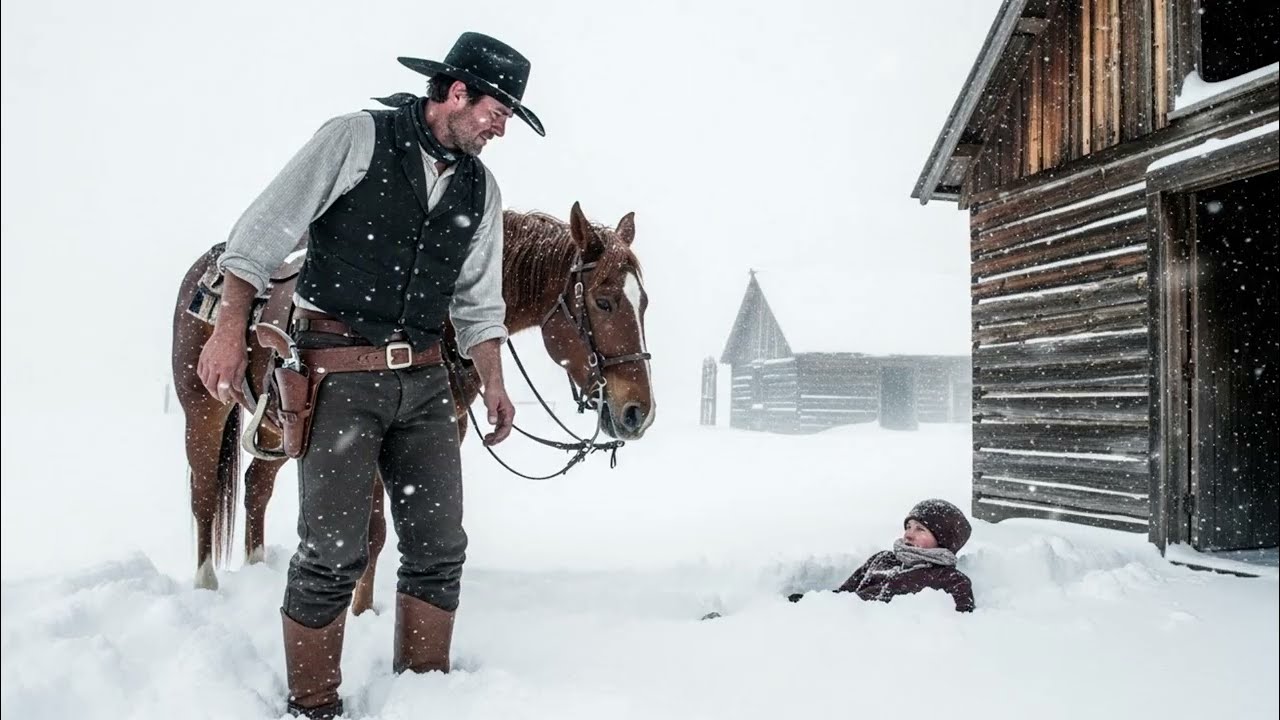
The first thing Caleb Rourke saw was the blood in the snow.
Not much of it. Just a thin, dark ribbon dragged across the white crust like someone had tried to crawl and failed halfway. His horse, Flint, stopped before Caleb touched the reins. The gelding’s ears pinned forward, breath bursting in gray clouds, hooves shifting against the frozen ground.
The wind came down from the Bitterroot like a living thing, carrying ice, pine resin, and the faint smell of smoke.
Caleb lifted his head.
No smoke should have been burning this far past the old stage road.
He sat tall in the saddle, one gloved hand resting near the rifle in its scabbard. The brim of his hat had frozen stiff. Snow clung to the shoulders of his duster. His beard was rimmed white from the storm, but his eyes—gray, tired, and watchful—moved over the trees without blinking.
Then he heard it.
Not a scream.
A voice.
Small. Broken. Fighting the wind.
“Please… don’t leave us.”
Flint tossed his head.
Caleb swung down before he knew he had decided. His boots sank to the ankle. The blood trail led between two leaning pines toward a shallow ravine where the snow had drifted high against a collapsed fence. Beyond it, half-hidden beneath the storm, stood a cabin that looked like it had been abandoned by God and forgotten by men.
One wall bowed inward. The chimney leaned. A strip of oilcloth flapped from a broken window, snapping in the wind like a warning flag.
Caleb drew his rifle.
The voice came again.
“Please…”
He moved toward the door.
A body lay three yards from the porch.
A woman.
Her face was turned toward the cabin. Her hair, once brown, had frozen in strands across her cheek. One arm reached forward, fingers clawed into the snow as if the last thing she had done in this world was try to get back inside.
Caleb crouched.
No breath. No pulse. A bullet hole beneath her collarbone, half-hidden by a wool shawl.
His jaw tightened.
Inside the cabin, something scraped across the floor.
Caleb rose slowly.
“Who’s in there?”
Silence.
Only the wind. The creak of a loose shutter. Flint stamping behind him.
Then a thud.
Caleb stepped onto the porch. The wood groaned under his weight. He pushed the door open with the rifle barrel.
The cabin smelled of ash, sickness, damp wool, and fear.
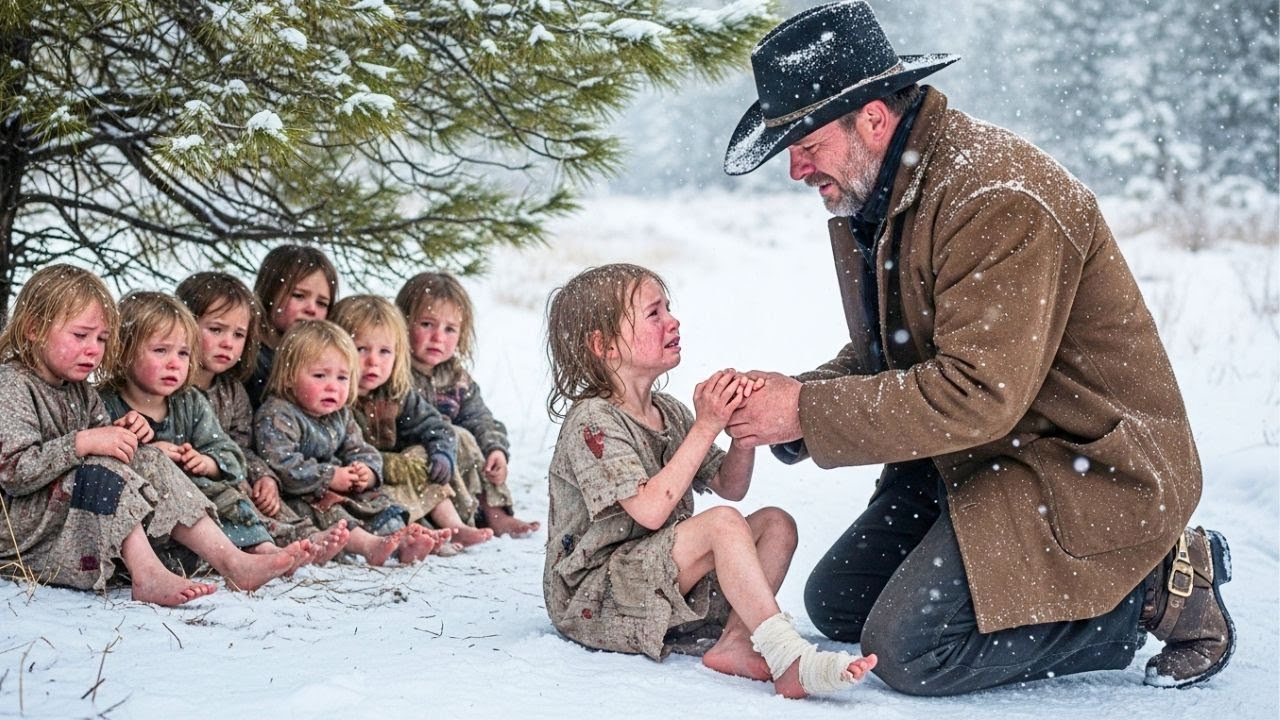
A tiny fire shivered in the hearth, more smoke than flame. Seven children huddled beneath quilts and feed sacks near the far wall. Their faces were hollow, eyes too large, lips blue from cold. A boy no older than twelve held a broken chair leg like a club. Two little girls clung to each other so tightly their fingers had gone white.
And in front of them, dragging herself across the warped floorboards, was a girl with a twisted leg.
She was perhaps fourteen, though hunger had made her look both younger and older. Her left leg bent strangely beneath her skirt, braced with leather straps and crude iron supports. One hand gripped a kitchen knife. The other pressed against the floor as she pulled herself between Caleb and the children.
Her hair, black and tangled, stuck to her damp forehead. Her cheeks were pale except where fever had painted them red.
She lifted the knife.
“Stay back.”
Caleb lowered his rifle an inch.
The girl’s wrist trembled. The knife did not.
“These children are under my protection,” she said.
Her voice cracked on the last word, but the room changed when she spoke. The younger children stopped crying. The boy with the chair leg straightened. Even the fire seemed to lean toward her.
Caleb looked at the woman outside. Then at the blood frozen on the threshold. Then at the girl’s bare feet, blue at the toes.
He set his rifle down on the floor.
“My name is Caleb Rourke,” he said. “I’m not here to hurt you.”
The girl stared at him as though kindness were another kind of trap.
“Men who hurt people say that first.”
Caleb did not move.
“Some do.”
“Then leave.”
“I can’t.”
Her chin lifted. “Why not?”
Caleb glanced toward the dead woman in the snow.
“Because whoever did that might come back.”
Behind the girl, a child whimpered.
The knife dipped half an inch.
The girl saw his eyes move. Her face changed—not fear, not surprise, but something worse. Confirmation.
“She made it outside,” she whispered.
Caleb removed his hat.
The girl’s mouth tightened until it was almost bloodless. She did not cry. Her fingers curled harder around the knife.
“What was her name?” Caleb asked.
The girl swallowed.
“Martha Bell.”
“Your mother?”
“No.” She glanced back at the children. “Ours for three weeks.”
The smallest child, a boy with a face smudged by soot, began to sob into a quilt.
Caleb knelt, keeping his hands visible.
“What happened here?”
The girl’s eyes flicked to his holster. His boots. His coat. His face.
She measured everything.
Then the boy with the chair leg said, “Don’t tell him, Elsie.”
So that was her name.
Elsie.
The girl did not look away from Caleb.
“He already knows enough to either help us or sell us.”
Caleb’s hand stopped near the edge of his coat.
“Sell you?”
A sound came from outside.
Not wind.
A branch cracking under weight.
Every child froze.
Caleb reached for his rifle.
Elsie whispered, “Too late.”
A horse snorted beyond the cabin wall.
Then a man’s voice called through the storm.
“Miss Bell? You alive in there?”
Caleb’s eyes narrowed.
Elsie’s face drained of what little color remained.
She dragged herself backward with sudden panic, knife scraping the floor.
“Don’t answer,” she mouthed.
The man outside laughed softly.
“I know you got children in there.”
A second horse shifted near the porch.
Caleb picked up his rifle and moved to the window.
Through the torn oilcloth, he saw two riders.
One wore a buffalo coat and carried a shotgun across his lap. The other sat straighter, dressed in a fine black overcoat too clean for the trail, his hat brim curled just so. Even through the snow, Caleb could see the shine of silver on his gloves.
The fine-dressed man looked at the body in the snow and sighed, as if Martha Bell had inconvenienced him.
“Well,” he called, “that is a shame.”
Elsie pressed her back to the wall. Her knife shook now.
The man’s voice turned bright.
“Children, my name is Gideon Vale. I am an officer of lawful placement under the Territorial Child Welfare Compact. Open the door, and no one else has to suffer.”
Caleb looked at Elsie.
Her eyes were wide with a terror she had not shown him.
“Is he the one?”
She nodded once.
Outside, Gideon Vale dismounted. Snow gathered on the shoulders of his black coat. He stepped over Martha Bell’s body without looking down.
Caleb lifted the rifle to his shoulder.
Gideon knocked on the cabin door.
Three polite taps.
“Children,” he said, “you belong to me now.”
And behind Caleb, Elsie whispered, “Please don’t let him take us alive.”
Chapter One: The Girl With the Knife
Gideon Vale had the kind of voice that could make a threat sound like a church hymn.
“Miss Bell has passed,” he called. “That leaves you in distress, and distress requires custody.”
The children shrank closer together.
Caleb moved away from the window and stood beside the door. His face had gone still, the way it had gone in the war when the bugle stopped and the screaming started.
“Elsie,” he said softly, “how many men?”
“Two now.” Her eyes stayed on the door. “More when he sends for them.”
“Does he know I’m here?”
“No.”
Caleb glanced at the boy with the chair leg. “What’s your name?”
“Tom.”
“How old?”
“Twelve.”
“Old enough to help. Take the little ones behind that table. Keep them flat.”
Tom stared at him, suspicion wrestling with desperation.
Elsie snapped, “Do it.”
Tom obeyed.
Caleb eased the hammer back on his rifle. The click was small, but every child heard it.
Gideon knocked again.
“Miss Bell was harboring state wards without authorization. That is a crime. I am prepared to forgive confusion, but not defiance.”
Caleb spoke just loud enough for the room.
“Elsie, when I open that door, you stay down.”
“No.”
His eyes cut to her.
“I said no.” Her fingers dug into the floorboards. “I don’t hide while others fight.”
Caleb looked at her twisted leg, the fever in her cheeks, the knife in her hand.
“You ever fired a gun?”
“No.”
“Then today ain’t the day to learn with children behind you.”
Anger flashed across her face. Not childish anger. The kind born from years of people deciding what she could not do before asking what she had already survived.
“I have kept them alive six days.”
Caleb’s expression changed.
Six days.
The girl saw that he understood.
Her voice dropped. “I boiled leather. I tore floorboards for firewood. I held Danny’s mouth shut when he cried because riders were outside. I lied to the little ones and told them help was coming.” Her eyes shone, but no tear fell. “So don’t speak to me like I’m furniture.”
The door latch rattled.
Caleb studied her another second.
Then he pulled a revolver from his belt, checked the cylinder, and slid it across the floor.
It stopped near Elsie’s hand.
“Point away from the children,” he said. “Only cock it if I fall.”
Elsie stared at the gun.
Gideon’s voice cooled.
“I dislike locked doors.”
The shotgun man kicked the door.
Wood split.
Caleb stepped back into shadow.
The second kick broke the latch.
The door flew inward.
The shotgun barrel entered first.
Caleb fired.
The blast punched the shotgun man backward off the porch. His weapon discharged into the roof beam, raining splinters and snow dust over the room. Children screamed.
Gideon Vale froze in the doorway with one hand raised, his eyes fixed on Caleb.
Caleb worked the rifle lever.
“Step inside,” Caleb said, “and you’ll leave like him.”
Gideon’s gaze moved from Caleb’s boots to his rifle, then to the children hiding behind the table. He did not look afraid. Only irritated.
“This is territorial business.”
“Looks like child stealing to me.”
Gideon smiled.
A narrow smile. No warmth in it.
“Then you are a man of limited education.”
Caleb moved the rifle barrel to Gideon’s chest.
“I read signs well enough.”
The man outside groaned in the snow.
Gideon’s eyes flicked toward him.
“Mr. Rourke, is it?”
Caleb did not answer.
Gideon smiled wider.
“Yes. I thought so. Caleb Rourke. Former cavalry scout. Court-martial recommended after the Cedar Wash incident, though never completed due to clerical decay after the war. A man with a history of disobeying lawful orders when his emotions outrun his judgment.”
The room went colder.
Elsie looked at Caleb.
Caleb’s face did not move, but his hand tightened on the rifle stock.
Gideon saw it. Enjoyed it.
“I know men,” he said. “Especially broken ones who believe a single noble gesture can buy back the dead.”
Caleb took one step forward.
Gideon’s smile vanished.
“Careful. There are papers filed in Helena giving me custody of every minor in this cabin. Lay a hand on me, and you become the criminal who murdered an officer while abducting children.”
“You stepped over a dead woman to serve paperwork.”
“I stepped over a fugitive who stole state property.”
The revolver clicked behind Caleb.
Elsie had cocked it.
The barrel pointed at Gideon’s face.
Her voice came low and raw.
“We are not property.”
For the first time, Gideon truly looked at her.
His expression softened, but not with compassion. With recognition of value.
“Elsbeth Crane,” he said. “I wondered where you had gone.”
Caleb turned slightly.
Elsie’s name was not Bell.
Not orphan.
Crane.
Gideon noticed the question before anyone asked it.
“Oh,” he said gently, “she did not tell you?”
Elsie’s breathing grew shallow.
Gideon brushed snow from his sleeve.
“This girl is worth more than all the others together.”
Tom shouted, “Shut up!”
Gideon ignored him.
“Her father left money. Land. Claims. Enough to make men lie, hide, and kill.” His eyes returned to Caleb. “And enough to make a crippled child think she can bargain with the world.”
Elsie fired.
The bullet tore through Gideon’s hat and buried itself in the doorframe.
The children went silent.
Gideon slowly touched the torn brim. A strand of hair fell over his forehead.
The politeness drained out of him.
“There she is,” he whispered.
Caleb fired into the porch near Gideon’s boot.
“Mount up.”
Gideon stepped backward.
The wounded shotgun man had staggered to his knees, clutching his shoulder. Gideon did not help him.
“You have until dawn,” Gideon said. “The temperature will fall below zero. The road west is blocked. The creek crossing is gone. You have one horse and eight children, one of whom cannot walk.” He looked at Elsie. “I don’t need to rush.”
He mounted with graceful ease.
Caleb watched him gather the reins.
Gideon tipped his ruined hat.
“By sunrise, Mr. Rourke, you will understand the difference between courage and logistics.”
He rode into the storm.
The wounded man stumbled after him, then managed to climb onto his horse.
The hoofbeats faded.
For several seconds, no one moved.
Then Elsie lowered the revolver.
Her hand shook so violently the gun slipped from her fingers.
Caleb caught it before it hit the floor.
Elsie stared at the open door, at Martha Bell’s body beyond it, at the blood disappearing under new snow.
Her face crumpled.
Not loudly. Not dramatically.
Her mouth opened once, as if she had forgotten how breath worked.
Then she bent over her ruined leg and made a sound so small that every child in the cabin began crying with her.
Caleb shut the door.
Outside, the storm buried the tracks.
Inside, dawn was still hours away.
And Gideon Vale was right about one thing.
They had one horse.
Eight children.
And a girl who could not walk.
Chapter Two: What the Dead Woman Hid
Caleb did not let them cry long.
Not because he lacked pity. Because pity would freeze them to death.
He found a dented kettle, packed it with snow, and set it over the fire. He tore strips from a blanket and plugged the broken window. He sent Tom and a red-haired girl named Ruth to gather anything edible from shelves, trunks, and pockets.
Their harvest looked like a joke told by hunger.
A fistful of oats.
Half an onion gone soft.
Two strips of salted pork hard as boot leather.
A jar of cloudy preserves.
Caleb divided the food without speaking. The smallest children watched every movement of his hands. Hunger had made them suspicious of fairness.
Elsie sat near the hearth, revolver in her lap, her injured leg stretched stiffly before her. Up close, Caleb saw the brace had rubbed the skin raw. Blood had dried beneath the leather straps. She had wrapped rags around the worst places and kept moving anyway.
“What happened to your leg?” he asked.
Elsie tore a strip of pork with her teeth.
“Horse cart tipped when I was seven.”
The answer came too quickly.
Caleb let it sit.
She looked at him.
“What happened to your soul?”
The children stopped chewing.
Caleb almost smiled. Almost.
“War.”
“That answer came too quickly.”
A faint warmth passed through the room, gone as soon as it arrived.
Caleb gave the youngest boy—Danny—the biggest share of preserves. Danny stared at the spoon before putting it in his mouth, as if sweetness might be a trick.
“What happened six days ago?” Caleb asked.
Elsie looked toward the door.
“Martha heard riders. She told us to hide under the floor.”
“There’s a cellar?”
“Not a cellar. Just space beneath boards. Old smuggler’s hollow, maybe. She had us climb down. Said not to breathe loud.”
Ruth hugged her knees. “We heard them hit her.”
Tom’s eyes hardened. “She didn’t tell them where we were.”
Elsie’s fingers tightened around the tin cup in her hands.
“They searched. Gideon kept asking for papers. Martha said she burned them. He called her a stupid woman. She laughed at him.” Elsie stared into the fire. “I think that’s why he shot her.”
Caleb crouched near the hearth.
“What papers?”
Elsie reached beneath her skirt and drew out a flat oilskin packet tied with twine.
Tom sucked in a breath.
“You still have it?”
“She told me to keep it against my skin.”
Caleb accepted the packet only after Elsie nodded. Inside were folded documents, damp at the edges but readable: birth records, placement certificates, a land deed, bank letters, and a map marked with a red X near a town called Mercy Crossing.
He read one name twice.
Elsbeth Abigail Crane.
Heiress to the Crane timber claim, held in trust until age eighteen.
Caleb glanced at Elsie.
“How old are you?”
“Fifteen next month.”
The corner of her mouth twitched without humor.
“If I live lavishly that long.”
Caleb studied the bank letter.
“Your guardian?”
“Dead.”
“Family?”
“An uncle in St. Louis I never met. Gideon says he signed me over.”
“Did he?”
Elsie looked away.
“Martha said no.”
Caleb unfolded another page. A list of children’s names. Beside each, a destination.
Not families.
Factories.
Mines.
Rail crews.
His stomach tightened.
“This isn’t placement,” he said.
“No,” Elsie answered. “It’s inventory.”
A gust struck the cabin so hard the door shook in its frame.
Caleb rose and moved to the window. The storm was thickening. Gideon had not lied about the temperature. By midnight, the cold would come through the walls like knives.
“We can’t stay,” he said.
Tom laughed, sharp and bitter.
“We can’t leave.”
Caleb looked at him.
Tom’s face flushed. “There’s babies. Ruth’s got a cough. Danny can’t stop shaking. Elsie can’t—”
“I can,” Elsie snapped.
Tom turned on her. “No, you can’t! You can barely sit upright.”
The room went still.
Elsie’s eyes flashed.
Tom’s anger broke open. “You think if you act like iron, we don’t see you bleed?”
Elsie looked as if he had slapped her.
Ruth started crying silently, wiping her face with both sleeves.
Caleb stepped between them.
“Enough.”
Tom backed away, breathing hard.
Elsie lowered her gaze to the revolver.
Her voice came smaller.
“I know what I am.”
Caleb turned.
“No. You know what men like Gideon taught you to measure.”
Her head lifted.
He held up the map.
“Can you read this trail?”
She nodded.
“Can you keep children quiet?”
“Yes.”
“Can you shoot close enough to scare a man?”
Her lips pressed together. “Apparently.”
“Then don’t tell me what you are like it’s a court sentence.”
For a moment, Elsie said nothing.
Then she looked at his bad hand.
He had kept it mostly hidden inside his glove, but two fingers did not bend right. Old break. Bad healing.
“What can’t you do?” she asked.
Caleb flexed the hand once.
“Forgive myself.”
The answer surprised both of them.
The fire popped.
Outside, something heavy slid from the roof and crashed into the snow.
Caleb folded the papers and tucked them back into the oilskin.
“Martha died protecting this. Gideon needs it. That gives us leverage.”
“Leverage for what?” Tom asked.
“For living.”
He walked to the door, opened it a crack, and looked toward the ravine. Snow had already swallowed most of the tracks.
“My cabin is nine miles north.”
Elsie stared at him.
“Nine?”
“There’s a line shack halfway if it hasn’t collapsed. We go now, before the moon drops.”
“With the storm?”
“With Gideon expecting us to wait for dawn.”
Caleb turned to the children.
“We take only what keeps you warm or alive. Nothing else.”
Ruth clutched a rag doll.
Caleb’s voice softened.
“That counts.”
He stepped outside to bring Flint closer.
The dead woman lay beneath a fine white sheet of new snow. Caleb paused beside her.
Martha Bell had no grave. No hymn. No hands folded proper.
He removed his hat again.
Behind him, the cabin door creaked.
Elsie had dragged herself onto the porch. Her face twisted with pain, but she kept moving until she reached the woman’s body.
Caleb started forward.
Elsie shook her head.
She placed one trembling hand on Martha’s frozen shoulder.
“You were right,” she whispered. “Help came meaner-looking than I expected.”
Caleb looked away.
Elsie took Martha’s shawl and wrapped it around her own shoulders.
Not theft.
Inheritance.
Then the wind rose, and from somewhere far down the ravine came a sound that did not belong to weather.
A whistle.
One short note.
Then another answered it.
Caleb looked into the trees.
Lantern light moved between the pines.
Gideon had not waited for dawn.
Chapter Three: The Night Trail
They left through the back wall.
Caleb knocked loose three boards with the butt of his rifle, helped Tom squeeze through first, then passed out the little ones one by one. Ruth carried Danny on her hip until her knees buckled. Caleb took him without comment and settled him inside his coat against his chest.
Elsie refused to be carried.
She made it eight yards.
Her brace caught under a root hidden by snow. She fell face-first, biting back a cry so hard blood appeared on her lip.
Caleb reached for her.
She slapped his hand away.
“I said I can—”
“You can die proud or live angry. Pick one.”
Her eyes burned.
Behind them, lanterns bobbed closer.
Tom whispered, “Elsie.”
That did it.
Not Caleb. Not fear. Tom.
Elsie looked at the children, then at Caleb’s open arms.
“Drop me,” she said, “and I’ll haunt you.”
Caleb lifted her.
She weighed less than his saddle.
The fact angered him more than her knife had.
He carried Danny under one arm and Elsie over the other shoulder, moving through the trees while Flint followed, reins tied to Caleb’s belt. The older children held one another’s coats in a chain. Snow slapped their faces. Branches clawed at sleeves. The forest became a tunnel of black trunks and white breath.
Behind them, Gideon’s men reached the cabin.
A shout rose.
Then gunfire.
A bullet cracked through branches above Ruth’s head. She screamed. Tom clapped a hand over her mouth and pulled her down.
Caleb dropped to one knee, setting Elsie behind a cedar trunk.
“Stay low.”
“I hate that sentence,” she hissed.
“Learn to hate quietly.”
He fired once toward the lanterns.
A man cursed.
The lanterns vanished.
Caleb listened. Wind. Children panting. Flint’s nervous snort.
Then Gideon’s voice floated through the trees.
“You cannot carry them all, Rourke.”
Caleb worked the rifle lever.
Gideon laughed softly.
“You know I’m right.”
Elsie gripped Caleb’s sleeve.
“Don’t answer.”
“I wasn’t planning to.”
But Gideon continued.
“Elsbeth, I know Martha told you stories. She had a sentimental disease common in women who read Scripture too literally. But ask yourself this—what future can that man give you? A crippled girl in a mountain shack? Seven mouths behind you? Winter eating the trail?”
Elsie’s nails dug into Caleb’s coat.
Gideon’s voice moved slightly left.
Caleb tracked it with the rifle.
“I can place the little ones. Warm beds. Work. Order. You, my dear, can be restored to your rightful estate under proper supervision.”
Tom whispered, “He means cages.”
Elsie’s face was close to Caleb’s ear.
“He’s circling.”
Caleb looked at her.
She pointed with her chin toward a slope hidden by blown snow.
“Dry creek bed. Sound carries wrong there.”
Caleb listened again.
Gideon’s voice came from the left.
But a branch snapped on the right.
Caleb swung and fired.
A man fell from the slope with a cry, rolling through brush into the creek bed.
The children gasped.
Elsie did not.
She only said, “Two more.”
Caleb stared at her.
She shrugged despite the pain.
“I told you I kept them alive six days.”
They moved again.
The storm covered them and punished them at the same time. Caleb put the smallest children on Flint, two at a time, walking beside the horse with one hand on Elsie’s back where she sat behind the saddle horn. She had protested until he pointed to the blood soaking through the rags at her brace.
After that, she said nothing.
The trail north narrowed along a ridge where the trees thinned and the wind came broadside. Below, the ravine dropped into darkness. Above, the moon showed itself for one pale minute before clouds swallowed it again.
Halfway across the ridge, Danny began to convulse.
Ruth screamed his name.
Caleb caught the boy as he slid from the saddle. Danny’s small body jerked in his arms, eyes rolled back, lips foaming.
Elsie grabbed the reins.
“Fever seizure,” she said. “He had one yesterday.”
“What did you do?”
“Kept him from swallowing his tongue. Cooled him down. Prayed badly.”
Caleb laid Danny on a blanket in the snow. Ruth sobbed, trying to reach him, but Tom held her back.
“Give him room,” Caleb ordered.
Elsie slid from the saddle and hit the ground hard. Pain flashed white across her face. She dragged herself to Danny and placed her hand against his neck.
“He’s burning.”
Caleb looked around. Ridge. Open wind. No shelter.
Behind them, faint but real, came hoofbeats.
Gideon’s riders had found the trail.
Caleb looked at Danny. Then at the children. Then at Elsie.
She saw the calculation and hated it.
“No.”
“I didn’t say anything.”
“You’re thinking he’ll slow us down.”
Caleb’s eyes hardened.
“I’m thinking how to keep him alive.”
Hoofbeats grew louder.
Flint tossed his head.
Tom lifted the chair leg he had carried all this way, absurd and brave.
Elsie looked down at Danny. The boy’s jerking had slowed, but his breath rattled.
“He can’t ride.”
Caleb looked toward the ravine.
An old memory struck him.
A line shack halfway.
But not on the ridge trail.
Below it.
He scanned the darkness until he found what he needed: two posts leaning out from the slope, almost buried.
“Mining chute,” he said.
Elsie followed his gaze.
“That thing?”
“It’ll get us down faster.”
“It’ll break our necks faster.”
“Maybe.”
A bullet hit the snow ten feet behind them.
The children screamed.
Caleb grabbed a half-rotted ore sled half-buried beside the chute. He kicked it free. The boards held, barely.
Elsie stared at him.
“You are insane.”
“Not tonight. Tonight I’m efficient.”
He wrapped Danny in a blanket, placed him on the sled, then looked at Elsie.
Her eyes narrowed.
“No.”
“Yes.”
“No, Caleb Rourke.”
He paused.
It was the first time she had used his full name.
For reasons he did not want to examine, it mattered.
He crouched before her.
“You said don’t drop you.”
“This counts as dropping me with ambition.”
A rider appeared at the far end of the ridge, lantern swinging.
Caleb lifted Elsie onto the sled beside Danny.
Tom helped Ruth and the others climb on. Caleb tied Flint’s reins to the rear rope, then looked down the chute vanishing into blackness.
The rider shouted.
Gideon’s voice followed.
“Stop them!”
Caleb shoved.
The sled dropped.
For one suspended heartbeat, there was no sound.
Then the world became speed, snow, screams, and splintering wood.
The chute hurled them down the mountain.
Trees whipped past as black bars. Snow exploded over the sled. Caleb ran beside it for three strides, then jumped onto the back, boots skidding, one hand gripping the rope, the other wrapped around Flint’s reins as the horse plunged after them.
Elsie held Danny with one arm and the sled rail with the other. Her face was wild, hair snapping across her eyes.
“Efficient?” she screamed.
Caleb leaned hard as the chute curved.
The sled tilted.
For a moment, the ravine opened beneath them like a mouth.
Caleb threw his weight left. Tom did the same without being told.
The sled slammed back into the chute.
Behind them, a horse screamed.
One of Gideon’s riders had tried to follow and failed.
The chute ended in a drift.
They hit it like a cannonball.
Snow swallowed everyone.
Silence.
Then Ruth coughed.
Tom cursed.
Danny whimpered.
Caleb clawed his way upright, snow packed inside his collar. Flint staggered nearby, shaking himself, alive by some miracle.
Elsie lay half-buried, one hand still gripping Danny’s blanket.
Caleb reached her.
“You breathing?”
Her eyes opened.
“I am reconsidering.”
He laughed once, breathless.
Then a lantern flared above the ridge.
Gideon stood looking down at them.
Too far to shoot cleanly. Close enough to be seen.
For the first time, his perfect coat was torn.
His voice dropped through the storm.
“You are making them suffer for nothing.”
Elsie pushed herself upright, snow in her hair, blood on her mouth, Danny alive against her chest.
She looked up at Gideon Vale.
“No,” she shouted. “We’re making you work.”
Caleb smiled despite himself.
Then the ice beneath the drift cracked.
Not loud.
Just a deep, slow groan.
Everyone looked down.
The creek below them was not frozen solid.
It was breaking.
Chapter Four: The Line Shack
Caleb moved before the children understood the danger.
“Up! Now!”
Water black as oil seeped through a jagged line in the ice. The sled had landed on the covered creek, and their weight had opened a fracture beneath it.
Tom pulled Ruth. Ruth grabbed Danny. Caleb lifted Elsie and shoved her toward the bank, where exposed roots twisted through the snow.
The ice cracked again.
A wider seam opened.
One of the little girls, May, slipped. Her boot punched through. Water swallowed her leg to the knee.
She screamed.
Tom lunged, but the ice between them split.
Caleb dropped flat and slid toward her.
“Don’t move!”
May’s face crumpled.
“I’m cold!”
“I know. Look at me.”
Her teeth chattered violently.
Caleb reached.
The ice under his chest groaned.
His bad hand failed to grip her sleeve.
He tried again.
Pain shot through his old injury. His fingers bent wrong, useless.
May began to sink.
Elsie saw.
She tore the leather strap from her own leg brace.
“What are you doing?” Tom shouted.
“Being furniture!”
She tied the strap around Caleb’s wrist and threw the other end to Tom.
“Pull when he has her!”
Caleb stretched farther. Water soaked his sleeve. May’s mitten brushed his fingers.
“May,” he said, voice steady, “give me your hand.”
“I can’t!”
“You can.”
Her eyes locked on his.
“Now.”
She threw her hand forward.
Caleb caught her.
The ice broke under his shoulders.
Tom and Elsie pulled together. Ruth joined. Then the others. Caleb dragged May free as the creek opened where she had been, swallowing the sled with a wooden crack that echoed down the ravine.
They collapsed onto the bank.
May sobbed into Caleb’s coat.
Elsie’s brace hung loose, useless without the strap.
She looked at it, then away.
Caleb saw the cost.
Said nothing.
The line shack stood a quarter mile east, tucked beneath a shelf of rock and almost invisible until they reached it. Its roof sagged under snow. One wall had gaps wide enough to see through. But the stove remained. So did a stack of dry kindling wrapped in canvas beneath a bunk.
Caleb got a fire going with hands that barely worked.
Warmth changed the children from ghosts into bodies. Pain returned first. Then hunger. Then questions.
Danny’s fever broke near dawn.
He opened his eyes and whispered, “Did we fly?”
Elsie, wrapped in Martha’s shawl near the stove, said, “Badly.”
The children laughed.
It was a thin sound, frightened of itself, but it filled the shack better than heat.
Caleb stepped outside when the sun rose.
The storm had passed. Morning laid blue shadows across the ravine. The world looked clean in the cruel way winter sometimes did after trying to kill everything.
Far above, along the ridge, dark figures moved.
Gideon had men searching.
Caleb counted at least six.
When he went back in, Elsie was watching him.
“How bad?”
“He’s persistent.”
“That’s not an answer.”
“It’s the one that won’t scare the little ones.”
She nodded toward the children, asleep in a pile of coats.
“They already know.”
Caleb crouched near the stove.
“We can reach my cabin by nightfall if we move slow.”
“With Gideon between us and north?”
“I know another way.”
She studied him.
“No one knows this country that well unless he spent time hiding in it.”
Caleb fed a stick into the stove.
“After the war, I took scouting work. Army paid me to find people.”
“Did you?”
“Sometimes.”
“And other times?”
The fire snapped.
Caleb’s eyes went to the stove door, where orange light pulsed through a crack.
“There was a band of families camped at Cedar Wash. Army said they were feeding raiders. Ordered us to bring them in.”
Elsie said nothing.
“My captain wanted speed. I told him the wash flooded in storms. He told me my job was tracks, not opinions.”
Outside, a crow called from a dead pine.
“I followed orders.”
Elsie’s face softened despite herself.
Caleb flexed his bad hand.
“Rain came hard. Water rose in the dark. By morning, the camp was gone.”
“All of them?”
His silence answered.
Elsie looked down.
“So now you don’t leave people behind.”
Caleb’s mouth tightened.
“Now I try not to.”
She considered that.
“My father didn’t die in a cart accident,” she said.
Caleb looked up.
Elsie kept her gaze on the fire.
“He found out Gideon was moving children through state contracts and selling them as labor. My father owned timber camps. He saw boys show up with new names and old bruises.” Her hand moved over her twisted leg. “He gathered records. Gideon came to our house one night. There was shouting. My mother hid me in the pantry.”
The shack seemed to hold its breath.
“I saw Gideon push my father down the stairs. My mother ran. Someone grabbed me. I kicked. Fell. The wheel of the supply cart rolled over my leg when they dragged me outside.”
Caleb’s eyes darkened.
“Gideon did this?”
“He says my father’s stubbornness did.” Her smile was small and terrible. “That’s the difference between men like him and monsters in stories. Monsters know they’re hungry.”
Caleb looked toward the window.
“What does Gideon fear?”
Elsie answered at once.
“Records.”
She tapped the oilskin packet beneath her shawl.
“Not money. Not guns. Not even prison, maybe. But being seen clearly? That terrifies him.”
Caleb stood.
“Then we stop running.”
Tom, awake on the bunk, lifted his head.
“What?”
Caleb looked at Elsie.
“You said Mercy Crossing is on that map. How far?”
“Sixteen miles east.”
“Town have a marshal?”
“Yes. But Gideon owns him.”
“A telegraph?”
Elsie blinked.
“At the rail office.”
Caleb nodded.
“Who doesn’t Gideon own?”
Elsie thought.
Then Ruth’s small voice came from beneath a coat.
“The newspaper lady.”
Everyone turned.
Ruth sat up, hair tangled, eyes swollen from sleep.
“Martha said if bad men came, we were to find Miss Odelia Price. She prints things people want buried.”
Elsie stared at Ruth.
“Why didn’t you tell me?”
“You didn’t ask about newspaper ladies.”
Caleb almost laughed again.
Elsie pulled out the map and unfolded it on the floor. Caleb leaned over her shoulder. Their heads nearly touched.
Mercy Crossing lay beyond the old mill road. Gideon would expect them to go north to Caleb’s cabin or west toward the stage route.
Not east.
Not toward the town where his papers made him powerful.
That was exactly why it might work.
“We reach Mercy Crossing,” Caleb said, “get the documents to Odelia Price, and send telegrams to Helena, Fort Missoula, and every judge Martha trusted.”
Elsie’s eyes sharpened.
“You think like a fugitive.”
“You think like a general.”
Color touched her cheeks.
Tom swung his legs off the bunk.
“And us?”
Caleb looked at the children.
“All of us.”
Outside, a rifle shot cracked.
The window shattered inward.
A bullet struck the stove pipe, filling the shack with sparks and smoke.
Children screamed.
Caleb shoved Elsie down.
Through the broken window came Gideon’s voice, closer than it should have been.
“Mr. Rourke,” he called, “I brought law with me this time.”
Caleb looked through a gap in the wall.
Men stood among the trees.
One wore a marshal’s badge.
And beside Gideon, bound at the wrists, stood a woman in a dark traveling coat with ink stains on her cuffs.
Elsie whispered, “Odelia Price.”
Gideon had found the newspaper lady first.
Chapter Five: Mercy Has Teeth
The marshal did not look proud.
That was the first thing Caleb noticed.
The badge on his chest caught the morning light, but his eyes kept sliding away from the shack. He was thick through the middle, red-nosed from drink or cold, with a shotgun held too low to mean real eagerness.
Gideon stood beside him like a blade in a velvet sheath.
Odelia Price, however, looked furious.
She was a woman in her forties, narrow as a fence rail, with silver threaded through black hair pinned badly under a hat. Her lip was split. Her spectacles hung crooked. Even bound, she had the posture of someone preparing to correct grammar at a hanging.
“Children,” Gideon called, “you are frightened because desperate adults have placed you in danger. Come out, and this ends.”
Elsie crawled toward the broken window.
Caleb caught her shoulder.
She looked back.
“That woman came for us.”
“And we’ll return the courtesy alive.”
Odelia lifted her chin.
“You in the shack!” she shouted. “If you have the Bell papers, do not surrender them!”
The marshal flinched.
Gideon struck her across the face.
The children gasped.
Elsie went still.
Not frozen. Sharpened.
Caleb recognized the change.
It was the moment fear became a weapon.
Gideon leaned close to Odelia’s ear, but his voice carried.
“You mistake noise for power.”
Odelia spit blood into the snow.
“No,” she said. “I print noise. Power comes afterward.”
Caleb smiled faintly.
He looked around the shack.
One door. One broken window. Rear wall against rock. Six armed men outside, plus Gideon, plus a reluctant marshal.
Bad odds.
But not sealed ones.
He turned to Tom.
“Can you ride?”
Tom blinked.
“Some.”
“Good enough.”
He handed him the oilskin packet.
Elsie’s head snapped toward him.
“No.”
Caleb kept his eyes on Tom.
“There’s a drainage cut behind the rock shelf. Too narrow for grown men on horses. It drops toward the mill road. Take Flint. Put Ruth behind you with Danny. Ride east. Don’t stop until Mercy Crossing.”
Tom stared at the packet as if it burned.
“What about you?”
“I’ll be loud.”
Elsie grabbed Caleb’s sleeve.
“I’m the one Gideon needs. Use me.”
“No.”
“You said not to measure me wrong.”
“I’m not.”
“Yes, you are. You’re deciding my life is worth protecting more than theirs.”
Caleb crouched so they were eye to eye.
“I’m deciding Gideon expects you to think exactly that.”
Her anger faltered.
Caleb nodded toward the children.
“He believes love makes people predictable. Prove him wrong.”
Elsie’s throat moved.
Outside, Gideon called, “I am losing patience.”
Odelia shouted, “Good! Maybe you’ll misplace it entirely!”
The marshal muttered something. Gideon ignored him.
Caleb gave Tom his revolver.
Tom’s hand shook around it.
“I don’t know if I can shoot a man.”
“Good,” Caleb said. “Try to keep that.”
He moved to the rear wall and kicked at a loose lower board. Cold air rushed in. Beyond it, a crawlspace opened beneath the rock shelf.
One by one, the children slipped through.
Ruth paused and hugged Elsie hard.
Elsie closed her eyes for half a second.
Then pushed her away.
“Go.”
Danny looked at Caleb.
“You coming?”
Caleb tucked the boy’s blanket tighter.
“Save me a biscuit in town.”
Danny nodded solemnly, as if biscuits were certain.
Then he disappeared into the dark gap.
Tom was last.
He looked at Elsie.
“I was wrong.”
She frowned. “About what?”
“You’re not iron.”
Her face tightened.
Tom swallowed.
“You’re better. Iron just breaks.”
Then he crawled out.
Elsie turned away quickly, but Caleb saw the tears.
He pretended not to.
Outside, Gideon raised his hand.
The men lifted their rifles.
Caleb looked at Elsie.
“Now we get loud.”
He tossed a tin cup through the broken window.
Every rifle fired at once.
The shack exploded with splinters.
Caleb rolled across the floor, grabbed a burning log from the stove with a folded cloth, and shoved it into a pile of damp feed sacks near the door. Smoke thickened fast.
Elsie coughed.
“What are you doing?”
“Making a ghost.”
He threw his coat over a chair, set his hat on top, and shoved it past the window with the rifle barrel.
Two shots punched through the coat.
Caleb fired under the window frame.
One man cried out and dropped behind a log.
Gideon shouted orders.
In the confusion, Flint’s muffled hoofbeats sounded from behind the shack.
Gideon heard.
His head turned.
So did Elsie’s.
Caleb saw the moment Gideon understood.
The children were gone.
The mask fell from his face.
Not completely. Just enough.
His mouth twisted. His eyes went flat and bright.
“There,” Elsie whispered. “That’s him.”
Gideon seized Odelia by the arm and dragged her toward his horse.
Caleb fired.
The bullet cut Gideon’s sleeve but missed flesh. Gideon shoved Odelia into the marshal, mounted, and pointed east.
“After them!”
Two riders broke toward the drainage cut.
Caleb cursed.
Elsie grabbed the fallen brace strap from the floor and tied it around her leg with shaking hands.
“What’s under this shack?” she asked.
“What?”
“Mines. You said old chute. Old mill. Is there a tunnel?”
Caleb stared at her.
Then he remembered.
The powder magazine.
“Not a tunnel.”
Her eyes lit.
“Better?”
“Worse.”
“Good.”
They escaped through smoke and gunfire, sliding under the rear wall into the crawlspace. Caleb dragged Elsie across frozen dirt while bullets thudded into the shack behind them. They emerged beneath the rock shelf, hidden from the men by brush and shadow.
To the east, Tom’s tracks led toward the drainage cut.
Two riders followed.
Caleb aimed.
Elsie pushed the barrel down.
“Too far. You’ll waste shots.”
He looked at her.
She nodded toward a narrow slope above the cut.
“Snow cornice.”
Caleb saw it then: a heavy overhang of wind-packed snow clinging to the ridge.
He fired into it.
Nothing.
He fired again.
A crack spread across the cornice.
The third shot brought the ridge down.
Snow roared into the drainage cut behind Tom’s path, not enough to bury the children, but enough to block the riders. Their horses reared. One man fell. The other barely kept his seat.
Elsie exhaled.
Then Gideon appeared below, leading his horse through the trees, not toward the blocked cut.
Toward the mill road.
He knew another way.
Caleb’s expression hardened.
“We need the magazine.”
They found it beneath a collapsed lean-to fifty yards from the shack: a stone-walled storage pit with a rusted iron door. Inside, wrapped in waxed cloth, were six sticks of old blasting powder, damp but not dead.
Elsie watched Caleb handle them.
“You know explosives?”
“No.”
“That pause suggests yes.”
“I know enough to dislike them.”
He packed powder into a cracked lantern, added nails from a broken crate, and tied a fuse with oil-soaked cloth.
Elsie’s eyes narrowed.
“You’re not throwing that near the children.”
“No.”
“Then where?”
Caleb looked toward the old mill bridge spanning the creek east of them.
“If Gideon reaches that bridge before Tom, he cuts them off.”
Elsie followed his gaze.
The bridge was ancient, timber-framed, slick with ice.
“You can’t outrun a horse.”
“No.”
Caleb tied the lantern to a length of rope.
“But I can make one refuse to cross.”
They moved along the creek bank, Caleb carrying Elsie when the ground grew too rough. She no longer protested every time. That scared him more than her anger had.
At the bridge, they arrived breathless.
Far down the road, Tom appeared on Flint, children clinging behind him and around him, the horse struggling but moving.
From the opposite side, Gideon rode hard.
He would reach the bridge first.
Caleb lit the fuse.
The flame sputtered.
Elsie gripped the bridge rail and pulled herself upright.
“Hurry.”
The fuse caught.
Caleb swung the lantern once, twice, and released.
It flew beneath the bridge and shattered against the central support.
For one terrible second, nothing happened.
Gideon reached the far end.
He saw Caleb.
Then Elsie.
His face changed.
He spurred his horse onto the bridge.
The powder ignited.
The explosion cracked the morning open.
Timber burst upward. The bridge buckled. Gideon’s horse screamed and reared, throwing him against the rail. Smoke rolled across the creek. Wood fell into the black water below.
When it cleared, half the bridge was gone.
Gideon hung from the broken far rail, one gloved hand gripping splintered wood over the creek.
His horse was gone.
Tom and the children thundered past on the near road, safe.
Elsie sagged with relief.
Caleb moved toward Gideon.
“Don’t,” Elsie said.
Caleb stopped.
Gideon looked up at them from across the gap. His perfect hair had fallen into his face. Blood ran from his temple.
For the first time, he looked human.
Not harmless.
Human.
“Rourke,” he called, voice strained. “Help me.”
The creek roared beneath him.
Elsie’s face went white.
Caleb said nothing.
Gideon’s hand slipped. He gasped, catching again.
“I have documents,” Gideon said quickly. “Names. Judges. Buyers. Men above me. You save me, I give them to you.”
Elsie stared.
Caleb looked at her.
Her breath came fast.
Every wound in her life hung over that broken bridge.
Gideon saw the battle in her face.
“Elspeth,” he pleaded, using her full name like a key. “I can tell you where your mother is buried.”
The world seemed to stop.
Caleb’s head turned.
Elsie swayed.
“My mother?”
Gideon’s lips trembled from cold and fear.
“She didn’t run. I lied. I know where she is.”
Elsie’s eyes filled.
Caleb stepped toward the broken edge.
Elsie grabbed his coat.
Her fingers were weak.
“Wait.”
Gideon’s voice rose.
“Do you want justice or revenge?”
Elsie looked at the creek. Then at the road where the children had disappeared. Then at Caleb.
Her face changed again.
Not soft.
Not hard.
Older.
“Justice,” she said, “has witnesses.”
She looked at Caleb.
“Save him.”
Caleb threw the rope.
Gideon caught it with his free hand.
For three brutal minutes, Caleb pulled while Elsie anchored the rope around the bridge post. His bad hand tore open inside the glove. Blood slicked the rope. Gideon clawed over the broken edge and collapsed on the near bank, coughing, shivering, alive.
Caleb rolled him onto his stomach and tied his wrists.
Gideon laughed weakly.
“You think chains change anything?”
Elsie dragged herself close enough that he had to look at her.
“No,” she said. “But newspapers do.”
For the first time, Gideon Vale looked afraid.
Not of death.
Of ink.
Chapter Six: The Town That Finally Looked
Mercy Crossing did not welcome them like heroes.
It stared.
The town sat in a shallow valley beneath a sky washed clean after the storm. False-front stores lined the main street: mercantile, livery, bank, assay office, saloon, church, newspaper. Chimneys smoked. Wagon wheels carved brown slush through the snow. Men came out of doorways. Women paused with baskets on their arms. Children peered from behind skirts.
They saw Caleb first: torn coat, rifle, blood on his glove.
Then Elsie, riding sidesaddle on Flint, Martha Bell’s shawl around her shoulders, her brace broken, her face pale and unbowed.
Then the seven children behind them.
Then Gideon Vale, tied over a borrowed mule like baggage, still trying to arrange dignity around humiliation.
Odelia Price met them outside the newspaper office with a swollen cheek and a smile sharp enough to shave bark.
“I see you acquired a story,” she said.
Elsie held out the oilskin packet.
Odelia did not take it immediately.
She looked at Elsie’s hand. The cracked knuckles. The blood. The tremor.
Then she removed her hat.
The gesture moved through the street like a match catching.
One by one, others removed theirs.
Not all.
Some looked away.
Some slipped back indoors.
Power never vanished in a single morning.
But enough people stayed.
Odelia took the packet.
“Come inside.”
The newspaper office smelled of ink, hot metal, paper dust, and coffee burned beyond salvation. A press dominated the back room like a black iron beast. Type trays lined the walls. Headlines from older editions hung crooked above a desk buried in notes.
Caleb placed Gideon in a chair and tied him to it.
Gideon looked around with contempt.
“A provincial print shop.”
Odelia dipped a pen.
“Empires have died of smaller cuts.”
For hours, the office became a battlefield without guns.
Elsie gave names.
Tom corrected dates.
Ruth remembered a brand on a wagon.
Danny drew a picture of a ring one man wore because children noticed what adults dismissed.
Caleb stood by the door, saying little, watching everyone who entered.
The marshal came at noon.
Without his shotgun.
Without his badge.
He placed it on Odelia’s desk.
“I looked away,” he said.
No one comforted him.
Odelia kept writing.
“Start looking now.”
By evening, telegrams had gone to Helena, Missoula, Butte, and three newspapers farther east. By nightfall, men who had once crossed the street to avoid Martha Bell’s questions arrived with ledgers, letters, and shame wrapped in confession.
Gideon said nothing.
Not until Odelia printed the first proof.
CHILD PLACEMENT OFFICER ACCUSED OF LABOR TRAFFICKING, FRAUD, AND MURDER
Below it were names.
Not all. Enough.
Odelia placed the proof before him.
Gideon read it.
The muscles in his cheek twitched.
“There are men on that list who will burn your building.”
Odelia leaned close.
“Then tomorrow’s headline will be shorter.”
Caleb almost smiled.
Elsie sat near the stove, exhausted beyond hiding. A doctor had cleaned her wounds and reset the brace as best he could. He had spoken gently, but his eyes carried the truth.
The leg would never be right.
Elsie had nodded once and asked whether she could still ride.
The doctor had blinked.
Caleb had looked out the window so she would not see his face.
Near midnight, he found her alone beside the press, touching the edge of a fresh newspaper sheet.
“They’ll come for him,” she said.
“Yes.”
“For us too?”
“Maybe.”
She looked up.
“You always say the honest thing too late.”
“I’m working on it.”
A tired smile passed between them.
Then she reached into Martha’s shawl and pulled out one last folded paper.
“I didn’t give Odelia this.”
Caleb opened it.
A letter.
Written by Martha Bell.
To whoever finds these children.
The handwriting was hurried, ink blotted in places.
Caleb read silently until one line stopped him.
Elsie saw.
“What?”
He handed it to her.
She read the line aloud, voice breaking.
“Elsbeth’s mother lives.”
The press clanked in the back room as someone prepared another edition.
Outside, hoofbeats approached fast down the frozen street.
Caleb moved to the window.
Three riders stopped before the newspaper office.
One wore a federal marshal’s star.
The second wore army blue.
The third was a woman with gray in her dark hair, sitting rigid in the saddle as if the only thing holding her together was will.
Elsie gripped the paper.
The woman looked toward the window.
Her hand rose to her mouth.
Elsie whispered, “Mama?”
Then Gideon Vale began to laugh from the next room.
Chapter Seven: What Survives the Cold
The woman’s name was Abigail Crane, and she did not run to her daughter.
That was how Caleb knew the reunion was real.
False love performed for witnesses. Real love feared doing harm.
Abigail stood in the doorway of the newspaper office with snow melting on her dark coat, one hand pressed to the frame. Her eyes stayed on Elsie’s face, then her brace, then the shawl, then back to her face again.
Elsie sat frozen in the chair.
Neither moved.
The children watched from the stairwell where Odelia had bedded them under blankets. Tom held Danny. Ruth gripped the rail.
Abigail took one step.
Elsie flinched.
The woman stopped as if struck.
“I won’t touch you unless you say,” Abigail whispered.
Elsie’s mouth trembled.
All the things she had survived had made her brave enough for guns, hunger, storms, and Gideon Vale.
But not this.
Not the return of the dead.
“You left,” Elsie said.
Abigail closed her eyes.
“No.”
The word was not defense. It was grief.
Gideon laughed again from the back room.
“She did,” he called. “Ask her why she signed nothing. Ask her why she never came.”
Caleb crossed the room and shut the door between them hard enough to rattle the glass.
Abigail looked at the door.
“He told me you died,” she said. “He brought me your ribbon. The blue one.”
Elsie’s hand went to her hair as if the ribbon might still be there.
“I woke in a convent hospital outside St. Louis. Fever. Broken ribs. No memory for weeks. By the time I knew my own name, Gideon had papers saying your father was dead, you were dead, and I was unstable with grief.”
Her voice shook, but she kept it quiet, letting each word stand on its own legs.
“I have spent seven years trying to prove a dead child was alive.”
Elsie looked down at her twisted leg.
“I stopped waiting after three.”
Abigail absorbed that. It entered her like a blade.
“I would have waited all my life.”
Elsie’s eyes filled, but anger held the tears in place.
“What if I don’t know how to be your daughter anymore?”
Abigail smiled through tears.
“Then we begin with your name.”
Elsie stared.
Abigail lowered herself slowly to the floor, ignoring the mud and melted snow.
Not above Elsie.
Below her.
“My daughter’s name is Elsbeth Abigail Crane. She hated carrots. She bit the doctor who set her arm when she was five. She once tried to keep a raccoon as a church pet.” A laugh broke in her throat. “And when she was afraid, she hummed through her teeth because she didn’t want fear to think it had won.”
Elsie made a sound.
Small. Shattered.
Abigail held out her hand, palm up.
Elsie looked at it for a long time.
Then she placed her fingers in her mother’s hand.
The sob that came out of her did not sound like weakness. It sounded like something frozen finally splitting under spring water.
Abigail folded around her daughter carefully, as though holding both a child and a wound.
Caleb stepped outside.
He stood on the boardwalk while Mercy Crossing moved uneasily around him. Men gathered near the saloon, whispering. A rider left for Helena with copies of Odelia’s paper sealed under his coat. The former marshal sat on the jail steps, head in his hands.
The federal marshal, a lean man named Harlan Voss, joined Caleb by the rail.
“You Rourke?”
Caleb nodded.
“I read about Cedar Wash.”
Caleb’s eyes stayed on the street.
“Most people did.”
“Most people read lies.”
That made Caleb turn.
Voss took a cigarette from his pocket but did not light it.
“I was a lieutenant under Major Bellamy. I know who ordered that camp into the wash.”
Caleb said nothing.
Voss looked toward the newspaper office.
“Funny thing about records. They survive men who count on silence.”
Caleb’s bad hand pulsed beneath its bandage.
“What are you saying?”
“I’m saying Gideon Vale kept files on everyone he meant to own. Including officers. Including judges. Including you.” Voss paused. “Your protest letter was in his satchel. The one your captain claimed you never wrote.”
The street blurred for one breath.
Caleb gripped the rail with his good hand.
Inside the newspaper office, Elsie cried against her mother.
Outside, Caleb stood very still while seven years of guilt shifted—not gone, not absolved, but no longer shaped exactly like the lie men had handed him.
Voss lit the cigarette at last.
“Helena will want your testimony.”
Caleb’s mouth twisted.
“Helena can want.”
“Children need witnesses.”
That landed.
Caleb looked through the window.
Elsie saw him from inside.
Her face was wet. Her mother’s arm was around her. The younger children had crept near, drawn by a kind of safety they did not yet trust.
Elsie held Caleb’s gaze.
Not asking him to stay.
Not asking him to leave.
Just seeing whether he would choose.
By morning, Gideon Vale had stopped laughing.
The second edition carried more names.
By noon, three arrests had been made.
By dusk, Mercy Crossing had become the kind of town that pretended it had always cared.
Odelia did not let it.
She printed Martha Bell’s name in bold type.
She printed the children’s names only with permission.
She printed Gideon’s full confession after Voss found the satchel under the false bottom of his trunk: ledgers, payments, forged signatures, burial notes, transfer contracts, and a small blue ribbon tied around a bundle of letters Abigail Crane had sent for seven years.
Elsie held that ribbon for an hour without speaking.
That evening, she found Caleb in the livery, saddling Flint.
The air smelled of hay, leather, manure, and lantern oil. Snowmelt dripped from the eaves. Flint turned his head toward Elsie and blew softly.
“You’re leaving,” she said.
Caleb tightened the cinch.
“Thinking about it.”
“That’s a coward’s yes.”
He looked at her.
She had come on crutches borrowed from the doctor, her brace repaired with new leather. Each step had cost her, but she stood straight.
“My mother wants to take us east after the trial,” she said.
“Us?”
“The children.” Her chin lifted. “All of them. She has money, land, guilt, and no chance of winning an argument against me.”
Caleb nodded.
“Sounds right.”
Elsie watched him.
“What do you have?”
He looked around the livery as if the answer might be hanging from a nail.
“A horse. A bad hand. A cabin north of nowhere.”
“And a habit of arriving when girls ask not to be left.”
His face softened.
“Elsie—”
“No.” She stepped closer. “Don’t make your voice kind. I can survive kind voices. They’re slippery.”
He shut his mouth.
She swallowed.
“You told me not to let Gideon measure me. So don’t let the war measure you. Don’t let one flooded wash be the only story you tell yourself until you die in some cabin and your horse has to explain you to strangers.”
A laugh escaped him despite the ache in his chest.
She did not smile.
“I’m serious.”
“I know.”
“Good.”
Silence settled between them, full but not empty.
Caleb rested one hand on Flint’s saddle.
“I don’t know how to stay.”
Elsie nodded.
“I don’t know how to be found.”
That was the truest thing either of them had said.
Flint shifted. A lantern hissed.
Then Elsie reached into her coat and pulled out a biscuit wrapped in cloth.
She held it out.
“Danny saved it.”
Caleb took it.
His throat tightened.
“He remembered.”
“He remembers everything. It’s inconvenient.”
Caleb looked at the biscuit in his scarred hand.
Outside, Odelia’s press began again, thundering into the night.
A sound like machinery.
A sound like justice learning to walk.
Caleb tucked the biscuit into his pocket.
“I’ll testify,” he said.
Elsie’s face changed before she could stop it.
Hope, sharp and dangerous.
“And after?”
He looked at Flint. Then at her.
“After, I might need help finding a better cabin.”
She nodded once, trying and failing to hide her smile.
“My standards are high.”
“I feared as much.”
“And the children hate boiled leather.”
“I’ll remember.”
She turned toward the door, then stopped.
“Caleb?”
“Yes?”
“That day in the snow. When I asked you not to leave us.”
He waited.
Her voice lowered.
“I wasn’t only asking for the children.”
The words hung there, fragile as frost.
Caleb removed his hat.
“I know.”
Elsie nodded, satisfied and embarrassed and brave enough not to run from either.
Then she left the livery, crutches tapping against the floorboards, each sound steady as a nail being driven into the future.
Caleb stood beside his horse for a long time.
At dawn, he did not ride north.
He walked to the newspaper office, where eight children were eating breakfast at Odelia’s long table, where Abigail Crane was braiding Ruth’s hair with hands that trembled, where Tom was pretending not to cry over a second helping of eggs, and where Elsie sat by the window with Martha Bell’s shawl around her shoulders.
She saw Caleb in the doorway.
No one spoke.
Danny climbed down from his chair, ran to him, and wrapped both arms around his leg.
Caleb froze.
Then, slowly, he placed his damaged hand on the boy’s head.
Elsie watched him from across the room.
Outside, the mountains stood white and cold under the morning sun.
The kind of mountains that could kill a person.
The kind that could also show them the way out.
Odelia lifted her coffee.
“Well,” she said, “if everyone is done surviving the night, we have a war to win before supper.”
The children laughed.
Abigail smiled through tears.
Tom passed Caleb a plate.
Elsie looked out the window at the street where people were already lining up to buy the paper.
Gideon Vale had believed courage was a feeling.
He had been wrong.
Courage was a limping girl with a knife.
A cowboy with a ruined hand.
A dead woman’s shawl.
A boy holding a chair leg.
A newspaper press shaking the floorboards.
A mother who crossed seven years of lies.
And eight children who learned, one brutal winter morning, that being abandoned by the world did not mean the world got the final word.
Elsie turned back to Caleb.
“You’re blocking the door,” she said.
Caleb stepped inside.
And for the first time in years, he did not look behind him for ghosts before closing it.
THE END