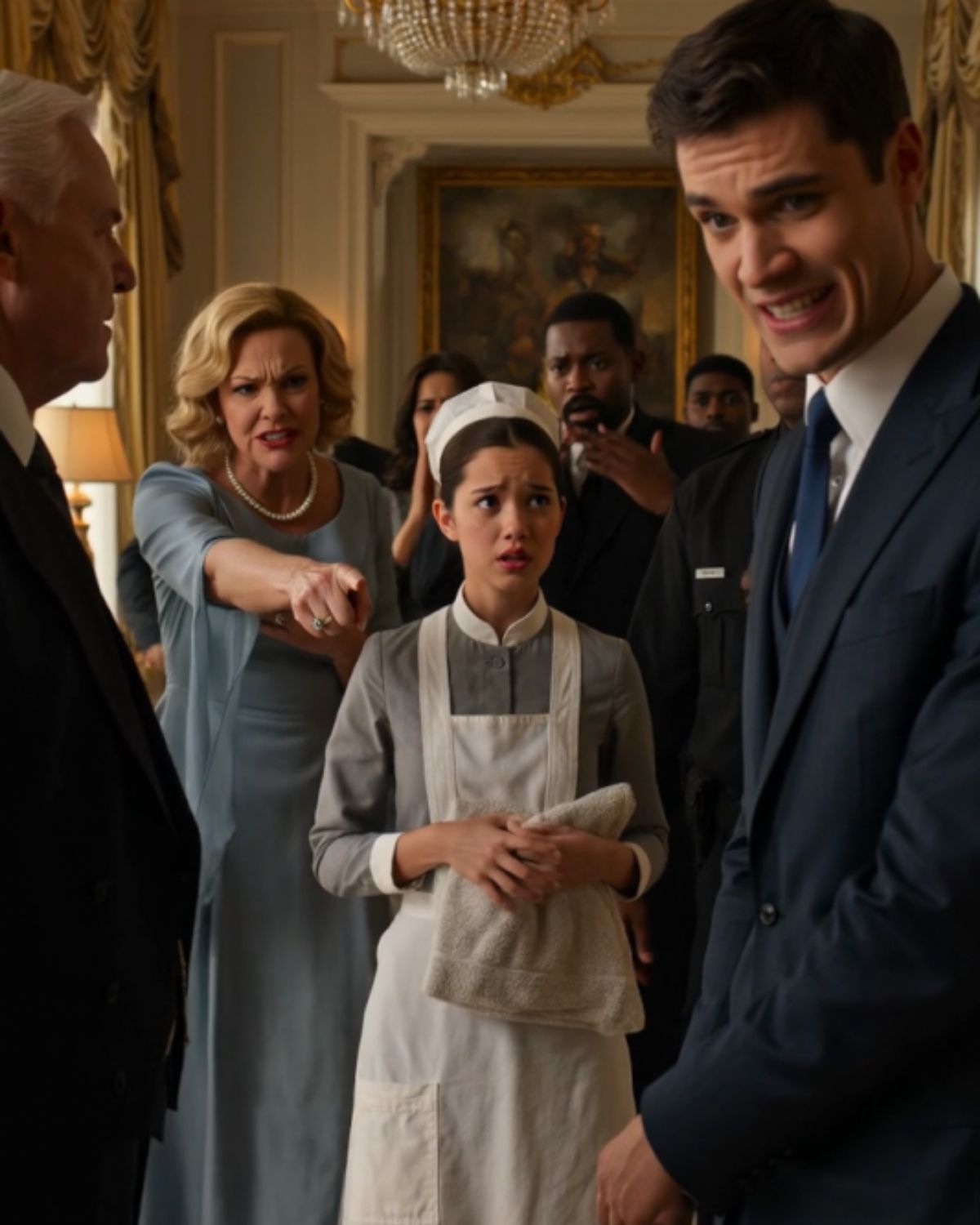
 A Maid Was Blamed For Stealing A Diamond Necklace — Until The CCTV Revealed The Real Thief.
The scream came from the second floor of the Whitmore mansion at exactly 7:42 in the evening.
“My diamond necklace is gone!”
Every conversation downstairs stopped.
In the grand living room, champagne glasses froze halfway to painted lips. A violinist near the fireplace missed a note. Two guests turned toward the marble staircase. A waiter carrying a tray of crystal flutes stood perfectly still, as if one wrong movement might pull suspicion toward him.
Upstairs, in the master bedroom, Evelyn Whitmore stood in front of her vanity table with one hand pressed against her chest.
The bedroom looked like a private suite in a royal hotel. Silk curtains fell from ceiling to floor. Gold-trimmed chairs sat beside a carved fireplace. A king-sized bed with cream velvet pillows reflected the warm glow of a chandelier. On the vanity table, beside a silver perfume tray, a black velvet jewelry box sat open.
Inside it was an empty necklace case.
The diamond necklace was gone.
It was not just expensive. It was famous inside the Whitmore family.
Evelyn had worn it to charity galas, magazine shoots, and her husband’s retirement dinner. A line of thirty-two diamonds, custom-set in white gold, worth more than most people earned in ten years. Her late mother-in-law had given it to her on her wedding day, and Evelyn had turned that story into a performance every time she wore it.
She stared at the empty case like someone had stolen a piece of her identity.
Her daughter-in-law, Marissa, rushed into the bedroom first. “What happened?”
Evelyn turned slowly, eyes wide and furious.
“My necklace,” she said. “It was right here.”
Two more women stepped into the doorway behind Marissa. A cousin. A neighbor. Both dressed in silk, both already leaning forward with the hunger people get when disaster happens inside someone else’s house.
“Are you sure you didn’t move it?” Marissa asked.
Evelyn snapped her head toward her. “Do you think I don’t know where I keep my own jewelry?”
Marissa fell silent.
Evelyn grabbed the velvet box and lifted it as if showing evidence to a courtroom.
“I placed it here before dinner. I was going to wear it after dessert for the photographs.”
Downstairs, footsteps gathered near the staircase.
Upstairs, a young maid in a gray uniform walked out of the linen room carrying a stack of fresh white towels.
Her name was Anna Morales.
She was twenty-three, quiet, and careful in the way people become careful when one mistake can cost them rent. Her dark hair was tied into a neat bun. Her shoes were plain black flats. Her uniform was freshly ironed because Mrs. Whitmore had once told the staff that “wrinkles make the house look cheap.”
Anna heard the scream and paused in the hallway.
A second later, Evelyn stepped out of the bedroom.
Their eyes met.
Anna held the towels closer. “Mrs. Whitmore? Is everything all right?”
Evelyn looked at the towels.
Then at Anna’s face.
Then at the bedroom behind her.
“She was the last one in my room,” Evelyn said sharply.
The hallway went silent.
Anna blinked. “Ma’am?”
“You were in my bedroom,” Evelyn said, pointing at her. “Before dinner. You brought the lavender towels.”
Anna nodded slowly. “Yes, ma’am. Housekeeper asked me to replace them.”
“And now my diamond necklace is missing.”
Anna’s grip tightened around the towels. “I didn’t see any necklace.”
Evelyn took one step closer. Her perfume filled the air, sharp and floral.
“Didn’t see it,” she repeated. “Or didn’t want anyone to know you saw it?”
Anna’s face changed. Not anger. Not yet.
Fear.
The kind of fear that arrives before the facts do.
Downstairs, the guests were beginning to whisper.
Evelyn looked over the railing.
“Everyone stay where you are,” she called. “Something has been stolen.”
That sentence moved through the mansion faster than any servant could.
The Whitmore mansion sat behind black iron gates in North Haven Hills, a neighborhood where the hedges were taller than most people’s fences and the driveways curved like private roads. That evening, the family had invited thirty guests for a charity dinner supporting a children’s hospital wing. There were donors, board members, distant relatives, and two local reporters waiting for a carefully staged photo after dessert.
The house was prepared like a museum.
Fresh orchids in the foyer.
Silver polished until it shone blue.
Crystal glasses arranged by height.
And now, in the middle of all that perfection, a maid stood in the second-floor hallway with towels in her arms while her employer accused her of theft.
“Come downstairs,” Evelyn ordered.
Anna looked toward the linen room, then toward the stairs. “Mrs. Whitmore, please. I didn’t take anything.”
“Downstairs.”
The towels trembled slightly in Anna’s hands.
She walked.
The camera of that moment, if anyone had filmed it, would have shown a slow tracking shot from behind: a young maid descending the grand staircase beneath a chandelier, followed by a wealthy woman in pearls and a dark green evening gown, with guests below looking up as if waiting for a verdict before the trial had even started.
In the grand living room, people parted when Anna reached the bottom step.
The room was large enough to echo. A white marble fireplace stretched along one wall. Oil portraits of Whitmore ancestors looked down from gold frames. Tall windows opened toward the garden terrace, where the city lights flickered beyond the lawn.
Anna stood near the center of the room.
Still holding the towels.
Evelyn came down behind her and announced, “My diamond necklace has been stolen.”
A murmur passed through the guests.
Someone whispered, “The heirloom?”
Another said, “The one from the gala photos?”
Anna kept her eyes lowered, but she could feel every stare. There is a difference between being looked at and being inspected. That night, she was not a person to them. She was a possibility.
A thief-shaped possibility.
Evelyn pointed at her. “Anna was the last person in my bedroom before I discovered it missing.”
Anna looked up quickly. “I only changed the towels. I didn’t touch the vanity.”
Evelyn’s son, Preston Whitmore, leaned against the edge of the bar with a glass in his hand.
He was twenty-nine, handsome in the polished way money can purchase around the edges. His tuxedo fit perfectly. His hair was slicked back. His shoes were handmade Italian leather. He had inherited his mother’s sharp cheekbones and his father’s talent for smiling without warmth.
At Anna’s words, Preston smirked.
“Stop lying,” he said.
The room turned toward him.
Anna looked at him, stunned.
Preston took a slow sip from his glass. “Poor people always want what they can’t afford.”
The sentence landed like a slap.
One of the waiters near the dining room lowered his eyes.
A maid named Clara pressed her lips together.
Anna’s face drained of color, but she did not respond.
Preston looked around the room, enjoying the attention. “Come on. We all know how this works. She sees something shiny, thinks no one will notice until later, slips it into a bag, then cries when she gets caught.”
“I didn’t take it,” Anna said softly.
Her voice was barely louder than the crackle of the fireplace.
Preston tilted his head. “Then you won’t mind being searched.”
Anna looked at Evelyn. “Ma’am, please. I’ve worked here for fourteen months. I’ve never taken so much as a spoon.”
Evelyn’s jaw tightened.
Her pride was bleeding in front of guests, and someone had to become the bandage.
“Where is your bag?” she asked.
“In the staff room.”
“Bring it.”
Anna’s eyes widened. “Mrs. Whitmore—”
“Bring it,” Evelyn repeated.
The head housekeeper, Mrs. Dalloway, stood near the hallway entrance. She had managed the Whitmore household for eleven years and knew the difference between a careless maid and a frightened innocent one. She also knew Evelyn Whitmore’s anger was like a chandelier: beautiful from a distance, dangerous when it fell.
Mrs. Dalloway quietly sent a footman to fetch Anna’s bag.
The waiting was worse than the accusation.
No one spoke normally. They whispered in small pockets, pretending not to stare while staring constantly. Anna stood in the center of the living room with her hands folded, trying to keep them still.
But they trembled.
A close-up would have shown her fingers pressing together so hard the knuckles went pale.
Two security guards entered from the foyer. One was tall and heavyset, with a radio clipped to his jacket. The other was younger, eyes moving too quickly around the room.
Evelyn pointed to Anna.
“Stand near her,” she said.
The guards stepped closer.
Anna inhaled, shallow and quiet.
That was when the old butler appeared at the doorway.
Mr. Howard Finch had served the Whitmore family longer than Preston had been alive. Seventy-one years old, straight-backed, silver-haired, and always dressed in a black suit that looked older than some of the guests but cleaner than all of them. He moved slowly now because of his knees, but no one in the mansion had ever mistaken slowness for weakness.
He had been in the service pantry when the scream happened.
Now he stood at the edge of the living room, watching Anna’s hands.
Then Preston’s face.
Then Evelyn’s anger.
“Madam,” he said.
Evelyn turned. “Not now, Howard.”
“I believe it is precisely now.”
Preston rolled his eyes. “Here we go.”
Howard ignored him.
Evelyn’s expression sharpened. “My necklace is missing, and she was the last person in my room.”
Howard looked at Anna. “Was she?”
Evelyn frowned. “What does that mean?”
“It means,” Howard said, “we should be careful before we turn suspicion into punishment.”
Preston gave a short laugh. “Howard, she’s staff. You don’t have to defend everyone who wears an apron.”
Howard’s gaze moved to him.
The room seemed to feel the shift before anyone understood it.
“Miss Morales is staff,” Howard said. “She is not furniture.”
A few guests looked down.
Preston’s smirk faded slightly, then returned.
“Very noble,” he said. “But the necklace is still gone.”
At that moment, the footman returned with Anna’s small canvas bag. It was navy blue, faded along the seams, with a broken zipper pull tied together by a piece of black ribbon.
He handed it to the security guard.
Anna took one step forward. “Please don’t dump it out in front of everyone.”
Evelyn’s face remained hard.
“Search it,” she snapped.
The guard unzipped the bag.
A few items came out onto the polished coffee table: a hairbrush, a paperback book, a clean pair of socks, a wallet, a folded bus schedule, a small packet of crackers, and a plastic pill bottle with Anna’s mother’s name written on the label.
Someone in the room whispered, “How sad.”
Anna heard it.
That hurt more than the accusation.
The guard checked every pocket. He turned the bag upside down. Nothing fell out.
No diamonds.
No velvet pouch.
No evidence.
Evelyn’s confidence faltered for half a second.
Preston stepped in quickly. “She could have hidden it somewhere.”
Anna looked at him. “Why are you doing this?”
His eyes narrowed.
It was a small question, but it landed too close to something.
“I’m doing what everyone else is too polite to do,” Preston said. “Telling the truth.”
“No,” Anna said, voice shaking. “You’re deciding I’m guilty because I’m easy to blame.”
The room went still.
For the first time, Anna’s voice had reached everyone.
Evelyn lifted her chin. “Careful.”
Anna looked at her, tears building but not falling. “I am careful, ma’am. Every day. I am careful with your floors, your china, your dresses, your flowers, your guests, your schedule, your dogs, your towels. I am careful because one broken glass could be taken from my pay. One late bus could cost me my job. One rumor could follow me to every house in this city.”
Her hands trembled again.
“But I did not steal your necklace.”
No one moved.
Even Preston had stopped smiling.
For three seconds, the room had the chance to become decent.
Then Evelyn said, “Search her locker.”
Anna closed her eyes.
The two guards shifted toward the service hallway.
Howard’s cane struck the floor once.
“Wait.”
The sound was not loud.
But it stopped them.
Howard stepped farther into the living room. “Before anyone touches her locker, check the CCTV first.”
Evelyn looked irritated. “Howard, we do not need to turn this dinner into a police investigation.”
“With respect, madam,” Howard said, “you have already turned it into one.”
A few guests looked at each other.
Preston placed his glass on the bar. “The cameras don’t point into bedrooms.”
“No,” Howard said. “But the hallway cameras show who entered and exited.”
Preston’s jaw tightened.
It was so quick most people missed it.
Howard did not.
Evelyn hesitated.
She did not want the police. She did not want reporters seeing her family in scandal. She wanted a quick confession, a returned necklace, and the power to decide how merciful she would appear.
But the guests had heard Howard now.
And Anna’s bag was empty.
Evelyn looked toward the security guards. “Fine. Check the footage.”
Preston stepped forward. “Mother, this is unnecessary.”
Evelyn snapped, “Quiet.”
That word surprised him.
It also irritated him.
The scene cut fast from the golden living room to the narrow service corridor behind it. The tone changed immediately. The walls were plain beige. The lighting was fluorescent. The flowers and velvet disappeared, replaced by cleaning carts, supply cabinets, and quiet staff members pretending not to listen.
Howard led the way.
Evelyn followed, then Preston, then Anna, then the guards. Several family members and two guests came too, drawn by the kind of curiosity that dresses itself up as concern.
They entered the security room near the back of the mansion.
It was small, dark, and warm from the equipment. Six monitors glowed blue-white against the wall, showing different parts of the property: front gate, garden terrace, kitchen entrance, second-floor hallway, garage, and foyer.
A security technician named Miles sat in the chair, looking as though he wished he had chosen any other profession.
Evelyn pointed at the screen. “Pull up the second-floor hallway. From six-thirty to seven-forty.”
Miles nodded and began typing.
The monitor flickered.
The mansion hallway appeared on screen from a high corner angle.
The footage showed the corridor outside Evelyn’s bedroom. The image was silent, but the truth did not need sound.
At 6:51 p.m., Anna appeared on screen carrying folded lavender towels. She entered the bedroom. Two minutes later, she came out empty-handed except for the old towels. She paused to straighten a small runner rug near the door, then walked toward the linen room.
Evelyn folded her arms.
Preston leaned against the wall, too casual.
Howard watched without blinking.
The footage continued.
A florist passed the hallway carrying a vase.
A guest’s child ran by and was pulled back by a nanny.
Mrs. Dalloway entered the room with a clipboard and left after thirty seconds.
Then the hallway was empty.
Miles moved the footage forward.
At 7:18 p.m., someone appeared at the far end of the corridor.
Preston.
The room changed before the evidence finished revealing itself.
He was wearing the same tuxedo, the same slicked hair, the same watch visible under his cuff. In the footage, he looked left, then right. He moved toward his mother’s bedroom door.
Behind the people in the security room, Anna stopped breathing for a moment.
Preston pushed himself off the wall. “I went in to look for my cufflink.”
No one answered.
On the monitor, Preston opened the bedroom door and slipped inside.
Miles clicked to the bedroom doorway camera, positioned from the opposite end of the hall. It did not see inside the room fully, but it caught the reflection in the tall antique mirror opposite Evelyn’s vanity.
The camera angle was imperfect.
But not useless.
The monitor showed Preston inside the bedroom, reflected in the mirror. He crossed to the vanity. He opened the black velvet jewelry box. He lifted something bright from inside.
A thin white sparkle flashed in the security room.
The diamond necklace.
Evelyn made a sound so small it barely seemed human.
Preston’s face went pale.
On the screen, the recorded Preston looked toward the door, then stuffed the necklace inside his jacket.
Miles paused the footage by accident, his finger frozen on the keyboard.
The image stopped on Preston’s hand disappearing into his tuxedo.
No one spoke.
The glow from the monitor lit every face in blue.
Howard’s voice cut through the silence.
“The camera never lies.”
Preston swallowed.
The sound was audible.
Evelyn turned toward her son slowly, as if the few feet between them had become a canyon.
“Preston,” she whispered.
He laughed once, but it came out wrong.
“Mother, don’t be dramatic. I was moving it.”
Howard said, “Into your jacket?”
Preston glared at him. “Stay out of this.”
Evelyn’s eyes remained on Preston. “Where is it?”
Preston’s face hardened. “I said I moved it.”
“Where is my necklace?”
He looked toward the door.
One guard stepped in front of it.
The old butler did not move, but somehow he seemed to stand taller than everyone.
Miles rewound the footage ten seconds and played it again.
Preston entering.
Preston checking the hallway.
Preston opening the jewelry box.
Preston hiding the necklace.
Again.
And again, in everyone’s mind.
The scene cut back to the grand living room, but it was no longer the same room.
The guests had gathered closer now. Word had traveled through whispers, through staff glances, through the sudden movement of important people returning from the security corridor. The violinist had stopped playing completely. The fireplace continued to burn as if it had no interest in human disgrace.
Anna stood near the doorway.
Preston was brought into the center of the room.
Not dragged. Not handcuffed. Not touched with the roughness he had been willing to use against Anna.
But exposed.
That was worse for him.
Evelyn stood opposite him with one hand gripping the back of a chair.
“Give it to me,” she said.
Preston’s mouth tightened. “This is ridiculous.”
Howard stepped forward. “Mr. Preston.”
The son turned on him. “I said stay out of it, old man.”
Howard did not blink. “The necklace.”
Preston looked around the room.
Every face had changed.
Ten minutes earlier, they had looked at Anna as a suspect. Now they looked at him as a man trying to outrun a mirror.
His smirk was gone.
His charm was gone.
His confidence, the kind that came from never being corrected in public, cracked visibly under the chandelier.
Slowly, he reached into the inside pocket of his tuxedo jacket.
The diamond necklace came out in his hand.
Gasps filled the room.
It sparkled under the lights with cruel beauty, as if it had no idea how much damage it had caused.
Evelyn stared at it.
Then at her son.
“Why?” she asked.
Preston’s jaw worked. “I needed money.”
The words opened another silence.
Marissa, his wife, took a step back.
Evelyn whispered, “For what?”
Preston did not answer.
Howard did.
“Gambling debts,” he said quietly.
Preston’s head snapped toward him.
Howard continued, “Three phone calls from creditors this week. Two visits to the gate last month. One argument in the garage with a man who said he would not wait past Friday.”
Evelyn looked as if the room had tilted.
“You knew?” she asked Howard.
“I suspected,” Howard said. “I did not know he would steal from you. And I did not know he would let Miss Morales be blamed for it.”
Anna looked at Preston.
Not with anger.
With disappointment so clean it made him look smaller.
Preston saw it and looked away.
That was when he finally understood.
Not when the CCTV showed him.
Not when his mother asked for the necklace.
Not even when the guests gasped.
It was when he looked at Anna and saw that the person he had called poor had more dignity in her silence than he had in all his wealth.
His face changed.
The blood left his cheeks. His lips parted. His eyes moved from Anna to the guards to the guests to the necklace in his own hand. For the first time that evening, Preston Whitmore looked less like an heir and more like a boy caught with something he could not talk his way out of.
He held the necklace out.
Evelyn did not take it.
Howard did.
He placed it gently on the coffee table, far away from Preston’s hand.
Evelyn turned toward Anna.
The room waited.
Anna stood still, her bag on the table behind her, its contents still spread out for everyone to see. Her bus schedule. Her crackers. Her mother’s medicine. Her small, ordinary life displayed under the eyes of people who had been ready to turn it into evidence.
Evelyn’s lips trembled.
She looked down.
Then she walked toward Anna.
Each step seemed harder than the last.
When she reached her, Evelyn tried to speak, but no words came. Her face, usually arranged in confidence, collapsed into something smaller. Shame does not always shout. Sometimes it lowers the chin.
“I’m sorry,” Evelyn whispered.
Anna’s eyes filled with tears.
She did not wipe them away.
Evelyn looked at the items on the coffee table and then back at Anna. “I should never have allowed this. I should never have accused you like that.”
Anna’s voice was quiet. “You didn’t just accuse me, ma’am. You let everyone believe I was the kind of person who would steal because I needed money.”
Evelyn closed her eyes.
The words were gentle.
That made them harder to bear.
Preston shifted near the fireplace. “Anna, look, I didn’t think it would go that far.”
The entire room turned toward him.
Anna looked at him then.
Her tears were still there, but her voice did not shake anymore.
“You told them poor people always want what they can’t afford.”
Preston’s mouth closed.
Anna looked at the necklace on the table.
“Maybe that was true,” she said. “Just not about me.”
A low murmur moved through the guests.
Howard’s expression did not change, but his eyes softened.
Evelyn turned to the security guards. “Call the police.”
Preston’s head lifted. “Mother.”
She did not look at him. “Call them.”
“Mother, please. We can handle this privately.”
That sentence revealed him again.
Privately.
That was where people like Preston expected consequences to go and die.
Evelyn looked at him with eyes that seemed older than they had been an hour ago.
“You were willing to destroy her publicly,” she said. “You do not get to be protected privately.”
Marissa covered her mouth and began to cry silently.
One of the reporters near the foyer lowered her camera, not out of respect for Preston, but because even she seemed to understand that some moments should be witnessed before they are captured.
The guards moved closer to Preston.
This time, he did not make jokes.
This time, he did not smirk.
This time, his expensive tuxedo could not save him from the simple fact that everyone had seen the footage.
Evelyn turned to Mrs. Dalloway. “Pack Miss Morales’s belongings neatly. Put everything back in her bag.”
Mrs. Dalloway nodded quickly.
“No,” Anna said.
Everyone looked at her.
She walked to the coffee table and began putting her own things back into the canvas bag.
Her hairbrush.
Her book.
Her socks.
Her wallet.
Her mother’s medicine.
The bus schedule.
The crackers.
One by one.
No rushing.
No apology for owning so little.
The guests watched, and many of them looked ashamed without being accused.
When Anna zipped the bag, the broken ribbon on the zipper caught for a second. Howard stepped forward as if to help, then stopped. Anna fixed it herself.
Evelyn took a breath. “Anna, your position in this house is secure. And of course, I’ll compensate you for the humiliation.”
Anna looked at her.
For a moment, everyone expected gratitude.
That was what power often expects after doing too little too late.
But Anna only said, “I don’t know if I want to work in a house where my honesty depends on a camera.”
Evelyn absorbed the sentence like a blow.
Howard looked down, but not in shame.
In respect.
Anna continued, “I came here every day and did my job. I remembered how you liked the blue guest towels folded. I stayed late when the florist delivered the wrong centerpieces. I covered Clara’s shift when her son was sick. I carried trays, cleaned rooms, polished silver, and smiled at people who never asked my name.”
She looked around the room.
“Tonight, most of you learned my name because you thought I stole something.”
No one answered.
There was nothing to say.
The police arrived fifteen minutes later.
No sirens. No chaos. Just two officers entering through the front door of a mansion that had spent decades keeping ugliness outside its gates. Howard handed them a copy of the footage. Miles provided the timestamp. Evelyn gave a statement with her shoulders stiff and her voice low.
Preston tried to speak to his mother twice.
She did not respond.
When the officers led him toward the foyer, he passed Anna.
He stopped for half a second.
His eyes were red now, whether from anger or fear, no one could tell.
“I’m sorry,” he muttered.
Anna looked at him, silent.
There was no forgiveness offered for the comfort of the guilty.
Not that night.
The front door opened. Cold air entered the mansion. Cameras from the security system captured Preston Whitmore, heir to a family fortune, walking out between two officers while the maid he tried to blame stood inside with her head lifted.
That image would stay with everyone.
Evelyn remained near the living room table, staring at the necklace that had returned to her but had somehow lost its shine.
Howard approached Anna.
“Miss Morales,” he said softly, “I should have insisted on the footage sooner.”
Anna looked at him. “You insisted when it mattered.”
Howard shook his head. “It mattered from the first accusation.”
Anna said nothing.
That was true.
Evelyn heard it.
She walked over, slowly, no longer performing for guests. “Anna, I cannot undo what happened. But I will make a statement in front of everyone here.”
She turned toward the room.
The guests straightened.
The staff gathered near the edges, half-hidden by habit.
Evelyn lifted her voice, but it cracked once before it steadied.
“I accused Anna Morales of stealing my necklace. I was wrong. She did not steal anything. She conducted herself with more grace under humiliation than many people in this room, including me, showed under suspicion.”
Several guests lowered their eyes.
Evelyn continued, “My son stole the necklace. My son lied. My son allowed an innocent woman to be searched and shamed because he believed her position made her disposable.”
The words seemed to cost her.
Good.
Some truths should cost something.
Evelyn looked at Anna. “I am sorry.”
This time, the apology did not come as a whisper.
It came in front of everyone who had heard the accusation.
Anna nodded once.
She did not smile.
She did not need to.
Mrs. Dalloway stepped closer and touched Anna’s elbow. Clara, the other maid, wiped her eyes. One of the waiters stood taller. The staff did not cheer, but something passed among them—a quiet recognition that dignity had survived the room.
Howard picked up the diamond necklace with gloved hands and placed it back in its velvet case.
The camera, if it had been there, would have cut from the necklace closing inside the box to Anna standing beneath the chandelier, her simple gray uniform surrounded by gowns, tuxedos, pearls, and shame.
Then it would have moved to Evelyn, head lowered.
Then to the guests, no longer whispering.
Then to the empty doorway where Preston had disappeared.
And finally back to Anna’s face.
There were still tears in her eyes.
But she was not trembling anymore.
The next morning, Anna did not return to the Whitmore mansion for her shift.
Instead, a car arrived at her apartment with a letter from Evelyn Whitmore, three months’ paid leave, a written public apology, and an offer: return if she wished, or accept a funded recommendation to the hospitality management program she had once mentioned to Mrs. Dalloway while folding napkins.
Anna read the letter twice at her small kitchen table.
Her mother sat across from her, holding the medicine bottle that had been displayed in that living room like evidence.
“What will you do?” her mother asked.
Anna looked at the morning light coming through the window.
Then she folded the letter neatly.
“I’ll study,” she said. “And one day, I’ll run a place where no one needs a camera to be believed.”
Months later, the story was still told among the Whitmore staff.
Not because a rich son stole diamonds.
People with money had done worse for less.
They told it because of the moment the room changed.
The moment suspicion turned around.
The moment a maid stood silent but dignified while the real thief was exposed in front of everyone who had judged her.
And the lesson stayed sharper than any diamond in that house:
Never confuse someone’s uniform with their worth, because the truth has a way of walking into the room and making everyone show who they really are.