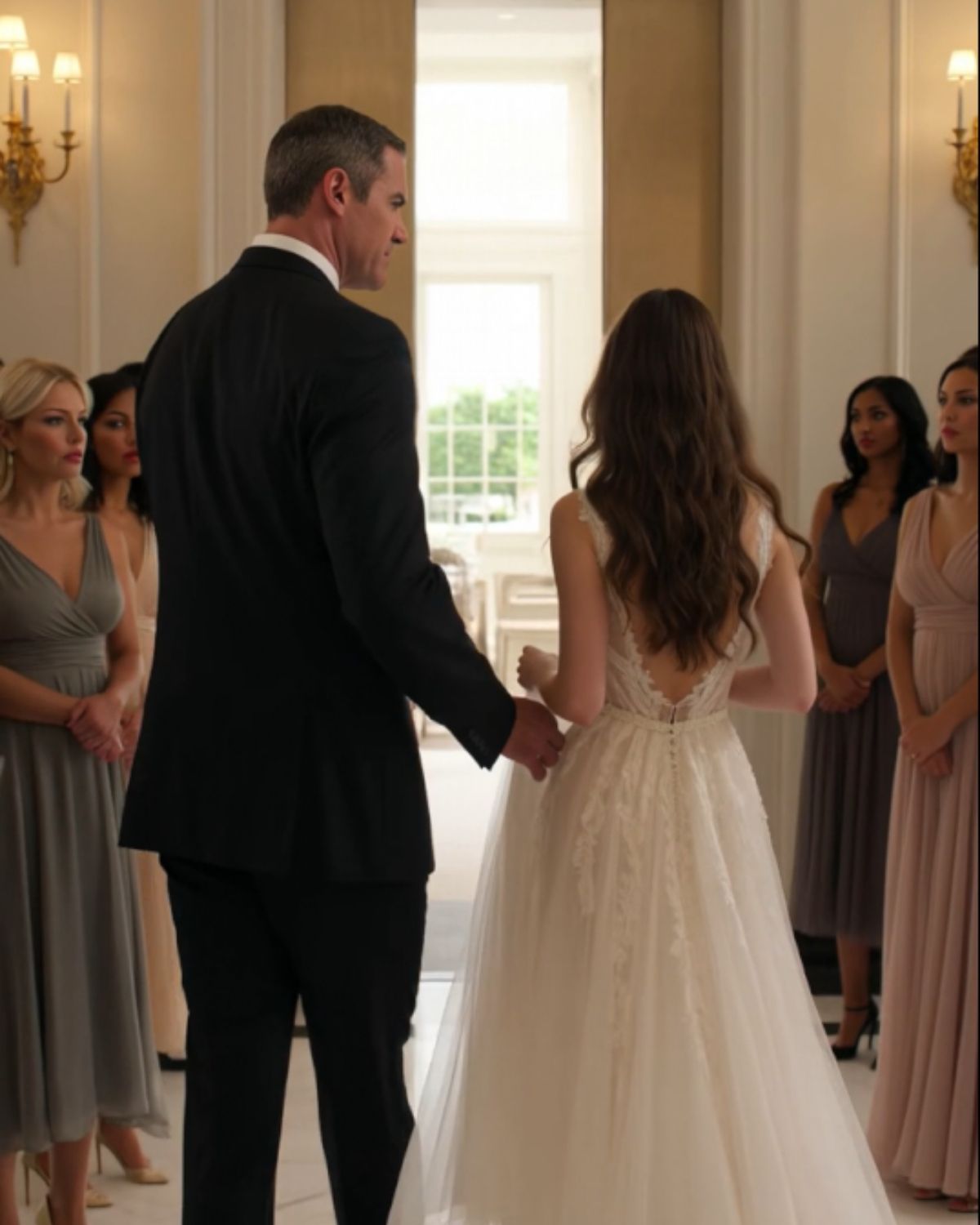
 The Grand Aurelia Hotel looked like it had been built for people who never had to wonder if they belonged.
White roses climbed the ballroom pillars in perfect spirals. Crystal chandeliers poured warm light over marble floors. Gold-rimmed champagne glasses stood ready on silver trays. Photographers adjusted their cameras near the entrance while florists moved quietly between tables, placing final stems into towering arrangements.
Outside the ballroom, staff checked guest lists on tablets.
Inside, violinists rehearsed a soft piece for the ceremony.
Everywhere, there were diamonds, designer dresses, tailored suits, polished shoes, and the quiet confidence of people who were used to being welcomed before they spoke.
It was the wedding of Daniel Whitmore.
The only son of Edward Whitmore.
Billionaire hotel investor. Chairman of Whitmore Global Holdings. A man whose name appeared on buildings, charity wings, and financial magazines. His family was one of those families people talked about in lowered voices, as if wealth itself required softer volume.
And in a small bridal preparation room at the end of the corridor, the bride stood alone in a simple white robe, holding her wedding dress in both hands.
Her name was Amara Bennett.
She was twenty-eight years old, a public school teacher from a working-class neighborhood on the south side. Her mother worked as a seamstress. Her father drove a city bus for thirty-two years before his knees gave out. Amara had grown up in a two-bedroom apartment above a laundromat, where the windows rattled in winter and the kitchen table served as a desk, sewing station, dinner table, and homework space.
She had never pretended to come from money.
Daniel loved that about her.
He loved that she remembered every student’s birthday. He loved that she wrote thank-you notes by hand. He loved that she could calm a crying child faster than most adults could finish giving advice. He loved that she had once spent her own grocery money buying winter gloves for three students who kept hiding their hands in their sleeves.
But love did not stop Amara’s hands from trembling that morning.
The dress was beautiful, but not flashy.
Cream satin. Long sleeves. Tiny pearl buttons down the back. Her mother had altered it herself, working late into the night with a lamp bent over the fabric, stitching carefully because she said no daughter of hers would walk into marriage wearing something that did not fit her soul.
Amara touched the sleeve gently.
“You ready?” her maid of honor, Lena, asked from behind her.
Amara smiled weakly. “Almost.”
“You look nervous.”
“I am nervous.”
“You’re allowed.”
Amara looked toward the mirror.
Without makeup, without the dress, without the veil, she looked exactly like herself: tired from barely sleeping, soft-eyed, simple, ordinary in the way real people are ordinary before a camera decides what to do with them.
She heard voices outside the preparation room.
Elegant voices.
Familiar only because she had heard them at the engagement dinner.
Daniel’s relatives.
Lena’s jaw tightened immediately.
“Ignore them.”
Amara took a breath. “I’m just going to ask the coordinator when the photographer is ready.”
“Want me to go?”
“No. I’ll be fine.”
She lifted the dress carefully over one arm and stepped into the corridor.
The hallway outside the ballroom was busy now.
Guests had begun to arrive early. Women in silk dresses greeted each other with cheek kisses. Men in dark suits checked their watches. Hotel staff moved in controlled lines, carrying trays, floral boxes, and garment bags.
Amara walked slowly, trying not to let the dress brush the wall.
Then she heard it.
“She doesn’t look like she belongs in this family.”
The words came from her left.
Two women stood near a marble column, both dressed in pale designer gowns, both wearing diamonds that caught the chandelier light. One was Daniel’s aunt, Celeste Whitmore. The other was his cousin’s wife, Vivian.
They were not whispering quietly enough.
They did not intend to.
Celeste’s eyes moved over Amara’s plain robe, bare face, and simple slippers.
“I thought the bride would at least have a stylist,” Vivian said.
Celeste gave a small laugh. “Maybe this is the stylist.”
Amara stopped walking.
For a second, she considered pretending she had not heard.
She had done that many times before in Daniel’s world.
At charity dinners when someone asked what her parents “did” and lost interest after the answer.
At the engagement party when one guest said, “Public school teacher? How noble,” in a tone that made noble sound like poor.
At a family brunch when Celeste asked whether Amara knew which fork to use, then smiled as if it were a joke.
Daniel had always defended her when he saw it.
But Daniel was not there now.
He was upstairs with his groomsmen, probably adjusting his tie, probably pacing, probably excited in that nervous way that made him check his phone every two minutes.
Amara did not want to call him.
Not today.
Not over this.
She kept walking.
A woman in a black suit stepped out from the ballroom entrance holding a clipboard.
Marissa Vale, the wedding coordinator.
She had been hired by the hotel, not by Amara. From their first meeting, Marissa had treated Amara as if she were a surprising inconvenience attached to a very important groom.
Marissa looked up from the clipboard.
Then her expression sharpened.
“Excuse me,” she said.
Amara stopped.
“Yes?”
Marissa looked her up and down.
The robe.
The slippers.
The dress in her arms.
The lack of jewelry.
The tired face.
“Are you sure you’re the bride?” she asked coldly. “The staff entrance is downstairs.”
The corridor quieted.
Not completely.
Just enough.
The kind of quiet that happens when people hear something cruel but wait to see if it will become entertaining.
Amara felt the heat rise in her face.
“I’m marrying Daniel today,” she said softly.
Celeste laughed under her breath.
Vivian did not even try to hide her smile.
Marissa’s eyes flicked toward them, then back to Amara.
“I see,” she said, in a tone that suggested she did not.
Amara adjusted her grip on the dress.
“I was looking for the photographer. I was told he might come to the preparation room before the ceremony.”
Marissa glanced at the dress.
“You should wait inside.”
“I understand. I just—”
“This corridor is for guest movement and vendor coordination,” Marissa interrupted. “We need to maintain the standard of the event.”
The standard.
Amara had heard words like that before.
Standard. Presentation. Fit. Background. Culture.
Polite words people used when they did not want to say class.
Celeste stepped closer, her smile sharp.
“Marissa is only trying to help, dear. These events can be overwhelming if you’re not used to them.”
Amara looked at her.
“I’m not overwhelmed.”
Vivian tilted her head.
“No? You look a little lost.”
The dress grew heavier in Amara’s hands.
Nearby, a photographer lowered his camera but did not move. A bellman paused with a tray of welcome drinks. Two younger guests whispered near the ballroom doors.
Amara felt every eye.
She tried to steady her breathing.
Today was supposed to be the day she walked toward Daniel.
Not the day she stood in a hotel corridor proving she deserved to.
Celeste’s voice lowered, but not enough.
“A girl like you marrying into this family… how embarrassing.”
The words went through Amara like cold water.
Her fingers tightened around the hanger.
The satin dress trembled.
That was what people noticed first.
Not her face.
Her hands.
The trembling hands of a bride trying not to cry while holding the dress she was supposed to wear into the happiest room of her life.
Lena appeared at the preparation room door.
“What is going on?”
Marissa lifted a hand.
“Please return to the bridal room. We’re handling the schedule.”
Lena looked at Amara’s face and immediately stepped forward.
“No, you’re not handling anything.”
Amara whispered, “Lena, please.”
She did not want a scene.
That was the cruelest part.
People could humiliate you in public and still make you feel responsible for keeping the room comfortable.
Celeste sighed.
“This is exactly what I was afraid of. Daniel is a good man, but he has always been sentimental. Marriage into a family like ours is not just about love. It is about understanding the life.”
Amara raised her eyes.
“My parents have been married thirty-four years,” she said quietly. “I understand marriage.”
Celeste’s face hardened.
Vivian gave a short laugh.
“How sweet.”
The elevator at the end of the corridor opened.
No one looked at first.
Then the staff nearest the elevator straightened.
The air changed before the man fully stepped out.
Edward Whitmore walked into the corridor wearing a sharp black suit, white shirt, and deep navy tie. He was tall, silver-haired, and calm in the way powerful people sometimes are when they do not need to rush for the world to make room.
Two assistants followed him.
The hotel general manager walked beside him, speaking quietly.
But Edward was not listening anymore.
He had seen Amara.
He had seen the dress trembling in her hands.
He had seen Celeste’s posture, Vivian’s smile, Marissa’s clipboard held like a shield, and the small crowd pretending not to watch.
The corridor went silent.
Edward’s eyes moved to Amara’s face.
Her lower lashes were wet.
Something in his expression changed.
Not dramatic anger.
Something colder.
Controlled disappointment.
The kind that frightened people who knew him.
He walked toward the group.
No one spoke.
Celeste immediately adjusted her face into a smile.
“Edward. There you are. We were just—”
Edward did not look at her.
He looked at Amara.
Then at the people around her.
His voice was low.
“Who made my future daughter-in-law cry?”
The sentence settled over the corridor like a verdict.
Celeste froze.
Vivian’s smile vanished.
Marissa’s grip tightened around the clipboard.
The hotel general manager looked horrified.
Amara opened her mouth.
“Mr. Whitmore, it’s all right.”
Edward turned gently toward her.
“No, Amara. It is not.”
She looked down, blinking fast.
Edward faced Marissa.
“You are the coordinator?”
Marissa swallowed.
“Yes, sir.”
“What happened?”
“Sir, we didn’t know—”
He cut her off.
“You didn’t know what?”
Marissa’s eyes darted toward Celeste.
“That she was…”
“The bride?” Edward asked.
Marissa’s face reddened.
“I meant, we didn’t realize—”
“That she mattered?”
The corridor went completely still.
Marissa had no answer.
Edward’s voice remained calm, which made every word sharper.
“You didn’t need to know her bank account to show respect.”
Marissa looked down.
He turned to Celeste.
“And you?”
Celeste tried to recover.
“Edward, please. This is a misunderstanding. We were concerned about appearances. You know how the press can be. Daniel’s marriage will be discussed, and I only meant—”
“What did you say to her?”
Celeste’s mouth tightened.
“Nothing worth repeating.”
Edward stepped closer.
“Then it was worth not saying.”
Vivian lowered her eyes.
Edward looked around the corridor, taking in the guests, staff, relatives, and photographers.
“Let us be clear,” he said. “This wedding is not a merger. It is not a society arrangement. It is not an acquisition of status.”
His gaze returned to Amara.
“My son is marrying a woman he loves.”
Amara’s eyes filled again.
Edward’s voice softened, but carried.
“And I support this marriage because I have watched who she is when no one important is looking.”
Celeste said quietly, “Edward—”
“No.”
The single word stopped her.
Edward continued, “When Daniel first brought Amara to dinner, she spent twenty minutes in the kitchen with a server whose mother was ill. Not because anyone asked her to. Because she noticed the woman was trying not to cry.”
The staff glanced at one another.
Amara looked surprised he knew.
Edward turned slightly toward the watching relatives.
“When my driver’s daughter needed help with a scholarship essay, Amara read three drafts after teaching all day. She never mentioned it. The driver told me.”
Lena smiled through angry tears.
“When one of Daniel’s board members spoke to a waiter like he was furniture, Amara corrected him with more grace than most people show in apology.”
Edward looked back at Celeste.
“You call that embarrassing?”
Celeste’s face lost color.
Edward’s voice deepened.
“My son chose a woman with kindness and dignity. That is worth more than every diamond in this room.”
Nobody spoke.
The chandeliers above them seemed too bright now.
Every polished surface reflected the shame of people who had mistaken wealth for worth.
Amara stood with her wedding dress in her arms, tears sliding silently down her face.
Edward stepped toward her and lowered his voice.
“I am sorry this happened today.”
She shook her head quickly.
“You don’t have to apologize.”
“Yes,” he said. “I do. Because they believed my silence would agree with them.”
That landed differently.
Celeste looked away.
For years, Edward Whitmore had been known as a hard man. Brilliant, disciplined, generous in public but reserved in private. He did not waste words. He did not flatter easily. He rarely explained himself twice.
And because he had been quiet about Daniel’s relationship, some relatives had taken that silence as disapproval.
They had been wrong.
Edward turned toward Marissa.
“You will no longer coordinate this wedding.”
Marissa’s head snapped up.
“Sir, please. The ceremony is in less than an hour.”
“The hotel has senior event staff who can finish the work. You will leave this floor.”
The general manager immediately nodded.
“I’ll handle the transition personally.”
Marissa looked toward Celeste, but Celeste had no help to offer.
Edward continued, “Before you go, you will apologize to the bride.”
Marissa’s lips parted.
The command was not loud.
It did not need to be.
She turned to Amara, face pale.
“I’m sorry,” she said.
Edward watched her.
Marissa swallowed.
“I’m sorry I judged you by your appearance. I should have treated you with respect from the start.”
Amara looked at her.
For a moment, she did not answer.
Then she said, “Thank you.”
Nothing more.
That made it worse somehow.
No dramatic forgiveness.
No performance of grace to rescue Marissa from discomfort.
Just thank you.
Marissa lowered her eyes and stepped away.
The general manager signaled another event supervisor, who immediately took over the clipboard.
Edward faced Celeste and Vivian.
“You will not speak to her that way again.”
Celeste stiffened.
“Edward, surely you don’t intend to embarrass family in front of staff.”
Edward’s eyes narrowed slightly.
“You embarrassed the family when you mistook cruelty for standards.”
Vivian looked down, ashamed now.
Celeste’s face trembled between pride and fear.
Edward continued, “If either of you cannot celebrate this marriage with sincerity, you may leave before the ceremony begins.”
The words shocked the corridor.
Celeste whispered, “You would ask me to leave your son’s wedding?”
“If your presence costs his bride her dignity, yes.”
For the first time, Celeste looked truly shaken.
Not because she had hurt Amara.
Not yet.
Because she had discovered that Edward’s support belonged somewhere she did not expect.
With the bride.
Amara finally spoke.
“Please,” she said softly. “I don’t want Daniel upset before the ceremony.”
Edward turned to her.
“He should know if you were mistreated.”
“I know,” she said. “And I won’t hide it from him. But I don’t want this moment to become the whole day.”
Edward studied her face.
That was Amara.
Not weak.
Not passive.
Composed enough to choose what mattered even while hurt.
He nodded.
“As you wish.”
Lena stepped beside Amara and placed a protective hand near her back.
“We should get you ready.”
Amara nodded, wiping her cheek carefully so she would not stain the dress.
Then Edward did something no one expected.
He offered his arm.
“Allow me to escort you back to the bridal room.”
Amara blinked.
“You don’t have to.”
“I know.”
She looked at his arm.
Then at the relatives.
Then at the staff watching in silence.
Slowly, she placed her hand on his sleeve.
The corridor parted.
No one asked if she belonged now.
But Edward knew that was not enough.
Respect that arrived only after power defended you was not true respect. It was fear correcting itself.
Still, fear could sometimes make space for truth to be heard.
He walked her to the bridal preparation room.
At the doorway, Amara stopped.
“Mr. Whitmore?”
“Yes?”
“Thank you.”
His face softened.
“Call me Edward. After today, perhaps Dad, if you ever want to make an old man emotional.”
A surprised laugh escaped her through tears.
Lena looked away, smiling.
Edward lowered his voice.
“Daniel is very lucky.”
Amara shook her head.
“I’m lucky too.”
“No,” Edward said gently. “You are both responsible for honoring the luck.”
She held his gaze.
“I will.”
“I know.”
Inside the bridal room, Lena closed the door.
The noise of the corridor faded.
For a moment, Amara stood still, holding the dress against her chest.
Then her composure cracked.
She sat down on the edge of the chair and cried.
Not loudly.
Not dramatically.
Just enough for the hurt to leave her body before it poisoned the day.
Lena knelt in front of her.
“You should’ve let me throw something.”
Amara laughed through tears.
“Not at my wedding.”
“Fine. At the brunch tomorrow.”
Amara wiped her face carefully.
“I hate that I cried.”
“Why?”
“Because now they’ll think they got to me.”
Lena shook her head.
“No. They saw you keep your dignity while they lost theirs.”
Amara looked toward the mirror.
Her eyes were red.
Her hands had stopped shaking.
Lena stood and picked up the makeup sponge.
“Come on. Let’s get you married.”
The scene shifted across the hotel.
In the grand wedding hall, guests took their seats beneath white flowers and golden chandeliers. The string quartet began warming up again. Staff moved more carefully now, more quietly, as if the building itself had learned something.
In the reception area, Celeste stood alone near a champagne table, staring at the floor.
Vivian approached slowly.
“I shouldn’t have laughed,” Vivian whispered.
Celeste said nothing.
Vivian continued, “She didn’t even answer back.”
Celeste’s jaw tightened.
“That does not make us right.”
Vivian looked surprised.
Celeste glanced toward the ballroom doors.
For years, she had believed protecting the Whitmore name meant keeping the wrong people out. But Edward’s words had cracked something open.
What if the wrong people had always been the ones who measured worth by entrance, accent, designer labels, and inherited ease?
She looked down at the diamond bracelet on her wrist.
It suddenly felt heavier than it had that morning.
Upstairs, Daniel stood in a private suite with his groomsmen, adjusting his cufflinks for the third time.
His best man, Aaron, checked his phone.
“You okay?”
Daniel exhaled.
“I feel like I’m about to give a presentation to my entire future.”
Aaron laughed.
“That’s marriage.”
There was a knock at the door.
Edward entered.
Daniel turned immediately.
“Dad.”
Edward looked at his son.
The same boy who once ran through hotel lobbies pretending the carpets were lava. The same boy who, at sixteen, asked why people treated staff differently when Edward was around. The same man who had chosen Amara without asking whether she increased his status.
Edward walked closer.
“You chose well.”
Daniel smiled nervously.
“I know.”
“No,” Edward said. “I mean it.”
Daniel’s smile faded slightly.
“What happened?”
Edward paused.
He had promised Amara not to make the moment the whole day. But Daniel deserved truth.
“Some people forgot who they were speaking to.”
Daniel’s face changed.
“Amara?”
“She handled herself with grace.”
Daniel stepped forward. “Who?”
Edward placed a hand on his shoulder.
“You will speak with her after the ceremony. Not before, unless she asks. She does not want anger walking her down the aisle.”
Daniel’s jaw tightened.
“Was it Celeste?”
Edward did not answer.
That was answer enough.
Daniel closed his eyes.
“I knew they’d do something.”
Edward’s hand remained steady on his shoulder.
“Then do not spend the ceremony thinking about them. Spend it looking at the woman who chose to walk toward you anyway.”
Daniel breathed in slowly.
Then nodded.
“You’re right.”
Edward looked at him for a long second.
“I have not always told you when I was proud.”
Daniel’s eyes lifted.
Edward continued, “I am proud today.”
Daniel swallowed.
“Dad…”
Edward squeezed his shoulder once.
“Don’t cry before the photos. Your mother used to say men in this family turn blotchy.”
Daniel laughed, then wiped his eyes anyway.
Back in the bridal room, Amara stepped into her dress.
The satin settled over her like calm returning.
Lena buttoned each pearl carefully.
The makeup artist softened the redness around her eyes without hiding them completely. Her mother entered quietly near the end, wearing a lavender dress she had sewn herself.
She stopped when she saw Amara.
“Oh, my baby.”
Amara turned.
Her mother covered her mouth.
The dress fit perfectly.
Not because it was expensive.
Because it had been loved into place.
Amara walked to her.
“Mom.”
Her mother took her hands.
“They upset you.”
Amara blinked. “How did you know?”
“I am your mother.”
That was the whole explanation.
Amara’s eyes filled again, but she smiled.
“I’m okay.”
Her mother studied her.
“No. But you will be.”
Then she adjusted the sleeve gently.
“Listen to me. You do not walk into that room hoping they accept you. You walk in knowing who raised you.”
Amara let out a shaky breath.
Her mother continued, “Your father drove buses through snowstorms to keep food on our table. I stitched dresses until my fingers cramped so you could have books and shoes. You became a teacher. You became a woman who gives more than people see. There is no shame in where you come from.”
Amara nodded, tears rising again.
Her mother touched her cheek.
“Do not borrow shame from people who have mistaken money for character.”
A soft knock came at the door.
The new event supervisor entered carefully.
“Mrs. Whitmore-to-be, we’re ready when you are.”
The title made Amara smile.
Not because of the name.
Because this time, it was spoken with respect.
In the corridor outside the ballroom, guests stood as the processional began.
Daniel waited at the front beneath an arch of white roses.
His face was pale with emotion.
Edward stood in the front row.
Celeste sat two seats away from him, stiff and silent. Vivian sat beside her, eyes lowered.
Marissa was gone.
The ballroom doors closed briefly.
Behind them, Amara stood with her father, Thomas Bennett, a retired bus driver with kind eyes and a limp from old knee injuries.
He looked at her.
“You ready, Mara?”
She nodded.
He leaned closer.
“I heard someone was unkind.”
Amara looked down.
“Dad…”
He placed her hand on his arm.
“I’ve driven every kind of person in this city. Rich, poor, tired, angry, lost, proud. You learn something after enough years behind the wheel.”
“What?”
“People who need to make others feel small are usually standing on something hollow.”
Amara smiled through tears.
The music changed.
The ballroom doors opened.
Everyone turned.
For one suspended second, Amara saw all of it.
The flowers.
The chandeliers.
The guests.
The relatives who had judged her.
Edward standing in the front row.
Daniel waiting at the altar.
Then Daniel saw her.
His face changed completely.
Not with surprise at the dress.
With recognition.
There you are.
The entire room seemed to soften around that look.
Amara walked forward on her father’s arm.
The crowd watched.
Some with admiration.
Some with guilt.
Some with curiosity.
But Amara’s eyes stayed on Daniel.
When she reached him, Thomas placed her hand in Daniel’s.
“Take care of my daughter,” he said.
Daniel’s voice was rough.
“With everything I am.”
Thomas nodded once.
Then he turned to Amara.
“And you take care of yourself too.”
She smiled.
“I will.”
The ceremony began.
The officiant spoke about love, partnership, patience, and choosing each other not only in joy but in difficulty.
Daniel kept his eyes on Amara.
When it was time for vows, he unfolded a small paper.
Then he stopped.
He looked at her face.
“I wrote something,” he said softly. “But I don’t need most of it.”
A ripple of gentle laughter moved through the room.
Daniel continued.
“Amara, I have watched you turn ordinary days into places people can rest. I have watched you remember names other people forget. I have watched you give dignity to people who were used to being rushed past.”
Amara’s lips trembled.
He glanced briefly toward his relatives, then back to her.
“If anyone ever makes you feel like you are lucky to be chosen by this family, I want you to remember this: I am the one who is lucky you chose me.”
Edward looked down, emotional.
Celeste closed her eyes.
Daniel’s voice thickened.
“I don’t want a life built on status. I want a life built on what you already carry: kindness, courage, truth, and the kind of love that makes people better without making them feel small.”
Amara wiped one tear with her thumb.
When it was her turn, she held Daniel’s hands.
“I was scared today,” she said.
A quiet hush moved through the room.
Daniel’s jaw tightened, but she squeezed his hands.
“I was scared because our worlds can look very different from the outside. But then I remembered something my mother told me. I do not walk into this marriage hoping to belong. I walk into it ready to build a home with you.”
Daniel’s eyes filled.
Amara continued.
“I promise to love you honestly. I promise to tell you the truth even when it is uncomfortable. I promise to see the people around us, not just the room we are standing in. And I promise that wherever life takes us, we will never measure people by what they own.”
The words found their targets without naming them.
Celeste stared at her hands.
Edward looked at Amara with quiet pride.
The vows ended.
The rings were exchanged.
The officiant smiled.
“You may kiss the bride.”
Daniel kissed her gently, then rested his forehead against hers for one brief second.
The applause rose.
This time, it was not polite.
It was full.
Relieved.
Human.
At the reception, the atmosphere changed.
Guests who had been curious about Amara now approached with warmth. Some were sincere. Some were embarrassed. Some were simply adjusting to the new center of power in the family.
Edward stayed near Amara’s parents for most of cocktail hour.
Not because it was strategic.
Because he wanted everyone to see where he stood.
Thomas Bennett told him stories about night bus routes, difficult passengers, and the time Daniel had taken three buses across town to surprise Amara after school.
Edward laughed more than people were used to seeing.
Amara’s mother discussed fabric with one of the hotel florists, who ended up showing her photos of her own daughter’s prom dress.
The wedding slowly became what it should have been all along.
Families meeting.
Not status levels competing.
Still, the final confrontation had not happened.
It came just before dinner, in the corridor outside the ballroom.
Amara had stepped away to breathe for a moment. The day had been beautiful, but overwhelming. She stood near a window overlooking the city lights, holding a glass of water.
Celeste approached quietly.
Amara saw her reflection first.
She prepared herself.
Celeste stopped a few feet away.
For once, she did not look sharp.
She looked older.
Less certain.
“Amara,” she said.
Amara turned.
“Yes?”
Celeste’s hands folded together.
“I owe you an apology.”
Amara stayed silent.
Celeste seemed to realize she would have to continue without being rescued.
“What I said earlier was cruel. Not protective. Not honest. Cruel.”
The word cost her something.
Good, Amara thought, then felt guilty for thinking it.
Celeste continued.
“I have spent much of my life believing families like ours must guard themselves. Against scandal. Against opportunists. Against people who want the name without understanding the weight of it.”
Amara’s voice remained calm.
“And you thought I was one of those people.”
“Yes.”
The directness surprised her.
Celeste looked toward the ballroom, where Daniel was laughing with Amara’s father.
“I was wrong.”
Amara did not rush to forgive.
Celeste’s eyes came back to her.
“And I am ashamed that I needed Edward to say it before I saw it clearly.”
That was the real apology.
Amara felt it.
Not perfect.
Not enough to erase the morning.
But real enough to answer.
“I love Daniel,” Amara said. “I’m not here for his name.”
“I know.”
“I hope you do.”
Celeste nodded.
“I do now.”
Amara looked through the ballroom doors.
“When I become part of this family, I will not become quiet just to make people comfortable.”
Celeste blinked.
Then, unexpectedly, smiled a little.
“I suspect that is one reason Edward likes you.”
Amara almost smiled too.
Celeste lowered her eyes.
“If you are willing, I would like to begin again. Not tonight. Tonight you should enjoy your wedding. But someday.”
Amara considered her.
“Someday,” she said.
Not yes.
Not no.
A door, but not a performance.
Celeste accepted it.
“Thank you.”
As Celeste walked away, Daniel appeared at the corridor entrance.
He had seen enough to understand something had passed between them.
“You okay?” he asked.
Amara walked to him.
“I am now.”
His face tightened.
“I’m sorry.”
“You didn’t do it.”
“No. But I should have protected you from it.”
She touched his cheek.
“We protect each other now.”
He nodded, eyes wet again.
“Deal.”
They returned to the ballroom together.
At dinner, Edward gave the first toast.
He stood at the center of the room, champagne glass in hand, the chandeliers glittering above him.
The room quieted immediately.
Edward looked first at Daniel.
“My son has made many decisions in his life that tested my patience.”
Laughter moved through the room.
Daniel lowered his head, smiling.
Edward continued.
“He once tried to convince me that dropping out of college to become a travel photographer was a financial strategy.”
More laughter.
Daniel mouthed, “It was.”
Edward smiled, then turned serious.
“But today, Daniel made a decision that fills me with pride. He chose a partner not because of convenience, status, or expectation, but because of character.”
The room became still.
Edward looked at Amara.
“Amara, this family has wealth. It has influence. It has tradition. Those things can be useful. They can also become dangerous when people mistake them for virtue.”
Celeste looked down.
Edward continued.
“You bring something into this family that cannot be inherited, purchased, or displayed in a glass case. You bring kindness with backbone. Grace without weakness. Dignity that does not need permission from any room.”
Amara’s mother began to cry.
Thomas put an arm around her.
Edward raised his glass.
“To Daniel and Amara. May your home be richer than any account, stronger than any name, and humble enough to welcome every person with respect before knowing what they own.”
The room rose to its feet.
Amara looked at Daniel.
Daniel looked at her.
For the first time all day, she felt the weight leave her shoulders.
Not because everyone approved.
Not because all prejudice had vanished.
But because the people who mattered had chosen truth in public.
Later, after dinner, after dancing, after cake, after hundreds of photos and hugs and congratulations, Amara found herself standing near the ballroom doors again.
The same doors she had walked through trembling.
Edward approached and offered his arm.
“May I have one dance with my daughter-in-law?”
Amara smiled.
“I’d be honored.”
As they moved onto the dance floor, the crowd made space.
Not the tense parting of the corridor earlier.
This was different.
Warm.
Respectful.
Edward was not a graceful dancer, but he was careful.
“My wife would have liked you,” he said.
Amara looked up.
“Daniel told me about her.”
“She had very little patience for snobbery.”
“I wish she were here.”
“So do I.”
They danced quietly for a few moments.
Then Edward said, “I meant what I said earlier. If anyone in this family makes you feel small, you come to me.”
Amara’s expression softened.
“Thank you. But I also need them to learn that I can speak for myself.”
Edward’s eyes warmed.
“Daniel truly chose well.”
She laughed.
“You keep saying that.”
“I am old. Repetition is one of my privileges.”
Across the room, Daniel watched them with a smile he did not try to hide.
Celeste watched too.
There was something unreadable in her face, but it was no longer contempt.
Maybe humility.
Maybe regret.
Maybe the beginning of change.
The night ended with sparklers outside the hotel entrance.
Guests lined the steps beneath the canopy. The city air was cold, and the sky had cleared. Daniel and Amara stood together, hands clasped, surrounded by light.
Her dress glowed softly.
His eyes never left her.
The photographers called for one more kiss, one more smile, one more turn toward the lights.
Then Daniel leaned close and whispered, “Ready to leave?”
Amara looked back through the glass doors.
At the marble corridor.
The ballroom.
The chandeliers.
The family she had entered with tears in her eyes and her dignity still intact.
Then she looked at her husband.
“Yes.”
They walked down the steps together.
Behind them, Edward stood beside Amara’s parents, watching with quiet satisfaction.
Celeste approached him slowly.
“You were right,” she said.
Edward did not look away from the couple.
“I know.”
A faint smile touched her face.
“You might at least pretend modesty.”
“Not tonight.”
She followed his gaze.
“She is stronger than I expected.”
Edward’s voice was calm.
“No. She is stronger than you allowed yourself to see.”
Celeste accepted the correction in silence.
Amara and Daniel stepped into the waiting car.
Just before the door closed, Amara looked back.
Edward raised one hand.
Her parents waved.
The crowd cheered.
And for one brief second, her eyes met Celeste’s.
Celeste gave a small nod.
Not enough to fix everything.
But enough to say the lesson had landed.
The car pulled away.
The hotel lights faded behind them.
People would later talk about the wedding as elegant, emotional, unforgettable.
Some would mention the flowers.
Some the food.
Some the billionaire father’s toast.
A few would whisper about the tense moment before the ceremony, when certain relatives learned that wealth does not give anyone permission to wound.
But Amara would remember something else.
She would remember standing in a corridor with trembling hands, holding the dress her mother had altered by lamplight.
She would remember being told she did not belong.
She would remember Edward Whitmore walking in, not to rescue a helpless bride, but to stand beside a woman whose dignity had already done most of the fighting.
And she would remember the sentence that changed the room:
“You didn’t need to know her bank account to show respect.”
Because the truth is simple.
Status can open doors.
Money can fill ballrooms.
Diamonds can catch every light in the room.
But character is revealed in the moment before you know who someone is, when all you have to guide you is the choice to treat them like they matter.
And on the day Amara Bennett became Amara Whitmore, the richest thing in that luxury hotel was not the flowers, the chandeliers, or the family fortune.
It was the quiet strength of a bride who refused to let anyone’s prejudice decide her worth.