The first time Sergeant Mark Dawson laughed at Evelyn Cain, thirty people laughed with him.
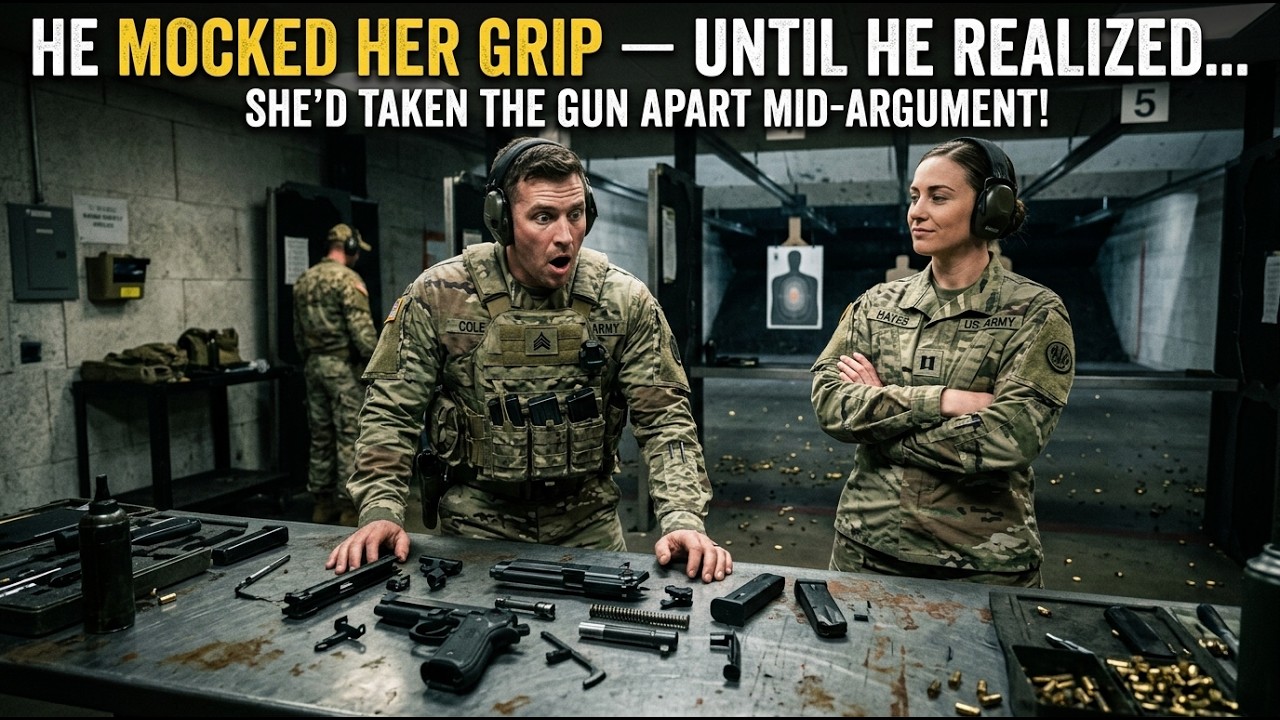
The second time, half the crowd reached for their phones.
By the third time, no one was laughing anymore.
It happened on a Saturday morning at Thunder Creek Range, a civilian-military training facility about forty minutes outside Fort Brennan. The place had a reputation. On weekdays, security contractors and off-duty military personnel used it for certification drills. On weekends, civilians came for beginner safety courses, corporate team-building packages, and the kind of controlled adrenaline that made people feel braver than they were.
The air smelled like hot metal, dust, sunscreen, and coffee from the paper cups lined along the folding table near the check-in tent. Targets stood in neat rows downrange. A faded American flag snapped hard in the wind behind the instructor platform.
There were about thirty people in that morning’s mixed class.
Some were nervous first-timers. Some were young men pretending not to be nervous. A few were former service members who had shown up mostly to prove they still knew what they were doing.
And then there was Evelyn Cain.
She arrived ten minutes early in faded jeans, a plain gray T-shirt, and an old navy baseball cap pulled low over her forehead. No tactical pants. No expensive range bag. No branded shooting shirt. No loud stories about “back when I trained with so-and-so.”
She carried herself quietly, almost carefully, like someone who did not want to take up too much space.
When the class gathered near lane seven for the safety demonstration, Evelyn stood toward the back. She listened without interrupting. She nodded once when the range officer explained the rules. She kept her hands folded in front of her.
Nobody paid much attention to her at first.
That changed when Sergeant Mark Dawson stepped onto the platform.
Mark was the lead instructor for the day. Late forties, square jaw, close-cropped hair, dark wraparound glasses, and a voice that could cut through engine noise. His polo shirt had “Dawson Tactical Consulting” stitched over the chest, and he wore his résumé like armor.
He had served overseas. He had trained law enforcement teams. He had stories about people freezing under pressure, people getting cocky, people who “should never be allowed within a mile of a weapon.”
Mark liked an audience.
And that morning, he had one.
“Listen up,” he said, clapping his hands once. “This is not a movie. This is not a video game. Out here, your ego can get someone hurt.”
A few people nodded.
Mark paced slowly in front of the group, enjoying the silence.
“I don’t care what you watched online,” he continued. “I don’t care what your uncle taught you behind a barn. You follow instructions here, or you go home.”
It was a solid message.
The problem was the way Mark delivered it.
He didn’t teach like a man trying to build confidence. He taught like a man waiting for someone to fail.
And Evelyn, unfortunately, gave him the opening he wanted.
During the first handling demonstration, each student was asked to step up, receive an unloaded training weapon, and show that they understood the basic safety checks under supervision. It was slow, controlled, and meant to be instructional.
When Evelyn’s turn came, she stepped forward without drama.
Mark handed her the training weapon and said, “Show me safe.”
Evelyn looked down at it. For half a second, her thumb hovered near the safety in a way that looked uncertain. She adjusted her grip, paused, and glanced toward the table.
It was a tiny moment.
But Mark saw it.
“Oh boy,” he said loudly.
A few people chuckled.
Evelyn looked up.
Mark tilted his head, as if he had just found the punchline he had been waiting for.
“Ma’am,” he said, “have you ever handled one of these before, or are we all about to become part of your learning journey?”
The group laughed.
Evelyn did not.
“I’m here for the course,” she said calmly.
“That wasn’t my question.”
“I’ve handled firearms before.”
Mark smiled.
It was not a kind smile.
“Handled firearms before,” he repeated, turning slightly toward the class. “That can mean a lot of things. It can mean competent. It can mean dangerous with confidence. Or it can mean someone’s boyfriend let her hold one at a barbecue.”
More laughter.
Someone near the back whispered, “Damn.”
Evelyn’s face did not change. She lowered her eyes back to the training weapon, completed the check under supervision, and stepped back.
Mark should have moved on.
He didn’t.
“Class,” he said, pointing toward Evelyn without looking at her, “this is why we do not assume. Plain clothes, nervous hands, uncertain pressure on the safety. That’s how accidents start.”
Evelyn turned her head slightly.
“I was waiting for your command to proceed,” she said.
The laughter thinned.
Mark removed his sunglasses slowly, like he had been personally challenged.
“My command?”
“Yes.”
“You froze.”
“I waited.”
The range went quiet enough that the flag behind the platform sounded louder.
Mark gave a short laugh.
“Lady, I have spent twenty-two years reading hesitation. Don’t dress it up.”
That was the first video that later showed up online. Someone in the second row had started recording just as Mark said it.
Evelyn looked at him for a long moment, then nodded once.
“Understood.”
That seemed to irritate him more than an argument would have.
Because Evelyn did not blush. She did not defend herself. She did not try to prove him wrong. She gave him nothing to push against.
And men like Mark often mistake silence for weakness.
The morning continued with dry drills, positioning, safety commands, and timed movement between stations. Mark moved through the group correcting people, but his eyes kept returning to Evelyn.
When another student fumbled a magazine, Mark corrected him quietly.
When Evelyn adjusted her stance, Mark stopped the entire line.
“Everyone pause,” he called out. “Look at lane seven.”
Thirty heads turned.
Evelyn stood still.
Mark walked over and tapped the dirt near her feet with his boot.
“You see this?” he asked the class. “This is what happens when people watch too much television. Feet wrong. Weight wrong. Shoulders too stiff.”
Evelyn looked down at her feet.
One of the assistant instructors, a younger man named Luis Ortega, glanced at Mark, then at Evelyn. His mouth tightened. He seemed to notice something, but he said nothing.
Mark stepped closer.
“What do you do for a living, Evelyn?” he asked, reading her name off the tag on her shirt.
“I work in logistics.”
“Logistics.”
He repeated the word as if it explained everything.
“Warehouse?”
“Among other things.”
“Among other things,” he echoed. “Well, among other things, this is not a spreadsheet. Out here, your body tells the truth.”
A couple of men laughed again, but it was weaker this time.
Evelyn only said, “I’ll correct it.”
“You’ll try,” Mark said.
The class moved into live-fire exercises after another safety briefing. Each student would take turns under close supervision. No one moved without command. No one loaded until told. Everything was slow and structured.
Evelyn waited at the back of lane seven, hands relaxed, eyes forward.
When her turn came, Mark positioned himself just behind her left shoulder.
“Let’s see what logistics can do,” he said.
Someone laughed nervously.
Evelyn put on her eye protection and adjusted her ear protection. She looked smaller with the cap pulled low, shoulders plain against the bright dirt of the range.
Mark gave the command.
Evelyn fired.
Her first shot landed low and left.
Mark immediately raised both arms.
“And there it is.”
Evelyn lowered the firearm safely and waited.
Mark turned to the group.
“Classic anticipation. Classic lack of control. This is why humility matters. Nobody is born good at this.”
The second shot landed slightly right.
Mark shook his head.
“Chasing the target now.”
The third shot clipped the outside edge.
The group murmured.
Mark stepped back with exaggerated patience.
“Evelyn,” he said, “I want you to listen very carefully. You are not bad because you missed. You are bad because you don’t know why you missed.”
That landed ugly.
Even the people who had laughed earlier went still.
Evelyn removed one hand from the grip and raised it slightly, keeping everything pointed safely downrange.
“May I ask a question?”
Mark sighed.
“Go ahead.”
“Is the rear sight on this rental adjusted?”
Mark’s face shifted.
Just a flicker.
Then the smirk returned.
“The rear sight?”
“Yes.”
He looked at the class again.
“Folks, this is another beginner habit. Blame the equipment. The gun is fine. The target is fine. The wind is not your enemy. The earth’s rotation is not your enemy.”
A bigger laugh this time, because he had made it easy.
Evelyn nodded.
“All right.”
She fired the remaining rounds under command.
The grouping was strange. Not random. Not wide from panic. It was tight, but consistently off from where she had aimed.
Luis Ortega saw it.
So did one older man in the back wearing a retired Navy cap. He leaned forward, squinting.
Mark walked downrange with the group when the line was cleared. He stopped at Evelyn’s target and tapped the paper.
“Now this,” he announced, “is what happens when someone tries to perform instead of learning.”
Evelyn stood beside him quietly.
The shots were grouped close together, but several inches from center.
Mark pointed at the cluster.
“She has consistency, I’ll give her that. Consistently wrong.”
That got the biggest laugh of the morning.
Phones were fully out now.
A woman near the benches whispered, “This is mean.”
Her husband muttered, “He’s making a point.”
“No,” she said. “He’s making an example.”
Mark heard the whisper but ignored it.
He turned to Evelyn.
“Do you want to continue, or do you want to sit this one out and observe?”
It was phrased like a courtesy.
It was not.
Everyone knew it.
Evelyn looked at the target, then at Mark.
“I’ll continue.”
Mark’s eyebrows lifted.
“With that performance?”
“Yes.”
Something about her calmness made him sharpen.
“Then we’ll do something useful,” he said. “Public correction.”
Luis stepped forward half a step.
“Sergeant, maybe we keep it standard rotation.”
Mark did not look at him.
“I said public correction.”
Luis stopped.
The next drill was a simple timed accuracy exercise for intermediate students. It was not part of the beginner rotation, but Mark framed it as a “teaching moment.” One target. Controlled distance. Five shots. The goal was not speed alone, but composure under observation.
He brought Evelyn forward in front of everyone.
“Since Evelyn wants to continue,” he said, “we’re going to help her. She’s going to shoot five rounds. I’m going to call out every mistake in real time. That way nobody here repeats them.”
A few faces changed.
This was no longer instruction.
This was a public stripping.
Evelyn stood at the line. The wind pushed dust around her shoes.
Mark leaned toward her, voice lower now but still audible.
“You sure you want to do this?”
“Yes.”
“You know cameras are rolling?”
“I noticed.”
That answer bothered him.
He glanced at the phones, then raised his voice again.
“Confidence without competence is dangerous.”
Evelyn put her ear protection back on.
Luis stood near the side table, jaw tight. The retired Navy man crossed his arms.
Mark gave the command.
Evelyn fired five rounds.
The target snapped lightly in the wind.
When the line was cleared and the target came back, people leaned in.
The grouping was tight again.
Still off-center.
Mark clapped once.
“Beautiful. Absolutely beautiful. A perfect example of repeatable failure.”
He took the paper target and held it up to the class.
“Everybody see this? This is not nerves. This is not the first-shot jitters. This is what we call bad fundamentals with enough confidence to be dangerous.”
Evelyn said nothing.
Mark turned back to her.
“I’m going to ask you one more time. Who taught you?”
There it was.
Not “what happened.” Not “what are you seeing.” Not “let’s check the equipment.”
Who taught you?
As if someone else had failed before she ever stepped onto the range.
Evelyn’s eyes moved past him for a second, toward the far end of the range office.
A man had just stepped out of the building.
He was in his sixties, with gray hair, a black range vest, and a clipboard tucked under one arm. He stopped when he saw the crowd gathered around lane seven.
Mark noticed Evelyn looking and turned.
The man began walking toward them.
Several staff members straightened.
Luis’s expression changed first.
Recognition.
Then caution.
Mark did not see it. He was too busy performing.
“Answer the question,” Mark said.
Evelyn looked back at him.
“My father started teaching me when I was twelve.”
Mark gave a small, theatrical wince.
“Well,” he said, “I don’t know your father, but based on what we’re seeing here, he did you no favors.”
The air dropped out of the range.
Not because the insult was loud.
Because it was personal.
Evelyn’s face remained still, but her fingers tightened once around the edge of her cap.
The older man from the office stopped ten feet behind Mark.
Luis quietly said, “Sergeant.”
Mark waved him off.
“No. This matters. People need to understand that bad training passed down through families is still bad training. Sentiment doesn’t make you safe.”
The man from the office said, “Mark.”
Only one word.
But it changed the posture of every staff member within earshot.
Mark turned, irritated.
“Colonel Harris, I’m in the middle of—”
“I can see that.”
Colonel Thomas Harris, the owner of Thunder Creek Range, looked at the target in Mark’s hand. Then he looked at Evelyn.
His face softened.
“Evelyn Cain,” he said.
A murmur moved through the group.
Mark’s head turned slowly back to her.
Evelyn removed her ear protection.
“Colonel,” she said.
Harris stepped closer.
“I didn’t know you were coming today.”
“I registered online,” Evelyn replied. “Under my married name.”
Mark’s smirk was gone now, but he tried to recover.
“You know her?”
Colonel Harris looked at him for a long second.
“Yes,” he said. “I know her.”
That was the moment the story changed.
But not the way people expected.
Mark looked annoyed, not afraid. In his mind, maybe Evelyn was a family friend. Maybe the colonel knew her father. Maybe this was about to become an awkward customer service issue.
He still thought he was the expert in the story.
Colonel Harris reached for the target.
“May I?”
Mark handed it over.
Harris studied the grouping.
Then he looked at the training weapon on the bench.
“Luis,” he said, “bring me the sight tool and the logbook for lane seven’s rental set.”
Luis moved immediately.
Mark frowned.
“Sir, with respect, the equipment is not the issue.”
Harris did not answer him.
Evelyn stood quietly, eyes on the dirt.
A few people lowered their phones, confused. Others kept recording because the atmosphere had become electric in a different way.
Luis returned with a small case and a clipboard.
Harris checked the serial number on the rental weapon against the logbook. He flipped two pages, then stopped.
His eyes narrowed.
“Mark,” he said, “when was this last verified?”
Mark shifted.
“The rentals are checked weekly.”
“That is not what I asked.”
The crowd was silent now.
Harris held up the logbook.
“This unit was flagged last Tuesday for rear sight drift after a private security class. It was supposed to be pulled from rotation.”
Luis looked down.
Mark’s jaw worked once.
“I wasn’t told that.”
Luis looked up sharply.
“I sent the maintenance note to the instructor group. Tuesday at 4:18 p.m.”
Mark’s face hardened.
“That thread gets cluttered. Nobody saw it.”
Harris turned the clipboard toward him.
“You replied.”
The silence became physical.
Someone in the crowd whispered, “Oh.”
Harris read from the logbook.
“‘Leave it in the case. I’ll use it for diagnostics Saturday.’ Your initials are here.”
Mark stared at the page.
For the first time that morning, he had no sentence ready.
The phones rose higher.
But the twist was not finished.
Harris handed the target back to Mark.
“Do you know what this grouping tells me?”
Mark did not answer.
Harris looked at the class.
“It tells me the shooter adapted to a misaligned sight picture while maintaining control. The shots are not where she wanted them because the equipment is off. But they are grouped tightly because her fundamentals are solid.”
The retired Navy man nodded once.
“I saw that,” he said.
Mark’s ears went red.
He looked at Evelyn, then at the target, then at the phones. His mouth opened slightly, but no sound came out.
And then Colonel Harris said the sentence that made Mark’s face change completely.
“Also, for the record, Evelyn Cain’s father was Daniel Cain.”
Several people reacted at once.
One of the younger men whispered, “Wait. Daniel Cain?”
The retired Navy man uncrossed his arms.
“Master Chief Cain?”
Harris nodded.
“Yes.”
Mark blinked.
That name meant something in that community.
Daniel Cain had been a quiet legend among instructors, armorers, and competitive shooters in the region. Not a celebrity. Not a loud man. But the kind of person serious people spoke about with respect. He had trained military teams, rebuilt range programs, and written safety protocols that several facilities still used.
He had died three years earlier.
Evelyn had not mentioned any of that.
She had let Mark insult him in front of everyone.
Harris looked at Evelyn.
“Your father helped design the original safety curriculum for this range.”
The group turned toward her.
Evelyn said nothing.
She did not smile.
She did not look victorious.
That made it worse for Mark.
Because there was no arrogance to attack.
Harris continued, “And Evelyn spent six years as the logistics and compliance lead for the regional training audit program before she left the industry.”
Mark stared at her.
“Logistics,” he said faintly.
Evelyn finally looked at him.
“Among other things.”
No one laughed.
Not because it wasn’t funny.
Because it was too clean.
Mark’s face had gone pale under the tan. His shoulders, which had been squared all morning, lowered by an inch. He looked at the target again as if it had betrayed him.
That was the moment of recognition.
Not a speech. Not an apology yet.
Just his eyes moving from the tight grouping to the logbook, then to Evelyn’s calm face, then to the phones pointed at him.
He had not corrected a beginner.
He had publicly humiliated a highly qualified woman using faulty equipment he had knowingly left in rotation.
And everyone had watched him do it.
Colonel Harris took one step closer to Mark.
“Why was this unit on the line?”
Mark swallowed.
“I thought it would be useful for demonstration.”
“For whom?”
Mark’s mouth tightened.
Harris waited.
The wind moved dust across the concrete pad.
Mark looked toward the crowd, then away.
“For diagnostics,” he said.
Harris’s voice dropped.
“Do not hide behind language.”
That sentence landed harder than yelling would have.
Luis looked at the ground.
The woman near the benches covered her mouth.
Mark exhaled through his nose.
“I wanted to see if she would notice,” he said.
The crowd reacted immediately.
“What?”
“That’s messed up.”
“Are you serious?”
Mark raised a hand, defensive now.
“It’s a common training technique. Equipment problems happen. People need to—”
“No,” Harris said.
One word. Flat. Final.
Mark stopped.
Harris turned to the class.
“Let me be very clear. We do not test beginners with known faulty equipment. We do not embarrass students for entertainment. And we do not use safety instruction as a stage for ego.”
Then he looked back at Mark.
“You are relieved from instruction for the day.”
Mark’s mouth opened.
“Colonel, I—”
“Now.”
The assistant instructors froze.
Mark looked around, searching for support. He had spent the morning training the crowd to laugh with him, to follow his confidence, to accept his authority.
But authority is fragile when people see what it was built on.
No one stepped forward.
No one defended him.
The retired Navy man shook his head once.
Luis quietly took Mark’s instructor badge from the table and held it out.
Mark stared at it.
His hand moved slowly.
When he took the badge, his fingers did not look steady.
That was when Evelyn finally spoke.
“Colonel Harris.”
Everyone turned.
“I’d like to finish the drill,” she said.
Harris looked at her for a moment.
Then he smiled slightly.
“Of course.”
He picked up a properly verified firearm from the clean rack, checked the log, and handed it to Luis, who prepared the lane under standard procedure. No showmanship. No sarcasm. No performance.
Just safety.
Evelyn stepped back to lane seven.
The class watched in total silence.
Not the silence of boredom.
The silence of people realizing they had misread the main character.
Mark stood near the side of the platform, badge in hand, no longer wearing his sunglasses. Without them, his face looked older. Smaller. He did not look like a villain from a movie. He looked like a man who had confused being feared with being respected.
Harris gave the command.
Evelyn raised her firearm.
Five shots.
Controlled. Calm. Measured.
The target came back.
This time, the grouping sat cleanly near center.
No one spoke for half a second.
Then the retired Navy man started clapping.
Once.
Twice.
Then the woman near the benches joined.
Then Luis.
Then nearly everyone.
It was not wild applause. It was better than that.
It was recognition.
Evelyn removed her ear protection and stepped back from the line. She did not bow. She did not look at Mark. She simply cleared the station as instructed and returned to the group.
Mark watched her, his mouth pressed into a thin line.
Harris held up the target.
“This,” he said to the class, “is why instructors ask before they assume. This is why we check equipment before we blame students. And this is why confidence without humility is just noise.”
The phones captured that too.
By noon, Mark Dawson’s morning had become a lesson he never intended to teach.
The clips spread quickly through local veteran groups, range forums, and community pages. The first video showed him mocking Evelyn’s hands. The second showed him insulting her father. The third showed Colonel Harris reading the logbook entry with Mark’s own initials on it.
But the clip people shared the most was the last one.
Evelyn standing at lane seven.
Silent.
Five shots.
Center grouping.
No speech. No revenge monologue. No dramatic confrontation.
Just proof.
Thunder Creek Range released a statement that evening. It was brief, professional, and devastating.
Sergeant Mark Dawson had been suspended from instructional duties pending review. Thunder Creek would be updating its instructor conduct policy. All rental equipment logs would be audited by a second staff member before public courses. Students from that day’s class were offered a free follow-up session.
Mark posted nothing.
But Luis later told someone that Mark came back the next morning to clean out his locker. He moved quietly. He avoided the main office. And when he passed lane seven, he stopped for a moment.
The paper target was still pinned to the corkboard near the classroom door.
Not as a trophy.
As a reminder.
The tight off-center grouping was pinned beside the corrected center grouping. Underneath, Colonel Harris had written one sentence in black marker:
“Before you judge the shooter, check your sights.”
Evelyn saw the photo of that board two days later when Luis sent it to her.
She was sitting at her kitchen table with a cup of coffee, her father’s old cap resting beside her laptop. The same navy cap she had worn at the range.
She looked at the photo for a long time.
Then she typed back:
“He would have liked that.”
Luis replied:
“He would have been proud of how you handled it.”
Evelyn did not answer right away.
Because the truth was, she had not gone to Thunder Creek Range to expose anyone.
She had gone because her father had loved that place.
After Daniel Cain died, Evelyn avoided ranges for years. Not because she was afraid. Because every smell, every command, every echo brought back the weight of standing beside him as a girl, watching him teach with patience that made even nervous people feel capable.
Her father never humiliated students.
He used to say that a scared beginner was not a problem to crush. A scared beginner was a responsibility.
That Saturday morning, Evelyn had registered for the course under her married name because she wanted to stand on that range as just another student. Not Daniel Cain’s daughter. Not a former compliance lead. Not someone people treated carefully because of a last name.
She wanted to see if the place still carried her father’s spirit.
For the first hour, it seemed like it didn’t.
Then the truth came out in front of everyone.
Not because she shouted.
Not because she demanded respect.
But because she stayed steady long enough for arrogance to reveal itself.
A week later, Thunder Creek held its next beginner class.
Colonel Harris taught the opening safety block himself.
Before the first drill, he pointed to the two targets on the classroom wall.
He did not mention Evelyn’s name.
He did not need to.
He told the students, “Around here, we correct mistakes. We do not perform superiority.”
In the back of the room, a nervous woman in a denim jacket adjusted her ear protection and smiled slightly, as if someone had just given her permission to learn without being mocked.
That became the real legacy of the incident.
Not Mark’s embarrassment.
Not the viral videos.
Not even Evelyn’s perfect grouping.
The real legacy was that Thunder Creek Range changed the way it treated the quietest person on the line.
Because sometimes the person everyone underestimates is not weak.
Sometimes she is experienced enough to stay calm while others expose themselves.
And sometimes justice does not arrive with a shout.
It arrives as five quiet shots, a signed logbook, and a room full of people realizing they laughed at the wrong person.