My father laughed before I touched the rifle.
That was how I knew he was nervous.
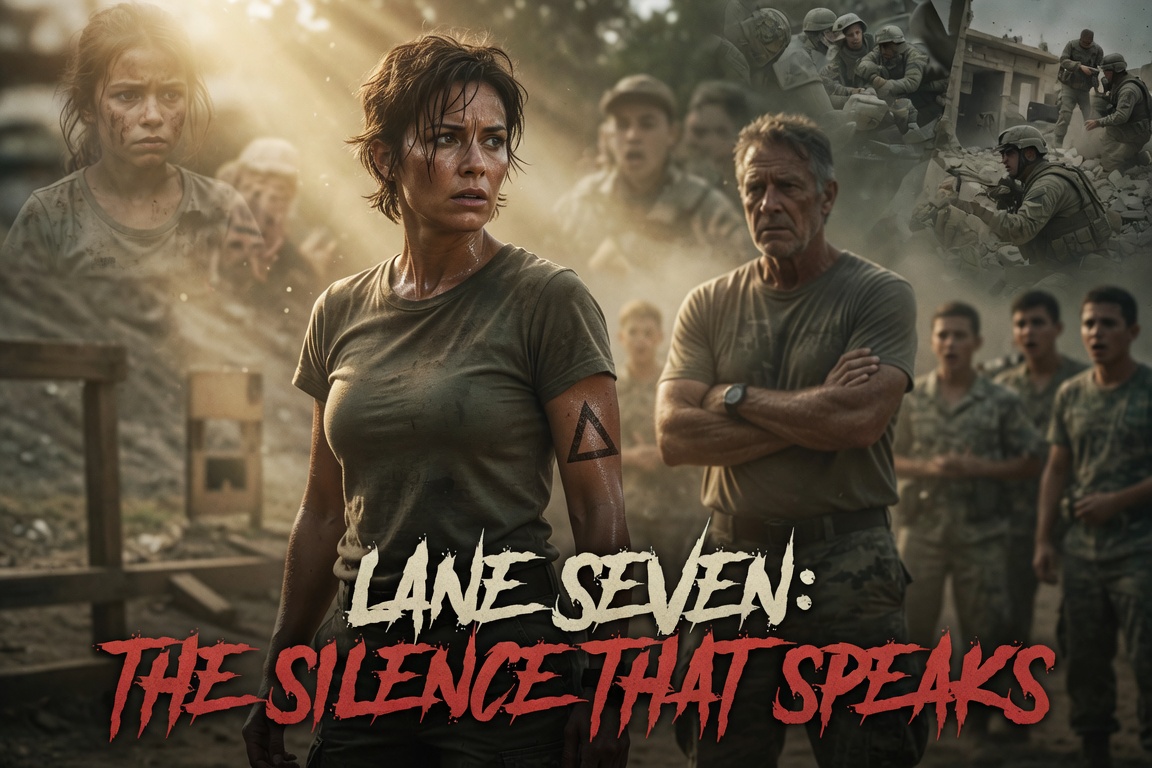
Colonel Patrick Delaney stood behind the firing line with his arms folded across his chest, gray hair clipped close, jaw set beneath skin weathered by sun and command. The morning wind moved dust across Range Nine in thin brown sheets. Flags snapped against the pale Texas sky. Empty brass from the previous relay glittered near my boots like scattered teeth.
Behind him, officers, instructors, and recruits gathered in loose clusters, pretending not to watch.
They were all watching.
My father made sure of it.
“Well,” he said, loud enough for the range tower to hear, “let’s see what my daughter learned as a lowly soldier.”
A few men laughed.
Not many.
Enough.
I stood at the lane marker with my sleeves rolled down despite the heat. Beneath the fabric, the tattoo on my left forearm pressed against my skin like a secret: three black coordinates, one broken arrow, and a date no official report would ever print.
Sergeant Faye Delaney.
Thirty-one years old.
Army marksman.
Daughter of the man who had built half the command culture around me and still looked at me like I was a failed reflection.
My father stepped closer.
“You know, Faye, there’s no shame in being average. Somebody has to fill the ranks.”
I checked the chamber.
The rifle answered with a clean metallic click.
“I wouldn’t know, sir.”
The laughter stopped.
His eyes narrowed.
On the far end of the range, targets waited at distances designed to humble confident people. Heat shimmered above the sandbags. The air smelled of gun oil, dry grass, sunscreen, and old dust baked into concrete.
Major Hollis, the range officer, glanced between my father and me.
“Shooter ready?”
I settled behind the rifle.
The world narrowed.
Wind from the left. Four miles per hour, gusting six. Heat lift near the third target. Slight mirage drift. Breath low. Shoulder loose. Finger resting, not pulling.
Behind me, my father muttered, “Don’t embarrass yourself.”
I looked through the scope.
The first target sharpened.
Then everything else disappeared.
The first shot cracked across the range.
Steel rang.
Second shot.
Ring.
Third.
Ring.
Men stopped whispering.
Fourth.
Fifth.
Sixth.
The rhythm became cleaner than thought.
A rifle does not care who your father is. It does not care what people call you. It does not care whether your family has mistaken silence for weakness. It only asks for breath, bone, wind, and truth.
By the twelfth shot, Major Hollis had stopped writing.
By the eighteenth, someone behind me said, “No way.”
By the twenty-fifth, the range tower went silent.
The final target was at a distance no one was supposed to clean under shifting wind.
My father’s boots scraped the gravel.
I exhaled.
The crosshair drifted, settled, waited.
I fired.
For one second, there was only recoil.
Then steel sang.
A clean, bright sound across the dust.
Major Hollis lowered the spotting scope.
His mouth stayed open.
A young corporal whispered, “She broke it.”
My father did not speak.
I rose from the mat, cleared the rifle, and placed it on the table.
Major Hollis looked at the score sheet as if numbers had betrayed him.
“Sergeant Delaney,” he said, voice rough, “you just broke the Fort Callahan precision record.”
The range erupted.
Not applause exactly.
Shock first. Then voices. Then boots moving. Then men and women looking at me differently, as if I had stepped out of a uniform they thought they understood.
My father’s face had gone still.
That pleased me less than I expected.
I picked up my gloves.
He stepped into my path.
“Where did you learn to shoot like that?”
The question was quiet now.
No performance.
Just fear wearing authority.
I looked at the colonel who had taught me that respect had to be earned, then spent years refusing to count anything I earned.
“You signed the report,” I said.
His eyes changed.
Not enough for the crowd to notice.
Enough for me.
“What report?”
I leaned closer.
“The one that said I never took the shot.”
The wind moved between us.
Dust struck his boots.
Behind his left shoulder, two military investigators appeared near the range gate.
My father saw my eyes shift.
Then he turned.
The morning stopped being about a shooting record.
It became about the thing he had buried under it.
Fort Callahan looked clean from a distance.
Red brick buildings. White water towers. Parade fields cut into perfect rectangles. Flags at every headquarters entrance. Roads named for dead generals. Bronze plaques polished by hands that knew ceremony better than history.
But every base has two versions.
The one on the map.
And the one people whisper about in parking lots, supply cages, locked offices, and bars outside the gate where men drink too much and say almost enough.
I had grown up on the first version.
Colonel Patrick Delaney made sure of that.
My childhood smelled of boot polish, pine floor cleaner, burnt coffee, and Sunday roast cooked by my mother while Dad corrected officers over the phone. Our house sat on the edge of officer housing, white porch, clipped hedges, an American flag that never touched the ground.
My brother Connor and I learned early that love in our home arrived through performance.
Connor performed easily.
Football captain. ROTC star. My father’s laugh. My mother’s favorite photos. The son who looked good beside a flag.
I performed quietly.
Perfect grades. Silent chores. No tears when Dad forgot my tenth birthday because Connor had a tournament. No complaint when he called me “little shadow” because I followed him to the garage to watch him clean rifles.
At twelve, I learned wind by watching smoke from my father’s cigar.
At fourteen, I could hit bottle caps off fence posts with an old air rifle.
At sixteen, I beat Connor at the county range, and my father said, “Lucky day.”
Connor threw the rifle case into the truck bed hard enough to crack the hinge.
Dad bought him a better one the next week.
That was the first lesson.
Talent in the wrong child becomes an inconvenience.
My mother died when I was nineteen.
Cancer took her slowly and politely, the way women in military families are expected to disappear without disrupting schedules. At her funeral, my father stood rigid beside the casket. Connor cried into his girlfriend’s hair. I held the folded program until my thumb wore a crease through my mother’s name.
After the burial, Dad told me, “Your mother worried you were too hard.”
I wanted to ask if he had ever wondered who made me that way.
Instead, I joined the Army.
Not to impress him.
I told myself that for years.
Lies sound more noble when they are useful.
By twenty-seven, I was attached to a precision support unit operating in places that never appeared in family Christmas letters. My job was not glamorous. Recon. overwatch. Quiet correction when larger plans began to fail.
I was good.
Good enough that people stopped asking whose daughter I was.
Then came Operation Glass Orchard.
A classified interdiction mission near a mountain border where weapons were moving through humanitarian corridors. The command network had been shaped by men my father had trained, mentored, promoted, or protected. His fingerprints were everywhere: doctrine, personnel, shortcuts disguised as tradition.
Connor was there too.
By then, Captain Connor Delaney had built a career out of looking like a future general in photographs. He had my father’s voice, my father’s walk, and none of my father’s restraint.
Glass Orchard went bad before dawn.
A convoy of relief trucks entered the valley. Our intelligence said two carried medical supplies and one carried missile guidance components hidden beneath flour sacks. We were ordered to disable the third truck before it crossed the ridge.
Clean shot. No civilian casualties. No escalation.
That was the plan.
Plans are where truth goes to be tested.
Through my scope, I saw a child climb into the third truck.
Then a woman.
Then two men wearing hospital bands.
Not weapons traffickers.
Patients.
The actual weapons truck was second in line, marked with a white cloth tied to the mirror.
I reported the correction.
Command told me to execute original target.
I refused.
The voice in my earpiece changed.
Connor.
“Take the shot, Sergeant.”
“Wrong truck,” I said.
“Command confirms third vehicle.”
“Command is wrong.”
A pause.
Then his voice hardened.
“Do not embarrass this family in the field.”
The words were so absurd under that sky that for half a second I almost laughed.
Then I shifted aim.
The second truck’s front axle crossed a broken line of pale rock.
Wind left to right. Down angle. Seven hundred twelve meters. Driver visible. Engine block safer.
Connor shouted in my ear.
I fired.
The second truck died in the road.
Men poured out with rifles and panic.
The third truck swerved clear.
The valley exploded into gunfire.
We survived because of that shot.
The report said otherwise.
Officially, Captain Connor Delaney identified the correct target after a subordinate hesitated under pressure. Officially, I had failed to follow command discipline and was removed from precision assignment pending review. Officially, the mission succeeded because Delaney leadership held.
Unofficially, three soldiers thanked me in a medical tent with tears in their eyes.
Unofficially, a medic sent me a photograph of the child from the third truck holding a bandaged teddy bear.
Unofficially, someone altered the drone footage.
My father chaired the preliminary review.
He never called me into the room.
Three months later, I was reassigned to training support at Fort Callahan.
A lowly soldier.
That was the version my father preferred.
Until the shooting record forced the old lie to stand up in daylight.
The investigators introduced themselves beside the range gate.
Captain Alina Voss, Army CID. Compact, dark hair pinned tight, eyes that missed nothing.
Warrant Officer Briggs, older, broad, quiet, with a face made for bad news.
My father greeted them like a commander receiving inconvenient guests.
“Captain Voss,” he said. “This seems like unusual timing.”
Voss did not blink.
“Records have a way of surfacing when people stop being afraid of them.”
My father’s jaw tightened.
“I am in the middle of a training evaluation.”
“Yes, sir. We saw the score.”
She glanced at me.
For one brief second, approval moved across her face.
Then it vanished.
“We need to speak with Sergeant Delaney.”
My father stepped slightly in front of me.
Old habit.
Control disguised as protection.
“Anything involving my daughter can go through me.”
Voss looked at him.
“No, Colonel. It can’t.”
Around us, the range had quieted. Soldiers pretended to clean weapons slowly. Major Hollis studied paperwork he was not reading. The wind dragged dust across the concrete.
My father turned to me.
“Faye.”
One word.
Warning, command, history.
I had obeyed that voice for too many years.
I looked at Captain Voss.
“I’m available.”
My father’s expression hardened.
“That is not wise.”
“Neither was signing a false review.”
The words landed between us with the weight of a loaded round.
Someone behind us stopped breathing.
Voss said nothing.
Briggs watched my father’s hands.
My father looked at me for a long moment.
The public mask remained, but underneath it something old cracked.
“You do not understand what I was trying to protect.”
I almost smiled.
Every betrayal in my life had worn that sentence sooner or later.
I followed CID into a white government SUV.
As we pulled away, I looked back through the tinted window.
My father remained at the range gate, alone in the dust, while soldiers whispered around the record I had broken and the truth he had not.
Captain Voss did not take me to headquarters.
She drove to an old maintenance building near the edge of the base, past warehouses that smelled of oil and hot rubber, past a row of decommissioned vehicles lined up like tired animals. The building had one door, no sign, and security cameras mounted too high to be decorative.
Inside, the air was cold.
A metal table waited beneath fluorescent lights. On it lay three folders, a laptop, and a plastic evidence bag.
Inside the bag was a strip of fabric.
My throat tightened.
It was olive drab, cut from an old field shirt.
On it, in black ink, were the coordinates tattooed under my sleeve.
Captain Voss watched my face.
“You recognize it.”
“Yes.”
“Tell me.”
I sat down.
The chair legs scraped concrete.
“That was tied to the steering wheel of the second truck after Glass Orchard.”
Briggs opened one folder.
“Why?”
“Because I marked it before the mission. Backup confirmation point. If the target vehicle matched updated intel, it would pass those coordinates at 0430.”
Voss leaned forward.
“And the official report?”
“Said no such marker existed.”
Briggs placed a photograph on the table.
The second truck.
Disabled.
Steering wheel visible.
Fabric strip tied exactly where I said.
My tattoo burned beneath my sleeve.
“Where did you get this?”
Voss’s mouth tightened.
“From a dead man’s storage unit.”
The room chilled.
“Who?”
She slid another photograph forward.
Staff Sergeant Milo Keene.
My spotter.
My friend.
Killed in a training accident six months after testifying privately that my shot saved civilians.
Except Milo’s accident had never felt right.
He had been too careful with weapons, too suspicious of shortcuts, too alive in the last voicemail he left me.
Faye, if your old man calls, don’t answer from your own phone. I found the missing angle.
Then nothing.
I looked at his photograph.
The room narrowed.
Voss’s voice softened.
“Sergeant Keene kept copies. Drone stills. Audio fragments. Range calculations. He also kept a written note naming Colonel Delaney, Captain Connor Delaney, and Lieutenant Colonel Hayes as participants in the review alteration.”
Hayes.
My father’s former protégé.
Current commander of Fort Callahan’s advanced marksman program.
A man with clean boots, cold eyes, and a reputation for turning talented soldiers into obedient ones.
I looked up.
“Why now?”
Briggs answered.
“Because Hayes is about to be nominated for brigade command. Your father endorsed him.”
Voss opened the third folder.
“And because someone tried to erase Sergeant Keene’s storage unit last week.”
My hands stayed flat on the table.
“Someone?”
Voss turned the laptop toward me.
Security footage.
Grainy. Night. A man in a ball cap entering the storage facility.
He looked up once.
Connor.
My brother.
The old room inside me where family still lived closed its door.
Voss let the footage play.
Connor carried out a small fireproof lockbox.
Then the video froze.
“We recovered the box,” she said. “Empty.”
I looked at Milo’s photograph.
“What do you need from me?”
Voss studied me.
“We need you to testify.”
“I already testified once.”
“No,” she said. “You were interviewed by a compromised review board. This would be formal. Sworn. Public if it reaches court-martial.”
My father’s face flashed in my mind.
Not the colonel.
The man in the garage when I was twelve, adjusting my stance, saying, Breathe before the shot, Fayebug. The bullet only goes where your body already believes.
My brother at sixteen, throwing the cracked rifle case.
My mother at the kitchen sink, watching us all and saying nothing.
I rolled up my left sleeve.
Voss’s eyes dropped to the tattoo.
Three coordinates.
One broken arrow.
The date of Glass Orchard.
“I didn’t get this because I wanted revenge,” I said.
Briggs looked at the ink.
“Why did you?”
“So if they changed every file, one record stayed on my skin.”
The room went quiet.
Captain Voss closed the folder.
“Then let’s make them read it.”
That evening, my father came to my quarters.
He did not knock like family.
He knocked like command.
Three hard strikes.
I opened the door and found him standing under the flickering exterior light, uniform still perfect, face tired in a way he would have punished in subordinates.
“May I come in?”
The politeness was new.
That made it dangerous.
I stepped aside.
My quarters were small. One couch. One table. One bookshelf. One photograph of my mother tucked beside a ceramic mug she had painted badly and loved anyway. The air smelled of coffee, laundry soap, and the rain that had started tapping against the windows.
My father looked around.
“You live like a cadet.”
“I live alone.”
His jaw tightened.
“I heard CID spoke to you.”
“I’m sure you did.”
He turned.
“Faye, there are things you don’t understand about command.”
I closed the door.
It clicked softly.
“You mean things men call command after they’ve run out of honesty?”
His eyes flashed.
“Watch your tone.”
There he was.
The father I knew.
Anger felt safer than whatever he had carried in.
I walked to the table and poured coffee into one mug. Not two.
He noticed.
Good.
He removed his cap and held it against his side.
“Glass Orchard was more complicated than you think.”
“I was there.”
“You saw a sight picture. I saw strategic consequences.”
I almost laughed.
Instead, I looked at his hands.
They were older now. Veins raised. Knuckles thick. One scar near the thumb from a hunting knife he had slipped with when I was a child. I remembered wrapping it with a dish towel while he told me not to fuss.
“What did Connor see?” I asked.
My father’s face hardened.
“Your brother made a call based on the information he had.”
“He ordered me to shoot civilians.”
“He ordered you to follow command.”
“I followed the truth.”
“That is not how armies function.”
“No,” I said. “That is how they survive.”
Rain struck harder.
His fingers tightened around the cap.
“You think this is about your pride.”
“No. You do.”
That hit.
For a moment, something flickered in his eyes.
Pain, maybe.
Then it disappeared behind rank.
“If you testify, you will damage your brother beyond repair.”
“If I don’t, Milo stays dead inside a lie.”
He looked away.
There.
The name reached him.
“You knew Milo had evidence,” I said.
My father’s voice lowered.
“I knew he was asking dangerous questions.”
“Did you warn him?”
“No.”
“Did Connor?”
Silence.
The rain filled it.
I stepped closer.
“Dad.”
His eyes cut back.
Not Colonel.
Dad.
The word struck the man beneath the uniform.
“Did Connor threaten Milo?”
“I don’t know.”
“Did Hayes?”
His jaw worked.
“I don’t know.”
“Did you?”
His face changed then.
Not anger.
Grief, almost.
“How can you ask me that?”
“Because I learned from you that people under pressure reveal themselves.”
He stared at me.
Then, quietly, “I never wanted you in that room.”
“What room?”
“The review.”
My breath stilled.
He looked toward my mother’s photograph.
“You were burned out. Angry. Your career would have become a battlefield. Connor’s mistake would have followed him forever. Hayes said the mission still succeeded. He said the cleanest path was to cite communications confusion and move on.”
“And Milo?”
“Milo refused.”
The room tightened.
“What happened?”
“I don’t know.”
“Stop saying that.”
My voice cracked.
Only a little.
Enough.
My father looked at me, and for the first time in years, he seemed unsure whether command could save him.
“Connor went to speak with him,” he said. “After that, Milo withdrew his complaint. Then the accident happened.”
I felt the floor under my boots.
Solid.
Unforgiving.
“You never asked why?”
His eyes reddened.
“I was afraid of the answer.”
The truth stood between us.
Ugly.
Late.
Alive.
I set the coffee mug down.
“You came here to ask me not to testify.”
“Yes.”
“Because you want to protect Connor.”
He closed his eyes.
When he opened them, they were wet.
“Because I don’t know how to lose both my children.”
The sentence hit the small apartment harder than any shout.
For one second, I saw not the colonel but the widower. The father who had loved badly because fear had made him choose the child most likely to break in public.
I wanted to soften.
That was the dangerous part.
My father had counted on the soft place in me my whole life.
I straightened.
“You already lost me when you signed the report.”
He flinched.
Good.
Pain belonged where truth placed it.
I opened the door.
He looked at me for a long moment.
Then put on his cap.
At the threshold, he stopped.
“Your mother would hate this.”
The old weapon.
I almost let it land.
Then I picked up her ceramic mug from the shelf and held it under the light. Blue flowers uneven. Handle slightly crooked. Her fingerprints still pressed in the glaze if you knew where to look.
“No,” I said. “She would hate that it took this long.”
My father left without another word.
The formal inquiry began on a Thursday morning in Building 214, a windowless administrative court where the air-conditioning ran too cold and every chair seemed designed to punish the guilty and innocent equally.
Lieutenant Colonel Hayes arrived first.
He wore confidence like body armor.
Tall, lean, smooth-shaven, perfect uniform, pale eyes that settled on people as if weighing their usefulness. He had mentored my brother, flattered my father, and turned Fort Callahan’s sniper program into a machine for producing obedient excellence.
He believed he was the future.
Men like that are most dangerous when they think corruption is maintenance.
Connor arrived ten minutes later.
I had not seen him in eight months.
He looked good.
That irritated me.
Sharp uniform. Strong jaw. Dark hair threaded with early gray at the temples in a way that made him look distinguished instead of tired. He crossed the room toward me, stopped, then seemed to remember we were being watched.
“Faye.”
“Connor.”
His eyes moved to my sleeve.
The tattoo was covered.
He knew anyway.
“You broke the range record.”
“Yes.”
A faint smile touched his mouth.
“Of course you did.”
For half a second, he sounded like my brother.
Then Hayes entered his orbit, and Connor’s face rearranged itself into something harder.
My father came last.
Not as counsel. Not as commander of the proceeding. As a witness.
That alone changed the room.
He avoided looking at me.
Captain Voss sat with prosecutors. Briggs stood near the evidence cart. Major Hollis had been called to verify the record and the conditions under which it was set. Milo Keene’s mother sat in the back row wearing a navy cardigan and holding a folded handkerchief.
I had not expected her.
When I saw her, my throat closed.
She caught my eye.
Then nodded once.
Not forgiveness.
Not accusation.
Permission.
The hearing officer, Colonel Sandra Pike, began without ceremony.
She had a severe face, steel-gray hair, and the exhausted patience of someone who had spent twenty-five years watching officers mistake rank for innocence.
“We are here to examine allegations of evidence suppression, false official statements, obstruction of review, and improper command influence related to Operation Glass Orchard.”
Hayes folded his hands.
Connor stared forward.
My father looked at the table.
The first hours were paper.
Drone stills. Audio logs. Target corrections. Review signatures. Chain-of-custody gaps. Emails with missing attachments. Recovered fragments from Milo’s storage unit.
Paper can bleed if you read it long enough.
Then came the audio.
My voice filled the room, younger and sharper beneath battlefield static.
“Wrong truck. Repeat, wrong truck. Civilians visible.”
Connor’s voice answered.
“Execute assigned target.”
“Negative. Target updated. Second truck carries cargo.”
“Sergeant Delaney, take the shot.”
“I will not fire on civilians.”
A pause.
Then Connor, low and furious.
“Do not embarrass this family in the field.”
The room changed.
Milo’s mother closed her eyes.
My father’s hand curled into a fist.
Connor’s face went pale.
Hayes did not move.
The shot cracked through the speakers.
Then shouting. Gunfire. My breathing. Milo calling wind. The second truck disabled. Men yelling in panic.
Then my voice again.
“Target stopped. Civilians clear. Request extraction.”
The recording ended.
No one spoke.
Colonel Pike looked at Connor.
“Captain Delaney, is that your voice?”
Connor swallowed.
“Yes, ma’am.”
“Did you order Sergeant Delaney to fire on the third vehicle despite her visual correction?”
Connor’s jaw tightened.
“I relayed command instruction based on the data available.”
Pike leaned back.
“That was not my question.”
Hayes shifted slightly.
Connor looked at him.
Only a flicker.
Enough.
Pike saw it.
So did Voss.
So did I.
Connor’s voice dropped.
“Yes, ma’am.”
“Did Sergeant Delaney’s shot prevent civilian casualties?”
Silence.
Hayes’s pen stopped moving.
Connor’s lips parted.
For years, his career had balanced on the answer.
So had mine.
“Yes,” he said.
The word cracked through the room.
My father closed his eyes.
Milo’s mother covered her mouth.
Hayes turned his head slowly toward Connor with a look so cold I felt the temperature change.
The future had just begun protecting itself.
By midafternoon, the hearing reached Milo.
Briggs presented the storage unit evidence. The strip of fabric. The drone stills. The note.
Then the voicemail.
Faye, if your old man calls, don’t answer from your own phone. I found the missing angle.
A click.
Then Milo laughing softly, nervous.
Also, if I get myself killed, tell my mom I was handsome and professionally misunderstood.
The room held its breath.
His mother made a small sound.
Voss stopped the playback.
Colonel Pike looked down for a moment, then continued.
“Captain Connor Delaney, security footage places you at Sergeant Keene’s storage unit last week. Why?”
Connor’s face had gone gray.
“My father received an anonymous message saying evidence had been planted there to frame him.”
Pike’s eyes sharpened.
“From whom?”
Connor did not answer.
Hayes closed his folder.
“Ma’am, my client should not speculate.”
Pike looked at him.
“Lieutenant Colonel Hayes, you are not his counsel.”
Hayes’s jaw tightened.
Connor stared at the table.
Then he looked at me.
Not with anger.
With something worse.
A plea.
I realized then that my brother had been arrogant for so long because terror lived directly underneath it.
He was terrified of being ordinary.
Terrified of disappointing Dad.
Terrified that the one time he failed publicly would erase every time he succeeded.
So he let them erase me.
“Connor,” I said quietly.
Colonel Pike did not stop me.
He swallowed.
“Hayes sent it.”
The room shifted.
Hayes stood.
“That is false.”
Connor turned on him.
“You told me Milo’s files had been altered. You told me Faye was working with CID to destroy Dad.”
Hayes’s voice sharpened.
“Careful.”
“No.” Connor’s hands shook. “No, I’m done being careful for you.”
My father looked up.
Connor faced the room now.
“Hayes told me to retrieve the lockbox and bring it to him. I did. It was empty when I got there.”
Voss exchanged a glance with Briggs.
Hayes smiled faintly.
“Convenient.”
Connor’s face hardened.
“You emptied it before I arrived.”
Hayes laughed once.
“Prove it.”
The door opened.
Warrant Officer Briggs stepped out.
A minute later, he returned with a woman in civilian clothes.
Late twenties. Hair pulled into a low bun. Brown eyes. Nervous hands gripping a canvas bag.
I recognized her from the range office.
Corporal Tessa Imani.
Records clerk.
The person everyone looked through.
She walked to the witness table and placed the canvas bag down.
Her voice shook but did not break.
“I can.”
Hayes went very still.
Tessa opened the bag.
Inside was Milo’s fireproof lockbox.
Not empty.
She looked at Colonel Pike.
“Sergeant Keene gave it to me three days before he died. He said if anything happened to him, I should only release it when Sergeant Delaney broke the record.”
A murmur moved through the room.
I stared at her.
“When I what?”
Tessa looked at me.
“He said they’d ignore truth from a disgraced soldier. But they couldn’t ignore truth from the best shooter on base.”
My chest tightened.
Milo.
Still spotting for me from the grave.
Briggs unlocked the box.
Inside were three items.
A full drone drive.
A signed statement from Milo.
And a photograph.
Hayes, meeting with a defense contractor named Orson Vale two days before Glass Orchard.
Vale’s company had supplied the corrupted target data.
Vale’s company had received military contracts after the mission.
Vale’s company was now funding Hayes’s leadership fellowship.
The room changed again.
Hayes’s confidence thinned.
Colonel Pike looked at him.
“Lieutenant Colonel Hayes, you are advised of your rights.”
Hayes did not sit.
He looked at my father.
“You knew how this worked, Patrick.”
My father’s face went white.
Hayes smiled bitterly.
“You all love clean heroes after dirty decisions succeed.”
Voss stood.
“Sir, step away from the table.”
Hayes ignored her.
His eyes moved to me.
“And you. You think one pretty record makes you righteous? You took an unauthorized shot.”
“Yes,” I said.
“I protected a chain of command.”
“No,” I said. “You protected a business model.”
His nostrils flared.
Voss signaled Briggs.
Hayes was escorted out.
Not dragged.
Men like him rarely give anyone the satisfaction.
At the door, he looked back.
“This will reach higher than you can shoot, Sergeant.”
I met his eyes.
“Then I’ll adjust for distance.”
For the first time, my father looked almost proud.
That made me angrier than disappointment.
The hearing lasted two more days.
By the end, Hayes was suspended pending court-martial. Connor was relieved of command and placed under investigation for evidence tampering, though his cooperation changed the shape of what came next. My father admitted improper influence in the review, failure to recuse himself, and suppression of conflicting testimony.
He did not blame medication.
He did not blame grief.
He did not blame me.
That mattered.
Not enough.
But it mattered.
My official record was corrected in a memorandum so dry it almost made me laugh.
Sergeant Delaney’s actions during Operation Glass Orchard directly prevented civilian casualties and contributed to mission success.
Directly prevented.
Three words after four years.
Major Hollis asked me to sign the new range record certificate.
I did.
Milo’s mother came to the ceremony.
It was small. No band. No polished speeches. Just a hot afternoon at Range Nine, a handful of soldiers, a plaque no larger than a dinner plate, and wind moving dust across the firing line.
She approached me after the certificate was mounted.
Her cardigan was pale blue this time. She held a paper bag.
“Milo talked about you,” she said.
My throat tightened.
“He talked too much.”
She laughed.
It broke into tears halfway.
“He did.”
She handed me the bag.
Inside was a worn notebook.
Milo’s range notes.
On the first page, in his messy handwriting, he had written:
Faye sees wind like it owes her money.
I smiled despite myself.
His mother touched the notebook.
“He believed you.”
I looked at the firing lanes.
The targets shimmered in heat.
“I should have protected him.”
Her hand closed over mine.
“No,” she said. “He was a grown man who chose the truth. Don’t steal that from him because grief wants company.”
The words stayed with me longer than comfort would have.
That evening, I found my father at the old range house.
He stood alone near the scoring board, looking at the new record line.
DELANEY, F. — PERFECT CLEAN / VARIABLE WIND.
For once, my name stood without an asterisk.
He did not turn when I approached.
“I taught you to shoot here,” he said.
“Yes.”
“You were nine the first time you outshot Connor.”
“I was eleven.”
A faint smile moved over his mouth and disappeared.
“I changed the target.”
I looked at him.
“What?”
He kept his eyes on the board.
“Your first group was better. Connor cried in the truck. I changed the paper before awards.”
The old memory shifted under my feet.
A dusty summer day. Connor holding a blue ribbon. Me staring at the target, knowing something was wrong but not yet old enough to understand adults could rewrite small truths before they rewrote large ones.
My father’s voice thickened.
“I told myself he needed it more.”
I said nothing.
He deserved the silence.
He turned then.
The evening light caught every line in his face.
“I told myself that for twenty years.”
Wind moved through the range flags.
He removed something from his pocket.
My mother’s old silver pendant.
A small arrow.
“She wanted you to have it.”
My chest tightened.
“She gave it to you before she died?”
He nodded.
“Asked me to wait until you stopped trying to earn my permission.”
The words opened something I had kept locked without knowing.
I took the pendant.
It was warm from his hand.
“I don’t forgive you,” I said.
His face twisted.
“I know.”
“I don’t know if I will.”
“I know that too.”
He nodded toward the record board.
“But you should know this. Not as your father. As an officer who should have said it years ago.”
He straightened.
“Your shot was clean.”
The words were simple.
Military words.
Range words.
Father words, if you knew how little he had ever given away.
My eyes burned.
I hated that they did.
“Thank you, sir.”
The sir hurt him.
I saw it.
I let it.
Some distances are part of the repair.
Connor called a week later.
I almost let it go to voicemail.
Then I answered.
For a few seconds, neither of us spoke.
The line carried faint background noise: traffic, a door closing, his breathing.
“I’m resigning my commission,” he said.
I closed my eyes.
“That’s your choice.”
“I don’t deserve it anymore.”
“That’s also your choice.”
He laughed once, bitter and small.
“You always make it sound simple.”
“No. I make it sound like yours.”
Silence.
Then he said, “I hated you.”
“I know.”
“Because you were better?”
“No,” I said. “Because Dad saw you as breakable and me as responsible.”
His breathing changed.
“I let him.”
“Yes.”
“I’m sorry, Faye.”
I looked at the pendant on my desk.
The arrow catching lamplight.
“I believe you.”
Hope entered his silence.
I did not feed it too quickly.
“That doesn’t make us okay.”
“I know.”
“For what it’s worth,” he said, voice rough, “Milo was right. You were the best shooter in that valley.”
I swallowed.
“Goodbye, Connor.”
“Goodbye, Fayebug.”
The old nickname almost undid me.
I ended the call before it could.
Months passed.
Hayes’s court-martial uncovered contract manipulation, falsified targeting software, and a network of officers who had mistaken loyalty for silence until silence became profit. Orson Vale testified in exchange for a sentence that satisfied no one but exposed enough to end careers up the chain.
My father retired early.
No ceremony.
No speech.
Just a box carried out under a gray sky.
Connor took a civilian job training emergency response teams in small towns. He sent one email every month. I answered two.
Progress, maybe.
Not forgiveness.
Maybe was rare enough.
As for me, I stayed at Fort Callahan.
People asked why.
After everything, why remain on the base where they tried to bury me?
I never had a clean answer.
Maybe because leaving would have given the lie too much ground.
Maybe because soldiers still came through Range Nine young, proud, afraid, desperate to be seen by fathers, commanders, ghosts.
Maybe because Milo’s plaque sat near the range house now, and someone had to keep brass polished.
One October morning, a new class arrived.
Among them was a young woman named Private Ellis, small, tense, jaw locked so hard I could see the headache forming. The men beside her looked at her rifle case and smirked.
I knew that room before it happened.
One recruit whispered, “Bet she’s admin.”
The others chuckled.
Private Ellis heard.
Her ears reddened.
She looked down.
I stepped behind the line.
The recruits snapped straight.
I let the silence stretch.
Then I placed my rifle on the table.
“Range rule,” I said. “The target doesn’t care what anyone calls you.”
No one moved.
I looked at Ellis.
“Shooter up.”
She blinked.
“Me, Sergeant?”
“You brought a rifle case.”
“Yes, Sergeant.”
“Then use it.”
She stepped forward.
Hands shaking.
Good.
Honest hands.
As she settled behind the rifle, the wind shifted left to right. I watched her notice. Watched her adjust. Watched the smirk fade from the recruit beside her before she fired a single shot.
The first round cracked.
Steel rang.
Private Ellis exhaled like she had been holding her breath for years.
I smiled.
Only a little.
Behind me, Major Hollis leaned against the tower post.
“Think she’ll break your record?”
“Maybe.”
He laughed.
“You worried?”
I looked downrange.
At the flags.
The dust.
The target waiting without prejudice.
“No,” I said.
The second shot rang.
Then the third.
And for once, the sound did not feel like revenge.
It felt like inheritance.
Not my father’s.
Not the Army’s.
Mine.
The kind built when truth survives the people who tried to edit it.
Years from now, some soldier might stand where I stood and hear my name attached to the record. They might imagine confidence, medals, a clean rise through ranks.
They would not know about the forged report, the hidden tattoo, the father who changed targets when I was eleven, the brother who mistook fear for loyalty, the spotter who kept evidence in a storage unit and waited for me to become impossible to ignore.
They would not know how silence can be a weapon or a wound.
But maybe they would learn the only thing that mattered.
Do not raise your voice just because people refuse to see you.
Raise the standard.
Let the shot speak.
And when the steel rings across the dust, do not look back to see who finally believes you.
You already know where it landed.