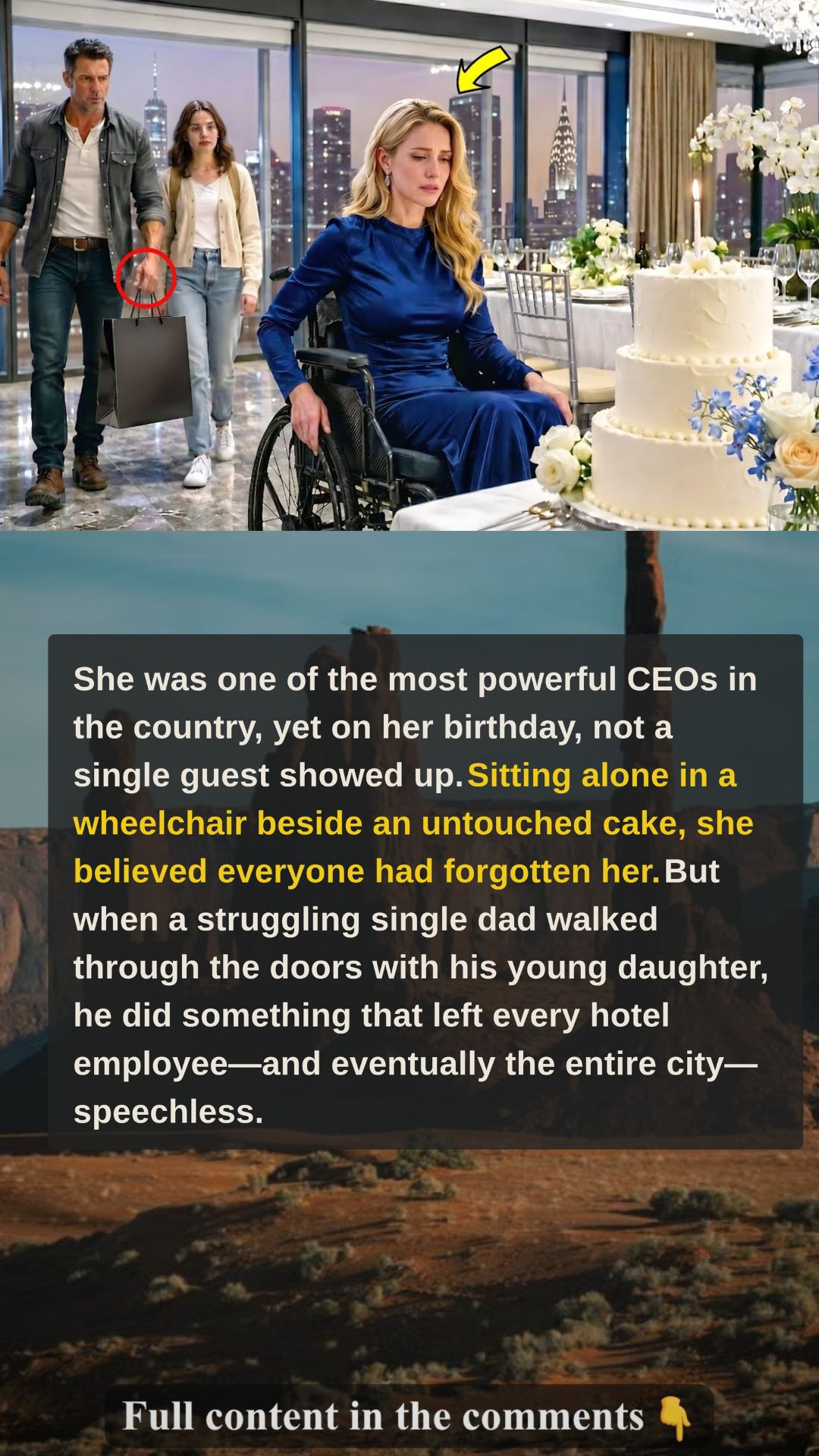
The ballroom had been prepared for a woman everyone claimed to admire.
Three crystal chandeliers glowed above rows of perfectly dressed tables. White roses sat in tall glass vases. The silverware had been polished so carefully that it caught the light like small mirrors. In the center of the room stood a three-tier birthday cake, untouched, with delicate gold lettering across the front.
Happy Birthday, Emma.
The hotel staff had checked the guest list twice. Every invitation had been confirmed. Venture partners, former executives, old friends, board members, people who once waited months just to get fifteen minutes on Emma Lawson’s calendar.
At 7:00 p.m., the room was ready.
At 7:30 p.m., the candles were still unlit.
At 8:15 p.m., every chair remained empty.
Emma Lawson sat near the head table in her wheelchair, her hands folded tightly in her lap, staring at the entrance doors as if hope itself might walk through them if she kept looking long enough.
Five years earlier, Emma had been the kind of CEO people wrote profiles about. She had built a technology company from a rented desk and a dying laptop into one of the fastest-growing software firms in the country. She had been sharp, composed, respected. She gave keynote speeches in New York, negotiated acquisitions in London, and walked into boardrooms with the quiet confidence of someone who had earned every inch of space she occupied.
Then the accident happened.
A rain-slick highway. A truck that ran a red light. A phone call her assistant never forgot making.
Emma survived, but her life was divided into two parts: before the crash and after it. The doctors called it a spinal cord injury. The press called it a tragedy. Some people called it inspiring, usually from a safe distance.
Emma simply called it exhausting.
After the accident, people still sent flowers. They sent messages full of elegant sadness. They wrote, “You’re so strong,” and “Let me know if you need anything,” and “We should catch up soon.”
But soon never seemed to arrive.
So when Emma’s assistant suggested a birthday dinner at the Harrison Grand Hotel, Emma almost said no. She had not celebrated properly in years. But something in her, something stubborn and still alive, wanted to believe that the people who had once filled conference halls to hear her speak would fill a ballroom just to sit with her.
They confirmed.
One by one, they confirmed.
Then, one by one, they disappeared.
The first cancellation came at 6:52 p.m.
So sorry, urgent investor call. Rain check?
The second came at 7:06.
Caught at the airport. Happy birthday, Emma. You deserve the best.
The third did not come as a message at all. Just silence.
Then more silence.
By 8:30, Emma’s assistant stood near the wall, pale and helpless, clutching her phone like it might still produce a miracle. The waiters had stopped pretending to adjust the napkins. The pianist had closed the lid over the keys. The cake stood untouched in the middle of the room, looking less like a celebration and more like evidence.
Emma blinked hard.
She was not crying because of the birthday.
She was crying because somewhere along the way, people had stopped seeing her as Emma Lawson and started seeing her as a sad story.
They admired her when she was powerful. They pitied her when she was injured. But on the night she simply wanted to be remembered, they left her alone in a room built for applause.
At 8:47 p.m., the ballroom was so quiet she could hear the faint hum of the chandelier above her.
Emma looked at the empty chairs and finally stopped checking the door.
She gave a small nod to the hotel manager, the kind of nod people give when they do not trust their voice.
“It’s all right,” she said softly. “You can start clearing.”
The manager hesitated. “Ms. Lawson, we can wait a little longer.”
Emma shook her head.
“There’s no one coming.”
Across the room, a young waiter lowered his eyes. A housekeeper standing near the service entrance pressed her lips together. No one knew what to say. There are moments when kindness feels too small to enter the room.
Emma turned her chair slightly toward the cake. The gold letters shimmered under the chandelier.
Happy Birthday, Emma.
She almost laughed.
Then the ballroom doors opened.
Not dramatically. Not with a rush of guests or camera flashes or apologies.
Just one door, pushed gently from the outside.
A man stood there in a faded delivery jacket, holding his cap in both hands.
His name was Daniel Carter, and he had not been invited.
Daniel had spent the day doing deliveries across the city, weaving through traffic in an aging van with a cracked side mirror and a heater that worked only when it felt generous. His last stop was the Harrison Grand Hotel, where he was dropping off a late shipment of specialty coffee for the hotel kitchen.
He was forty-two, though the past four years had aged him in quiet ways. His wife, Claire, had died of cancer when their daughter, Lily, was eight. Since then, Daniel had learned how to pack school lunches at 5:30 in the morning, answer client calls while sitting in pediatric waiting rooms, and stretch a paycheck until it looked almost transparent.
He was not the kind of man people noticed in hotel ballrooms.
He knew that.
Most people saw the delivery jacket before they saw the person inside it.
But while Daniel signed the delivery form near the service corridor, he saw two staff members rolling untouched trays of food toward the kitchen.
“Big event canceled?” he asked.
One of the waiters looked over his shoulder and lowered his voice.
“Not canceled. Nobody came.”
Daniel paused.
“What do you mean nobody came?”
The waiter nodded toward the ballroom. “Birthday party. Big one. Guest list was full. She’s still in there.”
Daniel looked through the half-open service door.
He saw the chandeliers first. Then the cake. Then the rows of empty chairs.
Then he saw Emma.
A woman sitting alone in a wheelchair at the head of a room prepared for people who had promised to show up.
Daniel felt something in his chest tighten.
It was not pity. He hated pity. Pity stood far away and felt sad without moving.
This was recognition.
He remembered Lily’s first birthday after Claire died. The way she sat at the kitchen table, staring at a cupcake with one candle in it, whispering, “It doesn’t feel like a birthday if Mommy isn’t here.” He remembered how helpless he felt, because grief is heavy enough when it is yours, but unbearable when it sits inside your child.
Daniel looked at Emma again.
Then he looked down at his delivery jacket, stained at one cuff and smelling faintly of cardboard and rain.
He knew he did not belong in that room.
But loneliness had never cared about dress codes.
He turned to the hotel manager, who was passing through the corridor.
“Sir,” Daniel said carefully, “may I go in?”
The manager frowned. “I’m sorry?”
“I know I’m not a guest. I just…” Daniel glanced into the ballroom. “Nobody should sit alone on their birthday.”
The manager studied him for a moment. Then he looked back at Emma.
Something in his face changed.
“Go ahead,” he said quietly.
Daniel stepped away first and made one call.
Ten minutes later, he returned through the ballroom doors with a twelve-year-old girl beside him.
Lily Carter wore a denim jacket over her school hoodie. Her sneakers were scuffed. Her hair was tied back with a blue ribbon that did not quite match anything else. In her hands, she held a folded piece of construction paper decorated with crooked stars and careful hearts.
They looked completely out of place.
That was what made everyone look up.
Emma turned toward them, confused.
Daniel stopped a respectful distance away.
“Ms. Lawson?” he said.
Emma’s assistant moved forward quickly. “Can I help you?”
Daniel raised both hands slightly, not wanting to alarm anyone.
“My name is Daniel Carter. I was making a delivery here tonight. I heard what happened, and I know this is strange.” He swallowed. “But my daughter and I wondered if we could wish you a happy birthday.”
Emma stared at him.
For a second, she could not answer.
All night, people who knew her had avoided the room. Now a stranger in a delivery jacket stood in front of her, looking embarrassed but sincere, with a child hiding half a step behind him.
Lily looked at the cake, then at the empty chairs, then at Emma.
She walked forward before her father could stop her.
“I made you something,” Lily said.
Emma looked down as Lily held out the card.
On the front was a drawing of three people standing around a birthday cake. The figures had round faces and uneven smiles. One of them sat in a wheelchair. Above them, in purple marker, Lily had written:
Nobody deserves to feel forgotten.
Emma’s hand trembled when she took it.
The ballroom seemed to hold its breath.
She opened the card. Inside, Lily had written, Happy Birthday, Emma. I hope your next year feels less lonely.
Emma pressed her fingers to the paper as if it were something fragile and priceless.
For the first time that evening, her eyes filled without shame.
“Thank you,” she whispered.
Lily smiled. “My dad says birthdays are for reminding people they matter.”
Daniel looked down, embarrassed. “She added the good part.”
Emma laughed.
It was small, almost broken, but it was real.
The sound changed the room.
The chef, who had been watching from the service doorway, disappeared into the kitchen and came back with fresh coffee. A waiter reached for a lighter and began moving from table to table, relighting the candles that had been left untouched. The pianist, an older man who had already packed his sheet music, quietly returned to the bench and lifted the cover from the keys.
A few soft notes filled the ballroom.
No announcement was made.
No one was instructed.
But one by one, the people who had been paid to serve the party began choosing to attend it.
A security guard near the entrance stepped inside and removed his cap. Two housekeepers came in carrying clean plates. A young waitress who had looked close to tears all evening brought three slices of cake to Emma, Daniel, and Lily before anyone had even cut it properly.
The hotel manager stood near the wall, watching his staff transform a failed event into something no event planner could have designed.
“Should we sing?” Lily asked.
Emma looked at the empty chairs.
Then at the people now standing around them.
“Yes,” she said. “I think we should.”
The first few voices were hesitant. Then stronger. The chef sang too loudly. The pianist played too slowly. The security guard forgot half the words and hummed the rest. Lily sang with complete seriousness, as if this were the most important concert of her life.
Emma sat in the center of it all, holding a handmade card against her heart.
When the song ended, everyone clapped.
Not politely.
Warmly.
The kind of applause that does not belong to status, performance, or achievement. The kind that says, We see you. You are here. You matter.
Emma closed her eyes for one second.
All evening, she had waited for important people.
But the people who saved her birthday were the ones who had been invisible in the room.
Later, after cake had been served and the untouched food finally became a shared meal, Daniel sat beside Emma near the window. Lily was helping a housekeeper arrange leftover flowers into smaller bouquets for the staff.
“You didn’t have to do this,” Emma said.
Daniel looked at his daughter, then back at Emma.
“I know.”
“Why did you?”
He was quiet for a moment.
“My wife died four years ago,” he said. “Cancer. After that, people didn’t know what to do with us. At first they came around. They brought casseroles. They cried in our kitchen. Then life went back to normal for them.”
Emma listened without interrupting.
Daniel rubbed his thumb along the edge of his paper coffee cup.
“But for Lily, normal never came back. There were days when all she needed was someone to sit with her. Not fix anything. Not say the perfect thing. Just sit there and not leave.”
Emma looked at the card in her lap.
“Presence,” she said.
Daniel nodded. “Most people underestimate it.”
For a long while, neither of them spoke.
Across the ballroom, Lily laughed at something the pianist said. The sound traveled through the room like light.
Emma looked around at the staff eating cake from porcelain plates, at the candles burning low, at the chairs that were no longer empty because people had stopped waiting for permission to care.
Something inside her shifted.
For years, she had measured strength by how well she could continue. How many meetings she could attend. How many articles called her resilient. How many investors still believed she could lead.
But that night, a delivery driver and his daughter taught her something her boardrooms never had.
A person can survive and still feel forgotten.
And sometimes the smallest act of kindness is not small at all to the person receiving it.
One week later, Emma returned to the headquarters of Lawson Systems.
The executive team expected a quarterly strategy meeting. They had prepared slides about expansion, margin protection, and market positioning. They sat around the glass conference table with tablets open and coffee cooling beside them.
Emma rolled into the room with Lily’s card resting on her lap.
Her chief financial officer began, “Emma, we’re ready to walk through the growth plan.”
Emma placed the card on the table.
“Not today.”
The room went still.
She looked at the people around her, many of whom had worked beside her for years but had never asked what her life looked like after the applause faded.
“Last week, I hosted a birthday dinner,” she said. “Most of you know that. Some of you were invited.”
A few faces changed.
No one spoke.
“No one came,” Emma continued.
The silence became uncomfortable.
She did not raise her voice. She did not accuse. That made it worse.
“I spent that evening looking at empty chairs. And then a man I had never met walked into that room with his daughter because he understood something too many people forget.”
She turned the card so everyone could read it.
Nobody deserves to feel forgotten.
Emma let the words sit in the room.
“Starting this quarter, Lawson Systems is establishing a community fund for single parents, caregivers, and people recovering from life-changing injuries. It will provide direct support, emergency care assistance, transportation grants, counseling access, and job transition programs.”
Her COO blinked. “Emma, that’s… significant.”
“Yes,” Emma said. “It is.”
The CFO leaned forward. “What are you calling it?”
Emma looked at the card again.
“The Empty Chair Initiative.”
No one asked why.
They already knew.
“The empty chair is the person who should have been there and wasn’t,” Emma said. “It is the parent missing from the table. The friend who stopped calling. The worker recovering at home while the world moves on. The patient who survived but lost their community. We are going to help fill those chairs with presence, dignity, and practical support.”
A board member who had missed the birthday dinner looked down at his hands.
For the first time in years, Emma felt the power in the room shift.
Not because she was the wealthiest person there.
Not because she had a title.
Because she had stopped pretending success meant anything if it made people easier to ignore.
Two days later, Daniel received a call.
He almost did not answer because he was carrying three grocery bags up the stairs and Lily was asking whether they could afford new shoes before school pictures.
When Emma introduced herself, he stopped on the second-floor landing.
“I’d like to offer you a job,” she said.
Daniel laughed once, thinking he had misunderstood. “A job?”
“Director of Community Outreach for The Empty Chair Initiative.”
There was silence on the line.
“Ms. Lawson, I think you have the wrong person.”
“I don’t.”
“I deliver packages. I don’t have a degree in nonprofit management. I don’t know corporate language. I’ve never led anything like that.”
“You led your daughter through grief,” Emma said. “You noticed pain in a room full of people trained to look away. You acted without reward. That is the qualification I am looking for.”
Daniel sat down on the stair.
“I don’t know if I deserve that.”
Emma’s voice softened.
“Daniel, people with polished resumes ignored an empty ballroom. You walked into it.”
That was how Daniel Carter, a delivery driver who once believed the world only saw his uniform, became one of the most important people in Emma Lawson’s company.
He did not become someone else.
That was the point.
He wore better shirts to meetings, but he still spoke plainly. When executives proposed programs that sounded impressive but helped no one, Daniel asked, “Would this matter to a parent choosing between groceries and physical therapy?” When teams designed application forms too complicated for exhausted caregivers, he made them rewrite every page. When someone suggested a campaign centered on Emma’s accident, Daniel quietly said, “This is not about turning pain into branding.”
Emma listened.
The initiative grew faster than anyone expected.
Within months, The Empty Chair Initiative helped families pay for home ramps, childcare during chemotherapy appointments, rides to rehabilitation centers, temporary housing after medical crises, and counseling for children who had lost parents too young.
A grandmother caring for three grandchildren wrote that she slept through the night for the first time in years.
A father recovering from a construction accident cried when Daniel told him the fund would cover transportation to his therapy appointments.
A nurse who had been caring for her husband after a stroke sent a photo of the first meal she had eaten sitting down in weeks.
Emma kept every message.
But she kept Lily’s card closest.
It sat in a frame on her desk, not behind her awards but beside her keyboard, where she could see it during investor calls and budget reviews and long afternoons when pain made her hands shake.
Nobody deserves to feel forgotten.
It became more than a sentence.
It became a rule.
Emma stopped measuring success only in revenue charts. She still cared about performance. She still ran a company. But the numbers no longer impressed her unless they pointed toward people.
How many families received help before eviction notices turned into homelessness?
How many caregivers got one afternoon to breathe?
How many injured workers found a way back into employment without losing their dignity?
How many children learned that grief did not mean disappearing?
Daniel often said the initiative worked because Emma understood what it meant to be seen and unseen in the same lifetime.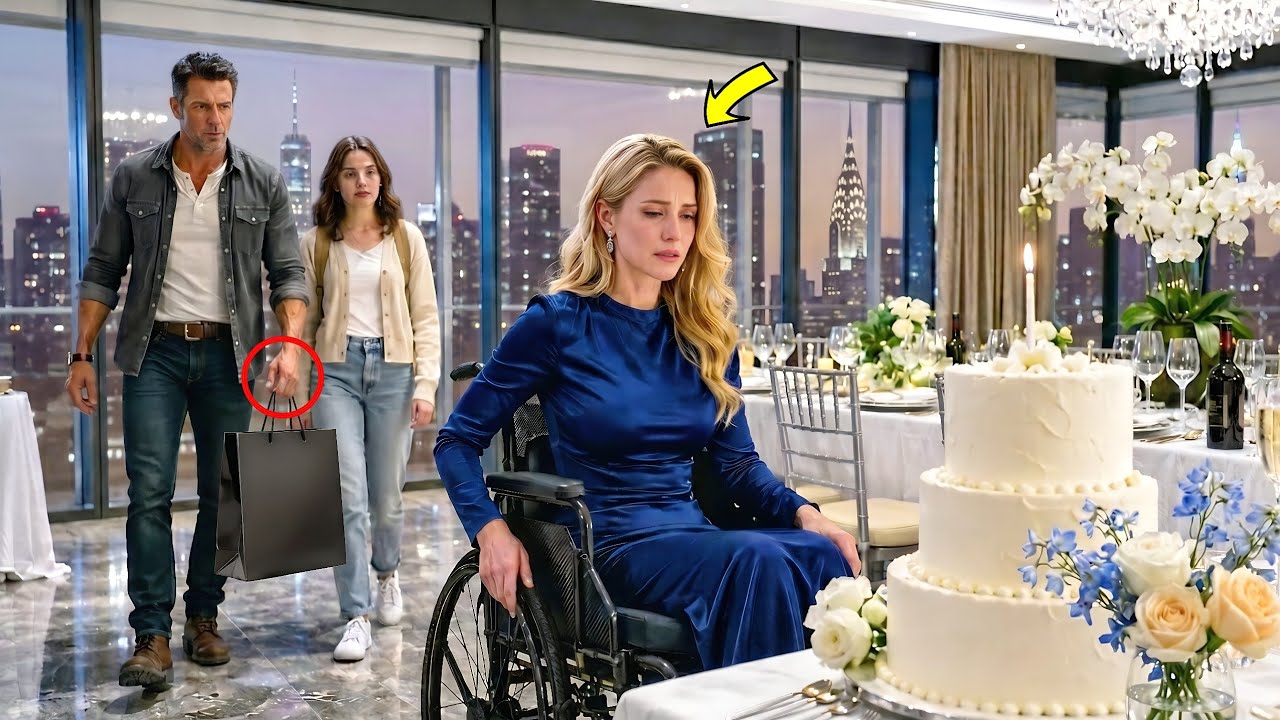
Emma said it worked because Daniel had the courage to walk into a room where he technically did not belong.
Lily said it worked because adults made everything too complicated and sometimes you just needed to make someone a card.
A year later, Emma celebrated her birthday again.
At the same hotel.
In the same ballroom.
The chandeliers still glowed gold. The tables were still dressed in white. Another cake stood in the center of the room.
But this time, the chairs were not empty.
They were filled with families who had received help, caregivers who had become friends, employees who now understood that compassion was not a side project, and children running between tables with the wild joy of people who knew they were welcome.
The chef who had brought Emma coffee the year before was there. So was the pianist. So was the security guard who had hummed through the birthday song and now proudly knew every word.
Daniel stood near the front with Lily beside him.
Lily was taller now, wearing a simple blue dress and holding a small wrapped box.
When it came time for speeches, Emma moved toward the microphone. The room quieted.
She looked out at the faces before her.
A year earlier, she had sat in that same ballroom and learned what abandonment sounded like.
It sounded like polished glasses untouched.
Like a piano with its lid closed.
Like a phone that stopped buzzing.
Like empty chairs under golden light.
Now the room sounded different.
It sounded like children laughing. Like plates being passed. Like people saying, “We saved you a seat.” Like a community built from one act no one had planned.
Emma looked at Daniel.
“Last year,” she said, “I thought my birthday had become proof that I had been forgotten.”
Daniel lowered his eyes.
“Then a stranger walked through those doors with his daughter and reminded me that kindness does not need an invitation.”
Lily smiled, but her eyes were wet.
Emma held up the framed card.
The room broke into applause before she could continue.
Daniel looked overwhelmed. He pressed one hand to his mouth. Lily leaned into him, and for a moment, he was not the man who had struggled alone for four years. He was not the delivery driver people overlooked. He was a father whose small act of courage had changed more lives than he could count.
Emma waited until the applause softened.
“I used to think the best birthday gift would be the right people showing up,” she said. “I was wrong. The best gift was one person showing up for the right reason.”
Later that evening, after the candles were lit, Emma asked Lily to stand beside her to cut the cake.
Daniel protested from the side. “You two go ahead.”
Emma looked at him and shook her head.
“No,” she said. “Family stands together.”
The word landed gently, but everyone near them felt it.
Family.
Not by blood.
Not by contract.
Not by status.
By presence.
By choosing to enter someone’s loneliness instead of walking past it.
Daniel stepped forward. Lily took Emma’s hand. Together, the three of them cut the cake while the room cheered.
And this time, when everyone sang happy birthday, Emma did not look at the door once.
She looked at the people in front of her.
The ones who came.
The ones who stayed.
The ones who understood that an empty chair is not just a symbol of absence, but an invitation to become the kind of person who fills it.
Because sometimes a life changes not when the powerful finally notice you, but when one ordinary person decides your loneliness is not acceptable.
And in a world full of people waiting for someone else to care, the rarest kind of kindness is still this: walking into the room when everyone else has walked away.


