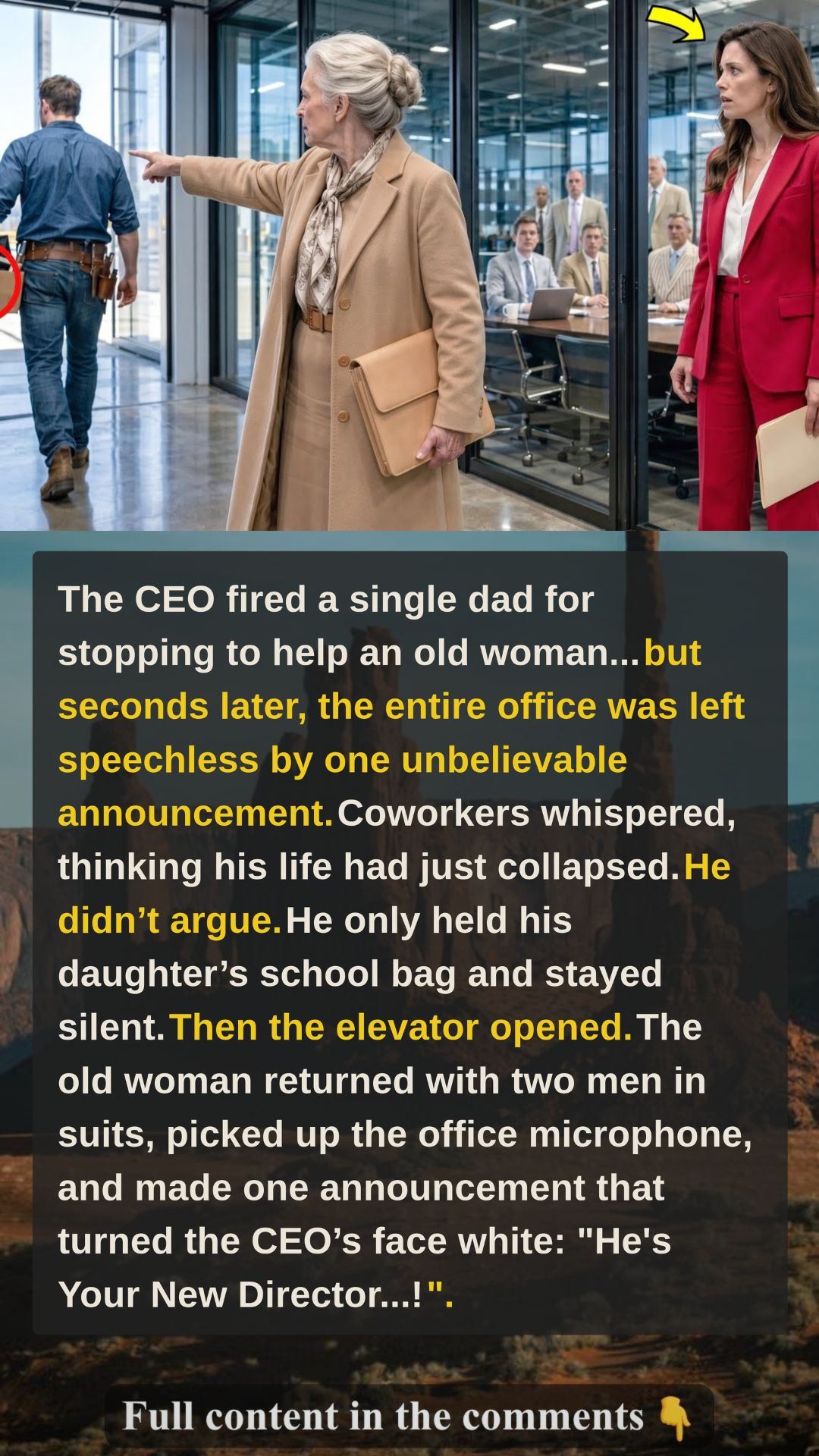
At 8:47 on a Tuesday morning, Ethan Carter lost his job for helping an old woman who could barely stand.
He was twelve minutes late.
Twelve minutes.
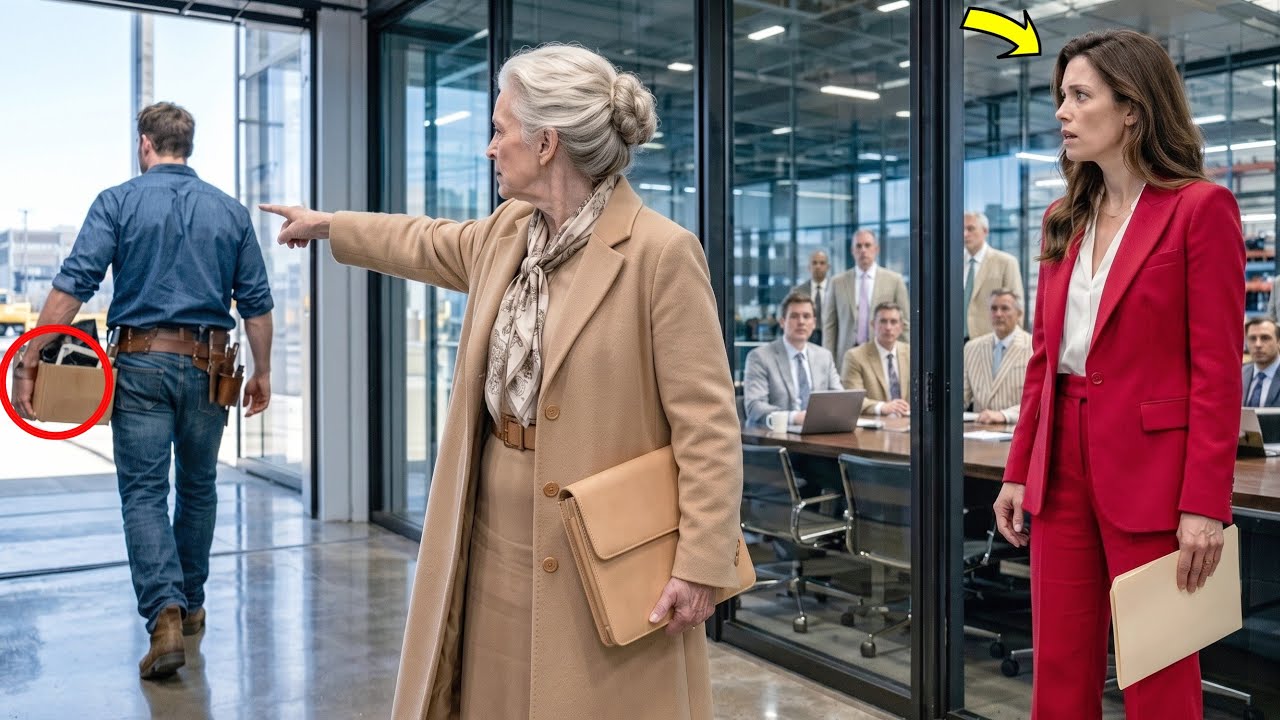
That was all it took for the new CEO of Whitmore & Co. to point at him in front of an entire floor of employees and say, “Pack your things. We don’t reward irresponsibility here.”
No one spoke.
Not his team.
Not the people he had stayed late to help.
Not the coworkers who knew he had come in sick, worked through lunch, fixed reports at midnight, and answered calls on weekends because he believed the company mattered.
Ethan simply stood there with his badge still clipped to his coat, rainwater on his sleeves, and the faint smell of hospital disinfectant on his hands.
For a moment, he didn’t think about the humiliation.
He thought about Lily.
His seven-year-old daughter, who had kissed his cheek that morning and said, “Don’t forget we’re making pancakes tonight, Dad.”
He thought about rent.
The electricity bill sitting unopened on the kitchen counter.
The lunchbox he had packed for her using the last slices of bread in the apartment.
And then he looked at Victoria Hale, the CEO who had just fired him, and said quietly, “Thank you for the opportunity.”
That made the silence even heavier.
Because everyone knew Ethan Carter was not irresponsible.
They knew the truth.
They were just too afraid to say it.
Whitmore & Co. was one of the largest business consulting firms in Chicago. Its glass headquarters rose thirty-two floors above the city, shining like a monument to ambition, pressure, and polished performance reviews.
Inside, everything ran on deadlines.
Meetings started to the second.
Reports had color-coded risk levels.
Employees whispered in elevators and checked their emails before they checked the weather.
For years, Ethan had survived there by being dependable.
He was not flashy. He was not loud. He did not make speeches in conference rooms or try to impress executives with dramatic ideas.
He was a mid-level operations manager on the seventeenth floor, the kind of employee people only noticed when something went wrong and he was the person quietly fixing it.
If a client presentation crashed at 10 p.m., Ethan stayed.
If a new hire was confused, Ethan explained the system without making them feel stupid.
If someone’s child got sick and they had to leave early, Ethan covered the report and never mentioned it again.
His coworkers respected him because he made difficult days feel survivable.
But respect did not pay medical debt.
Three years earlier, Ethan’s wife, Claire, had passed away after a sudden illness that left behind hospital bills, a child who asked questions he could not answer, and a silence in the apartment that never fully went away.
After Claire died, Ethan built his life around routines.
Wake up at 5:40.
Make Lily’s breakfast.
Braid her hair badly, then try again.
Walk her to school.
Take the train downtown.
Work harder than anyone expected.
Come home.
Cook dinner.
Read two pages of a bedtime story before falling asleep sitting on the edge of Lily’s bed.
He was tired in a way sleep could not fix.
But he kept going.
Because Lily needed him.
Because Claire had once told him, “The world will always have people who are cruel because it is easier. Promise me you’ll stay kind because it is harder.”
So Ethan did.
Even when life gave him every excuse not to.
For a long time, Whitmore & Co. had been a place where that kind of person could survive.
The company was demanding, but it still had a human pulse. People checked on each other. Managers made room for family emergencies. Employees stayed because they believed they were part of something bigger than invoices and quarterly numbers.
Then Victoria Hale arrived.
She was brilliant. No one denied that.
At forty-two, Victoria had already turned around two struggling companies and appeared on business magazine covers beside headlines about discipline, precision, and fearless leadership.
She entered Whitmore & Co. with a sharp navy suit, a colder smile, and a message that spread through the company by noon on her first day.
“Compassion is not a strategy. Accountability is.”
At first, people admired her.
The company had been underperforming. Clients were leaving. Departments were bloated. Decisions took too long.
Victoria changed that.
She cut waste. Eliminated weak contracts. Rebuilt reporting systems. Replaced friendly conversations with performance dashboards.
Numbers improved.
People did not.
Within three months, employees stopped decorating desks.
Within four, managers stopped approving flexible schedules.
Within six, no one wanted to be the first person to leave the office, even when their work was done.
Victoria’s rules were simple.
No excuses.
No emotional decision-making.
No tolerance for lateness.
She believed feelings weakened leadership, and leadership was the only thing that kept companies alive.
Ethan disagreed quietly.
He never challenged her publicly. He knew better. He had a daughter to feed and a job he could not afford to lose.
So he kept his head down.
He delivered his reports early.
He helped his team meet impossible targets.
He smiled at Lily every morning like he was not carrying a mountain behind his ribs.
Then came the Tuesday that changed everything.
That morning had already started badly.
Lily could not find her purple sweater. The toaster burned breakfast. Rain hit the apartment windows so hard it sounded like small stones.
Ethan checked the time three times while tying Lily’s shoes.
“Are we late?” Lily asked.
“Not yet,” he said, forcing a smile.
She looked at him carefully. Children notice the things adults try to hide.
“You look tired, Dad.”
“I’m fine.”
“That’s what you say when you’re not fine.”
He stopped tying her shoe for half a second.
Then he tapped her nose and said, “That is very advanced detective work for someone who still puts cereal in her backpack.”
She laughed, and for one moment the morning felt light.
After dropping Lily at school, Ethan hurried toward Whitmore & Co. with his umbrella fighting the wind. He was early enough to make his 9 a.m. team briefing, but not by much.
He was half a block from the office entrance when he heard a sharp cry near the curb.
At first, everyone turned.
Then, almost as quickly, everyone turned back.
A small elderly woman had slipped near the wet pavement just outside the company’s front plaza. Her grocery bag had fallen open, oranges rolling into the gutter. One hand was pressed against her chest. The other trembled against the concrete.
People passed around her.
Some looked uncomfortable.
One man slowed down, checked his watch, then kept walking.
A woman in heels stepped over one of the oranges and whispered, “Security will handle it.”
Ethan stopped.
His phone buzzed in his pocket.
8:43.
He looked at the office doors.
Then at the woman.
Then back at the doors.
For one brief second, the world gave him a choice.
Be on time.
Or be human.
Ethan ran to her.
“Ma’am, can you hear me?”
The woman’s breathing was uneven. Her gray hair had come loose from a clip, and rain dotted the lenses of her glasses.
“I’m all right,” she tried to say, but her voice shook.
“You’re not all right,” Ethan said gently. “Don’t try to stand yet.”
He crouched beside her, shielding her from the rain with his umbrella while people continued streaming toward the building behind him.
He called emergency services.
He gave the dispatcher the address.
He asked the woman if she had chest pain, if she was dizzy, if she had hit her head.
Then he took off his coat and folded it under her elbow so she would not have to lean on the wet pavement.
“My meeting…” she whispered.
“Your meeting can wait.”
She looked at him, surprised.
It was a strange look, as if she had expected to be managed, moved, ignored, or treated like a problem.
Not cared for.
“What’s your name?” Ethan asked.
“Margaret,” she said.
“I’m Ethan. Help is coming, Margaret.”
He bought a bottle of water from the lobby kiosk and helped her take small sips. He gathered her groceries, wiped dirt from her glasses with his tie, and stayed beside her until the ambulance arrived.
When the paramedics lifted her carefully onto the stretcher, Margaret reached for his hand.
“You stopped,” she said.
Ethan gave a tired smile. “Anyone would have.”
Margaret looked past him at the stream of employees moving through the revolving doors.
“No,” she said softly. “They wouldn’t.”
Ethan did not know what to say to that.
His phone buzzed again.
Three missed calls.
Two messages from his assistant manager.
One from the executive floor.
His stomach tightened.
He thanked the paramedics, made sure Margaret had her purse, then ran inside.
The lobby clock read 9:12.
Twelve minutes late.
By the time Ethan reached the seventeenth floor, the weekly operations meeting had already begun. The glass conference room was full. His team sat along one side of the table, silent and stiff-backed.
Victoria Hale stood at the front beside a screen displaying quarterly metrics.
She turned as Ethan entered.
She did not ask if he was okay.
She did not ask why he was wet.
She did not ask why his hands were shaking slightly as he closed the door.
She only looked at the clock.
“Mr. Carter,” she said. “How generous of you to join us.”
Every face turned.
Ethan felt the heat rise in his neck.
“I apologize,” he said. “There was a medical emergency outside the building. An elderly woman fell near the curb. I stayed until the ambulance arrived.”
Victoria stared at him.
No expression.
No softness.
“You stayed?”
“Yes.”
“You made that decision knowing you had a 9 a.m. briefing?”
Ethan kept his voice steady. “She needed help.”
Victoria took one slow step toward him.
“And did emergency services ask you to sacrifice company time?”
A few employees lowered their eyes.
Ethan glanced toward his team. He saw Priya from analytics, who had once cried in the stairwell because her mother was in surgery and Ethan had covered her client file without being asked.
He saw Marcus, whose promotion packet Ethan had helped rewrite on a Sunday.
He saw Daniel, who knew Ethan had slept four hours the night before because of a server escalation.
No one moved.
“No,” Ethan said. “But I believed it was the right thing to do.”
Victoria’s jaw tightened.
“That sentence is exactly what is wrong with this company.”
The room went still.
Victoria turned to the rest of the staff.
“For years, Whitmore & Co. has confused kindness with competence. People arrive late, miss deadlines, shift accountability, and then decorate failure with emotional explanations.”
Ethan said quietly, “With respect, this was not a missed deadline. It was a person in distress.”
Victoria looked back at him.
“With respect, Mr. Carter, you are not paid to make moral judgments on company time.”
The words landed like a slap.
Ethan felt something inside him recoil, but he did not raise his voice.
“Victoria, I understand the importance of discipline. I always have. My record shows that.”
“Your record is not the issue this morning.”
“My judgment is?”
“Yes,” she said. “Your judgment.”
A long silence stretched across the conference room.
Then Victoria closed the laptop in front of her.
“Effective immediately, your employment with Whitmore & Co. is terminated.”
A small sound escaped someone at the table.
Maybe a breath.
Maybe a gasp.
Ethan stood frozen.
“Terminated?” he repeated.
“You may collect your personal items. HR will process your documents.”
Priya’s eyes filled with tears, but she looked down before Victoria could see.
Marcus clenched his hands under the table.
Daniel opened his mouth, then shut it.
Fear moved through the room faster than courage.
Ethan looked at the people he had helped for years and realized none of them could save him. Maybe they wanted to. Maybe they hated themselves for staying silent. But they had mortgages, children, medical bills, aging parents, and inboxes full of warnings about performance discipline.
He understood.
That almost made it worse.
Victoria waited for him to argue.
He didn’t.
He simply nodded once.
“I’m sorry the company sees it that way,” Ethan said. “I’m grateful for the years I had here.”
Then he turned and walked out.
Nobody followed at first.
The sound of his footsteps in the hallway felt too loud.
At his desk, Ethan pulled a small cardboard box from under the supply cabinet. His hands moved mechanically.
A framed photo of Claire and Lily at the lake.
A mug Lily had painted with blue stars.
Three thank-you notes from coworkers.
A tiny plastic dinosaur Lily had placed beside his monitor “to guard his emails.”
He put each item in the box carefully, as if the dignity of the moment depended on not breaking anything.
Around him, people watched from their desks.
No one knew what to say.
Finally, Priya approached.
“Ethan,” she whispered, “I’m so sorry.”
He looked up and smiled in a way that hurt to see.
“It’s okay.”
“It’s not.”
He glanced toward the glass conference room, where Victoria had resumed the meeting as if nothing had happened.
“Take care of the team,” he said.
Priya wiped her cheek quickly.
“You shouldn’t be the one saying that.”
Ethan picked up the box.
Its weight was ridiculous. Years of work reduced to a photo, a mug, some paper, and a plastic dinosaur.
As he walked toward the elevator, the office seemed to hold its breath.
Then the elevator doors opened before he reached them.
But no one stepped out.
Instead, the main security doors near reception swung open.
A group entered the floor.
Not visitors.
Not clients.
The chairman of the board walked in first, surrounded by senior directors Ethan had only seen in annual meetings and formal announcements.
Beside him was the elderly woman from the sidewalk.
Margaret.
But she was not hunched over now.
She walked slowly, supported by a polished cane, her wet gray hair neatly pinned back, a navy coat over her shoulders. Her face still looked pale, but her eyes were sharp enough to silence the room.
Every executive around her treated her with visible respect.
Victoria stepped out of the conference room.
For the first time that morning, her perfect composure shifted.
“Chairman Whitmore,” she said. “We weren’t expecting—”
“No,” the chairman replied. “That was the point.”
The office went dead quiet.
Margaret’s gaze moved across the floor until it found Ethan standing by the elevator with a cardboard box in his arms.
Her expression changed.
Not into surprise.
Into recognition.
“There he is,” she said.
Everyone looked at Ethan.
Victoria’s eyes moved from Margaret to Ethan, then back again.
The chairman turned to the room.
“For those who have not had the privilege, this is Margaret Whitmore.”
A ripple passed through the employees.
Margaret Whitmore.
The name was carved into the company’s founding documents, printed in investor reports, mentioned in leadership training videos. She was the founding investor of Whitmore & Co., the company’s largest individual shareholder, and the widow of the man whose name was on the building.
Most employees had never seen her in person.
Victoria had.
And now her face was losing color.
Margaret stepped forward.
“This morning,” she said, “I came to this building without notice because numbers can tell you how a company performs, but they cannot tell you what a company has become.”
No one moved.
“I fell outside your front entrance,” Margaret continued. “Dozens of people passed me. Some looked at me. Some stepped around me. A few were wearing this company’s badge.”
Her voice remained calm, which somehow made it worse.
“Only one person stopped.”
Ethan swallowed.
Margaret pointed gently toward him.
“That man.”
The cardboard box suddenly felt heavier in Ethan’s hands.
“He did not know my name,” Margaret said. “He did not know my title. He did not know whether I had power, money, influence, or importance. He saw an old woman on the ground and decided that being late was less serious than being heartless.”
A few employees looked at the floor.
Margaret turned to Victoria.
“I understand he was dismissed for that.”
Victoria’s mouth opened, but nothing came out.
It was the first silence of hers anyone had ever seen.
The chairman looked at her.
“Is that correct, Ms. Hale?”
Victoria straightened, trying to recover. “Mr. Carter violated punctuality standards during an executive briefing. I made a decision consistent with the culture of accountability we have been building.”
Margaret studied her.
“No,” she said. “You made a decision consistent with fear.”
The room seemed to tighten around those words.
Victoria’s lips pressed together.
“Accountability without judgment becomes cruelty,” Margaret said. “Discipline without humanity becomes damage.”
Ethan wanted to disappear. He had not asked for this. He had not helped her because he expected a reward. He had not wanted anyone humiliated.
But he could not look away from Victoria.
Her eyes had shifted.
Not wide.
Not dramatic.
Just still.
The kind of stillness that comes when a person hears the truth and recognizes too late that everyone else heard it too.
The chairman then turned to Ethan.
“Mr. Carter, please don’t leave yet.”
Ethan looked down at the box in his arms. “Sir, I was told—”
“I know what you were told.”
Margaret took another step closer.
“Ethan, before I came here today, the board had already begun discussing a new leadership role. Director of People Development and Culture. Someone to rebuild trust across departments, restore ethical leadership practices, and make sure performance does not require people to abandon their humanity.”
Victoria’s face changed again.
This time, everyone saw it.
Her chin lifted slightly, as if bracing for impact, but her eyes betrayed her. She had already understood where this was going.
Margaret looked at Ethan.
“We have interviewed executives, consultants, and leadership experts. Most of them spoke beautifully about values. This morning, you demonstrated them while no one was watching.”
Ethan shook his head once.
“I’m not an executive.”
“No,” Margaret said. “You are something rarer.”
The chairman’s voice carried across the floor.
“Mr. Carter, the board would like to offer you the position.”
Ethan stared at him.
The room did not breathe.
Then Margaret said the words that no one in that office would ever forget.
“He will be your new director.”
The silence was not empty this time.
It was shock.
It was shame.
It was relief.
It was justice arriving so suddenly that no one knew how to stand in front of it.
Ethan looked around, confused, almost afraid someone would laugh and tell him there had been a mistake.
“I think you may have the wrong person,” he said.
Margaret smiled gently.
“That is exactly why we know we don’t.”
A sound came from Priya’s desk. She was crying openly now.
Marcus stood first.
Then Daniel.
Then another employee.
One by one, people rose from their chairs, not because anyone ordered them to, but because something in the room had shifted.
Ethan still held the box.
Lily’s painted mug peeked over the edge.
Victoria looked at it, then at Ethan’s wet sleeves, then at the elderly woman she had unknowingly dismissed as an inconvenience to productivity.
Her face was pale now.
Her shoulders had lowered by an inch.
For the first time since she arrived at Whitmore & Co., she looked less like someone in control and more like someone standing in front of the consequences of her own philosophy.
The chairman addressed the room.
“This company was built to serve clients, yes. But it was also built by people. If our employees are too afraid to help someone in distress because they might be punished for being twelve minutes late, then the problem is not the employee.”
He looked at Victoria.
“It is leadership.”
No one applauded.
It would have felt too small.
Instead, the room held the moment.
And Victoria, who had once believed emotion was weakness, stood in the center of the floor surrounded by the emotion she had tried to eliminate.
Shame.
Respect.
Loyalty.
Regret.
Ethan was taken into a private board meeting that afternoon.
He sat at a long table he had never imagined entering except to fix a scheduling issue or deliver reports.
His box sat beside his chair.
Margaret noticed.
“You can put that down, Ethan,” she said.
He gave a small laugh. “I’m not sure what I’m allowed to touch anymore.”
The chairman smiled faintly.
“You’re allowed to speak honestly.”
So Ethan did.
He did not complain about Victoria.
He did not ask for revenge.
He did not demand a bigger salary first, though the board later insisted the position would come with one.
Instead, he said one thing.
“I’ll accept only if we put a policy in writing.”
Margaret leaned forward. “What policy?”
“No employee should be punished for helping another human being during a genuine emergency. Family emergencies, medical emergencies, safety issues. We can still require communication. We can still protect accountability. But we cannot make people afraid to do the right thing.”
The chairman looked around the table.
No one objected.
Ethan continued, his voice steadier now.
“I’ve seen good employees hide grief, illness, fear, and family problems because they thought being honest would cost them their careers. That doesn’t make a company stronger. It makes people disappear while still sitting at their desks.”
Margaret nodded slowly.
“That will be your first initiative.”
By 5:30 p.m., an email went out to every employee at Whitmore & Co.
The subject line was simple:
Leadership and Culture Update.
It announced Ethan Carter as the new Director of People Development and Culture.
It announced a full review of disciplinary policies.
It announced mandatory leadership training for all managers.
And at the bottom, in language everyone could understand, it said:
“No employee will be penalized for taking reasonable action during a humanitarian, medical, family, or safety emergency.”
People read it once.
Then again.
Then screenshots quietly moved through private chats.
Not because it was corporate language.
Because for the first time in months, the company sounded like it remembered people worked there.
Victoria Hale did not resign.
The board did not remove her immediately.
That surprised some employees.
But Margaret insisted on something harder than punishment.
Accountability.
Victoria remained CEO, but her authority over people-related policy was reduced. She was required to work directly with Ethan on culture reform, leadership ethics, and employee trust.
At first, the arrangement was tense.
Victoria attended meetings with her arms crossed and her notes perfectly organized. Ethan came prepared, calm, and unwilling to embarrass her.
That irritated her more than anger would have.
She had expected bitterness.
He gave her professionalism.
She had expected weakness.
He gave her facts.
In the first month, Ethan introduced volunteer days for employees to serve local shelters, schools, and elder care centers.
In the second month, emergency flexibility guidelines were approved.
In the third, managers were trained on how to balance compassion with responsibility.
Not vague kindness.
Not chaos.
Not excuses.
A real system.
Employees still had goals. Deadlines still mattered. Clients still expected excellence.
But managers were now required to ask better questions before making life-altering decisions.
What happened?
Was there an emergency?
Was the employee’s pattern responsible?
What support would prevent this from becoming a bigger problem?
The results surprised even the board.
Absenteeism dropped.
Turnover slowed.
Project completion rates improved.
Internal referrals increased for the first time in over a year.
Clients started mentioning that teams seemed more responsive, more stable, more thoughtful.
One client wrote, “Your people seem different lately. Less afraid. More present.”
That sentence was printed and placed on the wall of Ethan’s office.
Not as a trophy.
As a reminder.
Six weeks after the morning that changed everything, Victoria knocked on Ethan’s door.
He looked up from a draft of a manager training guide.
“Come in.”
She entered without her usual sharpness.
For a moment, she stood near the doorway like someone unsure whether she had earned permission to sit.
Ethan gestured to the chair.
She sat.
There was no audience now.
No board.
No employees watching.
No dramatic reversal waiting.
Just two people in a quiet office, facing the cost of a public mistake.
“I owe you an apology,” Victoria said.
Ethan folded his hands on the desk.
She took a breath.
“I thought I was protecting this company from weakness. I convinced myself that if people feared consequences, they would perform better. And for a while, the numbers made me believe I was right.”
She looked toward the glass wall, where employees moved through the office with a little less tension than before.
“But I was measuring output while ignoring damage.”
Ethan said nothing.
Victoria’s voice lowered.
“When Margaret walked in, and I realized who she was, I was embarrassed. But when she said you helped her without knowing she mattered, that was worse. Because I understood that I had built a system where people only felt safe helping someone if that person was important.”
For the first time, Ethan saw no performance in her expression.
Just the exhaustion of someone meeting herself honestly.
“I was wrong,” she said. “Not just about you. About leadership.”
Ethan looked at her for a long moment.
Then he said, “I appreciate you saying that.”
“You should hate me.”
“I was angry,” Ethan admitted. “Mostly scared.”
She looked down.
“I thought about my daughter,” he continued. “I thought about how I would explain losing my job because I stopped to help someone. And then I realized I wouldn’t be ashamed to tell her the truth.”
Victoria’s eyes lifted.
Ethan’s voice stayed even.
“That helped.”
She nodded once, slowly.
There it was.
The moment of recognition.
Not a speech.
Not tears.
Just Victoria Hale, the CEO who had once fired a man for being twelve minutes late, sitting silently across from him because she finally understood that efficiency without humanity had almost cost the company one of its best people.
And worse, it had almost taught everyone else to walk past someone on the ground.
That evening, Ethan left work at 6:15.
Not midnight.
Not after answering one more unnecessary email.
6:15.
He stopped at the grocery store on the way home and bought pizza dough, tomato sauce, cheese, mushrooms, and a small box of chocolate cookies Lily loved but he usually said were too expensive.
When he opened the apartment door, Lily came running.
“Dad!”
He dropped his bag just in time to catch her.
She pulled back and studied his face.
“You’re smiling different.”
“I am?”
“Yes. Like your face remembered how.”
He laughed, and this time it did not feel forced.
They made pizza together at the tiny kitchen counter. Lily put all the cheese in one corner because she said that part would be “the treasure island.” Ethan let her.
Flour got on the floor.
Sauce got on Lily’s sleeve.
The smoke alarm complained for eleven seconds.
For the first time in months, the apartment did not feel like a place Ethan was barely managing to keep together.
It felt like home.
Over dinner, Lily asked, “Did something good happen today?”
Ethan looked at his daughter.
He thought about the old woman on the sidewalk.
The conference room.
The cardboard box.
Victoria’s face when the truth entered the room.
He thought about how close he had come to losing everything for doing something he still believed was right.
“Yes,” he said. “Something very good.”
“Did you get a prize?”
He smiled. “Kind of.”
“What did you do?”
“I helped someone.”
Lily considered this seriously, chewing her pizza.
“Do you always get a prize when you help someone?”
“No.”
“Then how do you know it’s worth it?”
Ethan set down his slice.
Because the question was bigger than a child knew.
He reached across the table and gently wiped sauce from her chin.
“You don’t help people because you know what you’ll get back,” he said. “You help because someone needs help. Sometimes nobody notices. Sometimes it costs you something. But it still matters.”
Lily looked at him with Claire’s eyes.
“And sometimes?”
He smiled.
“Sometimes the whole world changes because one person didn’t walk away.”
Months passed.
Whitmore & Co. became the subject of business articles, leadership panels, and university case studies.
Not because it became softer.
Because it became stronger.
The company posted its best employee retention numbers in five years. Client satisfaction rose. Internal promotions increased. Sick days were no longer treated like moral failures. Managers learned that empathy did not remove accountability; it made accountability fair enough for people to trust it.
The story of Ethan Carter traveled through the company until even new hires knew it.
They heard about the morning an operations manager stopped in the rain.
They heard about the CEO who fired him.
They heard about the elderly woman who turned out to be the company’s most powerful shareholder.
But the version Ethan preferred was simpler.
A person fell.
A person stopped.
That was all.
Margaret visited the office often after that.
Every time she saw Ethan, she asked about Lily.
Every time Ethan saw an employee hesitate before admitting they needed help, he remembered the cardboard box in his hands and made sure the conversation ended differently than his had.
Victoria changed too.
Not overnight.
Real change rarely looks dramatic while it is happening.
It looks like a CEO pausing before judgment.
It looks like asking one more question.
It looks like admitting in a leadership meeting, “I may be missing the human context here.”
Some people respected her more after that.
Not because she had been right.
Because she had finally been willing to learn.
One year later, Whitmore & Co. held its annual leadership summit in the same conference center where Victoria had once given a speech about ruthless discipline.
This time, Ethan stood on the stage.
He did not talk about himself.
He talked about systems.
He talked about trust.
He talked about the difference between high standards and hard hearts.
At the end, he told the audience, “The most dangerous culture is not one where people make mistakes. It is one where people are too afraid to do what is right.”
In the front row, Margaret nodded.
Victoria sat beside her, listening quietly.
And in the back of the room, Lily sat in a chair too big for her, swinging her feet, holding the tiny plastic dinosaur that had once guarded her father’s emails.
When the applause came, Ethan looked past the executives and saw his daughter smiling.
That was the promotion that mattered most.
Not the title.
Not the office.
Not the salary, though it helped pay the bills and put better food in the refrigerator.
The real promotion was this:
He had shown his daughter that kindness was not foolish.
He had shown his company that compassion was not weakness.
And he had shown everyone watching that sometimes the smallest human decision can expose the biggest leadership failure.
Because a company can survive missed meetings, delayed reports, and twelve lost minutes.
But it cannot survive becoming a place where good people are punished for having a heart.
Compassion does not make people weaker; it reveals who was strong enough to stay human when it would have been easier to walk away.