The first thing Captain Owen Rusk noticed was not the woman’s face.
It was the way she held the tray.
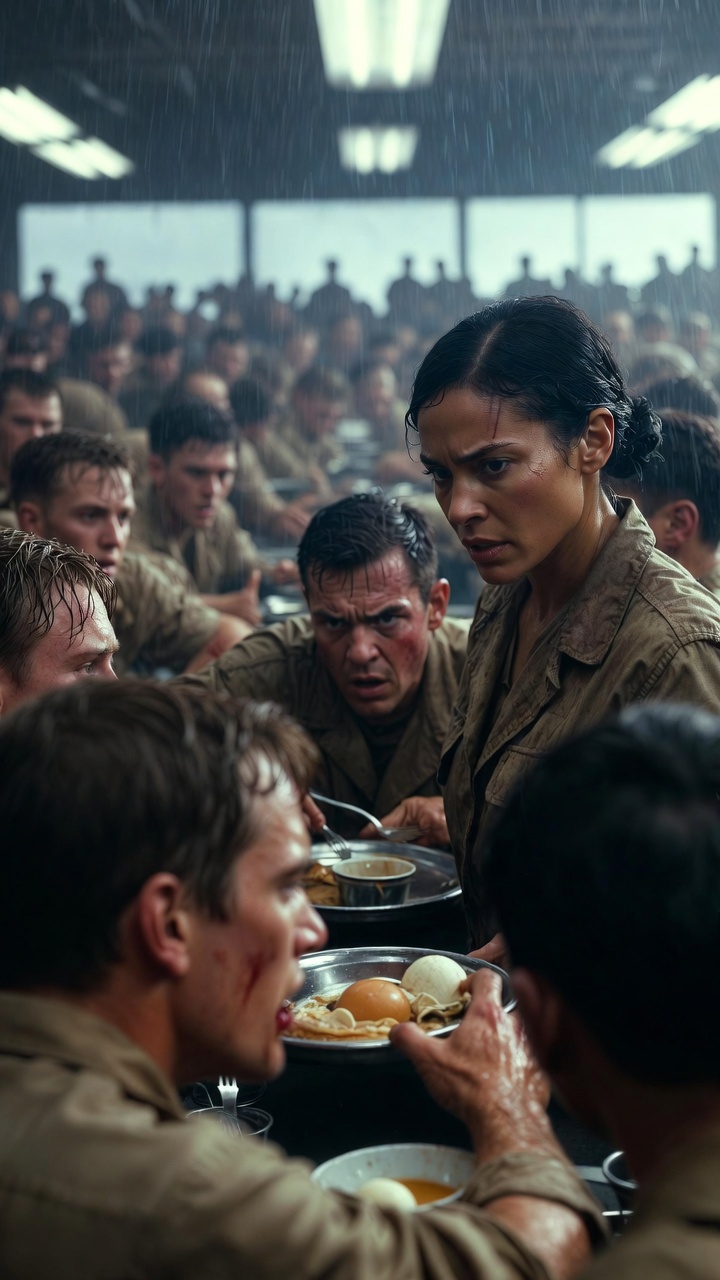
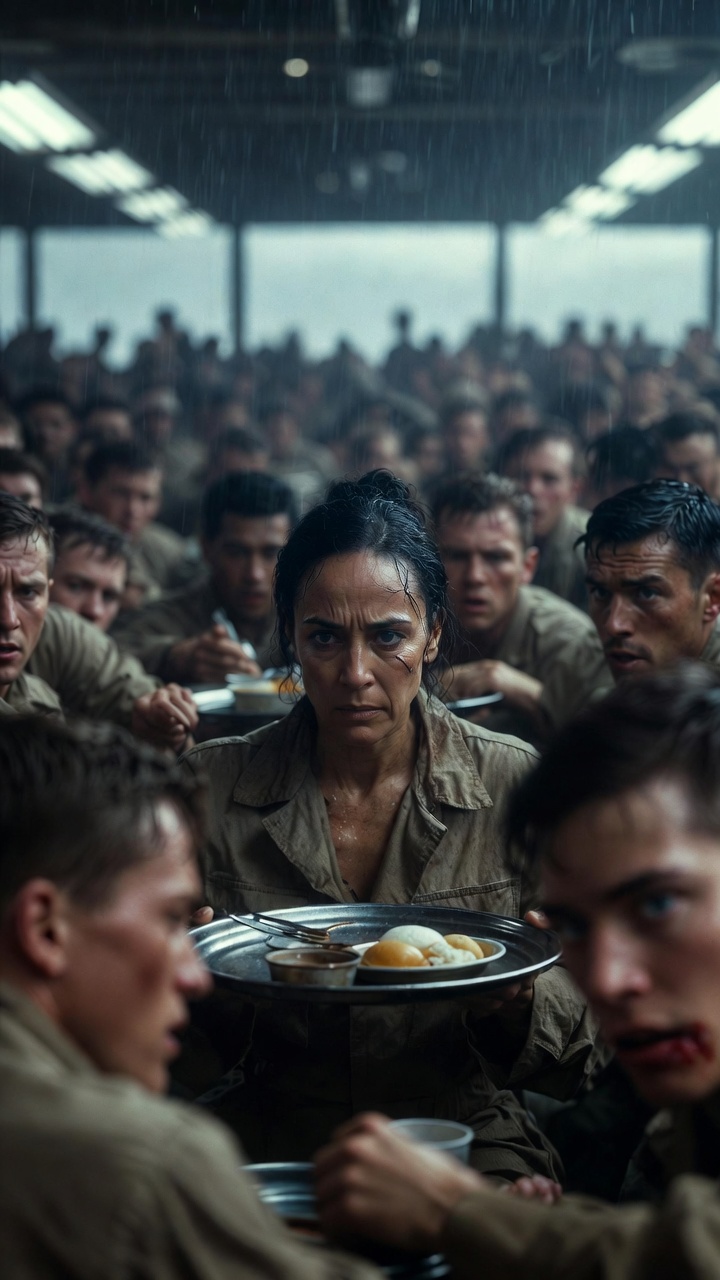
Every recruit, every private, every boot fresh out of Parris Island carried a chow tray like it was a loaded weapon the first week—stiff elbows, eyes down, shoulders tight, terrified of being noticed by the wrong man at the wrong table. But this woman moved through the mess hall with a quiet balance that did not belong to fear.
The steel tray rested level in one hand. Coffee did not tremble inside the paper cup. The eggs slid once with the movement of her steps, then settled.
Around her, Camp Hadley’s main chow hall roared with the animal noise of noon.
Forks scraped plastic plates. Boots hammered the scuffed tile. A soda machine coughed syrup into cups. Somewhere near the west windows, a lance corporal laughed too loudly at a joke nobody else had heard. Rain slapped against the high glass panels and turned the gray Carolina sky into a smear of wet metal.
The mess hall smelled of burned coffee, bleach, hot grease, damp uniforms, and the sour bite of men who had been awake since 0430.
Rusk sat at the center table beneath the framed campaign flags, his back to the wall, his sleeves rolled precisely twice. His forearms were thick, scarred, and darkened by years under foreign suns. He had the build of a man who had spent his life turning discomfort into muscle. At thirty-seven, he had a face that made young Marines stop smiling before he spoke.
His Marines called him Iron Rusk when he was not close enough to hear.
He had heard anyway.
He liked it.
Not because it fed his pride, he told himself, but because fear kept Marines alive. Fear of sloppiness. Fear of softness. Fear of hesitation. A Marine who feared shame would check his weapon twice. A Marine who feared weakness would keep walking when his legs begged him not to.
Fear had saved Rusk in Fallujah.
Fear had brought him home when better men had returned under flags.
So when the woman entered the chow hall wearing no rank on her visible collar, no name tape he recognized, and a faded utility jacket that did not match the clean rhythm of the room, something inside him tightened.
She looked wrong.
Not undisciplined. Not exactly.
Wrong in a way he could not place.
She was perhaps thirty-nine, maybe forty, lean rather than thin, with dark hair pinned at the back of her head in a knot so severe it seemed carved there. Her face had no makeup, no softness placed there for anyone else’s comfort. A thin white scar cut from the corner of her left eyebrow toward her temple, pale against brown skin. Her eyes moved once across the room—doors, windows, exits, corners, hands—and then dropped to her tray.
That was when Rusk stopped eating.
Because recruits looked at the floor.
Veterans looked at people.
This woman looked at architecture.
Across from him, Staff Sergeant Vance Mercer followed his gaze and smirked around a mouthful of toast.
“New doc?” Mercer asked.
Rusk did not answer.
The woman passed the trash bins. Two young Marines shifted aside without being told. She gave them no nod of thanks, only enough space not to collide. Her boots were regulation but old, polished in the way only a person with no interest in being admired polished boots—clean, functional, scarred at the toes.
At the far end of the hall, Corporal Tully said something from his table. Rusk did not catch the words, but he saw the shape of them ripple through the row: laughter, shoulders turning, eyes lifting.
The woman kept walking.
The laughter rose.
A fork clattered.
Then a voice cut through the mess hall.
“Hey. You lost?”
The woman stopped.
Not sharply.
Not like she had been startled.
She stopped as if someone had placed a hand on an invisible rail before her and she had politely reached it.
Private First Class Mason Creed rose from the table near the coffee station. Twenty-three years old, Alabama jawline, blue eyes too eager for violence, a fresh scar on his lower lip from last week’s combatives. Creed had been Rusk’s problem for three months. Strong. Fast. Brave in the way gasoline was brave near a match.
He wanted war the way young men wanted tattoos—because the pain proved something.
The woman turned her head slightly.
Creed stepped into the aisle, blocking her path.
“PX is the other way,” he said. “Civilians don’t eat here.”
A few Marines laughed. Not many. Enough.
The woman’s thumb shifted against the edge of her tray.
“I’m not lost,” she said.
Her voice was low. Southern, maybe. Or once Southern, sanded down by years elsewhere.
Creed tilted his head. “You got a unit?”
“Yes.”
“Name?”
The woman looked at him fully.
The laugh at the table died with no command.
Rusk felt the mess hall change.
It was subtle—a pressure drop before lightning. Men did not know why they stopped chewing. They only knew something had stepped into the room and was no longer pretending not to be dangerous.
“My name,” the woman said, “is not your concern.”
Creed smiled.
There it was, Rusk thought.
The break.
A good Marine would have heard the boundary. A trained Marine would have seen the posture. A disciplined Marine would have stepped aside, reported the irregularity, and lived the rest of the day without making himself famous.
Creed did none of those things.
“You hear that?” he called over his shoulder. “Not my concern.”
Mercer chuckled under his breath.
Rusk set his fork down.
The sound was small, but Mercer noticed. His smile thinned.
“Captain?” Mercer murmured.
Rusk watched Creed move closer.
The woman did not step back.
“Regulations say everybody in this facility identifies when challenged,” Creed said.
“Regulations say a Marine does not use a chow hall to perform for an audience.”
That struck him.
Not hard. Clean.
A few heads turned toward Rusk now. Men wanted to see if he would intervene. He should have. The thought touched him once, then slid away beneath something older and uglier.
His command had been under inspection for six weeks. Three incidents of contraband. One barracks fight. One missing weapons part later found under a mattress with chewing tobacco and a photograph of a woman who was not the Marine’s wife. Battalion had sent warnings. Higher had sent silence, which was worse.
And now some unknown woman stood in his chow hall challenging one of his Marines in front of everyone.
Order, Rusk believed, was a glass wall.
Once cracked, men leaned on it.
Creed reached for her tray.
“Let’s see some ID.”
The woman moved the tray away before his fingers touched it.
Not fast enough to look dramatic.
Fast enough to humiliate him.
A breath moved through the room.
Creed’s face changed. The boy vanished. Something wounded and stupid took his place.
He grabbed her sleeve.
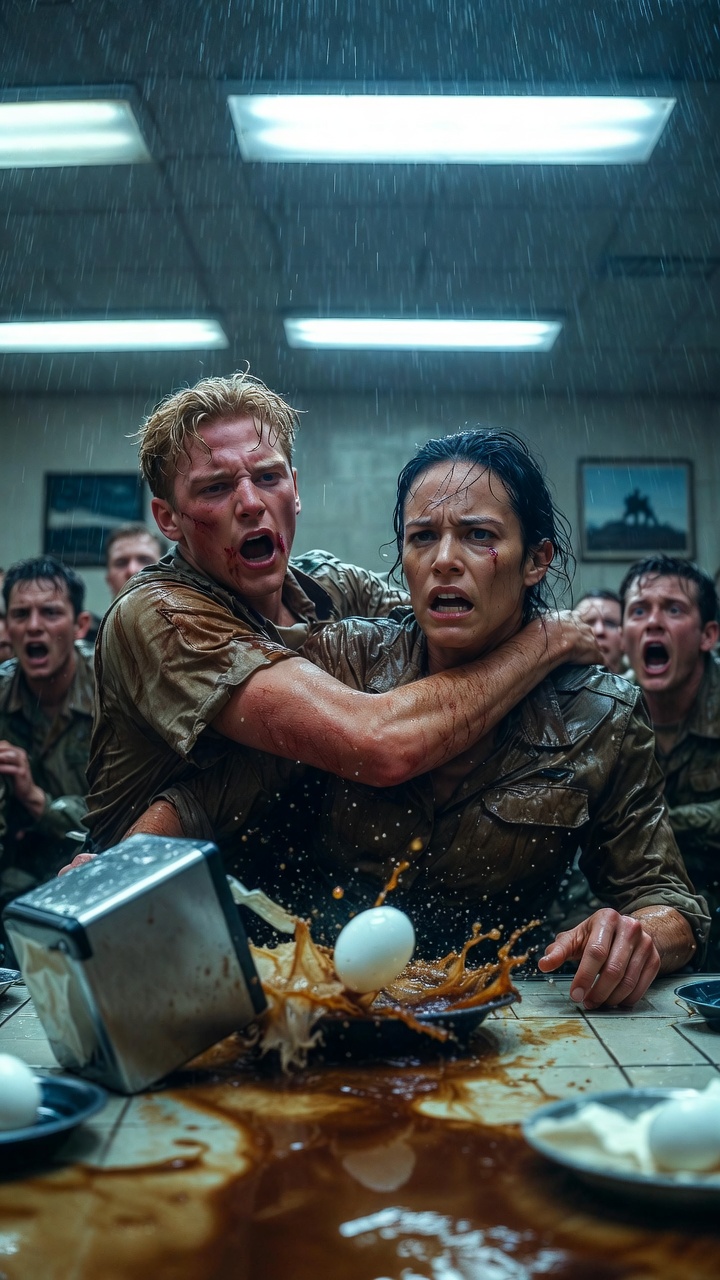
The tray hit the floor.
Coffee burst across the tiles. Eggs slid beneath a table. The paper cup rolled in a widening brown arc.
The room froze.
The woman’s hand closed around Creed’s wrist. For half a second, Rusk saw what she could have done. The angle was there. Thumb to tendon, hip shift, elbow destruction, face to tile. She saw it too.
And chose not to.
That mercy cost her.
Creed shoved her backward.
Her shoulder hit the wall hard enough to shake the framed photograph of Marines raising a flag on Iwo Jima.
A metal napkin dispenser fell from the ledge and exploded open at their feet.
Creed pinned his forearm across her collarbone.
“Show me ID,” he hissed.
No one moved.
Not the young Marines.
Not Mercer.
Not even Rusk.
The woman’s cheek was inches from the painted cinderblock. Rain trembled in bright streaks behind her through the high windows. Her eyes cut once across the room and found Rusk.
They did not plead.
That made it worse.
They measured him.
A red flush crawled up his neck.
He stood.
Chairs scraped back. Men snapped straighter.
“Creed,” Rusk said.
The private did not release her.
“Sir, she refused—”
“I said step back.”
Creed’s forearm lifted.
The woman drew a slow breath. Not shaking. Not angry. Something worse.
Still.
She bent, picked up the napkin dispenser, set it upright on the ledge, then crouched to gather the fallen tray.
A hundred Marines watched her wipe coffee from the tile with brown napkins that dissolved in her hand.
Rusk hated her for that.
Not because she had done anything wrong.
Because she had made his room look small.
“On your feet,” he said.
She looked up.
“Captain,” she replied, “your Marine assaulted a person in a controlled facility.”
A murmur broke out and died.
Rusk stepped closer. His boots stopped at the edge of the spilled coffee.
“You are in a Marine Corps mess facility without visible identification.”
“I am.”
“Then you will produce credentials.”
“When I am finished cleaning the mess your Marine made.”
A young corporal near the soda machine forgot himself and whispered, “Damn.”
Rusk’s eyes flicked toward him. The corporal went pale.
Rusk looked back down at the woman.
“What is your rank?”
She kept wiping the floor.
“Today?” she asked.
Mercer’s brows lifted.
Rusk felt heat move behind his eyes.
“Do not play games with me.”
The woman stood, holding the ruined napkins in one fist.
“I don’t play games with Marines, Captain. I bury them when men like you confuse volume with command.”
The mess hall went silent so fast the soda machine sounded obscene.
Rusk’s hand moved before his judgment caught up.
He did not strike her.
But his fingers clamped around her upper arm with enough force that several Marines leaned forward.
“Outside,” he said.
The woman looked at his hand.
Then at his face.
“Remove your hand.”
It was not loud.
It carried anyway.
Rusk did not remove it.
Behind him, Mercer rose. “Ma’am, I suggest you—”
She turned her eyes to Mercer.
Whatever he saw there cut the rest of the sentence from his mouth.
Then the far doors opened.
Cold rain-wind swept into the chow hall.
Three men entered in dark service uniforms, covers tucked beneath their arms. They did not look like mess staff. They did not look like base administration. They looked like men who had spent the morning deciding how many careers had to die before sunset.
The first was Colonel Daniel Harrow, Camp Hadley’s commanding officer, silver hair wet at the temples, face drawn tight.
The second was Major Elise Vaughn from Inspector General, narrow-eyed, carrying a black leather folder against her ribs.
The third was an older Navy corpsman with a limp and a chest full of ribbons that made every Marine who knew anything stop breathing.
Master Chief Samuel Pike.
Rusk’s hand fell from the woman’s arm.
Too late.
Harrow stopped ten feet away.
His gaze moved from the coffee on the floor, to Creed’s stiff posture, to Rusk’s hand still half-curled in the air.
Then he looked at the woman.
His entire body changed.
Not much.
A fraction.
His chin lowered.
His shoulders squared.
When he spoke, his voice had no thunder in it.
Only consequence.
“General Vale,” he said. “Are you injured?”
The room did not understand at first.
Words sometimes needed time to become bullets.
General.
The young Marines looked at one another.
Mercer’s mouth opened, then closed.
Creed turned so white the scar on his lip looked painted.
Rusk stared at the woman.
She reached into the inside pocket of her faded jacket and removed a black credential case. It opened with a dry leather snap.
A silver star caught the fluorescent light.
Brigadier General Mara Vale.
Commander, Joint Special Training Evaluation Group.
The commander of the classified readiness inspection that had been rumored for weeks and denied by everyone who knew it was real.
The woman Creed had slammed against the wall.
The woman Rusk had grabbed.
The woman who had cleaned coffee from the floor while a roomful of Marines mistook restraint for weakness.
General Mara Vale closed the credential case.
“No, Colonel,” she said. “I’m not injured.”
Her eyes remained on Rusk.
“Not by anything that hasn’t already been broken here.”
No one sat.
No one breathed correctly.
The rain hit harder against the windows, as if the sky wanted inside to watch.
Colonel Harrow’s jaw worked once.
“Captain Rusk. Staff Sergeant Mercer. Private First Class Creed. Conference Room One. Now.”
Creed moved first, too quickly, knocking his chair sideways.
“Leave it,” Harrow said.
The chair stayed on the floor.
General Vale looked across the mess hall. Not at the officers. Not at the NCOs. At the youngest faces—the ones watching their heroes shrink.
“Finish your meals,” she said.
Nobody moved.
Her voice softened by one degree.
“That was not a suggestion.”
Forks rose with shaking hands.
Rusk walked toward the door feeling every eye cut into his back.
For the first time in seventeen years, he did not know whether he was marching or being led.
Conference Room One smelled of wet wool, old coffee, and the lemon cleaner used by people who wanted a room to seem more honest than it was.
A long table occupied the center. On one wall hung the chain of command. On the other, a framed photograph of Camp Hadley from 1958, when the barracks were low and white and the pine trees still stood close enough to hide secrets.
General Vale stood at the window with her back to them.
Rain blurred the training field beyond the glass. A platoon in ponchos crossed the mud in two columns, rifles angled down. From here, they looked like shadows learning to obey.
Rusk stood at attention near the door.
Creed stood beside him, breathing through his nose.
Mercer had folded himself into the posture of a man trying not to occupy space.
Colonel Harrow sat at the head of the table, but he did not look like the highest-ranking person in the room. Major Vaughn placed her black folder down and opened it.
Master Chief Pike remained standing near the wall. His eyes stayed on Vale, not with fear, but with the tired devotion of a man who had seen her bleed.
“Let’s begin with the obvious,” Major Vaughn said. “An officer conducting an authorized inspection was physically assaulted by a Marine under your command.”
Creed swallowed.
“Ma’am, I didn’t know—”
Vale turned from the window.
That stopped him.
The general had removed her jacket. Beneath it, her sleeves were rolled to the forearm. A dark bruise was already blooming near her collarbone where Creed had pinned her to the wall.
She did not hide it.
“Private Creed,” she said, “finish your sentence.”
He stared at a point above her shoulder.
“I didn’t know who you were, ma’am.”
“No,” Vale said. “You knew exactly who I was.”
His eyes flicked to her.
“You believed I was someone without power.”
The words hung there.
Creed’s throat moved.
“You believed rank is what makes a person deserving of restraint,” she continued. “You believed a room would protect you if the room approved. You believed silence was permission.”
Rusk felt the sentence land against his own ribs.
Vale looked at him.
“And you, Captain, gave him that silence.”
Rusk had rehearsed a defense in the hallway. Regulations. Unauthorized presence. Heightened security. Inspection confusion. A dozen hard words with enough truth in them to stand upright if no one pushed too hard.
Now they all sounded like cheap metal.
“I failed to intervene quickly enough,” he said.
Vale watched him.
“No,” she said. “You waited to see if his violence would solve your discomfort.”
The words cut cleaner than shouting.
Harrow looked down at the table.
Major Vaughn wrote something.
Rusk’s fingers tightened along the seam of his trousers.
“With respect, General,” he said, “this command has been under pressure for weeks. We’ve had breaches, discipline issues, and outside scrutiny. My Marines are alert because I made them alert.”
“Alert Marines identify threats,” Vale said. “Undisciplined Marines manufacture them.”
Creed flinched.
Rusk did not.
He looked at her bruise. Then away.
“I built this company out of men no one wanted,” he said. “Half of them came to me broken, arrogant, addicted to stupid choices. I made them Marines.”
“Did you?” Vale asked.
His eyes snapped back.
The room tightened.
Vale moved to the table and placed Creed’s fallen ID card on the polished wood. Rusk had not seen her pick it up.
“Mason Creed,” she said. “Father deceased. Mother in long-term care. Three disciplinary notes in recruit training, all for retaliatory aggression. One commendation for carrying another recruit six miles after heat collapse. High physical scores. Low peer trust. Recommended for mentorship, not humiliation-based correction.”
Creed’s mouth parted.
Vale turned a page from memory, though nothing was in her hand.
“Captain Owen Rusk. Navy Cross recommendation downgraded to Silver Star after command review. Two deployments to Iraq, three to Afghanistan, one advisory tour no one in this room is cleared to discuss. Lost twelve Marines in Helmand after local partner forces abandoned a checkpoint. Since then, your units have produced exceptional combat scores and unusually high injury rates in training. You write Marines up for hesitation. You rarely write them up for cruelty.”
Rusk stared at her.
The room had no air.
Vale looked at Mercer.
“Staff Sergeant Vance Mercer. Good tactical instructor. Poor moral witness. You know when something is wrong, and you wait for someone stronger to say it first.”
Mercer’s face reddened.
Master Chief Pike’s eyes narrowed with the faintest approval.
Vale placed both hands on the table.
“I did not come to Camp Hadley to test whether Marines could salute me. I came to test whether this command can be trusted with young lives when nobody important is watching.”
Outside, thunder rolled low over the base.
Creed’s chin trembled once before he forced it still.
Rusk saw it.
For the first time all day, he saw him not as gasoline, not as a problem, not as a tool to be hardened.
A boy.
A dangerous boy.
But still a boy.
“What happens now?” Harrow asked.
Major Vaughn glanced at Vale.
Vale did not answer immediately.
She looked at Creed.
“Private, why did you put your hands on me?”
“Ma’am—”
“Not the regulation answer.”
Creed’s eyes shone. He blinked hard, angry at the water in them.
“Because everyone was watching.”
The honesty startled the room more than any lie would have.
Vale nodded once.
“And if nobody had laughed?”
Creed’s jaw flexed.
“I don’t know.”
“Yes, you do.”
His hands curled.
“I would’ve let you pass.”
“Why?”
“Because it wouldn’t have mattered.”
Vale’s face did not soften, but something in her eyes shifted.
“There it is.”
Creed lowered his head.
Rusk heard the rain. The clock. The faint clink of plates from the mess hall beyond the corridor.
Vale turned to him.
“Captain, why didn’t you stop him?”
Rusk’s answer rose from a place he had boarded shut.
Because I thought he was mine.
Because I thought if I corrected him in public, the room would see weakness.
Because I saw a woman refuse to bend and it felt like insubordination before I knew her name.
Because somewhere in Helmand, under orange smoke, I learned that hesitation kills, and I never learned what else it destroys.
He said none of that.
At first.
Then Master Chief Pike shifted his weight, his bad knee clicking softly.
Rusk looked at the old corpsman’s ribbons. One of them was from a battle Rusk had only read about in classified fragments.
Pike had the eyes of a man who knew all the excuses and had buried patients under each one.
Rusk inhaled.
“I thought control mattered more than judgment,” he said.
Vale held his gaze.
“And now?”
Rusk looked at Creed.
The private’s shoulders were still squared, but everything inside them had collapsed.
“Now I think I confused fear with discipline.”
No one wrote for a moment.
Major Vaughn’s pen hovered above the page.
Vale turned back to the window.
Beyond the glass, the platoon in ponchos reached the edge of the obstacle course. One Marine slipped in the mud. Another reached down and pulled him up before the sergeant saw.
Vale watched that small gesture longer than anyone expected.
Then she said, “Private Creed will be removed from the training track pending investigation. He will receive counsel, not protection. Staff Sergeant Mercer will be reassigned from direct recruit authority until he completes leadership remediation. Captain Rusk…”
Rusk braced.
Vale turned.
“You will remain in command for seventy-two hours.”
Harrow looked sharply at her.
Creed’s eyes widened.
Rusk felt no relief. Relief would have meant safety.
Vale’s expression gave him none.
“In seventy-two hours,” she continued, “Camp Hadley begins the Black Meridian exercise. Your company was scheduled to lead urban extraction. I am changing the scenario.”
Major Vaughn looked up.
Vale’s voice lowered.
“You will not be judged on speed. You will not be judged on aggression. You will be judged on whether your Marines can identify a lawful order, refuse an unlawful one, protect a vulnerable person, and complete the mission without becoming the threat themselves.”
Rusk swallowed.
“And if we fail?”
Vale picked up her jacket.
“Then I remove you in front of the same Marines who watched you fail today.”
She walked to the door.
Creed stepped back so quickly his heel struck the wall.
Vale paused beside him.
“Private.”
“Yes, ma’am.”
“Pain is not a credential.”
His face twisted.
“No, ma’am.”
“Remember that before you make someone else carry yours.”
Then she left.
For several seconds, no one moved.
Finally, Colonel Harrow stood.
“Captain Rusk.”
“Sir.”
“Fix your Marines.”
Rusk looked at the door General Vale had closed behind her.
For the first time in years, he understood that fixing them might begin with letting them see what was broken in him.
The Black Meridian exercise began before dawn under rain that had forgotten how to stop.
Camp Hadley’s mock village stood three miles east of the main barracks, a grid of concrete shells, plywood storefronts, burnt-out vehicles, and narrow alleys designed to teach Marines that streets could swallow men whole. Floodlights turned the puddles silver. Smoke machines breathed white fog between buildings. Loudspeakers played distant sirens and barking dogs.
Rusk stood beneath a camouflage net beside the staging area, helmet clipped under one arm, watching his company prepare.
No one laughed today.
Creed was gone from the formation. The empty space where he should have stood seemed louder than his voice had ever been.
Mercer moved among the Marines without barking. Twice he opened his mouth to snap at someone and stopped himself. The restraint looked painful. Good, Rusk thought. Let it hurt.
General Vale stood near the observation tower with Colonel Harrow, Major Vaughn, Master Chief Pike, and a cluster of evaluators. She wore full field gear now. No rank visible from a distance. No theatrical command presence. Just stillness.
Rusk had slept forty minutes.
At 0210, he had opened the personnel files of every Marine in his company and read them like casualty reports from a future he still had time to prevent.
At 0345, he had found Creed sitting alone outside the chapel, rain dripping from the brim of his cover.
The private had stood too fast.
Rusk had almost given him a speech.
Instead, he had sat beside him on the wet bench.
For a long time, neither man spoke.
Then Creed said, “My dad used to shove me into walls.”
The sentence came out flat. Not as excuse. As evidence.
Rusk stared at the dark chapel doors.
“What did you do?”
Creed rubbed his hands together until the knuckles whitened.
“Got big enough so nobody could.”
Rusk nodded once.
The rain ticked on the roof.
“That’s not strength,” Rusk said.
Creed’s face crumpled, but he caught it with his teeth before it fully broke.
“I know that now, sir.”
Rusk had looked at him then, really looked. Young. Afraid. Ashamed. Capable of harm. Capable of something else too, if someone reached him before the wrong part hardened forever.
“Knowing doesn’t clear you,” Rusk said.
“No, sir.”
“But it gives you somewhere to start.”
Now, standing in the wet blue dark of the exercise field, Rusk wondered if he had said it to Creed or to himself.
A whistle blew.
The exercise began.
Rusk’s company moved into the village in four squads, rifles loaded with blanks, sensors fixed to their vests, radios clicking softly in the rain. Their mission packet said an American aid worker was trapped inside Building Seven, surrounded by hostile militia role-players. Extract the target. Avoid civilian casualties. Maintain command integrity under misinformation.
Simple words.
Nothing about war was simple once people entered it.
The first ten minutes went clean.
Too clean.
First squad cleared the south alley. Second secured the market shell. Third established overwatch from a roof slick with rain. Fourth moved with Rusk toward Building Seven.
Then the screaming started.
A woman’s voice tore through the loudspeakers from the east side of the village.
“Help! Please! Don’t leave me!”
Several Marines turned.
The mission target was west.
Rusk saw the trap at once.
He also saw Lance Corporal Ben Halloway, nineteen, whose sister had died in a house fire, take two steps toward the scream before his squad leader caught his vest.
“Stay on mission,” Mercer snapped over comms.
Rusk touched his radio.
“Hold.”
Rain ran down his neck.
In the observation tower, Vale leaned forward.
The scream came again.
“Please! My baby’s inside!”
Halloway’s breathing became audible over the squad channel.
Rusk closed his eyes for one second.
Old Rusk would have crushed the hesitation.
New Rusk did not yet know what he would do.
He opened his eyes.
“Second squad, verify source. Two Marines only. No breach without confirmation. First squad, cover their movement. We do not abandon the mission, and we do not ignore a possible civilian.”
Mercer’s voice crackled. “Sir, packet says—”
“I know what the packet says.”
Silence.
Then Mercer answered, “Aye, Captain.”
The company split without breaking.
Two Marines reached the east building. The screaming stopped mid-breath. A role-player insurgent appeared in the upper window and fired blanks down into the alley.
First squad suppressed. Second squad pulled back.
No casualty.
No panic.
Rusk allowed himself half a breath.
Then Building Seven exploded.
Not real flame—flash charges, smoke, orange light bursting from the lower windows. The shockwave thudded through the village and rolled across the wet concrete.
“Contact west!”
“Man down!”
“Target moving!”
Radio traffic tangled. A role-player in civilian clothes ran from Building Seven with red smoke trailing from a canister in his hand. Behind him came two more, one dragging a mannequin in a tan vest.
A decoy.
Rusk saw Marines aim.
The civilian-clothed runner stumbled.
A young Marine shouted, “He’s got something!”
Rusk saw the object in the man’s hand.
Not a weapon.
A radio.
“Do not fire!” Rusk barked.
A rifle cracked anyway.
Blank fire.
The runner dropped theatrically, sensor screaming.
Major Vaughn’s voice cut over the evaluator net.
“Civilian casualty recorded.”
Rusk’s stomach turned cold.
The shooter was Corporal Tully.
His face had gone white beneath the rain.
“I thought—sir, I thought—”
Rusk wanted to curse. Wanted to slam the mistake into someone else’s hands.
Instead, he moved.
He crossed the alley, grabbed Tully by the vest—not violently, but firmly enough to anchor him—and put his own body between the corporal and the eyes of the squad.
“Breathe,” Rusk said.
Tully stared at him.
“Sir, I—”
“Breathe first. Report second.”
Tully sucked air.
Rusk turned to the squad.
“What did we miss?”
No one answered.
Rusk pointed at the fallen role-player.
“Hands. Eyes. Object. Movement. Someone tell me what we missed.”
Halloway spoke, voice shaking.
“He was scared. Not attacking.”
“Good. What else?”
“He ran from the blast,” another Marine said.
“Good. What else?”
Mercer appeared through the smoke, jaw tight.
“We let the explosion make the decision.”
Rusk looked at him.
Mercer looked ashamed.
“Correct,” Rusk said.
In the observation tower, General Vale watched without expression.
The exercise continued.
Harder now.
The village became a maze of bad information. A wounded role-player begged for aid while hiding a training grenade beneath his leg. A radio call used Rusk’s voice, deepfaked and distorted, ordering Third Squad to abandon overwatch. A simulated superior officer arrived on scene and screamed for speed, threatening careers, demanding they breach a building with unverified civilians inside.
Old habits twitched through the company like damaged nerves.
But something else moved too.
A pause.
A question.
A hand stopping another hand.
At 0617, Staff Sergeant Mercer refused the false order from the role-player colonel.
“Sir, I need authentication,” Mercer said, voice rough but steady.
The role-player stepped close. “You questioning me, Staff Sergeant?”
Mercer’s face darkened.
Everyone waited for the old bark, the old submission to rank and pressure.
Mercer swallowed.
“Yes, sir,” he said. “Until verified.”
From the tower, Master Chief Pike smiled for the first time.
At 0642, Halloway found the real aid worker—a female evaluator with a bleeding simulation kit—hidden inside a collapsed stairwell beneath Building Seven. The easy route was blocked. The fast route exposed the squad to sniper fire. The safe route required carrying her through standing water, under a low crawl, with no guarantee of success before the clock expired.
“Leave gear,” Mercer ordered.
Rusk almost corrected him.
Mercer caught himself.
“No. Secure gear. Rotate carriers. Nobody gets heroic alone.”
The extraction took nine minutes and cost them two simulated casualties.
But they brought her out alive.
When the final whistle blew, the rain had thinned to mist.
The Marines stood in the mock village with mud up their legs, smoke in their sleeves, and exhaustion hanging from their shoulders. No one celebrated. They knew they had not performed perfectly.
That mattered.
Perfect units learned nothing.
General Vale descended from the tower.
The company formed without being told. Rusk stood before them, helmet under one arm, rain dripping from his chin.
Vale approached slowly.
For a moment, no one spoke.
Then she turned to the Marines.
“You failed parts of this exercise,” she said.
Faces tightened.
“You misread a civilian. You allowed stress to narrow your vision. You hesitated when action was needed and moved too quickly when patience would have saved a life.”
The words struck hard because they were true.
Then Vale looked at Tully.
“But after the mistake, you did not hide it.”
She looked at Mercer.
“When pressured by rank, you demanded authentication.”
Mercer’s throat moved.
She looked at Halloway.
“When emotion pulled you off mission, your team did not shame you. They used your concern correctly.”
Halloway blinked fast.
Finally, Vale looked at Rusk.
“And your captain did something rare.”
Rusk felt the company’s attention turn toward him.
Vale’s voice carried through the mist.
“He gave up the comfort of appearing certain.”
No medal could have stunned him more.
Rusk stared at the wet ground.
Vale stepped closer.
“Captain, front and center.”
He moved.
The company held its breath.
Seventy-two hours ago, this would have been the moment of public removal. Rusk could feel it in the Marines behind him—the fear, the curiosity, the memory of the chow hall wall.
Vale faced him.
“You still have work to do.”
“Yes, ma’am.”
“Your command climate did not rot in one afternoon, and it will not heal in one exercise.”
“No, ma’am.”
“But today, your Marines made better decisions under pressure than they made three days ago.”
She paused.
“Why?”
Rusk turned to face his company.
Their faces watched him through rain and mud: Mercer, Tully, Halloway, the others. Young men and women carrying rifles, fear, pride, old wounds, and the dangerous hunger to be worthy of the uniform.
Rusk’s voice came out rough.
“Because I stopped asking you to be hard enough to break,” he said. “And started requiring you to be disciplined enough not to.”
No one moved.
The sentence settled over them.
Vale studied him for a long moment.
Then she nodded once.
“Continue the work.”
She turned to leave.
But a voice rose from the back of the formation.
“General?”
Every head snapped toward it.
Private First Class Mason Creed stood near the edge of the mock village in a rain jacket, escorted by Master Chief Pike. He was not part of the exercise. He had no weapon. His face looked like he had not slept.
Harrow’s expression hardened.
Rusk’s chest tightened.
Vale turned.
Creed stepped forward, stopped at regulation distance, and stood at attention.
“Permission to address the company, ma’am.”
Major Vaughn looked ready to refuse.
Vale held up one hand.
“Granted.”
Creed faced the Marines.
The same room that had watched him shove a woman into a wall now watched him try to stand inside the shape of what he had done.
His lips parted.
Nothing came out.
A few days earlier, he would have filled the silence with swagger.
Now he let it expose him.
Finally, he said, “I put my hands on someone because I thought the room was on my side.”
Rain ticked on helmets.
“I embarrassed this company. I disgraced the uniform. I hurt someone who showed more control than I did.”
He looked at Vale but did not seek forgiveness from her.
Then he looked at the younger Marines.
“If you laughed, that’s on you. If you stayed quiet, that’s on you too. But what I did is mine.”
His jaw trembled.
“I’m sorry.”
No one applauded.
It would have ruined the moment.
Vale walked toward him.
Creed braced as if expecting punishment.
She stopped one step away.
“Private Creed, apology is not repair.”
“No, ma’am.”
“Repair is what you do when nobody is moved by your regret anymore.”
“Yes, ma’am.”
She studied him.
Then she said, “Report to Master Chief Pike at 0500 tomorrow.”
Creed blinked.
“Ma’am?”
“You will assist medical training scenarios until your investigation is complete. You will learn how quickly bodies break. You will learn how long healing takes. You will learn the difference between force and care.”
Master Chief Pike’s smile vanished.
He looked at Creed like a surgeon considering an unpleasant but necessary operation.
“Bring coffee,” Pike said.
Creed nodded quickly.
“Yes, Master Chief.”
Vale turned back to the company.
“Dismissed.”
The formation broke slowly, not with the loose noise of relief, but with the quiet of people leaving a funeral that had somehow become a beginning.
Rusk remained in the rain.
Vale came to stand beside him.
For a while, they watched the Marines move through the mist toward the trucks.
“Why didn’t you remove me?” Rusk asked.
Vale did not look at him.
“Because men like you are dangerous when left uncorrected,” she said. “But useful when they finally become honest.”
He absorbed that.
It was not mercy.
It was responsibility.
“Did you know what would happen in the chow hall?” he asked.
“No.”
“But you expected something.”
Vale’s eyes remained on the field.
“I expected the room to tell me the truth.”
Rusk looked toward the distant mess hall, its windows glowing faintly through rain and pine.
“And did it?”
Vale’s scar caught the gray morning light.
“Yes,” she said. “Then, for once, the room listened.”
Three weeks later, the chow hall had changed in ways a visitor might not notice.
The campaign flags still hung from the beams. The coffee still tasted burned. The tile still carried the ghosts of thousands of boots. Rain still found the same windows when weather rolled in from the coast.
But the center table no longer belonged to whoever could make others fear sitting there.
Marines moved differently around one another. Not softer. Not slower. Just more awake.
A private dropped a tray one Tuesday and waited for the laughter.
None came.
Two Marines helped him clean it up.
Staff Sergeant Mercer still had a voice that could cut through a storm, but now he used silence with more precision than volume. Corporal Tully spent extra hours on threat-identification drills and became so good at reading hands that Major Vaughn used him in a training brief. Lance Corporal Halloway wrote to his mother for the first time in eight months.
Creed reported to Master Chief Pike every morning at 0500.
He cleaned training wounds. Reset mannequins. Carried litters. Learned the weight of unconscious bodies. Learned that blood, even fake blood, changed the temperature of a room. Learned that the strongest person in a crisis was often the one whose hands stayed gentle.
He did not become redeemed.
Not that quickly.
But he became quieter.
Sometimes that was where redemption started.
Captain Rusk kept command.
Not untouched. Not celebrated.
Watched.
He rewrote training protocols. He removed two squad leaders who mistook cruelty for intensity. He promoted one corporal who had never been the loudest voice in any room but had always been the first to notice when someone fell behind.
And once a week, he sat in the back of the mess hall with no chosen table and listened.
That was where General Mara Vale found him on her last day at Camp Hadley.
She entered at 1200, carrying a tray.
The room noticed.
Of course it did.
But this time, no one challenged her.
No one laughed.
No one performed.
Marines stood, not in panic, but in respect.
Vale scanned the room and found Rusk near the east wall.
He rose.
“General.”
“Captain.”
She looked at the empty seat across from him.
“Taken?”
“No, ma’am.”
She sat.
For a few minutes, they ate without speaking.
The chow hall noise moved around them—forks, boots, low voices, the hiss of rain beginning again against the windows.
Finally, Vale said, “Your company passed final review.”
Rusk set down his cup.
“Thank you, ma’am.”
“That was not praise. It was information.”
A faint smile touched his mouth.
“Yes, ma’am.”
She studied him.
“You look tired.”
“I am.”
“Good.”
He almost laughed.
Instead, he looked down at his hands. The same hands that had grabbed her arm. The same hands that had pulled Marines from burning vehicles. The same hands that had written letters to mothers and fathers when bravery had not been enough.
“I owe you an apology,” he said.
Vale held his gaze.
“You owe your Marines better command.”
“I’m trying to give it.”
“I know.”
The words should have comforted him.
They did not.
They steadied him instead.
Across the room, Creed entered with a medical bag over one shoulder. He saw Vale and stopped. For half a second, the old fear flashed across his face.
Then he walked over.
“General,” he said.
Vale looked up.
“Private.”
“Master Chief says I’m cleared to return to limited training next week.”
“And what do you say?”
Creed shifted the bag on his shoulder.
“I say limited means earned slow.”
Vale nodded.
“Maybe Pike taught you something after all.”
Creed glanced at Rusk.
Then back at Vale.
“I also wanted to say…” He stopped, swallowed, and began again. “No speeches. Just—what I did stays with me. I won’t ask you to take it off.”
Vale’s expression changed in a way so slight most would have missed it.
Rusk did not.
“Good,” she said. “Carry it correctly.”
Creed nodded.
“Yes, ma’am.”
He left.
Rusk watched him go.
“He may make it,” Vale said.
Rusk looked surprised.
“You think so?”
“I think he has a chance. That is not the same thing.”
“No, ma’am.”
Vale took one last drink of coffee and winced.
“How do Marines win wars drinking this?”
“Fear, General.”
She gave him a look.
He corrected himself.
“Discipline.”
This time, she did smile.
It was brief, and it vanished quickly, but it changed her face. For one second, Rusk saw not the commander, not the evaluator, not the woman slammed against a wall who had turned a room into a mirror.
He saw the scar near her eyebrow.
The fatigue beneath her eyes.
The cost of command carried without decoration.
“What made you this way?” he asked before he could stop himself.
The room seemed to recede.
Vale’s fingers rested against the edge of her tray.
For a moment, he thought she would refuse.
Then she said, “A lieutenant once shoved a detainee into a doorframe during an interrogation overseas. Everyone in the room knew it was wrong. I was the junior officer. I said nothing.”
Rusk waited.
“The detainee died two days later from injuries nobody documented properly.” Her voice did not change. “The lieutenant was punished for paperwork. Not for the shove. Not for the room.”
Rain crawled down the glass.
“I promised myself I would never again respect silence just because it wore a uniform.”
Rusk felt the weight of it settle between them.
“I’m sorry,” he said.
Vale stood, lifting her tray.
“So am I.”
She stepped away, then paused.
“Captain.”
He rose.
“Yes, ma’am.”
“The next time a room goes quiet, ask yourself who is paying for that silence.”
Then she walked out of the chow hall.
No music rose. No speech followed. No grand salute thundered through the building.
Only rain, trays, boots, breath.
Rusk remained standing until the door closed behind her.
Then he looked around the mess hall.
At the young Marine helping another fix a broken strap.
At Mercer listening instead of shouting.
At Creed kneeling to pick up a napkin someone else had dropped.
At the wall where General Mara Vale had once been pinned by a man who did not know who she was.
No.
That was not true.
He had known exactly who she was.
Someone he thought he could get away with hurting.
Rusk picked up his tray and carried it to the wash station. Halfway there, a private stepped into his path by accident, eyes widening when he realized who he had blocked.
The boy froze.
Rusk stopped.
The old room would have held its breath.
This one waited.
The captain shifted his tray to one hand and stepped aside.
“After you,” he said.
The private blinked, then moved.
Around them, the chow hall kept breathing.
And for the first time in a long while, it sounded less like fear.
It sounded like Marines learning the difference between being hard and being worthy.