THE PUBLIC HANGINGS OF THE STUTTHOF FEMALE GUARDS — AND THE QUESTION THAT STILL HAUNTS HISTORY
On the morning of July 4, 1946, thousands of people climbed Biskupia Górka, a hill overlooking the ruined city of Gdańsk, Poland.

They did not come for a celebration.
They came to watch twelve people die.
Across an open field, tall wooden gallows had already been erected. Ropes hung motionless in the summer air. Armed officers controlled the edges of a crowd so large that people at the back could barely see what was happening.
Some spectators had lost parents.
Others had lost children, spouses, homes, or entire families.
Many had lived through years in which people could disappear after a knock at the door and never return. Now, less than fourteen months after the war in Europe had ended, they had gathered to witness something presented as justice.
Among the condemned were five women.
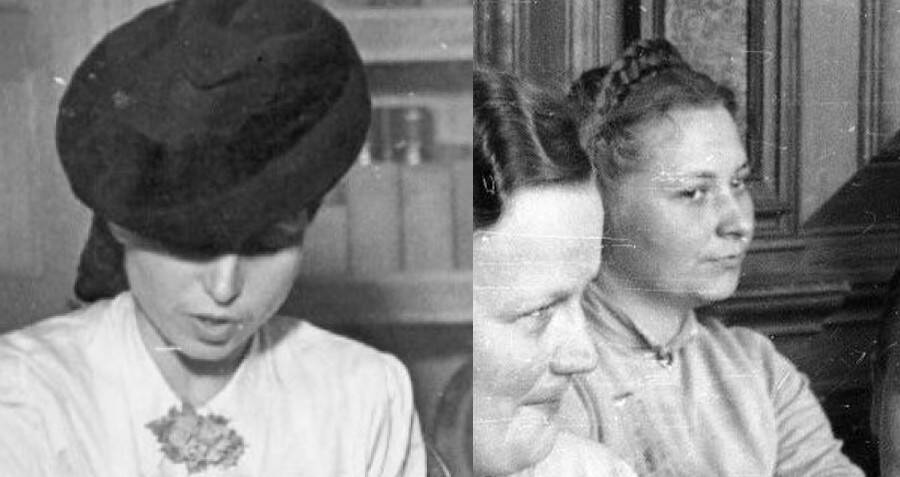
Jenny-Wanda Barkmann.
Elisabeth Becker.
Wanda Klaff.
Ewa Paradies.
Gerda Steinhoff.
They had served as guards within the Stutthof concentration camp system.
The photographs taken that day would become some of the most unsettling images of postwar Europe—not merely because women were being executed, but because of the question their presence raised.
How had women who once lived ordinary civilian lives become participants in a machinery of humiliation, suffering, and mass death?
And what did justice look like after crimes so enormous that no punishment could reverse them?
The answer began seven years earlier, in a place called Stutthof.
The camp stood near the Baltic coast, east of Danzig, the city now known as Gdańsk. It began operating in September 1939, almost immediately after Nazi Germany invaded Poland.
At first, Stutthof was used largely to imprison Polish civilians, community leaders, teachers, clergy members, activists, and others whom the German occupation authorities considered dangerous.
But Nazi camps rarely remained what they were at the beginning.
Stutthof expanded.
Its fences stretched farther. New barracks appeared. Watchtowers rose above the compound. A network of subcamps spread across the region, supplying prisoners as forced labor to farms, factories, shipyards, and military industries.
People arrived from across occupied Europe.
There were Poles, Jews, Soviet prisoners of war, political prisoners, resistance members, and people deported simply because Nazi racial ideology had classified their existence as undesirable.
Approximately 110,000 prisoners passed through the Stutthof camp system.
An estimated 63,000 to 65,000 died.
They were not lost through one single method.
Some were murdered directly. Others died from starvation, disease, exposure, exhaustion, beatings, medical neglect, forced labor, and the brutal evacuations carried out as the Third Reich collapsed.
At Stutthof, death was not always a sudden event.
Often, it was an administrative process.
A ration reduced.
A sick prisoner ordered back to work.
A name added to a transport list.
A person left standing in freezing weather.
A guard deciding that someone was moving too slowly.
The camp turned cruelty into routine.

That routine depended on more than senior Nazi officials. It required clerks, drivers, guards, supervisors, functionaries, and ordinary employees willing to enforce the system one command at a time.
Women became part of that system as the war expanded and the SS needed more personnel to oversee the growing population of female prisoners.
They were known as Aufseherinnen—female overseers.
They did not all arrive with the same backgrounds.
Some had worked in factories. Some came from modest families. Some had held ordinary jobs before the war. They were not mythical monsters who had emerged fully formed from darkness.
That was what made their stories so disturbing.
They had lived in neighborhoods.
They had stood in shops.
They had spoken with relatives and coworkers.
Then they entered a system that gave them uniforms, authority, and control over defenseless prisoners.
Inside the camp, that authority could determine whether another person received food, punishment, medical attention, forced labor, or death.
Survivors described a world in which guards could beat prisoners, set dogs on them, select them for punishment, and terrorize them without fear of meaningful consequences.
Not every guard behaved identically.
But the system did not require every participant to be equally violent. It required enough people to follow orders, accept the rules, remain silent, and treat prisoners as less than human.
The women later placed on trial were accused not simply of wearing uniforms but of participating in that system of abuse.
Jenny-Wanda Barkmann had worked as an overseer at Stutthof. Witnesses accused her of severe mistreatment of prisoners and involvement in selections.
Gerda Steinhoff had held a supervisory position. She had served within the camp system at a time when prisoners were being worked, starved, transported, and killed.
Wanda Klaff had also served as an overseer. Testimony presented after the war described physical abuse and cruelty toward prisoners under her control.
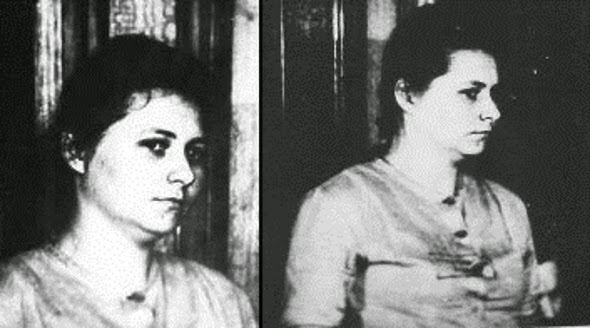
Ewa Paradies was accused of beating inmates and enforcing deadly punishments.
Elisabeth Becker had served for a much shorter period than some of the others. Her defense emphasized her limited time at the camp and her lower position. She appealed for mercy.
The court was not persuaded.
The central issue was not whether these women had designed the Holocaust.
They had not.
They had not written the racial laws, ordered the invasion of Poland, or built the Nazi concentration camp system.
The question was whether they had knowingly helped it function.
That distinction mattered because, after the war, countless former participants attempted to hide behind the structure of the regime.
They had only followed instructions.
They had only completed paperwork.
They had only guarded a gate.
They had only escorted prisoners.
They had only obeyed their superiors.
Each act sounded smaller when separated from the whole.
But the whole could not have existed without the acts.
By early 1945, the Nazi empire was collapsing.
The Soviet army was advancing from the east. German authorities began evacuating Stutthof, forcing tens of thousands of weakened prisoners into winter conditions.
The evacuations became another stage of killing.
Prisoners who had survived the barracks, hunger, disease, and forced labor were driven away from the approaching front. Many collapsed during the marches. Others froze, starved, or were killed when they could no longer continue.
Those left inside the main camp waited amid disease, death, and abandonment.
Stutthof was liberated on May 9, 1945.
It was among the last Nazi concentration camps to be liberated.
By then, most of its prisoners had already been evacuated, scattered, or killed.
The guards no longer possessed the authority that had once made them untouchable.
Uniforms were removed.
Records were examined.
Witnesses began speaking.
Survivors who had once been treated as numbers now entered courtrooms and gave names to the people who had controlled their lives.
In April 1946, the first Stutthof trial opened in Gdańsk before a Polish Special Criminal Court.
The defendants included former camp personnel and prisoner functionaries accused of abusing other inmates.
The women sat before judges rather than standing over prisoners.
That reversal of power was visible in every photograph.
Only months earlier, their victims had been expected to lower their eyes, obey instantly, and accept punishment without protest.
Now the accused had to listen while survivors described what had happened behind the fences.
The courtroom stripped away the protection of the camp.
No watchtowers surrounded them.
No SS hierarchy could silence witnesses.
No uniform could transform violence into discipline.
The accused offered different defenses.
Some denied the allegations.
Some minimized their authority.
Some insisted that witnesses had exaggerated.
Some argued that refusing orders would have placed them in danger.
The arguments exposed one of the most difficult questions of postwar justice: how much choice did an individual possess inside a dictatorship built on fear and obedience?
But another question followed immediately.
What choice had the prisoners possessed?
They had not volunteered to enter Stutthof.
They had not chosen hunger, forced labor, beatings, disease, or separation from their families.
The guards, however constrained they claimed to have been, had stood on the side holding the keys.
At the end of the trial, the court delivered its verdicts.
Eleven defendants received death sentences. Another condemned man associated with the case was also included in the executions carried out on July 4.
Five of those sentenced to die were the former female guards.
When the morning of the execution arrived, they were transported to Biskupia Górka.
The scale of the gathering transformed the event into more than the enforcement of a sentence.
It became public theater.
Vehicles were positioned beneath the gallows. The condemned stood under separate ropes while officials completed the final preparations.
The crowd watched every movement.
Some witnesses shouted.
Others stared in silence.
There were people present who saw the execution as the first visible answer to years of helplessness. They had watched occupation authorities arrest neighbors, destroy communities, and murder civilians while the perpetrators acted with apparent immunity.
Now that immunity was gone.
Yet the scene also carried a warning.
Public punishment can satisfy a demand for accountability, but it can also draw people toward spectacle. The boundary between witnessing justice and consuming suffering is dangerously thin.
The former guards had once stood before crowds of powerless prisoners.
Now they faced a crowd themselves.
Then came the moment photographs could capture but words could never fully explain.
The condemned looked outward.
The ropes were above them.
The vehicles were beneath them.
Beyond the officials stood thousands of faces.
There was no camp hierarchy left to protect them, no superior officer to redirect responsibility toward, and no administrative language capable of making the consequences disappear.
Whatever each woman believed in that final moment, the structure of power had reversed completely.
The prisoners they once controlled had been denied names, dignity, privacy, and legal protection.
The defendants had received a trial.
They had been allowed to speak.
Evidence had been heard.
Judgments had been issued.
That difference did not erase every concern about the fairness, speed, or atmosphere of postwar trials. Nor did it settle the moral debate over capital punishment.
But it revealed something the Nazi camp system had deliberately destroyed: the principle that accusations should be examined and that even the accused remained human beings before the law.
The sentences were carried out before the crowd.
Then the field began to empty.
People descended the hill and returned to a city still scarred by war.
The gallows had provided an ending for the condemned, but not for the survivors.
There was no rope capable of restoring a murdered child.
No verdict could rebuild a vanished family.
No public execution could return the years taken from those who had survived starvation, forced labor, disease, and terror.
That is the uncomfortable truth behind the photographs from Biskupia Górka.
They appear, at first, to tell a simple story: criminals were punished and justice was done.
But history is rarely that simple.
The deeper story concerns how ordinary people enter criminal systems and gradually accept the unacceptable.
Few begin by imagining themselves as perpetrators.
They begin with a job.
A uniform.
A promotion.
An instruction.
A rule everyone else appears willing to follow.
The first act of cruelty may disturb them.
The second becomes easier.
Soon, violence is renamed discipline. Prisoners become numbers. Responsibility is divided among so many people that each participant can claim to have done almost nothing.
That is how enormous crimes are made possible—not only by fanatics at the top, but by thousands of people who decide that obedience matters more than conscience.
The female guards of Stutthof were not significant because women were somehow expected to be incapable of cruelty.
They were significant because their ordinary backgrounds destroyed a comforting illusion.
Evil does not always announce itself through an extraordinary face.
Sometimes it arrives as employment.
Sometimes it offers authority.
Sometimes it asks only for silence at first.
The crowd on Biskupia Górka witnessed the final consequence of choices made behind the fences of Stutthof.
But the most important lesson was never contained in the gallows.
It was contained in everything that came before them.
A society begins to fall not only when violent leaders seize power, but when ordinary people learn to look away, follow the procedure, and call their obedience innocence.
Because the most dangerous sentence in history has never been “I wanted this.”
It has always been: “I was only doing my job.”