“Hold My Hand, Ma’am…” — The Homeless Boy Helped an Elderly Woman Across the Street, Unaware She Was a Billionaire
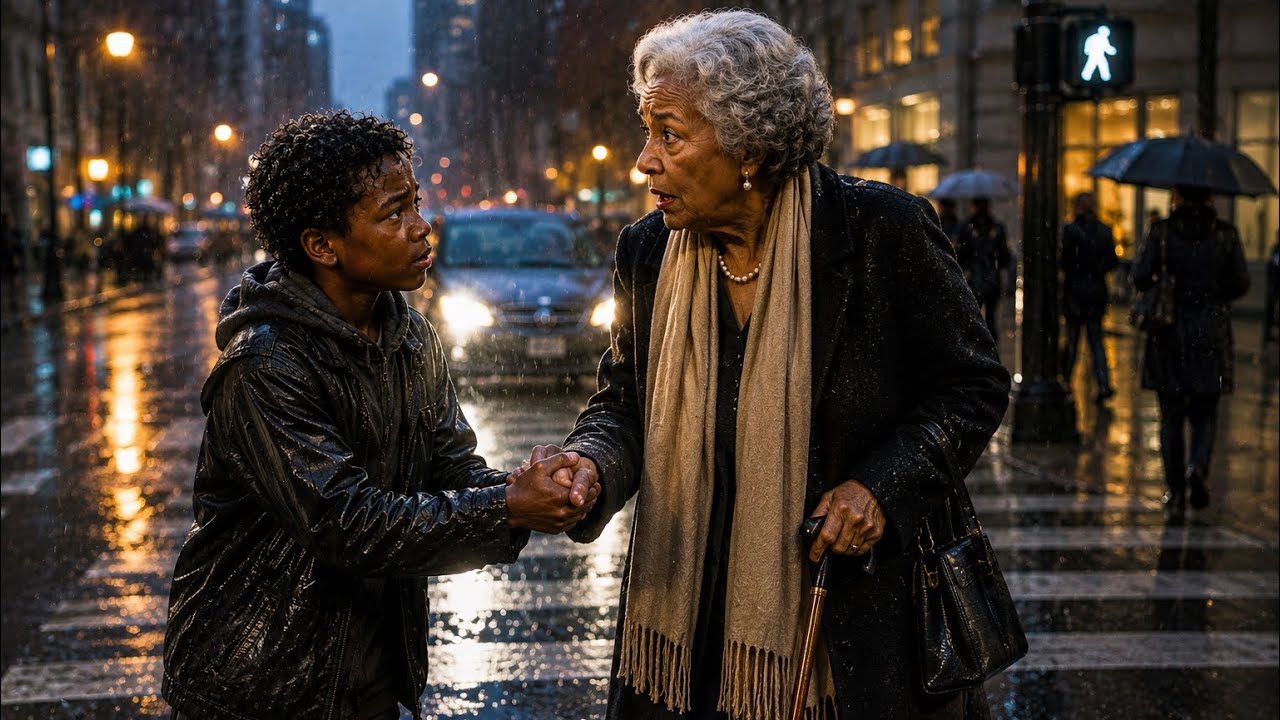
The horn came first.
Long, violent, and close enough to make everyone on the corner turn their heads.
A black SUV shot through the intersection on Michigan Avenue, spraying rainwater across the curb as pedestrians scattered backward. In the middle of the crosswalk, an elderly woman lost her balance.
Her cane slipped from her hand.
For one terrifying second, she stood frozen beneath the traffic light, staring at the vehicle rushing toward her.
Then a small hand grabbed hers.
“Hold my hand, ma’am.”
The boy pulled with everything he had.
They fell together onto the wet pavement as the SUV swerved past them, missing the woman by inches.
People screamed.
A coffee cup hit the ground.
The SUV stopped half a block away, but the driver never got out. After a moment, it disappeared into traffic.
The elderly woman lay on the road, stunned, rain soaking through her gray wool coat. Her breathing came in short, frightened bursts.
The boy was already pushing himself up.
He couldn’t have been older than twelve.
His jacket was too thin for the Chicago winter. One sleeve was torn near the elbow, and the sole of his right shoe had separated so badly that it flapped when he moved.
There was blood on his palm where it had scraped against the pavement.
But he didn’t look at his own hand.
He looked at her.
“Are you hurt?”
The woman blinked.
“No,” she whispered. “I don’t think so.”
The traffic light changed again. Drivers began honking, impatient with the crowd blocking the intersection.
The boy picked up her cane, slipped one arm beneath hers, and helped her to the sidewalk.
Several people watched.
No one stepped forward.
A man in a business suit raised his phone, apparently recording. A woman holding a shopping bag stared for a moment, then hurried away beneath her umbrella.
The boy guided the elderly woman beneath the awning of a closed bookstore.
“Sit here,” he said.
There was no bench, so he wiped rainwater from a low stone ledge with his sleeve.
The woman sat down slowly.
Only then did she notice the boy was shivering.
“What is your name?”
“Kofi.”
“Kofi what?”
“Kofi Mensah.”
She studied his face. His cheeks were hollow, his hair wet, his lips pale from the cold. Yet there was a steadiness in his eyes that seemed older than he was.
“I’m Evelyn,” she said.
He gave a small nod, as though introductions were important even when two people had nearly been killed.
“Do you have someone I can call, Miss Evelyn?”

She almost smiled.
It had been years since anyone had called her “Miss Evelyn.”
“My phone is in my bag.”
Her handbag had fallen near the curb. Kofi ran back through the rain, retrieved it, and checked the clasp before handing it to her.
Nothing was missing.
Evelyn opened the bag and reached for her phone. Her fingers trembled too badly to unlock it.
Kofi pretended not to notice.
“Do you know the number?” he asked.
She gave him one.
A man answered after the first ring.
“Mrs. Turner?”
“Yes, Daniel. I had a small accident.”
The voice on the other end changed immediately.
“Where are you?”
Evelyn looked at the street sign.
“Michigan and Pearson.”
“I’m coming now. Don’t move.”
She ended the call.
Kofi stood a few feet away, rubbing his injured palm against his jeans.
“You should have that cleaned,” Evelyn said.
“It’s fine.”
“It’s bleeding.”
“It’ll stop.”
She looked at him more carefully.
“Where are your parents?”
Kofi’s eyes moved toward the traffic.
“My mother died last year.”
“And your father?”
“I don’t know where he is.”
The answer came without self-pity. That made it harder to hear.
“Who do you live with?”
He hesitated.

“No one.”
Evelyn tightened her grip around the handle of her cane.
“Do you sleep outside?”
“Sometimes.”
“In this weather?”
“There’s a loading dock behind a restaurant. The wind doesn’t reach it as much.”
Evelyn turned away for a moment.
All around them, Chicago continued moving.
Taxis rushed past. Office workers stepped around puddles. Storefronts glowed with warm light. People carried bags filled with things they had bought simply because they wanted them.
And beside her stood a child who measured shelter by how much wind reached the concrete.
A black sedan pulled to the curb less than ten minutes later.
A tall man in a navy overcoat jumped out before the driver could open his door.
“Mrs. Turner.”
Daniel Reeves hurried toward her. He was in his forties, clean-shaven, and normally composed. Now his face was tight with alarm.
He checked Evelyn’s arms, shoulders, and face.
“Are you injured? Should I call an ambulance?”
“I’m all right.”
“You were hit?”
“Almost.”
Daniel looked at the crowd, then at the road.
“What happened?”
Evelyn pointed to Kofi.
“He saved my life.”
Daniel finally noticed the boy.
His eyes moved over the torn jacket, wet clothes, damaged shoes, and dirty backpack.
His expression changed.
Not dramatically.
Just enough.
“Thank you,” he said, but his voice was cautious.
Kofi nodded.
Daniel turned back to Evelyn. “We should go.”
“Yes.”
Kofi took a step away.
Evelyn noticed.
“Wait.”
The boy stopped.
She opened her handbag and removed several folded bills.
Kofi’s face immediately closed.
“I don’t need money.”
Evelyn looked surprised.
“You’re cold. You’re hungry.”
“I helped because you needed help.”
“I understand.”
“No, ma’am.” His voice remained respectful, but firm. “You don’t owe me.”
Daniel glanced at the passing pedestrians as though the conversation were becoming uncomfortable.
Evelyn slowly returned the money to her bag.
“Then let us buy you lunch.”
Kofi shook his head.
“I have to go.”
“To where?”
He didn’t answer.
Daniel stepped closer to Evelyn.
“Mrs. Turner, the rain is getting worse.”
Kofi adjusted the strap of his backpack.
“Be careful next time,” he said to her. “Some drivers don’t look.”
Then he turned and walked away.
His broken shoe slapped against the sidewalk with every step.
Evelyn watched until he disappeared into the crowd.
Inside the sedan, Daniel wrapped a blanket around her shoulders.
“You should have had security with you.”
“I wanted to walk.”
“You could have been killed.”
“I know.”
Daniel looked out the window.
“Did the boy take anything?”
Evelyn turned slowly toward him.
“He saved my life.”
“I’m not accusing him. I’m only saying we should check your wallet.”
“My wallet is there.”
“Your jewelry?”
“Daniel.”
He went silent.
The sedan merged into traffic.
Evelyn Turner leaned back against the leather seat and closed her eyes.
Most people in Chicago would not have recognized her.
She rarely attended public events anymore. She had stepped away from interviews years earlier, and the photographs attached to business articles were usually decades old.
But Evelyn Turner was the majority owner of Turner Global Logistics, a transportation and infrastructure company operating in twenty-two countries.
Her personal fortune was estimated at more than four billion dollars.
That morning, she had walked alone because she was tired of people opening doors before she reached them, agreeing before she spoke, and asking questions only after they had calculated the value of her answer.
She wanted to know what it felt like to move through the city as an ordinary woman.
She had received her answer at the intersection.
Most people had ignored her.
A homeless boy had risked his life for her.
By the time she reached her townhouse, Evelyn had made a decision.
“Find him,” she told Daniel.
Daniel frowned. “The boy?”
“Kofi Mensah.”
“Chicago is a large city.”
“He said he sleeps near a restaurant loading dock.”
“That could mean hundreds of places.”
“Then start with this neighborhood.”
Daniel removed his glasses.
“What exactly do you want me to do when I find him?”
Evelyn looked down at the scrape on her wrist.
“I want to know how a twelve-year-old child became invisible to an entire city.”
For the next three days, Daniel’s staff searched shelters, schools, churches, police outreach records, and neighborhood businesses.
They found nothing.
Kofi had not attended school in months. He had never stayed long enough at a shelter to complete intake paperwork. He avoided police officers because he believed they would send him into foster care.
On the fourth evening, a dishwasher at a small restaurant on East Chicago Avenue recognized his description.
The man pointed toward an alley behind the building.
“He comes after closing sometimes,” he said. “Never steals. Just waits until we throw out the bread.”
Daniel found Kofi sitting beside a loading ramp with his backpack beneath his head.
The temperature was below freezing.
A flattened cardboard box separated his body from the concrete.
Daniel stood at the entrance to the alley, suddenly ashamed of his polished shoes.
“Kofi?”
The boy sat up immediately.
When he recognized Daniel, his expression hardened.
“Miss Evelyn is okay?”
“She’s fine.”
“Then why are you here?”
“She asked me to find you.”
Kofi picked up his backpack.
“I don’t want money.”
“She knows.”
“Then what does she want?”
“To speak with you.”
Kofi looked toward the street.
Daniel could see the calculation in his face. Run or stay.
“She has food,” Daniel added.
Kofi’s jaw tightened.
It was the wrong thing to say.
“I’m not a dog.”
Daniel felt the words land.
“No,” he said quietly. “You’re not.”
For the first time, he lowered himself onto the wet step so they were closer to eye level.
“I judged you the day we met,” Daniel said. “I looked at your clothes before I looked at what you had done.”
Kofi said nothing.
“I was wrong.”
The alley filled with the low hum of kitchen fans.
Daniel reached inside his coat, but stopped when Kofi tensed.
He slowly removed a business card and placed it on the step between them.
“That is my number. Evelyn would like to see you. But no one will force you.”
Kofi stared at the card.
“Who is she?”
Daniel paused.
“Someone who should have thanked you properly.”
The next afternoon, Kofi arrived at the address on the card.
He expected an apartment.
Instead, he found a limestone townhouse with iron gates, security cameras, and two black vehicles parked outside.
He stood across the street for nearly five minutes.
Then Evelyn appeared at the front door.
She wore the same gray coat.
“Kofi.”
He looked from her to the house.
“You live here?”
“Yes.”
“Are you famous?”
“Not exactly.”
A man opened the gate, but Evelyn waved him away and walked outside herself.
“I was beginning to think you wouldn’t come.”
“I almost didn’t.”
“Why did you?”
Kofi looked down.
“You said you wanted to thank me.”
Evelyn nodded.
“I do. But first, I owe you an apology.”
“For what?”
“For offering you money before asking what you needed.”
Kofi looked at her carefully.
Adults rarely apologized to him.
“Come inside,” she said. “You can leave whenever you choose.”
The house was warmer than any place Kofi had been in months.
He stood just inside the entrance, afraid to touch anything. Paintings hung beneath soft lights. A grand staircase curved toward the second floor. The rug beneath his damaged shoes looked more expensive than every object he had ever owned.
A housekeeper approached, but Evelyn spoke first.
“This is Kofi Mensah. He is my guest.”
The emphasis was unmistakable.
Not a charity case.
Not a problem.
A guest.
They ate tomato soup and grilled cheese in the kitchen instead of the formal dining room.
Kofi finished the first bowl quickly, then slowed down when he realized no one would take the second away.
Evelyn did not ask why he was homeless.
She waited.
Eventually, Kofi told her.
His mother, Abena, had worked nights cleaning offices downtown. She became ill but kept working because they were behind on rent. By the time she went to the hospital, the cancer had spread.
After she died, Kofi was placed temporarily with a distant family acquaintance.
The man took the survivor benefits meant for Kofi and threw him out two months later.
“Did you tell anyone?” Evelyn asked.
“I told a caseworker.”
“What happened?”
“She said she would investigate.”
“Did she?”
Kofi stirred his soup.
“I never saw her again.”
Evelyn’s face became very still.
“Do you remember the man’s name?”
“Yes.”
“Do you remember the caseworker’s name?”
“Yes.”
Daniel, seated at the far end of the kitchen, began writing.
Over the next week, Evelyn arranged for Kofi to stay at a small youth residence run by a nonprofit organization. She visited it personally before he moved in.
She checked the locks.
She opened the refrigerator.
She spoke privately with three children who already lived there.
Kofi was given a room, clean clothes, medical care, and a place at a nearby school.
He accepted all of it cautiously.
Then something changed.
Evelyn stopped visiting.
At first, Kofi assumed she was busy.
A week passed.
Then two.
Daniel answered his calls but always sounded distracted.
“She’s dealing with some business matters,” he said.
Kofi began to suspect what he had feared from the beginning.
Evelyn had helped him because she felt guilty.
Now the guilt had passed.
At school, students had learned where he lived. One boy called him “the alley kid.” Another asked whether he had stolen his new shoes.
Kofi ignored them.
But one Friday afternoon, the principal called him into the office.
Daniel was waiting.
His face was pale.
“What happened?” Kofi asked.
“It’s Evelyn.”
The drive to Northwestern Memorial Hospital took less than fifteen minutes.
Kofi stared through the window, remembering the intersection, the cane slipping, the SUV, the blood on his palm.
“Is she dying?”
“No,” Daniel said quickly. “But she had surgery.”
“For what?”
Daniel hesitated.
“Her heart.”
Kofi turned toward him.
“She knew?”
“She knew there was a problem. That was why she froze in the street that day. She wasn’t only afraid of traffic. She was having chest pain.”
“Why didn’t she tell me?”
“She didn’t want you to think saving her had become your responsibility.”
At the hospital, Kofi found Evelyn sitting upright in bed, smaller than he remembered.
“You disappeared,” he said from the doorway.
She looked up.
“I’m sorry.”
“You said adults should ask what people need.”
“Yes.”
“You should’ve asked if I needed to know you were okay.”
Evelyn’s eyes filled.
“You’re right.”
Kofi walked to the bed and took her hand.
This time, she was the one trembling.
“Hold my hand, ma’am,” he said.
Evelyn laughed once through her tears.
“I believe I’ve heard that before.”
Three weeks later, Turner Global Logistics held its annual executive meeting at its headquarters beside the Chicago River.
More than sixty senior leaders filled the glass-walled conference room.
Kofi had no idea why Evelyn had asked him to attend.
He wore a navy suit Daniel had helped him choose. The sleeves were slightly too long, and he kept pulling them over his wrists.
At the front of the room, Evelyn stood beside a large screen.
She had recovered enough to walk without assistance, though her cane remained nearby.
“Before we discuss quarterly results,” she said, “we need to discuss a failure.”
The room became quiet.
The screen displayed a photograph from a traffic camera.
It showed Evelyn and Kofi in the crosswalk seconds before the SUV approached.
Another image appeared.
The black vehicle’s license plate was visible.
Several executives shifted in their seats.
Kofi looked toward Daniel.
Daniel did not move.
Evelyn continued.
“The vehicle that nearly struck us was registered to Turner Global Logistics.”
The silence deepened.
A man near the center of the table stopped breathing for a moment.
His name was Richard Hale, the company’s senior vice president of operations.
Evelyn looked directly at him.
“The driver was your son.”
Richard’s face drained of color.
“He borrowed the vehicle,” Evelyn said. “He was texting while driving. After nearly killing two people, he left the scene.”
Richard opened his mouth.
“Evelyn, I can explain.”
She raised one hand.
“You already did.”
Daniel placed a printed email on the table.
Richard stared at it.
The email had been sent to the company’s security director less than an hour after the incident.
It instructed him to erase the SUV’s route history and report the vehicle as being serviced that morning.
Kofi watched Richard’s eyes move across the page.
Then came the moment Evelyn had been waiting for.
Richard looked toward Kofi.
Not through him.
At him.
The confident expression disappeared from his face. His shoulders sank. His lips parted, but no words came.
Around the table, executives avoided his gaze.
The boy he would once have passed on the sidewalk without noticing was now sitting beside the woman who controlled the company—and beside the evidence that would end his career.
Richard swallowed.
“I was protecting my son.”
“No,” Evelyn said. “You were protecting his position.”
“He made a mistake.”
“A mistake is missing a turn. He nearly killed a child and an elderly woman, then fled.”
Richard looked at Kofi again.
“I’m sorry.”
Kofi held his gaze.
“You weren’t sorry when you thought no one knew.”
No one in the room moved.
Evelyn removed Richard from his position that morning. The company turned over its records to the police, including the attempted cover-up.
But Evelyn was not finished.
She announced the creation of the Abena Mensah Fund, named after Kofi’s mother.
The fund would support homeless children, provide emergency housing, restore stolen benefits, and assign independent advocates to minors who had disappeared from the social service system.
Then she revealed why Kofi had truly been invited.
The investigators she hired had found the man who took his survivor benefits.
They had also found the caseworker.
The caseworker had filed reports claiming Kofi was safely housed, even after learning he had been thrown out. She had closed his file to reduce her workload.
Both cases had been referred to authorities.
More importantly, every dollar stolen from Kofi had been recovered and placed in a protected trust for his education.
Kofi sat completely still.
For months, adults had spoken about him as though his life were a misplaced document.
Now an entire room was listening.
Evelyn walked toward him.
“There is one more matter,” she said.
Kofi looked worried.
Evelyn smiled.
“I have applied to become your legal guardian.”
The room blurred around him.
“You don’t have to say yes today,” she added quickly. “Or ever. The decision is yours.”
Kofi stared at her.
“Would I live with you?”
“Yes.”
“Would I still go to my school?”
“If you choose.”
“Would Daniel still act like he knows everything?”
A few people laughed.
Daniel lowered his head.
“Unfortunately,” Evelyn said, “that appears to be permanent.”
Kofi looked down at his hands.
The scrape from the intersection had healed, leaving only a faint line across his palm.
“You’re old,” he said.
Evelyn raised an eyebrow.
“I am aware.”
“What if you get sick again?”
“Then I will tell you.”
“Promise?”
“I promise.”
Kofi stood.
He did not make a speech.
He simply reached for her hand.
“Yes,” he said.
Six months later, Evelyn and Kofi returned to the same intersection on Michigan Avenue.
The rain had stopped, but the pavement was still wet.
Traffic rushed past them.
Evelyn waited at the curb with her cane.
Kofi stood beside her in a warm coat and a pair of shoes that fit.
When the light changed, Evelyn hesitated.
Kofi smiled and held out his hand.
“Come on, ma’am.”
She took it.
This time, no car came speeding toward them.
No crowd gathered.
No one recorded the moment.
They simply crossed the street together.
Most people would later say Evelyn Turner changed Kofi’s life because she gave him a home, an education, and a future.
But Evelyn always corrected them.
Kofi had changed her life first.
He had nothing that morning—not safety, not shelter, not even a dry pair of shoes.
Yet when another human being was in danger, he gave the only thing he had without hesitation: his hand.
And sometimes, the person the world refuses to see is the very person who reminds it what humanity is supposed to look like.

