Chapter 1 — The Explosion That Failed
East Prussia
January 24, 1945
The order was simple.
Destroy everything.
The men standing inside the concrete fortress had no doubt what it meant.
The war was ending.
The enemy was coming.
And Adolf Hitler’s most secret headquarters could not fall into Soviet hands.
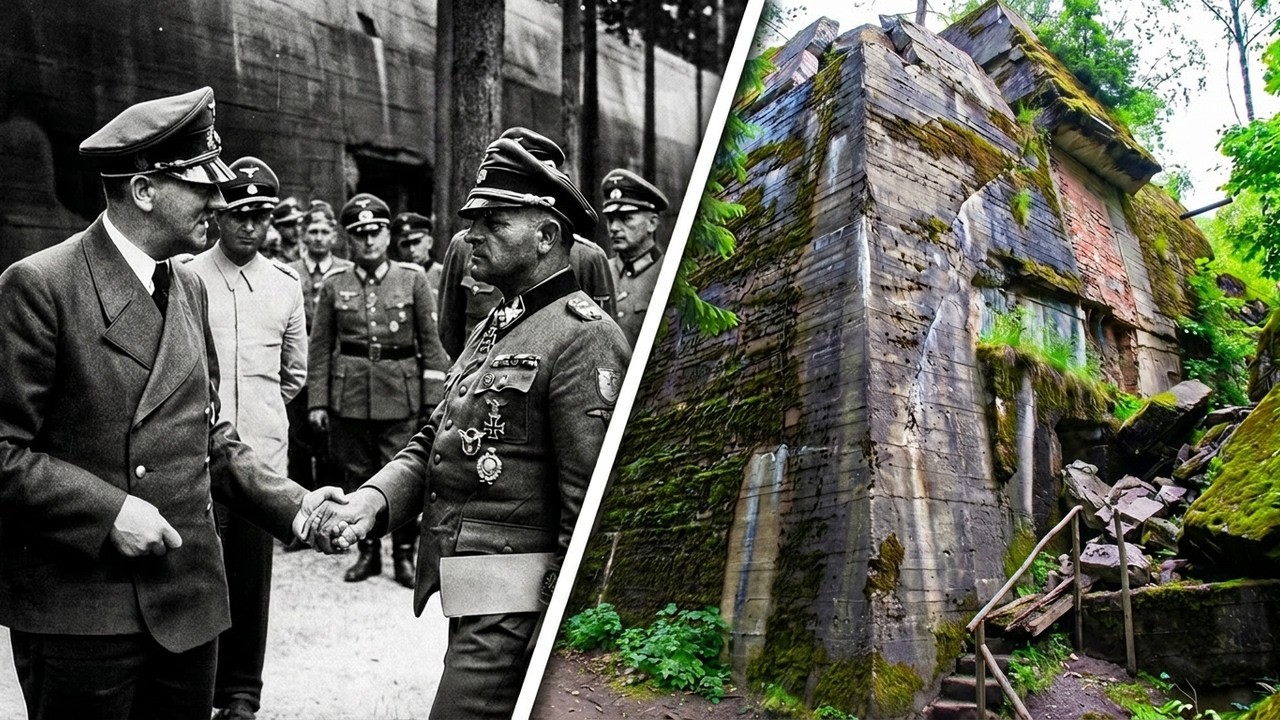
Deep inside the forest of East Prussia, beneath layers of reinforced concrete and steel, German engineers prepared the final act of the Wolf’s Lair.
For almost four years, this place had been the hidden heart of Nazi Germany’s war machine.
From these walls, Hitler had directed armies.
From these rooms, generals had planned offensives.
From this isolated compound surrounded by forests and swamps, decisions had been made that would reshape the world.
Now the same place was scheduled to disappear.
Snow covered the narrow roads leading into the complex.
The trees stood motionless.
The cold air carried the smell of smoke and fuel.
The once-busy headquarters had become strangely empty.
The endless movement of officers.
The sound of telephones.
The footsteps of messengers.
All gone.
Only a few soldiers remained.
Their mission was not victory.
Their mission was destruction.
Inside one of the massive bunkers, an engineer ran his hand across the concrete wall.
Nearly two meters thick.
Reinforced with steel.
Designed to withstand direct attacks.
He had helped build parts of this fortress years earlier.
Back then, everyone believed the Third Reich would last for generations.
Now he was preparing to bury it.
A younger soldier watched him.
“Will it work?”
The engineer did not answer immediately.
He looked around the bunker.
At the walls.
The ceiling.
The structure that represented years of German ambition.
Finally, he said:
“It has to.”
But even he did not sound convinced.
The Birth of the Wolf’s Lair
The Wolfsschanze — the Wolf’s Lair — was not simply a military base.
It was a world hidden inside another world.
Built in the forests near present-day Kętrzyn, Poland, the headquarters was designed for secrecy and protection.
From above, it disappeared among the trees.
From the ground, it looked like an ordinary military installation.
But beneath the surface was a massive complex.
Concrete bunkers.
Barracks.
Command buildings.
Communication centers.
Security checkpoints.
Thousands of people would eventually pass through the site.
Military officers.
Secretaries.
Bodyguards.
Engineers.
And one man whose presence changed the atmosphere wherever he went.
Adolf Hitler.
Hitler arrived at the Wolf’s Lair in June 1941.
The location had one main advantage:
Distance.
Far from Berlin.
Far from the public.
Hidden from enemy observation.
Here, surrounded by forests and barbed wire, Hitler could control his war from behind walls.
The place reflected his personality.
Suspicious.
Isolated.
Controlled.
Every entrance was guarded.
Every movement was monitored.
Every conversation could have consequences.
A Fortress Built Around Fear
The Wolf’s Lair was not only a headquarters.
It was a psychological space.
Inside those forests, Hitler surrounded himself with people who lived under constant pressure.
Generals waited for his decisions.
Staff members learned to read his moods.
Officers understood that disagreement could end careers.
The walls protected them from bombs.
But they could not protect them from the consequences of the decisions made inside.
One of the most famous moments in the Wolf’s Lair’s history came on July 20, 1944.
That afternoon, a briefcase containing explosives was placed beneath a conference table.
The man who brought it inside was Colonel Claus von Stauffenberg.
His plan was to kill Hitler and overthrow the Nazi leadership.
At 12:42 p.m., the bomb exploded.
The room was destroyed.
Several men were killed.
But Hitler survived.
The failed assassination attempt transformed the Wolf’s Lair into something even darker.
It became the scene of Hitler’s survival.
And the place where his revenge began.
January 1945 — The End Approaches
Six months later, the situation was completely different.
The Red Army was advancing from the east.
Germany’s eastern territories were collapsing.
The Nazi leadership was running out of options.
Hitler had already left the Wolf’s Lair months earlier.
The place that had once been the center of his power was now abandoned.
But before retreating, German authorities gave the final order.
Erase it.
The explosives were placed carefully.
The goal was not simply damage.
The goal was total destruction.
The Germans knew Soviet forces would arrive soon.
They did not want the enemy studying the construction.
They did not want the world walking through Hitler’s private fortress.
They wanted history itself to lose the evidence.
The countdown began.
Men moved away from the bunkers.
The forest became silent.
Then came the explosion.
A massive wave of force ripped through the complex.
Smoke rose above the trees.
The ground shook.
Windows shattered.
Concrete cracked.
For a moment, everyone believed the Wolf’s Lair was gone.
Destroyed.
Buried.
Forgotten.
But when the smoke cleared…
The bunkers were still standing.
Broken.
Damaged.
But alive.
The engineers had underestimated what they had built.
The walls designed to protect Nazi leadership had become stronger than the explosives meant to destroy them.
The Wolf’s Lair had survived.
The Soviet Arrival
Days later, Soviet soldiers entered the abandoned headquarters.
They walked through the ruins carefully.
The forest around them was quiet.
Too quiet.
They did not know what dangers remained beneath their feet.
The Germans had left behind something more dangerous than concrete.
They had left behind death.
Thousands of hidden mines.
Explosive traps.
Unmarked areas.
A final layer of destruction waiting long after the war ended.
A Soviet soldier stepped forward.
The ground beneath him looked ordinary.
Snow.
Mud.
Trees.
Nothing unusual.
That was the danger.
The most deadly things were often the ones people could not see.
The war had ended for many.
But around Hitler’s former headquarters, another battle was about to begin.
A battle fought not with armies…
but with men searching the earth centimeter by centimeter.
And for the people sent to clear the Wolf’s Lair…
the war was far from over.
Because beneath the ruins of Hitler’s secret headquarters waited more than 65,000 reasons to be afraid.
To be continued — Chapter 2: The Invisible War Beneath the Forest