Chapter 1 — The Man Who Entered War Without Becoming a Warrior
France, Western Front
Night — 1916
The first thing William Harold Coltman heard was not an order.
It was a scream.
Not the sharp cry of a soldier charging forward.
Not the roar of anger that came before battle.
A scream of pain.
A human voice disappearing into the darkness.
Coltman lay pressed against the cold earth inside a shell crater, his uniform soaked with mud and rain. Above him, the night sky flashed orange every few seconds as artillery shells exploded across the battlefield.
The ground moved beneath him.
The air smelled of smoke, burning metal, and blood.
Around him, men were dying.
Somewhere beyond the crater, wounded soldiers were calling for help.
“Medic!”
“Please!”
“Over here!”
Their voices came and went between explosions.
Coltman could hear them.
But he could not reach them.
Not yet.
Every instinct told him to stay down.
A man who stood up in that storm would become another body lying in the mud.
The bullets cutting through the darkness did not care about courage.
They did not care about kindness.
They did not care about who deserved to live.
They simply came.
William Coltman had entered the First World War like thousands of other young men.
With uncertainty.
With fear.
With the belief that he could do something meaningful.
But unlike many soldiers around him, Coltman carried a conflict inside himself before he ever reached the battlefield.
He did not believe he could take another human life.
Not because he lacked courage.
But because he believed life itself was sacred.
The Quiet Man From Burton-upon-Trent
Before the trenches.
Before the medals.
Before his name appeared in military records.
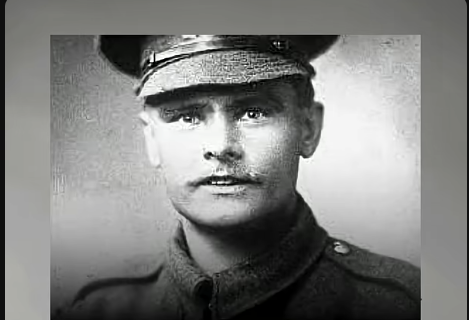
William Harold Coltman was simply a gardener.
Born in 1891 near Burton-upon-Trent, England, he grew up far away from military glory.
His world was soil.
Plants.
Seasons.
The slow rhythm of ordinary life.
He worked with his hands.
He knew the patience required to grow something.
A seed could not be forced to become a flower.
A damaged plant could not be healed by violence.
Nature taught him something he carried throughout his life:
Everything living had value.
Coltman was not the kind of man people imagined when they pictured a soldier.
He was small.
Quiet.
Gentle in manner.
He did not seek attention.
He did not dominate conversations.
People who knew him described him as someone who listened more than he spoke.
On Sundays, he taught children at his church.
The Plymouth Brethren community shaped much of his worldview.
Their teachings emphasized faith, humility, and nonviolence.
To Coltman, Christianity was not something to display.
It was something to practice.
Especially when it was difficult.
Then came 1914.
The world changed.
Across Europe, millions of young men were pulled into a war unlike anything before it.
Entire generations were sent toward battlefields filled with machine guns, artillery, and industrial destruction.
Like many others, Coltman felt the pressure to serve.
But his decision was complicated.
He did not hate his country.
He did not want to abandon people suffering because of war.
He simply could not accept killing.
When he volunteered, nobody gave him a special uniform.
Nobody recognized him as different.
He was issued the same equipment as everyone else.
Including a rifle.
The weapon rested in his hands.
Cold.
Heavy.
A symbol of what the army expected him to become.
A soldier.
A fighter.
A man trained to destroy.
But Coltman looked at it differently.
To him, the rifle represented a line he could not cross.
The Question No One Asked
The army had room for many types of courage.
But in 1914, the battlefield had one definition of bravery.
Advance.
Attack.
Defeat the enemy.
The man who saved lives was often invisible compared to the man who destroyed them.
A soldier who refused to fire could easily be misunderstood.
Some might call him weak.
Some might question his loyalty.
Some might believe he did not belong among fighters.
Coltman understood the risk.
But he also understood something else.
If everyone became willing to kill…
who would be left to save?
The Night Everything Changed
The battlefield eventually answered that question for him.
The shell crater.
The wounded men.
The voices calling through the darkness.
That night, Coltman faced a choice.
Stay hidden.
Survive.
Or stand up.
The next explosion shook the earth.
A man nearby cried out.
“Help me!”
Coltman closed his eyes.
For a moment, he imagined walking into the open.
He imagined the bullets.
The possibility of never returning.
Then he imagined the wounded soldier lying alone.
A man who had a name.
A family.
Someone waiting for him.
The decision was already made.
Coltman pushed himself upward.
The soldier beside him grabbed his sleeve.
“Where are you going?”
Coltman looked toward the darkness.
“To get them.”
The other man stared at him.
“You’ll be killed.”
Coltman tightened the strap of his medical equipment.
“Maybe.”
A shell exploded nearby.
The ground disappeared beneath smoke.
Then Coltman moved.
Not with a rifle.
Not with a weapon.
With bandages.
He crawled across the battlefield.
Every movement exposed him.
Every second invited death.
The same enemy fire that could destroy a man in combat could not stop him from reaching those who were already dying.
When he reached the first wounded soldier, he found a young man barely conscious.
The soldier looked up.
“Are you… carrying a gun?”
Coltman shook his head.
“No.”
The wounded man almost laughed.
“You’re mad.”
Maybe he was.
Maybe anyone who walked willingly into that nightmare without a weapon was impossible to understand.
But Coltman did not see himself as brave.
He saw a person who needed help.
That night became the beginning of something unexpected.
The army had sent William Coltman to war expecting him to become a soldier.
Instead, he became something else.
A man who walked toward danger while others ran from it.
A man whose courage would not be measured by enemies defeated…
but by lives saved.
Years later, historians would look at his record and find something extraordinary.
Military Medal.
Bar.
Distinguished Conduct Medal.
Another Distinguished Conduct Medal.
Victoria Cross.
The highest military honor Britain could award.
All earned by a man who never fired a shot in anger.
But before the medals…
Before Buckingham Palace…
Before the world knew his name…
There was only one question.
Could a man survive the deadliest battlefield in human history…
without ever becoming what the battlefield demanded?
And Coltman was about to discover the answer.
To be continued — Chapter 2: The Stretcher-Bearer Who Walked Into Hell