
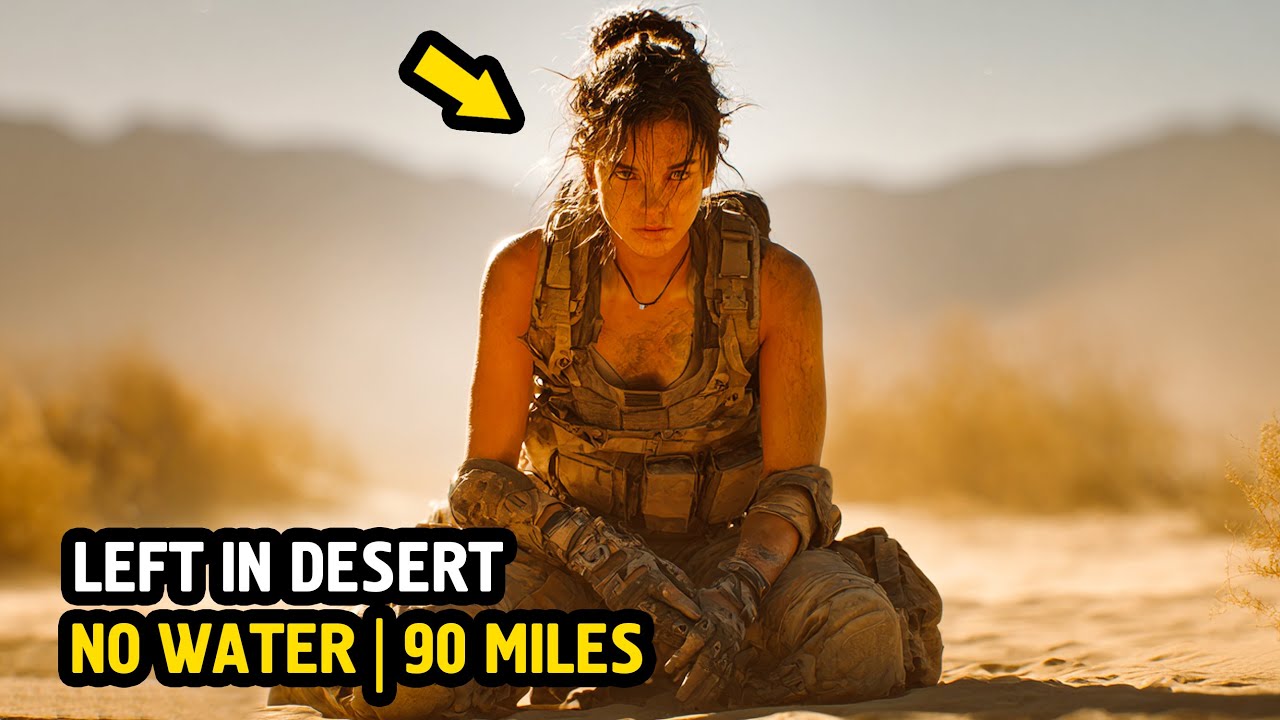
The men who abandoned Staff Sergeant Zoe Brooks in the Sonoran Desert made sure she had nothing.
No rifle.
No radio.
No boots.
Not even a canteen.
They tied her wrists with plastic restraints, pushed her from the back of a pickup, and watched her fall onto the burning gravel.
The cartel commander glanced at the white horizon, where the heat made the mountains appear to float above the earth.
“Walk north,” he told her. “America is that way.”
His men laughed.
The nearest road was more than sixty miles away.
The temperature had already passed 112 degrees.
Zoe lifted her face from the dust and looked at him without speaking.
That silence bothered him more than begging would have.
Three days earlier, she had been sitting inside a windowless briefing room at Davis-Monthan Air Force Base, studying satellite images of a fortified compound buried deep in the Sonoran Desert.
Special Agent Daniel Morrison stood at the front of the room.
He was the senior federal coordinator for Operation Dry Line, a joint mission targeting one of the Salazar cartel’s largest fentanyl distribution hubs.
Morrison enlarged a satellite photograph on the screen.
The compound looked like an abandoned mining facility surrounded by rusted fences, fuel tanks, and low concrete buildings.
It was anything but abandoned.
“Our best estimate is forty-two armed personnel,” Morrison said. “Possibly more underground. Belt-fed weapons on the east and west approaches. Vehicle-mounted guns near the southern gate.”
He clicked to the next image.
Aerial photography showed three American hostages being moved between buildings.
Two were undercover agents.
The third was a civilian communications engineer who had disappeared while repairing equipment near Nogales.
Morrison paused before displaying the final slide.
Rows of plastic drums filled a warehouse.
“Enough precursor chemicals and finished product to put several million lethal doses into circulation.”
Nobody spoke.
At the far end of the table sat Lieutenant Colonel David Kaine, the Delta Force team leader assigned to the operation.
Kaine was in his late forties, with gray beginning to show at his temples and the stillness of a man who had spent most of his adult life making decisions under pressure.
Beside him were the operators selected for the mission.
Master Sergeant Marcus Washington would handle communications and battlefield coordination.
Sergeant First Class Jennifer Martinez was the team medic.
Two others specialized in mobility and technical entry.
Zoe Brooks was the youngest person at the table.
She was thirty-one, quiet, and small enough that people who did not know her often assumed she had wandered into the wrong room.
She had not.
Zoe had grown up outside Tucson, where her father worked as a hydrologist and her mother served as a county emergency nurse. She had spent her childhood learning that the desert was never empty.
It was simply unforgiving toward people who failed to pay attention.
While everyone else studied guard positions, walls, and weapon systems, Zoe kept looking beyond the compound.
Then she raised her hand.
“Where do they get their water?”
Morrison stopped.
A contractor seated near the door gave a faint smile, as if she had asked about the cafeteria menu.
Morrison looked back at the image.
“There are tanks near the north building.”
“Those are storage tanks,” Zoe said. “Where are they being filled?”
One of the analysts opened a folder.
“Truck deliveries, probably.”
“No tire patterns,” Zoe replied.
The room went silent again.
She stood and walked toward the screen.
“The southern road shows constant vehicle traffic. The northern access trail doesn’t. But the tanks are on the north side.”
She pointed to a faint line running from the compound toward a dry ridge.
“There’s either a buried pipe or an old well system.”
Morrison zoomed in.
The line was barely visible.
Kaine leaned forward.
Zoe continued.
“Forty or fifty people cannot stay at that facility without a dependable water source. Fuel can be rationed. Ammunition can be stored. Water controls everything.”
The contractor near the door finally spoke.
His name was Bryce Harlan, a private security adviser who had worked with Morrison’s task force for nearly a year.
“We’re not conducting a geology survey,” Harlan said. “We’re rescuing hostages.”
Zoe looked at him.
“In this environment, those are the same mission.”
Harlan’s smile disappeared.
After the briefing, Kaine found Zoe alone in the corridor, studying a printed topographic map.
“You don’t like the plan,” he said.
“I don’t like what isn’t on the map.”
Kaine waited.
Zoe traced a dry wash with one finger.
“They know we can see the roads. They know we can see the guard towers. But if the water comes from that ridge, the real infrastructure is underground.”
“You think there’s another entrance.”
“I think there could be.”
Kaine looked through the glass at Morrison and Harlan, who were speaking with two intelligence officers.
“What else?”
Zoe hesitated.
“The compound is too visible.”
“For a cartel hub?”
“For the most important cartel hub in the region.”
Kaine studied her face.
“So what are we looking at?”
“A shield,” she said. “Not the center.”
That evening, a reconnaissance drone confirmed part of her suspicion.
A thermal scan revealed a narrow underground channel running from the northern water tanks toward the ridge.
But Morrison refused to delay the operation.
Intelligence suggested the hostages would be moved within twenty-four hours.
The mission launched before midnight.
Two unmarked helicopters carried the Delta team low across the desert, following valleys and dry riverbeds to avoid detection.
They landed more than twelve miles from the compound.
The team moved on foot beneath a moonless sky.
At 2:18 a.m., Zoe located the buried water line.
It was an old steel pipe, patched in several places and covered with less than two feet of soil.
She followed it toward the ridge until she found a maintenance hatch concealed beneath a sheet of weathered metal.
Kaine crouched beside her.
“Good call.”
Harlan, who had insisted on accompanying the mission as a liaison, examined the opening.
“This isn’t on the satellite package.”
“No,” Zoe said. “It isn’t.”
The tunnel beyond the hatch was narrow and smelled of rust and minerals.
It led beneath the ridge, then descended toward the compound.
The team entered without triggering the perimeter alarms.
For the first twenty minutes, everything went according to plan.
Two guards were quietly detained.
The surveillance room was secured.
Martinez found the hostages locked inside a storage chamber beneath the main warehouse.
Then Marcus intercepted a burst of radio traffic.
“Movement outside,” he whispered. “Multiple vehicles approaching from the west.”
Kaine checked the time.
The convoy was not supposed to arrive until the following afternoon.
Harlan looked immediately at Morrison’s field representative.
“Someone changed the schedule.”
“No,” Zoe said.
She was examining the underground layout.
“They didn’t change it. They were waiting.”
Before anyone could answer, the power went out.
Emergency lights flashed red.
Metal shutters slammed across the tunnel entrances.
Gunfire erupted above them.
The compound had not been surprised.
The team had been invited inside.
Kaine divided the group.
Martinez and two operators moved the hostages toward the maintenance tunnel.
Marcus attempted to restore communications.
Zoe and Kaine covered the northern corridor.
Harlan stayed close to the rescued engineer.
Too close.
When Zoe glanced back, she saw Harlan gripping the engineer’s shoulder and whispering into his ear.
Then she noticed something else.
Harlan’s radio was still working.
Everyone else had lost contact.
“Harlan,” she said.
He turned.
For one second, neither of them moved.
Then he drew his pistol.
Zoe knocked the weapon aside as it fired.
The shot struck a light fixture.
Kaine lunged toward them, but an explosion tore through the corridor and threw everyone to the floor.
Cartel gunmen poured through a concealed door.
The fight lasted less than three minutes.
Kaine’s team reached the tunnel with the hostages, but Zoe was cut off behind a steel barrier.
Her last transmission reached Marcus through a backup channel.
“Move them. Don’t stop.”
Then the signal disappeared.
Kaine wanted to go back.
The hostages were injured, enemy vehicles were closing from three directions, and the extraction window was collapsing.
He made the decision every commander fears.
He ordered the team to withdraw.
Zoe woke with blood in her mouth and her hands bound behind her.
Harlan stood over her.
His expensive field shirt was torn at the shoulder, but he appeared otherwise unharmed.
Beside him was Emiliano Varga, the Salazar cartel commander responsible for the desert facility.
Varga had a narrow face, polished boots, and the calm arrogance of someone who had paid enough people to believe consequences no longer applied to him.
“You noticed the water,” Varga said.
Zoe said nothing.
“You noticed the tunnel. You noticed our convoy.”
He crouched in front of her.
“But you did not notice your own man.”
Harlan folded his arms.
“I warned them you were observant.”
Zoe finally looked at him.
“You gave them the hostage schedule.”
“I gave them more than that.”
Harlan had been feeding intelligence to Varga for eleven months.
He had redirected surveillance flights, altered threat assessments, and arranged raids against empty warehouses while the cartel moved fentanyl through protected corridors.
The compound had been designed as a trap.
The captured Americans were bait.
But Harlan had made one mistake.
He had assumed Zoe’s question about water was merely clever.
He had not understood what she had discovered beneath the ridge.
Varga’s men interrogated her until sunrise.
She gave them nothing.
By midmorning, Varga decided that killing her with a bullet would be too merciful.
His men drove her deep into the desert.
They removed her boots because the ground was covered with sharp volcanic rock.
They emptied their water onto the sand in front of her.
Then they cut the restraints from her ankles but left her wrists bound.
“Walk north,” Varga said.
The pickup disappeared in a cloud of dust.
Zoe remained on her knees until the engine could no longer be heard.
Then she stood.
She did not walk north.
She turned west.
At the extraction point, Kaine’s team was furious.
The hostages were alive, but Morrison refused to authorize an immediate rescue attempt.
“We have no confirmed location,” he said through the secure video link. “No aircraft until we know the compound’s air defenses.”
“We left one of ours behind,” Kaine replied.
“I understand that.”
“No. You understand the sentence. You don’t understand what it means.”
Morrison looked exhausted.
Before he could respond, Marcus interrupted.
“I’ve got something.”
He placed an audio file on the screen.
It was Zoe’s final transmission.
At first, there was only static and gunfire.
Then her voice came through.
“Move them. Don’t stop.”
Marcus replayed it.
This time, he isolated a sound underneath her voice.
Three short metallic taps.
A pause.
Two taps.
Another pause.
Three taps.
Kaine’s expression changed.
“What is that?” Morrison asked.
Marcus looked at him.
“A location marker.”
During the firefight, Zoe had struck her weapon against the water pipe.
She was not simply telling them to leave.
She was marking the section of pipeline where she had been captured.
Kaine pulled up the terrain map.
The pipe continued west beneath the ridge, splitting into two branches.
One ran toward the visible compound.
The other disappeared beneath a dry basin nearly eight miles away.
Zoe had been right from the beginning.
The fortified facility was not the hub.
It was the shield.
The real production site was underground, concealed beneath the basin and supplied by the same water network.
Morrison stared at the map.
“Harlan knew we’d raid the decoy.”
“And Zoe knew he’d have to take her near the real site,” Kaine said.
The realization settled over the room.
She had not failed to escape.
She had allowed them to believe they were moving her beyond reach.
In the desert, Delta Force did not teach operators merely to endure heat.
They learned to read terrain as information.
Wind direction.
Animal movement.
The color of soil.
The way moisture gathered beneath stone.
The way human beings, no matter how careful, built patterns around the things they could not live without.
Especially water.
Zoe moved only during the cooler hours.
She broke the plastic restraint by grinding it against a jagged piece of basalt until her wrists bled.
She wrapped her feet with strips torn from her shirt.
She did not waste energy climbing ridges for a better view.
She followed the shallow depressions where desert plants grew slightly greener than the surrounding brush.
Near sunset, she found a line of ants disappearing beneath a rock.
Under it, the soil was damp.
Not enough to drink.
Enough to confirm direction.
The buried pipeline was close.
By midnight, she reached a pressure valve protruding from the ground behind a cluster of mesquite.
The valve had been recently serviced.
Fresh tool marks shone against the metal.
Zoe loosened the maintenance cap just enough for water to leak into the cloth of her sleeve.
She drank slowly.
Then she tightened it again.
At dawn, she climbed a low rise and saw vehicle tracks below.
They did not lead toward the border.
They led into a dry lakebed and vanished.
An underground entrance.
Varga’s real facility.
Zoe waited among the rocks until a maintenance truck approached.
The driver stepped out to inspect a sensor post.
He never saw her move behind him.
Minutes later, Zoe had his boots, his radio, and a folding knife.
She did not enter the hidden compound.
She did something more valuable.
She climbed the highest point she could reach, opened the stolen radio, and transmitted a six-second burst on an emergency frequency Marcus monitored.
No words.
Just coordinates.
The signal reached Kaine’s team at 6:42 a.m.
By then, Morrison had obtained authorization for a second operation.
This time, Harlan was no longer controlling the intelligence.
The assault began before sunrise the following day.
Cartel guards rushed to defend the visible compound, believing the Americans had returned for revenge.
They did not realize Kaine’s team was approaching from beneath the dry basin.
The underground production site was secured in less than forty minutes.
Federal agents seized hundreds of kilograms of finished fentanyl, chemical records, financial ledgers, and encrypted communications identifying officials Harlan had bribed.
Varga attempted to escape through the water tunnel.
He emerged from a maintenance hatch and found Zoe standing on the other side.
She was wearing borrowed boots and carrying the rifle of one of his guards.
For the first time since meeting her, Varga had nothing to say.
His eyes moved from the weapon to the bloodied cloth around her wrists.
Then he looked past her.
Kaine, Marcus, and Martinez stood along the ridge.
More agents were climbing from the basin behind them.
Varga’s shoulders dropped.
His mouth opened slightly, but no sound came out.
The desert commander who had laughed while pouring water into the sand finally understood.
He had not abandoned a helpless prisoner.
He had released a trained operator into the one environment she understood better than he did.
Harlan was arrested three hours later while attempting to cross into Mexico using documents provided by the cartel.
At his arraignment, he avoided looking toward the Delta team seated behind the prosecutors.
But when Zoe entered the courtroom, his face changed.
The confidence left first.
Then the color.
He stared at the scars around her wrists and lowered his eyes to the table.
He knew exactly how close he had come to burying the truth with her in the desert.
He also knew why he had failed.
Harlan had believed training was about weapons.
Varga had believed power was about fear.
Both men had underestimated the quiet woman who kept asking where the water came from.
The operation dismantled the Salazar network across three states. The evidence recovered beneath the dry lakebed led to dozens of arrests, including customs officials, transport contractors, and two federal employees who had protected the route.
The rescued hostages returned home.
Morrison later admitted during an internal review that the entire mission had turned on a question no one else in the briefing room had thought to ask.
Where do they get their water?
Months later, a new group of operators gathered for desert training outside Arizona.
Zoe stood in front of them with a topographic map folded beneath her arm.
She did not tell them how far she had walked.
She did not mention the heat, her injuries, or the men who had assumed she would die alone.
She pointed toward the empty horizon.
“What do you see?” she asked.
One soldier mentioned the ridgeline.
Another identified possible cover.
A third estimated the distance to the nearest road.
Zoe waited.
Finally, someone near the back studied the scattered vegetation and said, “There’s water underground.”
Zoe nodded.
Because the most dangerous person in the room is rarely the loudest, the strongest, or the one with the highest rank.
Sometimes, it is the person everyone ignored—until survival depended on the question only they were smart enough to ask.