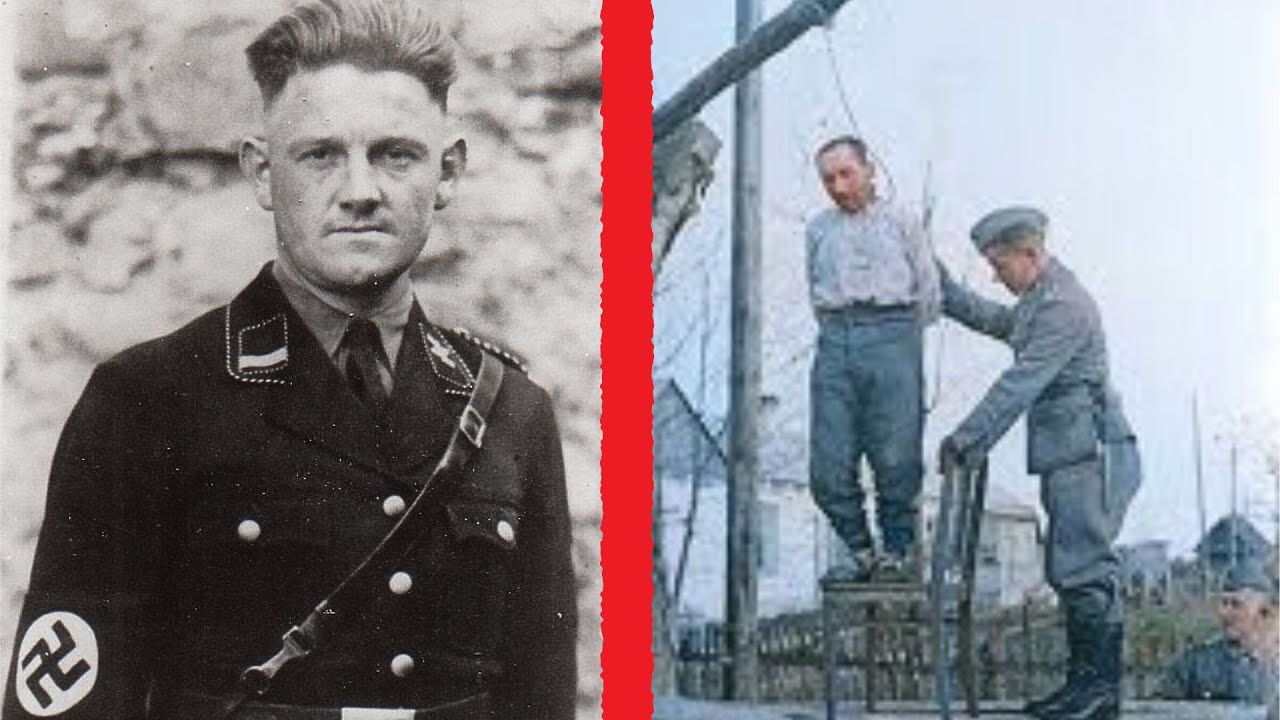
When British soldiers entered Bergen-Belsen on April 15, 1945, they could not immediately tell which prisoners were alive.
Bodies lay beside barracks, along paths, and in open spaces across the camp. Inside the huts, men and women reduced to skin and bone stared back at the soldiers. Disease was everywhere. The smell reached the liberators before they understood what they were seeing.
Among those skeletal prisoners stood a well-fed German man wearing clothes intended to make him look like one of them.
His name was Franz Hössler.
Only days earlier, he had been deputy commandant of the camp. Now, with the Third Reich collapsing around him, he had abandoned the uniform that once gave him the power to decide who would work, who would starve, and who would die.
He believed a change of clothes could erase twelve years of service in the SS.
But Hössler had made a fatal miscalculation.
He had chosen to hide in the one place filled with people who knew exactly what his face meant.
The prisoners he had treated as numbers still remembered him.
And this time, they were no longer standing behind electrified wire without a voice.
Franz Hössler had not begun life as a powerful man.
Born in 1906 in the Bavarian village of Oberdorf, he was the son of a foreman. He left school early, trained as a photographer, worked in a warehouse, and eventually became unemployed during the economic crisis that devastated Germany.
There was nothing in his childhood that marked him as a future mass murderer.
No inherited title. No exceptional education. No distinguished military career.
He was ordinary.
And that was precisely what made his transformation so frightening.
In the early 1930s, Germany was filled with men who felt humiliated, overlooked, and powerless. The Nazi movement offered them something intoxicating: a uniform, a rank, an enemy to blame, and permission to feel important.
Hössler joined the Nazi Party and the SS as Hitler’s movement approached power.
In 1933, he was sent to Dachau, one of the first concentration camps established by the Nazi regime. His earliest duties were unremarkable. He worked among the guard staff and later served as a cook.
A man preparing meals did not look like an architect of terror.
But the concentration-camp system did not require every participant to arrive as a fanatic. It trained men through repetition. It rewarded obedience. It made cruelty routine and then promoted those who performed it efficiently.
Hössler learned quickly.
He discovered that inside the SS, compassion slowed a career while compliance advanced it.
The cook began climbing.
In June 1940, Hössler was transferred to the newly established Auschwitz concentration camp.
At first, he again worked in practical roles involving kitchens, labor assignments, and camp administration. But at Auschwitz, administration was never separate from violence.
A food ration could determine whether a prisoner lived another week.
A work assignment could be a temporary reprieve or a death sentence.
A name placed on a transport list could send a human being beyond the camp gates and into a killing facility.
By 1941, Hössler was no longer standing behind a stove.
On July 28 of that year, he accompanied 575 sick and disabled Auschwitz prisoners to the Sonnenstein killing center. They had been selected under a Nazi program that targeted prisoners considered unable to work.
The language surrounding the transport was bureaucratic.
The destination was murder.
The prisoners were transported away and killed by gas.
Hössler returned to Auschwitz and continued serving.
There is no record that the deaths of those 575 people ended his loyalty to the system. There is no evidence that he resigned, requested a transfer, or refused the next assignment.
Instead, his responsibilities grew.
In June 1942, Hössler was involved with other SS personnel in the killing of 168 prisoners connected to an attempted revolt in Auschwitz’s penal company.

By then, he was no longer a low-ranking functionary being introduced to the camp’s violence.
He had become one of the men trusted to carry it out.
Later that year, the SS faced a problem.
The mass graves around Auschwitz contained evidence.
More than one hundred thousand corpses had been buried in pits. As Nazi leaders expanded their extermination program, they also began worrying about what advancing armies—or future investigators—might discover.
The bodies had to disappear.
From September to November 1942, a prisoner unit that became associated with Hössler’s name was forced to open mass graves and burn the remains. Historical accounts attribute the exhumation and destruction of approximately 107,000 bodies to this operation.
The prisoners assigned to such work did not volunteer.
They labored under armed guard, surrounded by the physical evidence of mass murder, knowing they could be killed once they had completed the task.
This was not merely an attempt to dispose of the dead.
It was an attempt to destroy the truth.
Hössler’s role had evolved again. He was no longer simply helping operate a camp in which people died. He was helping erase proof that they had ever lived.
The photographer from Bavaria had become a supervisor in the destruction of memory itself.
In August 1943, Hössler received one of his most powerful positions.
He became a leader of the women’s compound at Auschwitz-Birkenau.
The title sounded administrative. In practice, it gave him authority over thousands of terrified women whose survival depended on decisions made during inspections and selection parades.
The prisoners were ordered to stand in lines.
SS doctors and camp officials walked past them.
Those considered strong enough to work were sent in one direction. The sick, the exhausted, mothers with children, and others judged “unfit” could be sent toward the gas chambers.
Witnesses later testified that Hössler participated in these selections.
One survivor, Helene Klein, described being selected in January 1944. According to the trial record, she tried to hide before her number could be written down. When she appealed to Hössler, he responded with chilling familiarity:
“You have lived long enough. Come, my child.”
She escaped before her number was recorded.
Others did not.
Another survivor testified that Hössler took her mother from her during a selection and sent her to the gas chamber.
Anita Lasker, a young Jewish cellist imprisoned first at Auschwitz and later at Bergen-Belsen, told the British military court that she had seen Hössler, Josef Kramer, and camp doctor Fritz Klein taking part in gas-chamber selections.
These were not distant accusations made by people who knew Hössler only through rumor.
They were memories from women who had stood close enough to hear his voice.
What survivors remembered most was not always shouting or uncontrolled rage.
It was the calmness.
Hössler could stand at a selection as though he were organizing a work schedule. A gesture, a glance, or a number written down could separate a woman from her mother forever.
The machinery of Auschwitz depended on men capable of doing this without interrupting their day.
Hössler fitted that machinery perfectly.
Photographs taken by SS personnel in 1944 reveal another world existing only a short distance from the killing facilities.
At the Solahütte retreat near Auschwitz, senior SS men gathered to relax. They smiled, sang, drank, and listened to accordion music. Among them were some of the most important figures in the Auschwitz camp system.
Franz Hössler stood with them.
The photographs are disturbing not because the men appear monstrous, but because they do not.
They look like colleagues enjoying an afternoon away from work.
That was the hidden strength of the system Hössler served. Its participants could supervise starvation and selection, then sit together for refreshments. They had learned to place murder inside one compartment of the day and ordinary social life inside another.
To them, the victims had become an administrative category.
To the victims, Hössler’s face was unforgettable.
By January 1945, the world around him was collapsing.
The Red Army was approaching Auschwitz. The SS began evacuating the camp, forcing prisoners westward in brutal winter conditions.
Hössler was transferred to Mittelbau-Dora, a concentration-camp complex where prisoners were exploited as slave laborers in underground weapons production.
The setting had changed.
The method had not.
Prisoners worked in tunnels under appalling conditions, deprived of adequate food, sleep, sanitation, and medical care. Men too weak to remain useful were discarded by a system that measured human value in units of labor.
Hössler again held a senior protective-custody position.
He had now served at Dachau, Auschwitz, and Mittelbau-Dora. Each transfer gave him another opportunity to step away.
Each time, he continued.
On April 5, 1945, as American forces drew closer, Hössler helped lead the evacuation of prisoners from the Dora complex toward Bergen-Belsen.
Some were moved by rail. Others were forced to march during the final stages.
Prisoners who had already survived forced labor, beatings, hunger, and disease were driven onward while the regime responsible for their suffering disintegrated.
Many never reached the destination.
Hössler did.
On April 8, he arrived at Bergen-Belsen and became deputy commandant under Josef Kramer.
Bergen-Belsen was no longer functioning as an organized camp in any meaningful sense.
It had become a human catastrophe.
Transports from evacuated camps had flooded the site with prisoners. Food supplies had broken down. Clean water was scarce. Sanitation had collapsed. Typhus and other diseases spread rapidly through overcrowded barracks.
People died so quickly that the SS could not bury them.
Corpses accumulated in the open.
Yet the guards still possessed weapons. They still controlled food. They still issued orders to people who were barely able to stand.
The German military position was hopeless, but the camp hierarchy remained intact until the final hours.
For men like Hössler, power had become a habit.
Then British troops arrived.
The transformation was immediate.
The gates that had kept prisoners inside now kept SS personnel from escaping. The men and women who had issued commands were disarmed. Cameras began recording the conditions the Nazis had failed to conceal.
Hössler understood what those images would mean.
He also understood what the survivors could say.
So he tried to disappear.
He removed the appearance of authority and concealed himself among the prisoners in camouflaged or prisoner-like clothing.
For years, he had relied on cloth, insignia, and armed guards to separate himself from the people he controlled. Without them, he apparently believed he could become anonymous.
That was his final mistake.
He thought prisoners saw only the uniform.
He did not understand that they had memorized the man inside it.
The reliable historical record establishes that Hössler was discovered hiding among prisoners and taken into British custody. Later retellings add different details about precisely what he wore, but the essential fact remains: his disguise failed.
He had spent years treating people as if they had no identities.
Now their memories gave his identity back to him.
After his arrest, Hössler was forced with other detained SS personnel to confront what they had left across Bergen-Belsen.
Under British guard, they carried bodies and buried them in mass graves.
The reversal was visible to everyone.
Only days earlier, Hössler had been a deputy commandant. Prisoners had been required to move when he ordered them to move and stop when he ordered them to stop.
Now British soldiers gave the orders.
The prisoners watched.
Hössler could no longer delegate the evidence to a Sonderkommando or hide it beneath earth and ash. The bodies were in front of him. Cameras were operating. The world was looking.
The man who had helped supervise the destruction of evidence at Auschwitz was now being photographed clearing evidence at Bergen-Belsen.
No disguise could undo that image.
In September 1945, Hössler entered a converted gymnasium in Lüneburg for the first Bergen-Belsen trial.
Forty-five defendants faced a British military court. They included SS officers, guards, female overseers, doctors, and prisoner functionaries accused of participating in crimes at Bergen-Belsen and Auschwitz.
The legal charge was war crimes against Allied nationals. The proceedings lasted 54 court days, from September 17 to November 17.
The trial drew journalists and observers from across the world.
For many people outside occupied Europe, it was one of the first occasions on which the internal workings of Auschwitz were described publicly by survivors.
Film from Bergen-Belsen was presented as evidence—a groundbreaking use of recorded images in a war-crimes proceeding.
Hössler could no longer reduce his victims to numbers on a list.
They entered the courtroom with names.
They pointed toward the dock.
They described the selection parades.
They described relatives taken from them.
They described the man who had stood beside the doctors while decisions of life and death were made.
Hössler tried to rebuild himself as a reluctant subordinate.
He admitted attending selection parades but claimed he had not personally made the selections. He said doctors had chosen the victims while he had merely ensured that prisoners remained guarded.
He insisted that he had objected when first ordered to attend.
He even claimed that he had saved hundreds of people by falsifying records.
It was a remarkable defense.
The man who had risen through the camp system portrayed himself as someone without meaningful power. The officer trusted with senior positions across multiple camps claimed he had been little more than a witness.
But the survivors remembered his actions.
And his career told its own story.
One accidental assignment might be explained away.
One brief appearance at a selection might be denied.
But Hössler had remained inside the concentration-camp system from 1933 until its final collapse. He had advanced from Dachau to Auschwitz, from Auschwitz to Dora, and from Dora to Bergen-Belsen.
Again and again, the system had selected him.
And again and again, he had accepted.
The court rejected the version of Hössler that he tried to present.
The moment of recognition did not arrive as an apology.
No great confession is preserved in the record.
There was only a reversal of power.
Hössler sat while former prisoners spoke.
He listened while the machinery he had served was described in public.
He could not stop them. He could not remove them from the courtroom. He could not send them to another block or make their numbers disappear.
The silence itself became the moment.
The people he had expected to vanish were alive.
The Reich he had expected to endure was gone.
And the uniform that once protected him had become evidence against him.
On November 17, 1945, the court sentenced Franz Hössler to death by hanging.
Less than a month later, on December 13, he was taken to the gallows at Hamelin Prison. Britain’s chief executioner, Albert Pierrepoint, carried out the sentence.
Ten other defendants condemned in the Belsen trial were executed that day, including Josef Kramer, Fritz Klein, Irma Grese, Elisabeth Volkenrath, and Johanna Bormann.
The procedure was controlled, recorded, and lawful.
It bore no resemblance to the selections Hössler had attended, where frightened prisoners were given no charge, no defense counsel, no witnesses, and no appeal.
At Auschwitz, he had helped decide death in seconds.
At Lüneburg, evidence was heard for weeks.
That difference mattered.
Franz Hössler’s execution could not restore a single mother taken from her daughter.
It could not return the 575 prisoners transported to Sonnenstein.
It could not rebuild the lives destroyed at Auschwitz, Dora, or Bergen-Belsen.
Justice after mass murder is always incomplete because punishment cannot reverse the crime.
But his conviction accomplished something the Nazi system had worked desperately to prevent.
It created a record.
The bodies the SS tried to burn became evidence.
The prisoners the SS tried to silence became witnesses.
The man who tried to hide became a defendant known by name.
Hössler’s life remains a warning because he did not enter history as an extraordinary monster. He entered as an unemployed photographer, accepted a minor position, followed the incentives of a criminal institution, and allowed each act of obedience to prepare him for the next.
He was not powerless.
He repeatedly chose the side that gave him power.
And when that power disappeared, he tried to borrow the appearance of the people he had persecuted.
But clothes could not erase memory.