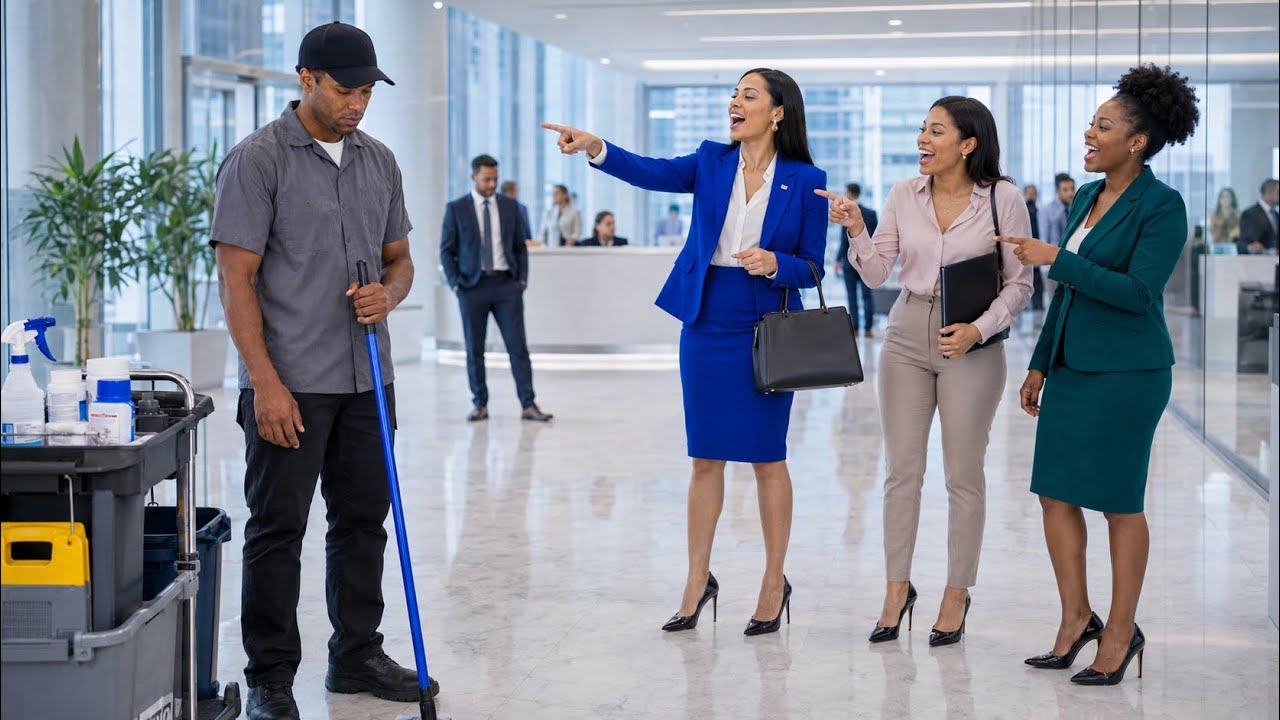
The Billionaire’s Son Disguised Himself as a Janitor to Find Out Who Deserved His Trust—Only One Woman Passed the Test
Every morning at 6:15, Devon pushed a gray cleaning cart through the marble lobby of Caldwell Group.
His uniform was faded. His name badge had no last name. His cap sat low enough to hide most of his face.
Hundreds of employees walked past him on their way to glass offices thirty floors above.
Almost none of them looked at him.
That was exactly what Devon wanted.
At 9:00 each morning, the atmosphere changed.
Conversations became quieter. Backs straightened. Assistants checked their schedules twice.
Morgan Caldwell had entered the building.
Morgan was the founder and CEO of Caldwell Group, a multinational logistics and infrastructure company employing more than 18,000 people.
She had built it after her husband died unexpectedly, leaving her with a six-year-old son, a struggling regional business, and more debt than anyone outside the family knew.
Advisers told her to sell.
Competitors predicted she would fail.
One newspaper columnist described her as “a grieving widow attempting to run a company beyond her experience.”
Morgan framed that article and kept it in the bottom drawer of her desk.
Over the next twenty years, she expanded the company into seven countries.
She negotiated with governments, survived two recessions, and once removed an entire executive team after discovering they had hidden safety violations from her.
People called her ruthless.
Those who knew her well understood something different.
Morgan was not afraid of difficult decisions because life had already made the hardest one for her.
She had raised Devon alone.
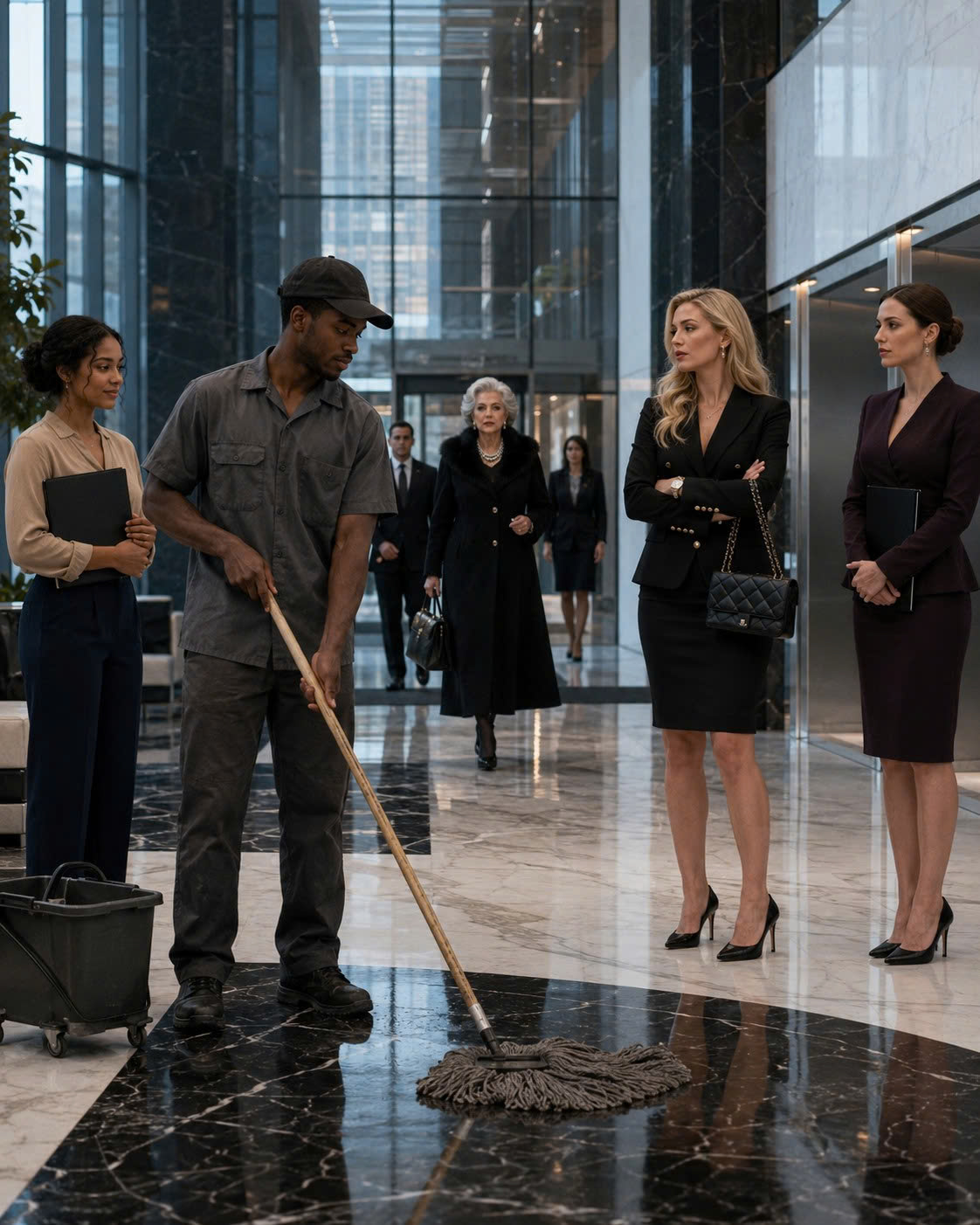
And despite everything she had built, she considered him her greatest achievement.
Devon was intelligent, calm, and unusually observant. He had spent three years studying organizational leadership overseas and had recently returned home to prepare for a future role at Caldwell Group.
Morgan knew he was ready for responsibility.
What concerned her was everything that came with his name.
The moment people learned he was Devon Caldwell, they became kinder, funnier, and more interested in whatever he had to say.
Women who had never noticed him suddenly found reasons to stand near him.
Executives who dismissed his ideas in private praised them when Morgan entered the room.
Devon could see the performance.
But Morgan wanted him to understand how deep it went.
One evening, she sat in her office with Rita Hayes, her executive assistant of sixteen years.
Three personnel files rested on the desk between them.
Brianna Cole worked in compliance. She was quiet, dependable, and rarely mentioned in meetings unless something went wrong and she was needed to fix it.
Kylie Mercer worked in corporate communications. She was charismatic, polished, and capable of making a room pay attention within seconds.
Jordan Lee was a strategy analyst. She was careful, courteous, and skilled at learning what powerful people wanted before they said it aloud.
Morgan had watched all three women for months.
Not during presentations or performance reviews.
She watched how they spoke to drivers, receptionists, interns, and catering staff.
“People show you their résumé when they want something,” Morgan told Rita. “They show you their character when they think no one important is watching.”
Over the next week, Morgan invited each woman into her office separately.
Brianna arrived first.
She sat with both hands folded in her lap and listened as Morgan explained that Devon had returned from overseas.
“I’ve noticed your work,” Morgan said. “And I’ve noticed the way you carry yourself. I believe you and my son might enjoy meeting.”
Brianna’s expression changed, but not in the way Morgan expected.
She looked uncomfortable.
“I’m honored that you would think highly enough of me to suggest that,” Brianna said carefully. “But I don’t know your son. I wouldn’t want to imagine a connection just because of who his family is.”
Morgan studied her.
“You’re not interested?”
“I’m interested in meeting good people,” Brianna replied. “I just don’t think anyone should decide what a relationship means before two people have even spoken.”
Morgan thanked her and asked her to keep the conversation private.
After Brianna left, Morgan wrote one word in her notebook.
Grounded.
Kylie arrived the following afternoon wearing a cream suit and a confident smile.
When Morgan mentioned Devon, Kylie leaned forward.
“I’ve heard wonderful things about him.”
Morgan knew that was unlikely. Devon had never worked publicly at the company.
Still, Kylie continued.
“I think it’s incredibly thoughtful of you to consider me. I’d be delighted to meet him.”
Within an hour, Kylie was standing beside the elevators telling a colleague she might soon have “a much more personal connection to the Caldwell family.”
By the end of the week, she had joked twice about becoming “the future Mrs. Caldwell.”
Morgan added a word to her notebook.
Eager.
Jordan was more controlled.
She thanked Morgan, said she respected Devon’s privacy, and promised not to make assumptions.
It was nearly a perfect response.
But twenty minutes after leaving the office, Jordan stopped by Rita’s desk.
“Just so I can avoid an awkward situation,” she said, lowering her voice, “do you know when Devon officially starts?”
Rita said she did not.
Jordan smiled and walked away.
That evening, she searched the company travel system, reviewed executive-floor visitor records, and asked an analyst whether any leadership announcements were being prepared.
Morgan wrote:
Strategic.
When Devon heard what had happened, he did not want a formal introduction.
“Anyone can behave well at dinner with the CEO’s son,” he told his mother. “Let me meet them when they think I can do nothing for them.”
Morgan called Caleb Ross, the company’s head of operations.
Within forty-eight hours, Devon had become a temporary member of the night-and-morning cleaning team.
Only Morgan, Caleb, and Devon knew.
Mr. Price, the facilities supervisor, treated him like every other new employee.
“You’re late twice, you’re gone,” he said. “You leave chemicals unsecured, you’re gone. You damage equipment and hide it, you’re gone.”
Devon nodded.
“Understood.”
His first lesson came before sunrise.
Cleaning was not simple work.
It required timing, physical endurance, attention to detail, and the ability to move through crowded spaces without interrupting anyone.
By 8:30, Devon’s back hurt.
By 10:00, he understood why the cleaning staff wore supportive shoes.
By noon, he had learned how many people could drop something three feet from a trash can and continue walking without looking back.
One executive finished a coffee, set the empty cup on Devon’s cart, and walked away while Devon was holding a full garbage bag.
Another employee stepped over a wet-floor sign, left muddy prints across a freshly cleaned area, and complained that the lobby looked untidy.
Devon said nothing.
He watched.
Brianna noticed him on his third day.
She arrived early and stopped when she saw the wet floor outside the elevators.
“I can wait,” she said.
“You can walk around,” Devon replied.
“That would make you clean it twice.”
She stayed behind the sign until the floor dried.
Before leaving, she looked at his badge.
“Thank you, Devon.”
It was the first time anyone outside the facilities team had called him by name.
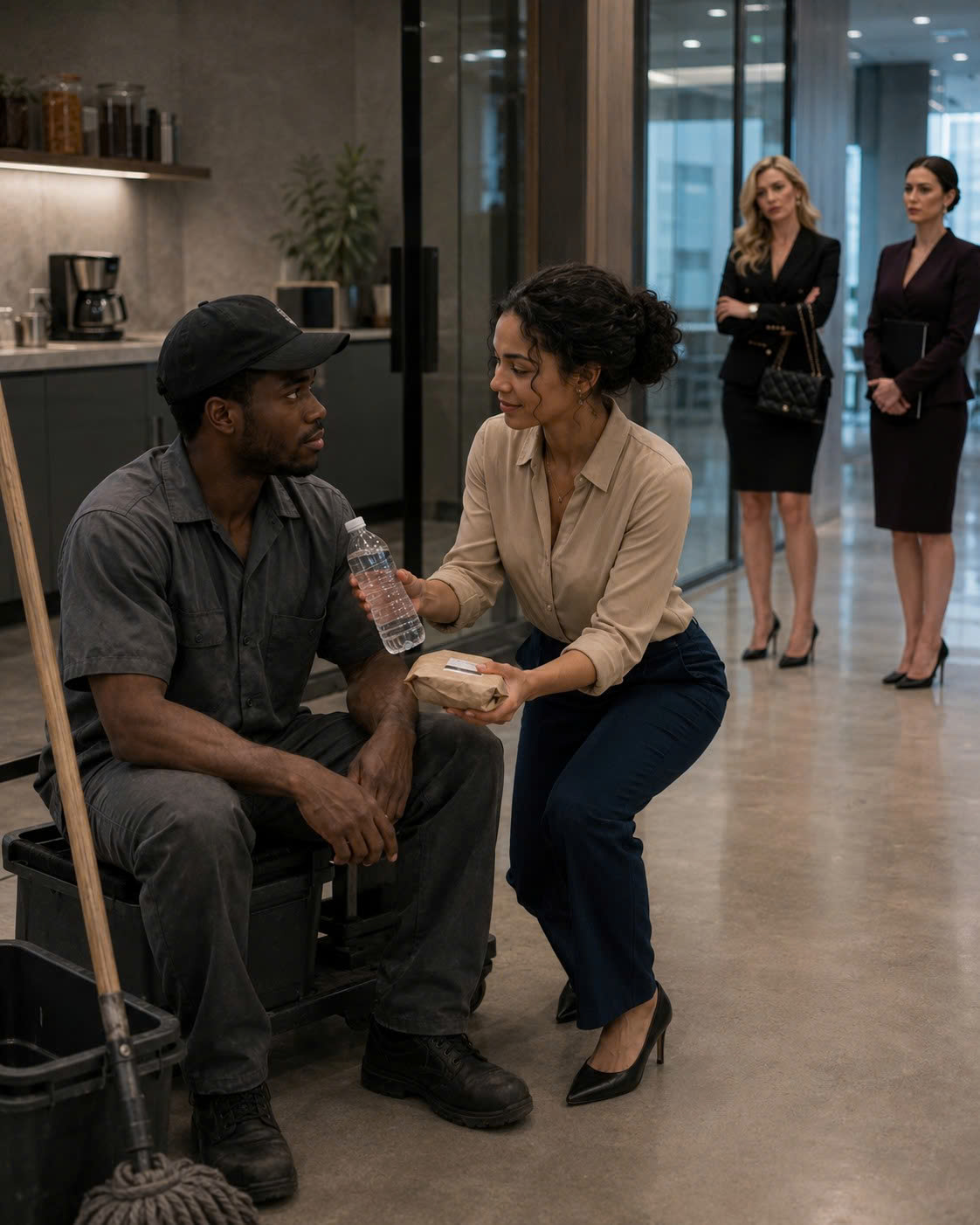
Two days later, she saw him replacing a trash liner in a conference room.
“Have you had lunch?”
He glanced at the clock.
It was almost 3:00.
“Not yet.”
Brianna returned ten minutes later with a bottle of water and a sandwich from the cafeteria.
“They were about to close,” she said. “You don’t have to eat it, but you should eat something.”
She placed the food on the corner of the table and left before he could properly thank her.
There was no audience.
No manager nearby.
No reason for her to do it except that she had noticed another human being was tired.
Kylie noticed Devon too.
Her first interaction with him happened outside a conference room.
He was cleaning a spill when she approached.
“Move the cart,” she said.
“There’s broken glass,” Devon warned. “Please give me one minute.”
“I have a meeting.”
“So does everyone else,” he replied calmly. “I don’t want you to get hurt.”
Kylie stared at him.
Then she stepped around the warning sign and knocked the edge of her shoe against his bucket.
Water splashed across the floor.
She looked down at the mess.
“Well,” she said, “now you have something else to clean.”
Another time, she called him into her office because of a ring left by a glass on her desk.
“You missed this.”
Devon wiped it.
As he turned to leave, Kylie tipped the remaining water from her glass onto the surface.
“You missed another spot.”
Her colleague laughed nervously.
Kylie leaned back in her chair.
“Some people are meant to make decisions,” she said. “Some people are meant to clean up after them.”
Devon looked at the water spreading toward a stack of folders.
Then he quietly moved the documents before they were damaged.
Jordan behaved differently.
When people were around, she smiled at Devon.
“You’re doing a great job,” she once said loudly while two directors passed behind her.
But when they were alone, her voice changed.
“Don’t leave your supplies near the strategy department,” she said. “It makes the area look unprofessional.”
Another morning, Devon saw her speaking politely to a catering assistant while Morgan’s deputy stood nearby.
The moment the deputy entered the elevator, Jordan handed the assistant an overflowing tray.
“Take this,” she said. “And don’t come through the front hallway again.”
She was never openly cruel.
She was careful enough to keep her cruelty deniable.
Over the following weeks, Brianna and Devon spoke more often.
Their conversations were never dramatic.
She told him about her father, who had worked maintenance at a hospital for twenty-seven years.
Devon told her he had recently returned from living abroad but did not explain why.
She asked what he wanted to do next.
“I’m trying to understand how companies really work,” he said.
Brianna smiled.
“You’re learning from the right floor.”
He remembered that sentence.
So did Morgan, when Devon repeated it to her later.
Kylie soon noticed their conversations.
One afternoon, she saw Brianna hand Devon a cup of coffee.
“Careful,” Kylie said after Devon walked away. “People might think you have a thing for the janitor.”
Brianna did not look embarrassed.
“He has a name.”
Kylie laughed.
“I’m sure he does.”
The confrontation came several days later.
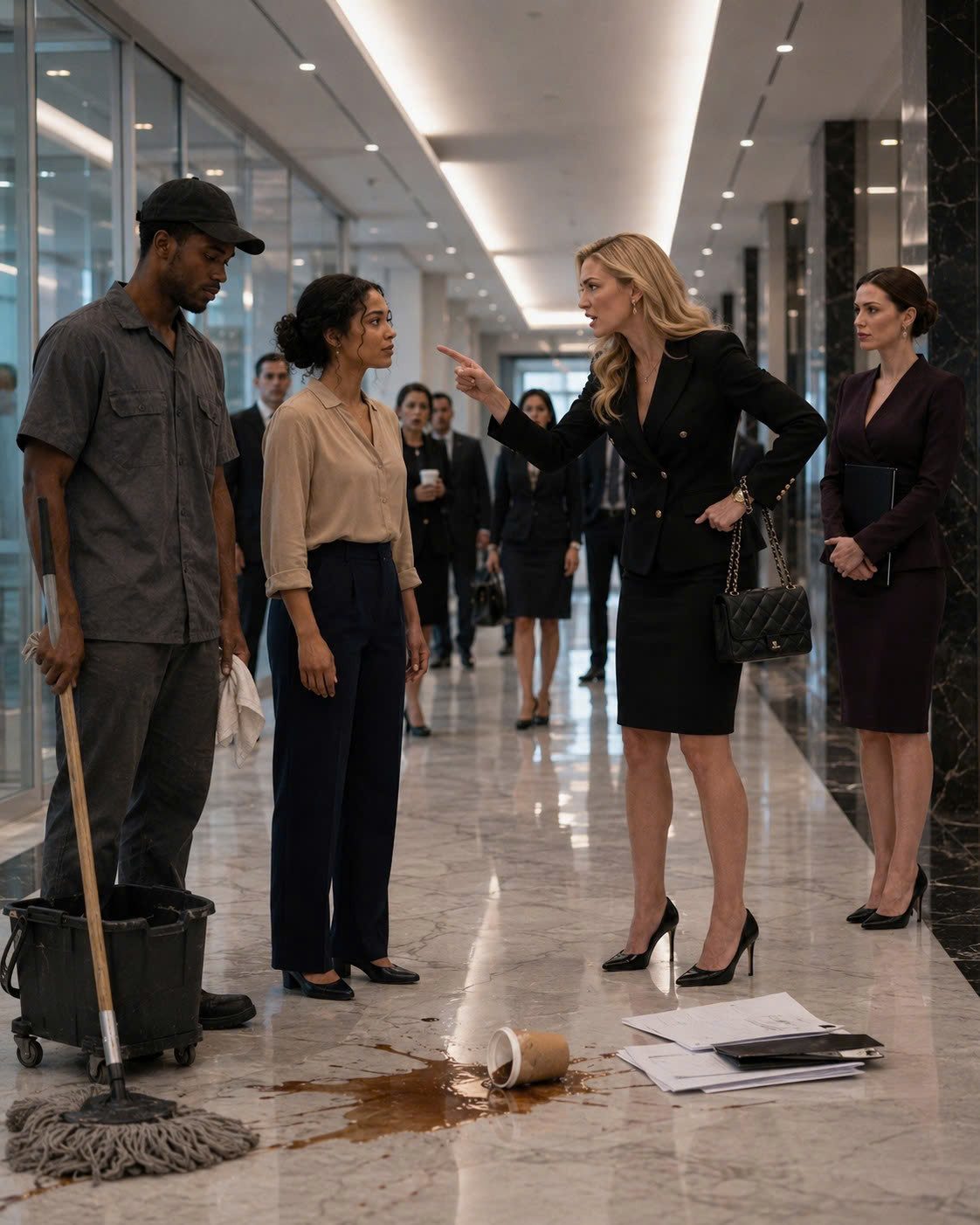
A young cleaning employee named Aaron bumped into Kylie near the executive elevators.
The cup in her hand spilled across several printed reports.
Aaron immediately apologized and reached for paper towels.
Kylie raised her voice.
“Do you understand how important these documents are?”
“I’m sorry. I didn’t see you turn—”
“That is the problem with people like you. You don’t see anything beyond the next mess you’re making.”
Employees began slowing down in the hallway.
Aaron’s face turned red.
Brianna stepped between them.
“It was an accident,” she said.
Kylie turned toward her.
“I wasn’t speaking to you.”
“You’re speaking loudly enough for everyone.”
A silence spread across the corridor.
Brianna picked up the reports and checked them.
“They’re copies. The originals are in the meeting room.”
“That isn’t the point.”
“No,” Brianna said. “The point is that he apologized, and you’re humiliating him because you can.”
Kylie’s jaw tightened.
“You’re making a very strange career choice.”
Brianna handed the undamaged pages back to her.
“Then it’s mine to make.”
Devon witnessed the entire exchange from the end of the hallway.
That evening, he told Morgan the test was over.
But Brianna made the next move before he could.
She called Morgan and asked for a private conversation.
Her voice shook slightly.
“I need to be honest with you,” she said. “I don’t think I should meet your son.”
Morgan remained quiet.
Brianna continued.
“I’ve developed feelings for someone else.”
“Someone at the company?”
“Yes.”
“Who?”
Brianna took a breath.
“Devon. He works with the cleaning team.”
Morgan looked across her office at the personnel notebook she had been keeping.
“What do you know about him?”
“Not much,” Brianna admitted. “But I know how he treats people. I know he listens. And I know I would feel dishonest meeting your son while thinking about someone else.”
Morgan invited her to dinner that Saturday.
The Caldwell home was large, but it did not feel like a palace.
There were family photographs in the hallway, old books on the shelves, and a framed newspaper article in Morgan’s study.
Brianna arrived expecting an uncomfortable conversation.
Morgan offered her tea.
Then footsteps sounded behind them.
Devon entered wearing dark trousers and a simple blue shirt.
No cap.
No uniform.
No cleaning cart.
Brianna stood so quickly that her knee struck the table.
For several seconds, she could not speak.
Her eyes moved from Devon to Morgan and back again.
“No,” she whispered.
Devon stopped a few feet away.
“My name is Devon Caldwell.”
The color left Brianna’s face.
Every conversation replayed at once—the sandwich, the wet floor, the stories about her father, the moment she defended Aaron.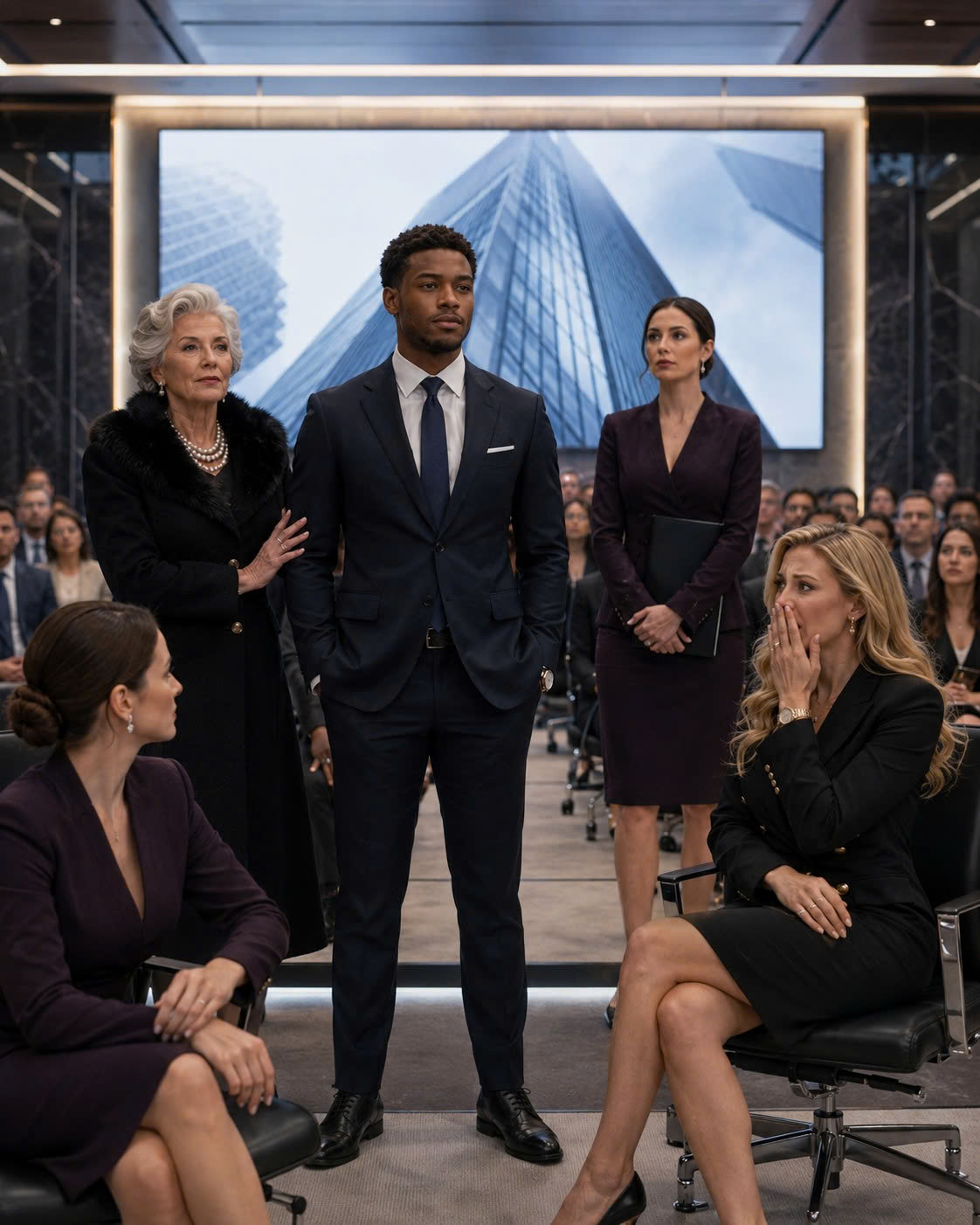
“You tested me.”
Morgan did not answer for him.
Devon did.
“Yes.”
Brianna’s eyes filled, but her voice remained steady.
“Did you ever plan to tell me?”
“I planned to tell you before anything between us went further.”
“Anything between us?”
“The conversations were real,” Devon said. “My interest in you was real. The uniform was not.”
Brianna looked toward the door.
“I need time.”
Devon nodded.
“You deserve it.”
She left without taking the tea.
The following weekend, Kylie received the same invitation.
She entered Morgan’s home smiling.
When Devon walked into the room, Kylie stared at him.
Her smile vanished.
Then it returned too quickly.
“I knew there was something different about you,” she said.
Devon said nothing.
Kylie stepped closer.
“I mean, obviously, you didn’t carry yourself like an ordinary cleaner.”
Morgan opened a folder on the table.
“On March 12, you poured water onto a desk and ordered him to clean it.”
Kylie’s lips parted.
“On March 18,” Devon added, “you said some people were meant to make decisions and others were meant to clean up after them.”
Kylie’s eyes flicked toward Morgan.
“That was taken out of context.”
Caleb pressed a button on a tablet.
Security footage appeared on the television.
There was no sound, but the images were enough.
Kylie tipping the glass.
Kylie leaning back.
Devon moving the folders away from the water.
Her face changed slowly.
First disbelief.
Then calculation.
Then fear.
Her shoulders dropped. Her hands, which had been confidently resting on her handbag, tightened around the straps.
She looked at Morgan, then at Devon, then toward the blank television screen where her behavior had just played back in front of her.
No one spoke.
That silence was the moment she understood.
The man she had treated as invisible had seen everything.
And the people whose approval she wanted had seen her too.
Kylie began to cry.
“I made a mistake.”
“It was not one mistake,” Morgan said. “It was a pattern.”
Kylie apologized repeatedly.
But apologies made only after consequences become visible are rarely proof of changed character.
Jordan arrived last.
She remained composed when Devon entered.
She even smiled.
“I suspected there might be more to the situation.”
Caleb placed a report on the table.
It showed Jordan’s searches of restricted travel calendars, her inquiries about executive schedules, and her attempts to access information about Devon’s return.
Jordan read the first page and stopped smiling.
Morgan did not fire her.
Jordan was talented, and Morgan believed consequences should be precise rather than theatrical.
She transferred Jordan to a role with greater operational accountability and less access to confidential executive information.
“You know how to study power,” Morgan told her. “Now you need to learn how to deserve trust.”
The following Monday, every employee was called to the main conference hall.
The facilities team stood near the back.
Devon walked onto the stage in a tailored suit.
A murmur moved through the room.
Some employees recognized him immediately.
Others recognized him only when his photograph appeared beside his name on the screen.
For three weeks, he explained, he had worked inside Caldwell Group as a cleaner.
He described the long shifts, the physical strain, and the way employees became invisible when they wore certain uniforms.
He did not name Kylie.
He did not embarrass Jordan.
He did not praise Brianna.
Instead, he announced changes.
Cleaning and maintenance wages would increase.
Break rooms would be renovated.
Facilities employees would receive the same access to professional development programs as other departments.
A formal dignity-at-work policy would make repeated status-based harassment a disciplinary offense.
Managers would be evaluated partly on how their teams treated contractors, assistants, and support staff.
“A company’s values are not visible when the CEO enters the room,” Devon said. “They are visible when the cleaner does.”
At the back of the hall, Mr. Price folded his arms and nodded.
Aaron smiled.
Brianna stood near the side wall, watching quietly.
She had not forgiven Devon immediately.
It took several honest conversations.
Devon apologized without defending the deception.
Brianna admitted that what hurt most was realizing a private part of her character had been examined without her consent.
They started again slowly.
Not as an heiress candidate and an undercover cleaner.
As two people who had seen each other under uncomfortable circumstances and still wanted to know more.
Several months later, Devon invited Brianna to a small restaurant where they had once eaten lunch during her break.
There were no photographers.
No executives.
No elaborate decorations.
After dinner, he placed a ring on the table.
“The first thing you ever gave me was a sandwich,” he said. “You thought I had no influence, no money, and nothing to offer you. You saw someone who was tired, and you helped.”
Brianna covered her mouth with one hand.
“I don’t need someone who loves the Caldwell name,” Devon continued. “I need someone who can still see me when the name is gone.”
He had not finished the question when she said yes.
Kylie resigned from Caldwell Group two months later.
No one forced her to leave, but her reputation never recovered. Employees remembered the hallway incidents, the spilled water, and the things she said when she believed the people around her had no power.
Jordan stayed.
Her new role was difficult and far less glamorous, but over time she began listening more carefully and performing less often.
Morgan never trusted her in quite the same way again.
Trust, she believed, could be rebuilt.
But it could not be reset.
Devon and Brianna married on a clear spring morning.
After becoming part of the Caldwell family, Brianna continued arriving early, greeting employees by name, holding doors for delivery workers, and speaking up when someone was treated unfairly.
Status changed her schedule.
It never changed her character.
Years later, Devon still remembered his first morning with the cleaning cart and the wet marble floor.
The uniform had never made him less valuable.
It had simply revealed who believed value depended on a uniform.
Because the truest measure of a person is not how they treat someone powerful—it is how they treat someone they believe will never be able to repay them.


