
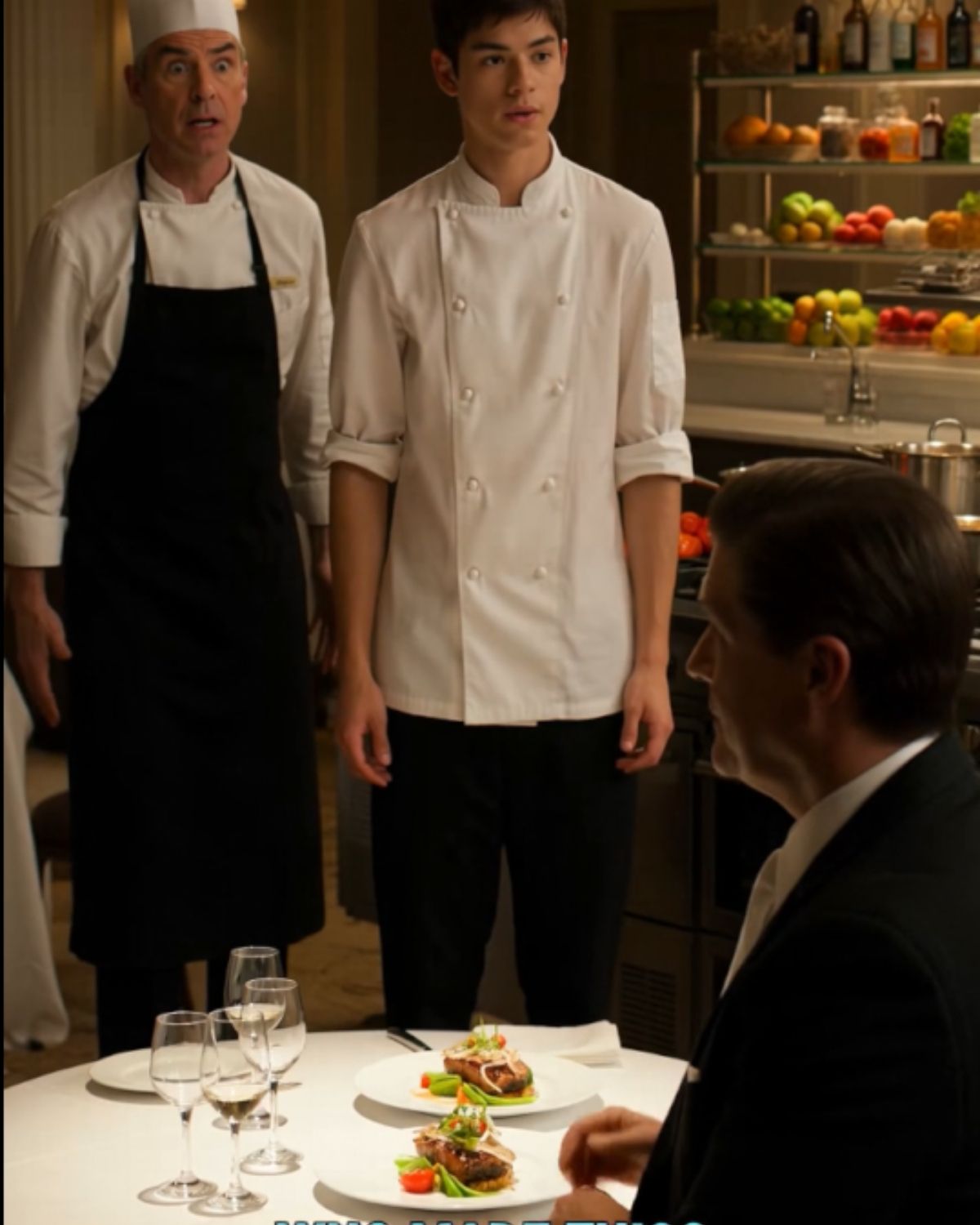
The sauce split twelve minutes before the most important dinner the hotel had hosted all year.
One second, it was smooth and glossy beneath the kitchen lights.
The next, a ribbon of oil separated across the surface.
Head Chef Marcus Vale stared into the copper pan.
“No.”
He whisked harder.
The sauce broke further.
Around him, the kitchen of the Royal Crescent Hotel moved at full speed. Flames rose beneath heavy pans. Knives struck cutting boards in rapid rhythm. Servers waited beside silver doors leading to the private dining room.
Beyond those doors sat ministers, investors, television personalities and one of the most famous chefs in the world.
In twelve minutes, they expected Marcus Vale’s signature dish.
Now its most important element was ruined.
“The sauce is gone!” Marcus shouted.
The kitchen froze.
At the far preparation station, a young kitchen assistant slowly lifted his head.
His name was Noah Park.
He was twenty-three years old.
His uniform did not say chef.
It said KITCHEN ASSISTANT.
That meant he washed herbs, peeled vegetables, cleaned stations and carried heavy boxes from the cold room. He sharpened other people’s knives and stayed after midnight scrubbing pans used by men who rarely remembered his name.
But Noah knew exactly why the sauce had failed.
And he knew how to save the dish.
The problem was that no one in the VIP kitchen believed he belonged near it.
Three hours earlier, the Royal Crescent had been preparing for what hotel management called “the dinner that could define the next decade.”
The guest of honor was Julian Cross, a celebrity chef whose restaurants held international awards and whose television series reached millions of viewers.
Julian was not merely dining at the hotel.
He was considering a partnership.
The Royal Crescent wanted him to open a flagship restaurant inside its newly renovated east wing.
A successful dinner could lead to a contract worth millions.
A bad dinner could end the conversation before it began.
Every senior chef had been called in.
Extra servers had been assigned.
Fresh seafood had arrived that morning in refrigerated cases.
The hotel’s general manager visited the kitchen twice before noon to remind everyone that nothing could go wrong.
At the center of the operation stood Marcus Vale.
Marcus was forty-eight, disciplined and widely respected. He had spent twenty-five years in professional kitchens and carried his authority like another part of his uniform.
His jacket was perfectly white.
His knives were aligned by size.
His voice could silence a room faster than any fire alarm.
He had designed the seven-course menu personally.
The centerpiece was roasted sea bass with a champagne shellfish sauce, compressed fennel and a delicate citrus oil.
It was the dish that had made Marcus famous within the hotel industry.
He had served versions of it to diplomats and business leaders.
Tonight, he planned to serve it to Julian Cross.
Noah had been working at the Royal Crescent for fourteen months.
He had applied for a junior cook position three times.
Each time, the answer had been the same.
Not enough professional experience.
Not enough formal training.
Not ready.
The kitchen director had offered him assistant shifts instead.
Noah accepted because he needed the income.
His mother’s medical bills had erased most of the family’s savings. Culinary school had become impossible. So Noah learned wherever he could.
He arrived early and watched the breakfast cooks.
He memorized sauces while cleaning pans.
He studied discarded prep sheets.
At home, he practiced with cheap ingredients in a narrow apartment kitchen.
He bought bruised vegetables at closing time from a market vendor.
He turned stale bread into crumbs, soups and dumplings.
He could not afford expensive seafood, so he learned precision with eggs, onions and chicken bones.
He wrote every result in a small black notebook.
Nobody in the Royal Crescent knew about it.
To them, Noah was the quiet assistant who worked quickly and never complained.
That afternoon, he stood at the end of the main preparation table, zesting lemons for the VIP dinner.
Marcus moved down the line, inspecting each station.
“Fish temperature?”
“Thirty-four degrees.”
“Fennel?”
“Compressed and chilled.”
“Stock?”
“Reduced by half.”
Marcus stopped beside Noah.
On the corner of Noah’s station sat a small steel bowl.
Inside was a mixture of roasted citrus peel, fresh herbs and a little fermented chili paste.
Marcus looked at it.
“What is that?”
Noah wiped his hands.
“A finishing paste.”
“For what?”
“The sea bass.”
Marcus’s eyes narrowed.
“I did not ask for a finishing paste.”
“No, Chef.”
“Then why did you make one?”
Noah hesitated.
“The fish is rich. I thought a small amount of acidity and heat might—”
Marcus picked up the bowl.
He smelled it.
Then he set it down sharply.
“You thought?”
Noah straightened.
“Yes, Chef.”
Marcus looked toward the senior cooks.
A few of them were listening.
“You are here to prepare what you are assigned.”
“I understand.”
“You do not modify my menu.”
“I wasn’t planning to serve it without permission.”
“You were not planning to serve anything.”
The words were calm.
That made them worse.
Marcus pointed toward the VIP station.
“Don’t touch the VIP dishes. You’re only an assistant.”
Noah stepped back.
The nearest cook lowered his eyes.
Another smirked.
Noah said nothing.
He covered the bowl and moved it beneath the table.
Marcus continued down the line.
The kitchen returned to motion.
But the sentence remained.
You’re only an assistant.
Noah had heard versions of it for years.
You are too young.
You did not attend the right school.
You have never worked in a serious restaurant.
You do not understand fine dining.
He never argued.
He understood that talent did not become visible simply because the person possessing it believed it existed.
In a professional kitchen, proof had to arrive on a plate.
So he kept working.
At seven thirty, the first course left the kitchen.
A chilled oyster dish with cucumber and green apple.
The VIP dining room responded well.
Empty plates returned.
The second course followed.
Then the third.
With each successful service, Marcus relaxed slightly.
The private dining room glowed beneath low chandeliers. A long table had been set with white linen and hand-polished silverware.
Julian Cross sat near the center.
He was sixty, broad-shouldered and known for an expression that revealed almost nothing while he tasted food.
He rarely praised dishes quickly.
He asked direct questions.
He noticed shortcuts.
Beside him sat hotel executives who laughed a little too loudly at his quiet jokes.
Each time a course arrived, the general manager watched Julian’s face.
The first three dishes were good.
Professional.
Elegant.
But Julian offered no strong reaction.
He tasted.
He nodded.
He moved on.
Back in the kitchen, Marcus received the reports.
“Chef Cross finished the oyster.”
“Good.”
“He asked about the source of the duck.”
“Good.”
“He said the consommé was clean.”
Marcus paused.
“Clean?”
The server nodded.
No chef wanted his best work described only as clean.
Marcus adjusted the next plate himself.
“Course four in two minutes.”
Noah remained at the preparation station.
He trimmed herbs and arranged backup garnishes.
He watched how Marcus built each plate.
He noticed the details others missed.
The sea bass portions had been salted early.
The shellfish stock was reducing faster than expected.
The champagne used in the sauce was more acidic than the brand listed in the recipe.
Marcus had compensated with cream.
Too much cream.
It would hold if the temperature stayed controlled.
But the dinner was running late.
The sauce would have to remain warm longer than planned.
Noah looked toward the copper pan.
He could see a faint shine forming around the edge.
The first sign of separation.
He approached the sauce cook.
“Your heat is too high.”
The cook looked at him.
“I know my station.”
“The cream is beginning to—”
“I said I know.”
Noah stepped away.
Two minutes later, Marcus arrived.
He tasted the sauce.
His face tightened.
“Lower the flame.”
The cook did.
Marcus added a small amount of stock and whisked.
The sauce came back together.
For the moment.
“Watch it,” Marcus said.
The cook nodded.
At eight forty-two, the fifth course was cleared from the dining room.
The sea bass was next.
Sixteen plates had to leave together.
Marcus moved to the center station.
“Fish in pans.”
Butter foamed.
Sea bass portions hit the heat with a sharp hiss.
“Fennel warm.”
Small cylinders of compressed fennel moved into a low oven.
“Plates under lamps.”
The kitchen accelerated.
Noah carried clean spoons toward the plating area.
Marcus saw him.
“Stay at your station.”
“Yes, Chef.”
Noah returned to the far table.
He watched the sauce.
A server entered.
“VIP table ready in fourteen minutes.”
Marcus nodded.
“Perfect.”
The sea bass cooked skin-side down.
The smell of browned butter filled the room.
The sauce cook stirred the copper pan.
Then someone at the pastry station called for help.
The sauce cook turned for less than thirty seconds.
When he faced the pan again, a line of oil had appeared across the surface.
He grabbed the whisk.
The line widened.
“Chef.”
Marcus turned.
The cook whisked faster.
“Chef!”
Marcus crossed the kitchen.
He looked into the pan.
“No.”
He reduced the heat.
Added cold cream.
Whisked.
The sauce thickened unevenly.
Oil gathered around the sides.
Marcus transferred it to another pan.
The texture worsened.
The sea bass continued cooking.
“Fish in four minutes,” a cook called.
Marcus did not answer.
The general manager appeared at the kitchen doors.
“How long?”
Marcus raised one hand without looking at him.
The manager remained there.
“Marcus.”
“Get out of my kitchen.”
The manager stepped back.
Marcus tasted the broken sauce.
It was greasy.
Heavy.
Unusable.
“The sauce is ruined!” he shouted.
Every station stopped for half a second.
Then Marcus began issuing orders.
“Start another batch.”
The sauce cook stared at him.
“We don’t have enough reduced stock.”
“Use the backup.”
“The backup went into the consommé.”
Marcus turned.
“What?”
“You approved it this afternoon.”
Marcus looked toward the clock.
Eleven minutes.
A fresh reduction would take at least twenty-five.
The sea bass would not wait.
The guests would not wait.
Neither would Julian Cross.
“Make a beurre blanc,” Marcus said.
“With what base?”
“Champagne. Shallots. Butter.”
“We don’t have enough cold butter prepared.”
“Then cut it.”
The cooks moved.
A block of butter came from refrigeration.
Knives struck rapidly.
Another pan went onto the flame.
Champagne poured.
Shallots followed.
Marcus was moving too quickly now.
His commands overlapped.
The kitchen felt the panic spreading from him.
Noah stepped closer.
“Chef.”
Marcus ignored him.
“Reduce faster.”
The cook increased the flame.
“Chef,” Noah repeated.
Marcus turned.
“What?”
“I can make another sauce.”
Marcus stared at him.
“You can what?”
“I can make something that works with the fish.”
A senior cook gave a quiet laugh.
Marcus did not.
“We do not need an experiment.”
“It won’t be an experiment.”
“You are not touching the course.”
“Chef, the fish will be ready in three minutes.”
“I know how long fish takes.”
“The new beurre blanc needs more time.”
Marcus stepped toward him.
“You think this is your opportunity?”
Noah held his gaze.
“No.”
“Then return to your station.”
Noah looked at the sea bass.
The skin was nearly crisp.
The flesh was close to perfect.
In two minutes, it would begin drying beneath the heat lamps.
He looked back at Marcus.
“I can save the course.”
The kitchen became quiet.
Marcus’s face hardened.
“You were told not to touch the VIP dishes.”
Noah nodded.
“Yes, Chef.”
“Then why are you still standing here?”
Before Noah could answer, the private dining room doors opened.
A server rushed in.
“They’re asking about the next course.”
The general manager appeared behind her.
Marcus closed his eyes for half a second.
When he opened them, he looked toward the unfinished beurre blanc.
The liquid had barely reduced.
The butter was still being cut.
He looked at the fish.
Then at Noah.
“What would you make?”
Noah answered immediately.
“A warm roasted citrus emulsion with shellfish glaze.”
Marcus frowned.
“There is no shellfish glaze.”
“There is reduced stock stuck to the bottom of the first pan.”
“That is waste.”
“It’s concentrated flavor.”
“You have three minutes.”
“I need two.”
Marcus looked at him for a long moment.
Then he stepped aside.
“Two minutes.”
Noah moved.
The entire kitchen watched.
He grabbed the damaged sauce pan and poured off the separated fat.
At the bottom remained a dark, intensely flavored layer of shellfish reduction.
He loosened it with a small amount of hot water.
Then he added roasted lemon juice from the garnish station.
A spoon of mustard.
A few drops of honey.
The fermented chili paste he had prepared earlier.
Marcus saw the bowl.
“I told you to put that away.”
Noah did not look up.
“You told me not to serve it without permission.”
One cook inhaled sharply.
Marcus said nothing.
Noah whisked the mixture.
It was too sharp.
He tasted it.
Added browned butter from the fish pans.
Whisked again.
The liquid became glossy.
Not thick like the original sauce.
Lighter.
Brighter.
He crushed fresh herbs between his fingers and added them at the last moment.
“Plate,” he said.
No one moved.
Noah looked up.
“Please.”
The fish cook placed one portion before him.
Noah set the sea bass over warm fennel.
He spooned the citrus emulsion around the plate rather than over the crisp skin.
He added a small amount of the finishing paste near the edge.
Then he placed three thin slices of charred grape beside the fish.
Marcus stared.
“Grapes?”
“Acidity, sweetness and smoke.”
“On sea bass?”
Noah lifted a spoon.
“Taste.”
Marcus hesitated.
The entire kitchen waited.
He tasted the sauce alone first.
His expression did not change.
Then he cut a small piece of fish with fennel and grape.
He chewed.
Silence.
Noah watched his eyes.
Marcus looked down at the plate again.
The sauce did not taste like Marcus’s signature preparation.
It was cleaner.
More modern.
The shellfish flavor remained, but without the weight of the cream.
The citrus sharpened the fish.
The fermented chili added warmth that arrived after the first bite.
It was unexpected.
Balanced.
Complete.
Marcus set down the spoon.
“How many plates can you do?”
“All sixteen.”
“In how long?”
“Four minutes.”
“We have two.”
“Then give me six hands.”
Marcus turned toward the line.
“You heard him.”
The kitchen exploded into motion.
Noah took control of the plating station.
Not loudly.
Not theatrically.
He simply began assigning tasks.
“Hot water in the sauce pan.”
“Slice the grapes thinner.”
“Keep the fish skin dry.”
“Fennel first.”
“Emulsion around, not on top.”
Senior cooks followed his instructions because there was no time to protect rank.
Marcus stood beside him.
For the first time, he was not directing the plate.
Noah was.
Sixteen white dishes lined the counter.
Fennel.
Fish.
Sauce.
Paste.
Grapes.
Herbs.
The first eight were finished in ninety seconds.
The final plate was completed just as the server entered.
Marcus inspected them.
One sauce line was uneven.
Noah wiped it clean.
“Go,” Marcus said.
The doors opened.
The plates left the kitchen.
Then there was nothing to do but wait.
The sudden quiet felt unnatural.
Noah stood at the station, breathing hard.
His hands were steady.
Marcus looked at the empty copper pan.
Then at the small bowl of finishing paste.
“You made that today?”
“Yes, Chef.”
“Why?”
“I tasted the citrus garnish this morning. It needed something bitter and warm.”
Marcus’s jaw tightened.
“You tasted ingredients assigned to another station?”
“I tasted one piece of peel that had been discarded.”
A cook looked away to hide a smile.
Marcus folded his arms.
“Do not mistake one emergency for a promotion.”
Noah nodded.
“I won’t.”
But his voice was different now.
Not defiant.
Certain.
In the private dining room, servers placed the sea bass before the guests.
The general manager stood near the wall.
He knew the original sauce had failed.
He also knew a kitchen assistant had created the replacement.
He said nothing.
Julian Cross looked down at the dish.
The presentation was simple.
Crisp fish.
Pale fennel.
A bright amber sauce.
Charred grape.
He lifted his fork.
Around the table, conversations softened.
Julian cut through the fish.
The skin cracked cleanly.
He took one bite.
Then stopped.
The general manager watched his face.
Julian looked at the plate again.
He tasted the sauce by itself.
Then the grape.
Then another piece of fish with all the elements together.
He placed the fork down.
No one spoke.
A hotel investor leaned forward.
“Is something wrong?”
Julian did not answer immediately.
He picked up the fork again.
Took another bite.
Then another.
Across the room, the general manager felt his pulse rising.
Julian finally looked toward the nearest server.
“Who made this?”
The server glanced toward the manager.
The manager stepped forward.
“This evening’s menu was created by our executive chef, Marcus Vale.”
Julian shook his head.
“I know Marcus’s food.”
The room grew still.
He pointed to the plate.
“Who made this dish?”
The general manager hesitated.
“The kitchen team prepared it.”
Julian’s expression hardened.
“That was not my question.”
At the far end of the table, a guest set down her glass.
Everyone was listening now.
Julian continued.
“The sauce does not match the menu description. The dish was changed.”
The general manager forced a smile.
“There was a small adjustment during service.”
“What adjustment?”
“A technical issue.”
“And who solved it?”
The general manager looked toward the kitchen doors.
Julian followed his gaze.
“Bring them out.”
“Chef Cross, the team is still in service.”
“The team can continue.”
He touched the edge of the plate.
“I want to meet the person who made this.”
In the kitchen, Marcus was preparing the next course when the server returned.
“Chef Cross wants to speak to the person who made the sea bass.”
Marcus stopped.
The senior cooks looked toward him.
The server continued.
“He asked specifically.”
Marcus wiped his hands.
“I’ll go.”
The server hesitated.
“He said the person who changed the sauce.”
The kitchen went silent.
Everyone looked at Noah.
Marcus did not move.
Noah stood near the sink, washing the sauce from his hands.
The server looked between them.
“He is waiting.”
Marcus’s face revealed nothing.
Then he removed his apron.
“Noah.”
Noah turned.
“Come with me.”
They walked through the silver doors together.
The private dining room felt colder than the kitchen.
Sixteen guests sat around the long table.
Julian Cross waited at the center.
The general manager stood near the wall, visibly uncomfortable.
Marcus approached first.
“Chef Cross.”
“Marcus.”
Julian gestured toward the plate.
“Was this your dish?”
Marcus looked at the sea bass.
“It was based on my course.”
“That is not what I asked.”
Marcus paused.
Then he stepped slightly aside.
“No.”
Every person at the table looked toward Noah.
He stood behind Marcus in an assistant’s jacket stained with citrus and butter.
Julian studied him.
“What is your name?”
“Noah Park.”
“Your position?”
“Kitchen assistant.”
A few guests exchanged surprised glances.
Julian leaned back.
“You made the sauce?”
“Yes, Chef.”
“Why?”
“The original split before service.”
Marcus’s shoulders stiffened.
Julian looked toward him.
“Is that true?”
Marcus nodded.
“It is.”
Julian faced Noah again.
“What was in the replacement?”
Noah answered carefully.
“Shellfish reduction from the original pan, roasted lemon juice, mustard, honey, browned butter, fresh herbs and fermented chili.”
“Grape?”
“Charred.”
“Why?”
“The sauce was bright but needed sweetness. The grape also echoed the champagne in the original preparation.”
Julian’s expression changed slightly.
It was not yet approval.
It was attention.
“Why fermented chili?”
“The fish and butter needed warmth, but black pepper would have sat on top of the flavor. Fermentation made it deeper.”
Julian picked up his fork.
“And the paste near the edge?”
“The same chili with citrus peel and herbs.”
“You prepared it before the sauce failed?”
“Yes.”
“Why?”
Noah glanced toward Marcus.
Marcus did not look at him.
“I thought the original dish needed contrast.”
A quiet murmur moved around the table.
Julian’s eyes narrowed.
“You disagreed with the executive chef’s dish?”
“I thought it was technically excellent.”
“That sounds like an answer designed to protect your job.”
A few guests smiled.
Noah remained still.
Julian waited.
Finally, Noah said, “It was elegant, but too safe.”
The room went silent.
The general manager looked alarmed.
Marcus slowly turned toward Noah.
Julian’s mouth moved slightly.
Not quite a smile.
“What made it safe?”
“The fish was rich. The sauce was rich. The fennel was sweet. Every element was soft.”
Noah pointed carefully toward the plate.
“It needed tension.”
Julian nodded once.
“That is the word.”
Marcus looked down at the table.
Julian took another bite.
“You did not try to recreate the broken sauce.”
“There wasn’t time.”
“Most young cooks would have tried.”
“I thought saving the idea was more important than copying the recipe.”
Julian placed the fork down.
“Where did you train?”
“I didn’t attend culinary school.”
“Which restaurants?”
“This is my first hotel kitchen.”
Julian looked at his uniform.
“You are telling me you have never held a cook position?”
“No.”
“Then where did you learn to build flavor like this?”
Noah hesitated.
“At home.”
Julian waited.
“My mother worked nights,” Noah continued. “When I was young, we cooked with whatever was cheap. If something was bitter, we had to balance it. If meat was tough, we had to use time. If ingredients were old, we had to understand which parts could still be saved.”
Julian listened without interrupting.
Noah glanced toward the kitchen doors.
“I learned not to waste flavor.”
Julian looked at the empty sauce around the fish.
“That is obvious.”
He turned to Marcus.
“Why is he an assistant?”
Marcus’s face became still.
“He lacks formal experience.”
“He just saved your signature course during the most important dinner of your year.”
Marcus said nothing.
Julian continued.
“Has he cooked for you before?”
“No.”
“Have you tasted his food?”
Marcus looked toward Noah.
“No.”
“Why not?”
The question hung above the table.
Marcus could have answered with policy.
Hierarchy.
Standards.
Experience.
But none of those words survived contact with the plate in front of Julian Cross.
Finally, Marcus said, “Because I did not believe he was ready.”
Julian glanced at the half-finished dish.
“And now?”
Marcus looked at Noah fully.
For the first time that evening, he saw more than an assistant.
He saw the speed with which Noah had understood the failed sauce.
The control in his hands.
The decisions made without hesitation.
The balance Marcus himself had missed.
He also saw the covered bowl he had dismissed before service.
The flavor had not been created in panic.
Noah had already imagined it hours earlier.
Marcus’s expression changed.
The certainty left his eyes.
His mouth tightened, then relaxed.
Around the table, guests waited.
The general manager watched him.
Noah did not look away.
Marcus finally spoke.
“Now I believe I was wrong.”
It was the first public apology anyone in the kitchen had ever heard from him.
Julian nodded.
“Good.”
Then he turned toward Noah.
“This is the talent I was looking for.”
Noah’s face remained still for one second.
Then confusion appeared.
“I’m sorry?”
Julian leaned forward.
“I did not come here only to discuss a hotel partnership.”
The executives at the table looked toward one another.
Julian continued.
“I am launching a culinary development program for young cooks who did not come through traditional schools.”
The general manager looked surprised.
Noah said nothing.
“We have interviewed graduates from some of the most expensive academies in Europe and Asia,” Julian said. “Many are skilled.”
He pointed toward the sea bass.
“But skill is not the same as instinct.”
Noah’s hands slowly closed at his sides.
Julian continued.
“Technique can be taught. Discipline can be taught. Presentation can be taught.”
He looked directly at Noah.
“But the ability to understand a dish while everyone else is panicking is rare.”
Marcus stood beside Noah in silence.
Julian lifted the fork again.
“You saw a ruined sauce and did not see failure. You saw concentrated stock, browned butter and an opportunity to create contrast.”
He set the fork down.
“That is not assistant thinking.”
Noah swallowed.
Julian looked toward the hotel executives.
“I want him included in the program.”
The general manager spoke quickly.
“Of course. We would be delighted to arrange—”
Julian raised one hand.
“I was speaking to Noah.”
The manager stopped.
Julian looked back at him.
“The program lasts six months. Participants rotate through my restaurants and work directly with my development team.”
Noah’s voice was quiet.
“Why me?”
Julian looked almost offended by the question.
“Because I tasted the plate.”
A few guests smiled.
Noah looked toward Marcus.
For months, he had wanted this man’s approval more than he admitted.
Marcus had represented the gate between the job he had and the work he believed he could do.
Now Marcus stood beside him with the entire room watching.
His face held something Noah had never seen before.
Not anger.
Recognition.
Marcus turned toward Julian.
“The next course is waiting.”
Julian nodded.
“Then return to the kitchen.”
Marcus looked at Noah.
“You too.”
Noah started toward the doors.
Then Marcus stopped him.
“Not the prep station.”
Noah waited.
Marcus spoke loudly enough for everyone to hear.
“Take the sauce position.”
The words changed the room.
They also changed the kitchen before Noah had even returned to it.
When the silver doors opened, every cook looked up.
Marcus walked in first.
Noah followed.
The sauce cook stood near the central station.
Marcus pointed toward Noah.
“He takes over here for the rest of service.”
No one laughed this time.
No one questioned it.
The former sauce cook stepped aside.
Noah moved into position.
Marcus handed him a clean tasting spoon.
“Next course is lamb.”
Noah looked at the prepared reduction.
“What do you think?” Marcus asked.
It was a simple question.
But everyone in the kitchen understood what had just happened.
Three hours earlier, Marcus had told Noah not to touch the VIP dishes.
Now he was asking for his judgment.
Noah tasted the reduction.
“It needs salt.”
Marcus waited.
“And?”
Noah tasted again.
“A little coffee.”
One cook looked confused.
Marcus raised an eyebrow.
“Coffee?”
“The lamb glaze is sweet. Coffee will add bitterness without changing the texture.”
Marcus considered it.
Then he nodded.
“Try it on one portion.”
Noah moved immediately.
The final courses left the kitchen without another problem.
After dessert, Julian asked for the young chef again.
This time, Noah entered the dining room alone.
The guests applauded as he approached.
He stopped, visibly uncomfortable.
Julian stood.
He held the sea bass plate, now nearly clean except for a trace of amber sauce.
“In professional kitchens,” Julian said, “people often confuse position with ability.”
The room quieted.
“A title tells us what someone has been permitted to do.”
He looked toward Noah.
“It does not always tell us what they are capable of doing.”
Marcus had entered quietly through the side door.
He stood near the wall.
Julian continued.
“This young man was told not to touch the VIP dishes because he was only an assistant.”
Several guests turned toward Marcus.
Marcus did not hide.
Julian raised the plate.
“Then the VIP dish failed, and the assistant became the only person in the room who knew how to save it.”
Applause filled the dining room.
Noah looked toward the floor.
Julian walked closer and extended his hand.
Noah shook it.
Cameras rose around the table.
The general manager stepped forward, eager to be part of the moment.
Julian turned toward him.
“What position will Noah have tomorrow?”
The manager paused.
The question had not been discussed.
“Well, naturally, we will review his responsibilities.”
Julian’s face hardened.
“Review?”
Marcus stepped away from the wall.
“He will be promoted to junior chef.”
The general manager looked at him.
Marcus continued.
“Effective immediately.”
Noah turned.
Marcus met his eyes.
“And he will be paid as one.”
The room applauded again.
This time, Noah did not look down.
The next morning, the hotel issued a formal announcement about its new partnership with Julian Cross.
But the story guests remembered was not the contract.
It was the assistant who had saved the dinner.
Within days, a short video recorded by one of the guests spread online. It showed Julian asking who had made the dish, Noah stepping forward in a stained assistant’s jacket and Marcus publicly admitting that he had been wrong.
People shared the clip thousands of times.
Many praised Noah.
Some criticized Marcus.
But Noah refused to turn the moment into revenge.
When a reporter asked whether the head chef had held him back, Noah answered carefully.
“He judged me by the work he had seen.”
The reporter leaned closer.
“But he never allowed you to show him more.”
Noah paused.
“That part is true.”
Marcus watched the interview from his office.
The sentence stayed with him.
A leader could claim to reward talent.
But talent could not be rewarded if it was never allowed near the table.
The following week, Marcus changed the kitchen schedule.
Every assistant would receive one supervised cooking shift each month.
Dishwashers who wanted culinary training could apply for preparation hours.
Junior staff were invited to submit one original idea for the seasonal menu.
Some senior cooks complained.
Marcus ignored them.
He placed Noah’s roasted citrus sea bass on the hotel menu for a limited run.
The printed description included two names:
Created by Noah Park.
Developed under Chef Marcus Vale.
Marcus had suggested listing only Noah.
Noah insisted on both.
“The original dish was yours,” he said.
“The rescue was yours,” Marcus replied.
“The final plate came from both.”
Marcus looked at him for a long moment.
Then he nodded.
Six months later, Noah completed Julian Cross’s development program.
He worked in three cities.
He learned pastry discipline from a chef who measured temperature to a tenth of a degree.
He learned fermentation from a cook who maintained starters older than Noah himself.
He learned leadership from a kitchen where even the youngest employee was expected to speak when something looked wrong.
At the program’s final dinner, every participant prepared one original course.
Noah served sea bass.
But not the version from the Royal Crescent.
This one included smoked citrus broth, charred grapes and a thin crisp made from fish skin that other kitchens would have discarded.
Julian tasted it.
“So,” he said, “you still refuse to waste flavor.”
Noah smiled.
“Yes, Chef.”
After graduation, Julian offered him a position.
Noah accepted.
But before leaving the Royal Crescent, he worked one final dinner under Marcus.
The kitchen was busy.
A new assistant stood at the preparation table, slicing herbs too slowly.
A senior cook became impatient.
“Move. You’re only here to prep.”
Marcus heard him.
The entire kitchen expected an explosion.
Instead, Marcus walked to the assistant.
“What is your name?”
“Eli, Chef.”
“Do you cook?”
“A little.”
Marcus picked up a pan.
“Show me.”
From the sauce station, Noah watched.
Marcus looked toward him.
For a moment, neither man spoke.
Then Marcus nodded once.
It was not a dramatic apology.
It was something better.
Proof that he had changed.
At the end of the night, Noah removed his jacket from the employee locker room.
The old assistant uniform still hung at the back.
He ran one hand across the name stitched above the pocket.
For fourteen months, that jacket had told everyone where he stood.
It had not told them what he knew.
It had not shown the recipes in his notebook, the years spent practicing at home or the instinct that appeared when a kitchen full of experienced chefs had frozen.
Titles can organize a workplace.
But they can also blind it.
Because sometimes the person carrying the boxes, washing the pans or chopping the herbs is not waiting to become talented.
They are waiting for someone powerful enough to finally notice that they already are.


