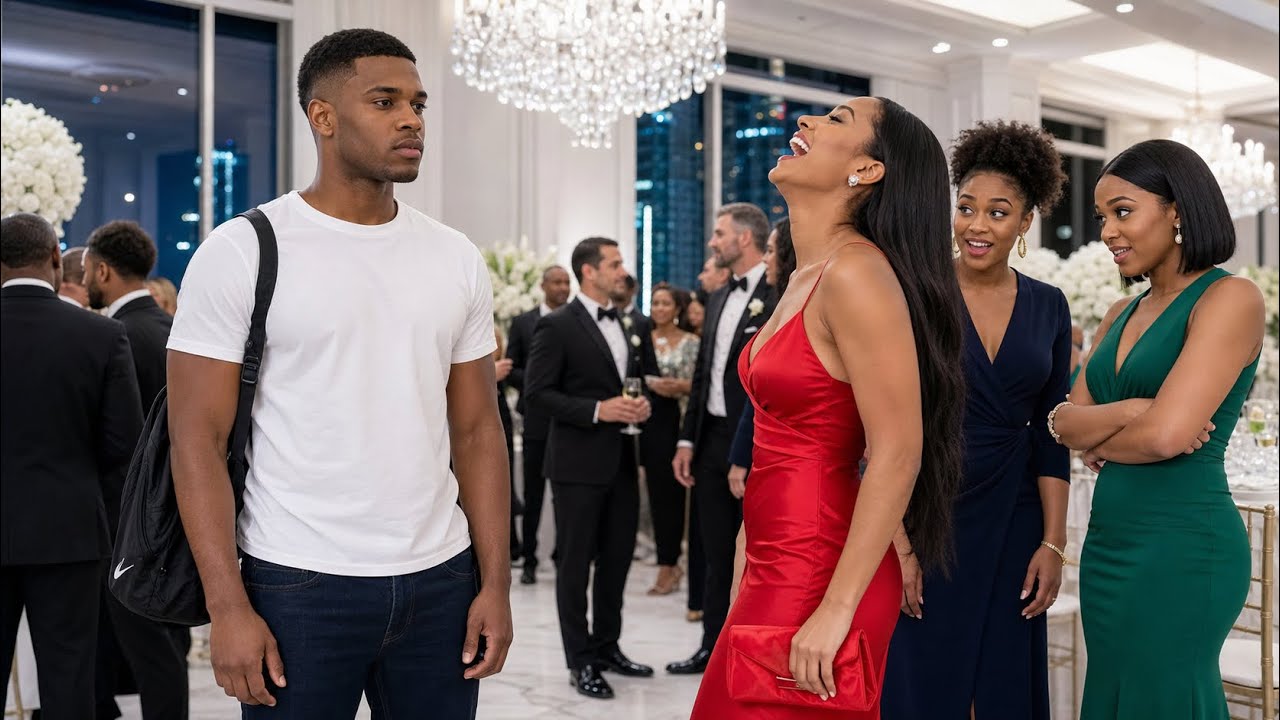
The wedding venue cost $30,000 for one night.
That did not include the flowers.
It did not include the champagne, the live string quartet, the custom lighting, the imported table linens, the celebrity photographer, or the row of black luxury cars waiting beneath the glass entrance.
By the time the first guests arrived, the ballroom looked less like a wedding venue and more like a private kingdom built for one evening.
Crystal chandeliers hung above the dance floor in three glowing tiers. White orchids spilled from gold stands taller than most of the guests. A DJ from Los Angeles was setting up behind a polished black booth while waiters moved through the room carrying trays of champagne that cost more per bottle than some people’s monthly rent.
Everywhere you looked, someone was being photographed.
Everywhere you listened, someone was discussing a deal.
A real estate acquisition.
A technology fund.
A private school board.
A hotel project in Miami.
The wedding was for the daughter of a prominent developer, and the guest list reflected it. Executives, investors, attorneys, surgeons, political donors, and people who rarely introduced themselves without including a title.
It was the kind of room where appearances were not simply noticed.
They were used as evidence.
At the front entrance stood a security guard named Raymond Ellis.
Raymond had worked private events for eleven years. He had guarded charity galas, private auctions, political dinners, and weddings where the floral budget could have purchased a small house.
He had developed an instinct for people.
He knew who walked in expecting to be recognized.
He knew who paused too long at the door.
He knew who belonged, who was working, and who was hoping confidence alone might carry them past the guest list.
So when a young man approached the entrance wearing a plain white T-shirt, dark jeans, worn Nike sneakers, and a small drawstring bag over one shoulder, Raymond looked up immediately.
The man wore no watch.
No jewelry.
No jacket.
Nothing about him matched the room waiting on the other side of the doors.
But he did not look nervous.
He did not check his phone repeatedly.
He did not straighten his shirt or prepare an explanation.
He simply walked toward Raymond with the calm expression of someone arriving exactly where he intended to be.
“Name?” Raymond asked.
“Jordan Calloway.”
Raymond checked the tablet.
The name was there.
No company title. No plus-one. No special notation.
Just Jordan Calloway.
Raymond gave him a small nod and opened the door.
Jordan thanked him and stepped inside.
The reaction was almost immediate.
A woman near the champagne tower glanced at his sneakers, then at the waiter beside her, as if trying to decide whether Jordan was part of the staff.
Two men in tuxedos looked toward him, stopped speaking for half a second, then continued in lower voices.
A photographer lifted his camera, recognized that Jordan was not dressed for a formal portrait, and turned away.
Jordan noticed all of it.
He responded to none of it.
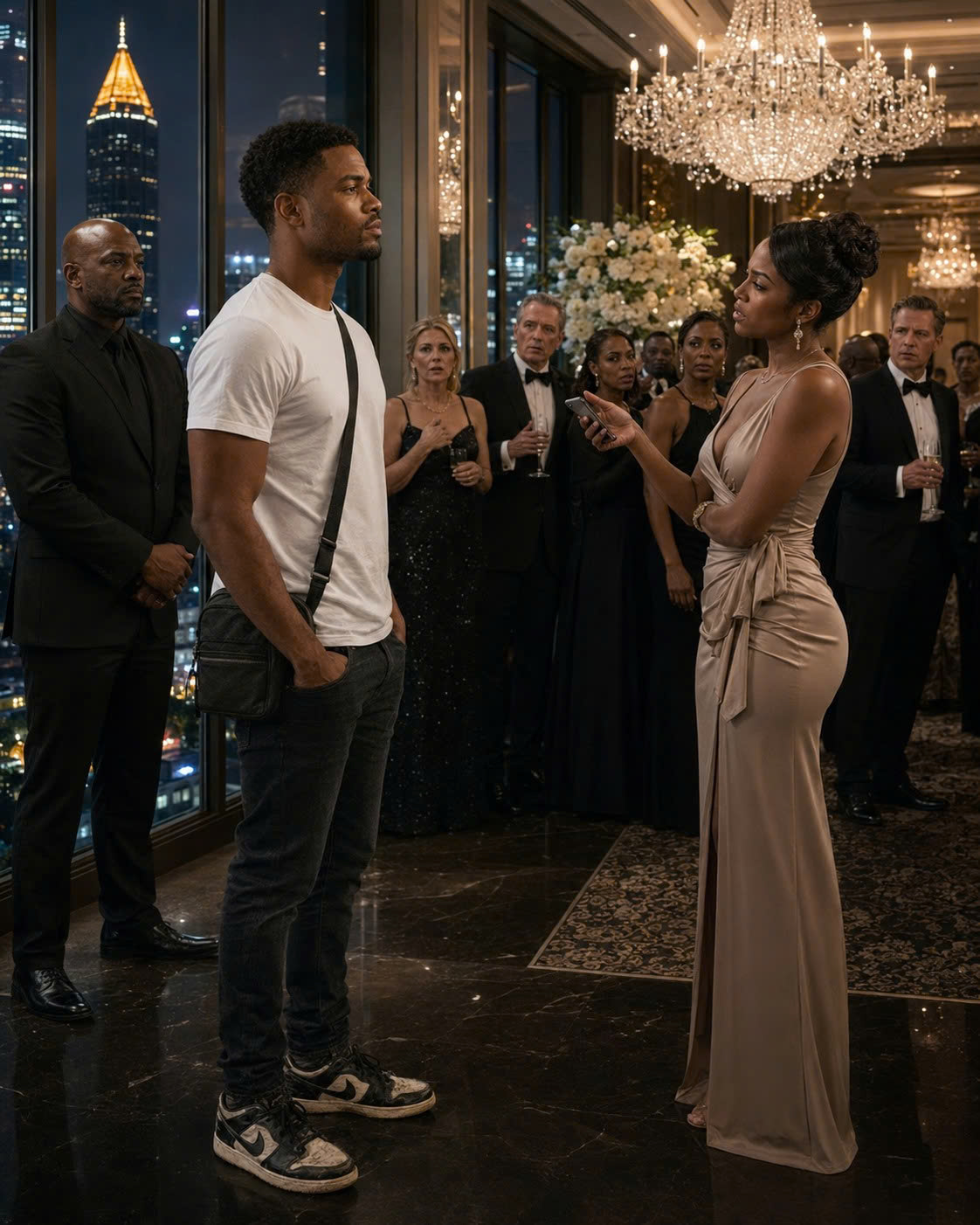
He walked through the ballroom without hurrying, found a quiet place near the windows, and stood alone looking out over the city skyline.
From forty floors above the street, the lights below looked orderly.
Inside the room, the judgment was less subtle.
“Who is that?”
“I thought the staff had uniforms.”
“Maybe he’s with the DJ.”
“No, the DJ’s team is wearing black.”
Jordan remained near the glass, one hand in his pocket, the other holding a glass of sparkling water.
That was where Kayla Bellamy saw him.
Kayla was the bride’s cousin and had spent most of the evening acting as though the wedding were partly hers to manage.
She knew the family.
She knew the venue coordinator.
She knew which guests were important and which guests were merely invited.
Her father, Marcus Bellamy, owned a commercial construction company and had worked with the bride’s family for years. Kayla had grown up in rooms like this one.
She understood the social map of wealth.
Who stood near the center.
Who waited to be approached.
Who wore understated clothing because they were powerful enough not to advertise it.
And who, in her opinion, simply did not belong.
She watched Jordan for less than a minute before deciding which category he occupied.
Then she crossed the ballroom.
Her expression was polite from a distance.
Up close, it was not.
“Excuse me,” she said.
Jordan turned from the window.
“Yes?”
“Are you looking for someone?”
“No.”
Kayla waited for more.
Jordan offered nothing.
Her eyes moved from his shirt to his shoes, then to the small bag over his shoulder.
“This is a private wedding.”
“I know.”
“You know?”
“Yes.”
Kayla smiled, but there was no warmth in it.
“Then you probably know guests were asked to bring their invitations.”
“I didn’t bring a printed invitation.”
“Of course.”
The two words were quiet, but several people nearby heard them.
Jordan did too.
He took a sip of water.
“I was invited directly.”
“By whom?”
“Trent.”
Kayla almost laughed.
Trent Hollis was the groom.
He had grown up around money, attended one of the best universities in the country, and now worked at an investment firm with offices in New York and Chicago.
People did not casually use his first name unless they knew him well.
Kayla looked at Jordan again.
This time, her expression carried open disbelief.
“Trent invited you.”
“Yes.”
“Personally.”
“Yes.”
A woman standing behind Kayla turned slightly, pretending not to listen.
Kayla folded her arms.
“What is your last name?”
“Calloway.”
She searched his face for hesitation.
There was none.
“Do you have a text from him?”
“Probably.”
“Probably?”
“My phone is in the bag.”
“Then perhaps you should get it.”
Jordan looked at her for a long second.
He was not angry.
That almost seemed to irritate her more.
“I already checked in at the door,” he said.
“That doesn’t mean there wasn’t a mistake.”
Raymond, still visible near the entrance, noticed the conversation but did not interfere. Jordan’s name had been on the list.
Kayla took out her phone.
“I’ll ask Trent.”
“You can.”
That answer drew another small silence.
Kayla had expected defensiveness.
An apology.
Maybe embarrassment.
Instead, Jordan stood calmly in front of her as though she were the one delaying the evening.
She typed quickly.
There’s a man here named Jordan Calloway. Says you invited him. White shirt, jeans. Do you know him?
She pressed send.
Then she looked up.
“Let’s wait here.”
Jordan glanced toward the dance floor.
“I was already waiting here.”
A few guests nearby smiled into their drinks.
Kayla’s jaw tightened.
Within seconds, three more people had become aware of the confrontation. Then six. Then ten.
The attention spread quietly through the ballroom.
Not enough to stop the music.
Just enough to create a circle of curiosity.
Kayla stood with her phone in her hand, confident that the situation was about to resolve itself in her favor.
Jordan returned his attention to the skyline.
Then Trent Hollis entered the ballroom from a side corridor.
He was still adjusting one cufflink, speaking to the venue manager, when Kayla raised her hand.
“Trent.”
He looked over.
Kayla gestured toward Jordan.
“I need you for a second.”
Trent followed her line of sight.
The moment he saw Jordan, his entire face changed.
Not with confusion.
With recognition.
“Jordan?”
Jordan turned.
Trent abandoned the venue manager in the middle of a sentence and walked straight across the room.
Then, in front of Kayla and everyone who had been watching, the groom wrapped both arms around Jordan and pulled him into a tight embrace.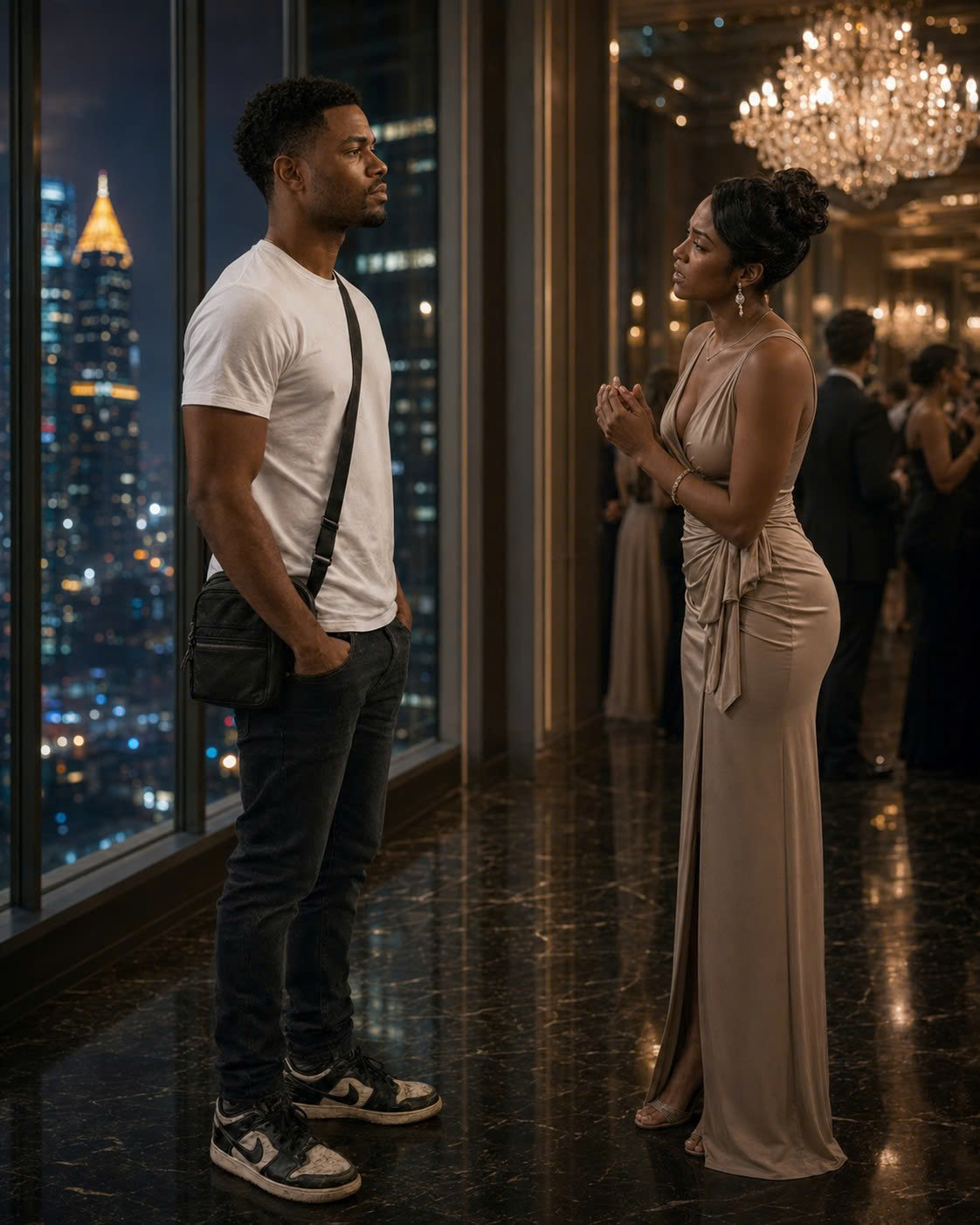
“You actually came.”
Jordan laughed.
“You invited me three times.”
“Because you ignored the first two messages.”
“I was working.”
“You’re always working.”
Trent stepped back, still holding Jordan by the shoulders.
“I can’t believe you wore that.”
“You told me to come as I was.”
“I thought you had better judgment.”
The exchange was easy, familiar, and impossible to misinterpret.
They were not acquaintances.
They were not business contacts performing politeness.
They were old friends.
The room changed.
It happened without anyone announcing it.
Conversations slowed.
Faces turned.
People who had dismissed Jordan seconds earlier began studying him with new interest.
Kayla was still holding her phone.
Trent’s reply appeared on the screen.
Yes. He’s one of my closest friends. Make sure he’s taken care of.
She read it once.
Then again.
Trent finally seemed to notice her expression.
“What happened?”
Kayla lowered the phone.
“Nothing. I was just confirming that he was invited.”
Trent looked from her to Jordan.
Jordan said nothing.
That silence told Trent enough.
“He was on the guest list,” Trent said.
“I know. I just thought there might have been some confusion.”
“There wasn’t.”
Kayla’s confidence weakened, but she tried to preserve the frame she had created.
“I was only being careful.”
Trent did not argue with her.
He simply placed a hand on Jordan’s shoulder and said, “Come on. The bride’s father has been asking when you’d arrive.”
As they walked away, Kayla stood motionless.
The circle of attention around her dissolved, but the discomfort remained.
A woman beside her leaned closer.
“Did he say Calloway?”
Kayla looked over.
“What?”
“His last name.”
“Yes.”
The woman stared toward Jordan.
“Jordan Calloway?”
Kayla’s stomach tightened.
“You know him?”
“Not personally.”
The woman lowered her voice.
“But I know the name.”
She pulled out her phone and searched quickly.
A company profile appeared.
Calloway Group.
Infrastructure, commercial development, logistics, energy, and private investment.
The business operated across multiple states and had recently led a redevelopment project worth several hundred million dollars.
At the top of the page was a photograph of Derek Calloway, the company’s founder and executive chairman.
Beneath it, in a smaller leadership section, was Jordan’s name.
Jordan Calloway.
Director of Strategic Operations.
Kayla looked at the photograph.
It was the same man standing twenty feet away in worn sneakers.
The news moved through the ballroom with remarkable speed.
Not loudly.
Rooms like that rarely needed loud gossip.
A name passed from one person to another.
Calloway.
Derek Calloway’s son.
Calloway Group.
Trent’s friend from college.
Someone said Jordan had helped restructure one of the company’s underperforming divisions.
Someone else said he had negotiated a logistics partnership that saved millions.
A third person claimed he was being prepared to take over part of the group.
The same people who had ignored him began searching for reasons to approach him.
A man who had looked away earlier now adjusted his jacket and walked toward Trent.
A woman near the bar asked whether Jordan was single.
Another guest quietly deleted a joke he had typed into a group chat.
Kayla heard fragments of it all.
Each one landed like another weight.
Then the ballroom shifted again.
Derek Calloway had arrived.
He did not enter with an entourage.
He did not pause for photographs.
He wore a dark suit with no visible designer logo and carried himself with the relaxed focus of a man who had nothing to prove.
Still, people noticed.
The bride’s father excused himself from a conversation.
Two investors moved aside.
A city official straightened as Derek passed.
He greeted several people by name, but he did not stop for long.
His attention had already settled on his son.
Derek walked directly to Jordan.
When he reached him, he placed one hand against the back of Jordan’s neck and pulled him close for a brief embrace.
It was not a formal gesture.
It was the instinctive touch of a father who had greeted his son that way for years.
“You made it,” Derek said.
“Barely.”
“You’re late.”
“I’m twenty minutes early.”
“For you, that’s late.”
Jordan smiled.
Across the room, Marcus Bellamy watched the exchange.
Marcus knew Derek.
Not well enough to call him a friend, but well enough to understand what his presence meant.
He also knew his daughter.
He looked at Kayla, then toward Jordan, then back at Kayla.
His expression changed slowly.
First confusion.
Then recognition.
Then disappointment.
Kayla could not hold his gaze.
For the first time that night, she seemed to notice every detail of her own appearance.
The expensive dress.
The diamond earrings.
The shoes selected specifically because they would be seen.
Minutes earlier, those things had made her feel secure.
Now they felt like evidence against her.
She moved away from the center of the ballroom and stood near an empty corridor behind the reception area.
The music continued.
The champagne continued.
Guests returned to their conversations.
But Kayla could not.
She replayed the scene exactly as it had happened.
The way she had looked at Jordan’s shoes.
The tone she had used when he said Trent invited him.
The satisfaction she had felt while sending the message.
The fact that she had not merely questioned him.
She had wanted other people to see her question him.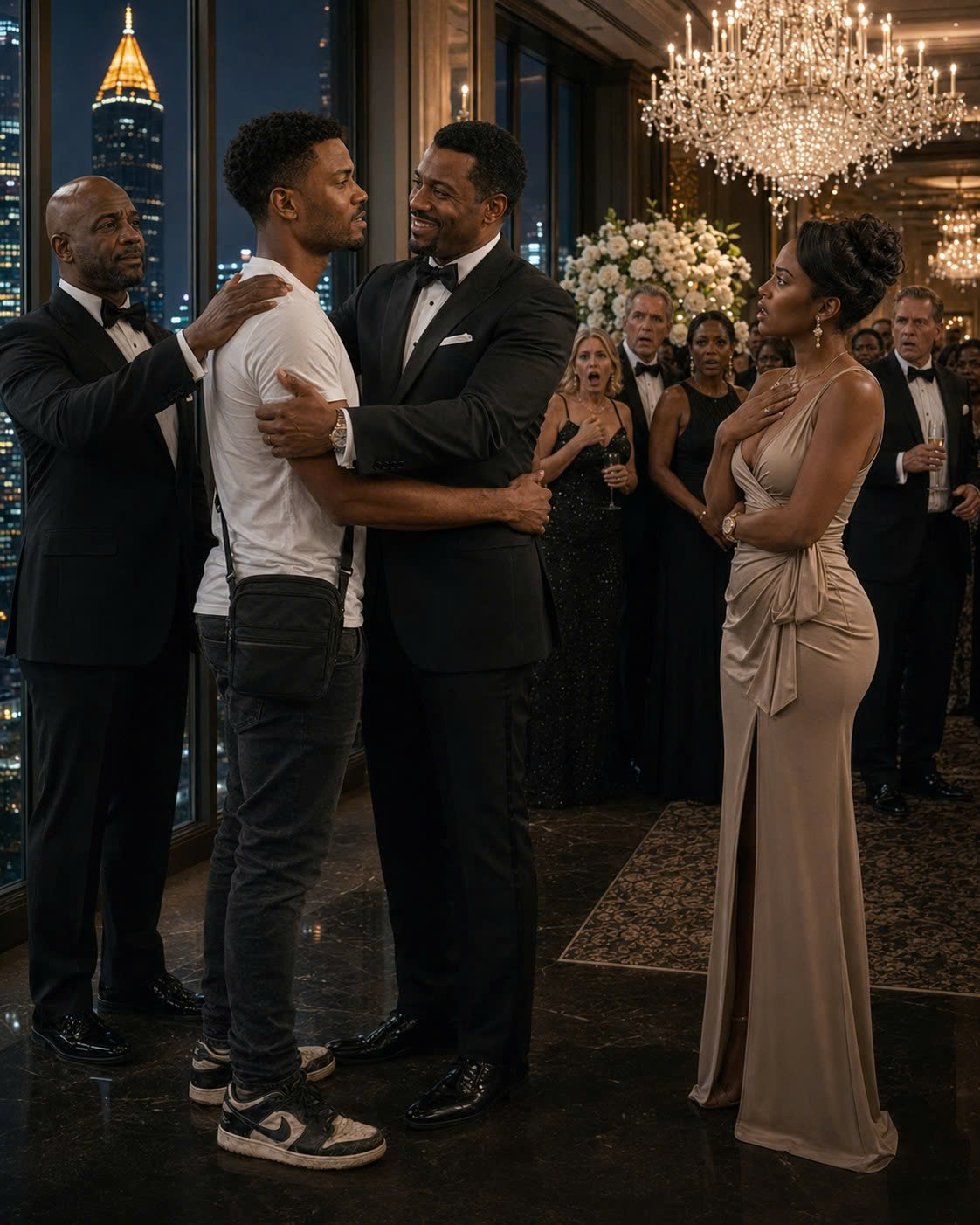
That was the part she could not excuse.
She had not been protecting the wedding.
She had been performing authority.
And she had chosen Jordan because she believed his appearance made him safe to humiliate.
For nearly twenty minutes, she remained in the corridor.
Then she found him.
Jordan was standing near a quieter section of the terrace, away from the music, speaking with one of Trent’s relatives.
Kayla waited until the conversation ended.
“Jordan?”
He turned.
Her voice no longer carried the edge it had before.
“Can I speak with you?”
He looked at her for a moment.
“Sure.”
“Privately?”
They walked several steps away from the terrace doors.
Kayla clasped her hands in front of her.
For once, she did not know where to place them.
“I owe you an apology.”
Jordan said nothing.
She continued.
“I judged you based on what you were wearing. I assumed you didn’t belong here, and I spoke to you in a way I would not have spoken to someone I considered important.”
Her voice tightened slightly.
“I also did it in front of other people. I could have asked Raymond quietly. I could have checked the guest list. But I wanted to make an example of you.”
Jordan’s expression remained calm.
Kayla looked directly at him.
“That was cruel. And it was embarrassing. Not for you. For me.”
The music from inside softened as the terrace doors closed.
Jordan let several seconds pass.
Then he asked, “Would you be apologizing if Trent hadn’t hugged me?”
Kayla’s face changed.
She had prepared herself for anger.
She had not prepared for precision.
Jordan continued.
“Would you be standing here if no one had told you who my father was?”
Kayla looked down.
“No.”
The answer came quietly.
Then she looked up again.
“Not tonight.”
Jordan waited.
She took a breath.
“I think the truth is that finding out who you were shocked me into seeing what I had done. So yes, your name is part of why I’m here.”
She swallowed.
“But it isn’t the reason I know I was wrong.”
Jordan studied her face.
There was no performance left in it.
No attempt to appear polished.
No effort to protect her reputation.
Just discomfort and honesty.
“I’m sorry,” she said. “Not because you’re Derek Calloway’s son. I’m sorry because you should not have needed to be.”
Jordan looked toward the city.
For the first time since she approached him, his expression softened.
“That’s a better apology.”
Kayla exhaled slowly.
“I don’t expect you to forgive me.”
“I do.”
She blinked.
“You do?”
“I forgive you.”
“Why?”
“Because staying angry won’t improve either of us.”
He paused.
“And because you came back.”
Kayla’s shoulders lowered slightly.
Most of the tension remained, but something had shifted.
They stood in silence for a moment.
Then Kayla glanced through the glass toward Derek.
“Your father seems different from what I expected.”
Jordan smiled faintly.
“What did you expect?”
“I don’t know. Someone louder.”
“He can be loud.”
“He seems real.”
Jordan looked back toward his father.
“He is.”
Kayla hesitated.
“Can I ask you something?”
“You’ve asked several things already.”
This time, there was humor in his voice.
She almost smiled.
“Why did you dress like that?”
Jordan looked down at his white T-shirt.
“Like what?”
“You know what I mean.”
“I do.”
He adjusted the strap of the small drawstring bag.
“My father asked me to.”
Kayla frowned.
“For the wedding?”
“Not specifically.”
Jordan leaned against the terrace railing.
“When I was sixteen, my father took me to a hotel where he was considering investing. He gave me cash for lunch, took my phone, and told me to walk in wearing clothes that made me look like I had no money.”
“What happened?”
“The staff ignored me for twenty minutes.”
Kayla said nothing.
“A manager eventually told me the lobby was for guests only. Then my father walked in, and everything changed.”
Jordan glanced through the doors at the ballroom.
“He bought the hotel six months later. The manager was not fired, but the entire staff was retrained.”
Kayla folded her arms, not defensively this time, but as though the night air had become colder.
“My father told me that money has a way of changing the temperature of a room. People become warmer. More patient. More interested.”
Jordan tapped one finger lightly against the railing.
“So once a year, at least once, he asks me to attend something important without showing any sign of status. No tailored suit. No watch. No car waiting outside. No assistant.”
“He sends you into rooms like this on purpose?”
“He calls it the real test.”
Kayla looked at him.
“A test of what?”
“Of the room.”
Jordan’s answer was simple.
He continued before she could respond.
“You learn a lot about people when they believe you cannot help them.”
The words settled between them.
Inside, guests laughed as the band began its next song.
Kayla looked through the glass at the chandeliers, the flowers, the designer clothes, and the carefully arranged tables.
Earlier, the room had seemed beautiful.
Now it seemed revealing.
“So I failed,” she said.
Jordan did not answer immediately.
“You were part of the answer.”
Kayla closed her eyes for half a second.
The sentence was not cruel.
That made it harder to avoid.
“I’m going to remember that.”
“I think you will.”
They returned to the reception separately.
No one applauded.
No one announced that Kayla had apologized.
There was no dramatic confrontation and no public punishment.
But something had changed in the way she moved through the room.
She stopped scanning for the most important person to greet.
She thanked a waiter after he replaced her glass.
She introduced herself to Raymond on her way past the entrance.
Later, when one of her friends made a quiet joke about Jordan’s sneakers, Kayla did not laugh.
“Don’t,” she said.
The friend looked surprised.
Kayla did not explain.
Near the end of the evening, Derek found Jordan standing by the same window where he had spent his first minutes at the wedding.
“How was the room?” Derek asked.
Jordan smiled.
“Predictable.”
“That bad?”
“Not entirely.”
Derek followed his gaze toward the ballroom.
“Someone came back.”
Derek looked at him.
“To apologize?”
“Yes.”
“Honestly?”
“I think so.”
Derek nodded once.
“That’s rare.”
“I forgave her.”
Another small nod.
“Good.”
That was all Derek said.
But Jordan understood what it meant.
They stood side by side near the glass, both looking out over the city.
From behind, their posture was almost identical.
The same stillness.
The same patience.
The same refusal to let a room decide their value.
Across the ballroom, Kayla saw them.
She did not approach.
She simply watched for a moment, then collected her coat and left the venue alone.
The line of luxury cars was still waiting outside.
The flowers were still perfect.
The chandeliers were still glowing.
But none of it impressed her the way it had a few hours earlier.
Three weeks later, Kayla returned to a youth center where she had volunteered twice before.
On her previous visits, she had spent most of her time taking photographs, organizing donations, and making sure the nonprofit director knew which family had sponsored the afternoon program.
This time, she left her phone in her bag.
Near the back of the room sat a teenage boy in an oversized sweatshirt.
He had not joined the basketball game.
He had not spoken to the volunteers.
One of the staff members said he was new.
Kayla almost asked him why he was sitting alone.
Instead, she walked over, sat in the chair beside him, and looked toward the court.
For several minutes, neither of them spoke.
Then the boy said, “I don’t know anyone here.”
Kayla nodded.
“I didn’t know anyone at my first day either.”
He looked at her.
She did not ask where he lived.
She did not ask about his parents.
She did not decide who he was from his clothes.
She simply stayed.
That night at the wedding had not changed the chandeliers, the guest list, or the amount of money in the room.
It changed the way Kayla entered the next one.
Because the most expensive mistake we make is not wearing the wrong thing, saying the wrong name, or standing in the wrong place.
It is looking directly at a human being and deciding they matter only after someone powerful tells us they do.