Chapter One
The Man in the Faded Denim Jacket
Judge Adrian Voss had humiliated twelve people before lunch.
The thirteenth wore medals.
They hung from a faded denim jacket that had gone soft at the elbows and pale along the seams. Some ribbons were sun-bleached. One bronze medallion carried a nick along its edge. Above them all rested a blue ribbon holding a five-pointed star inside a ring of gold.
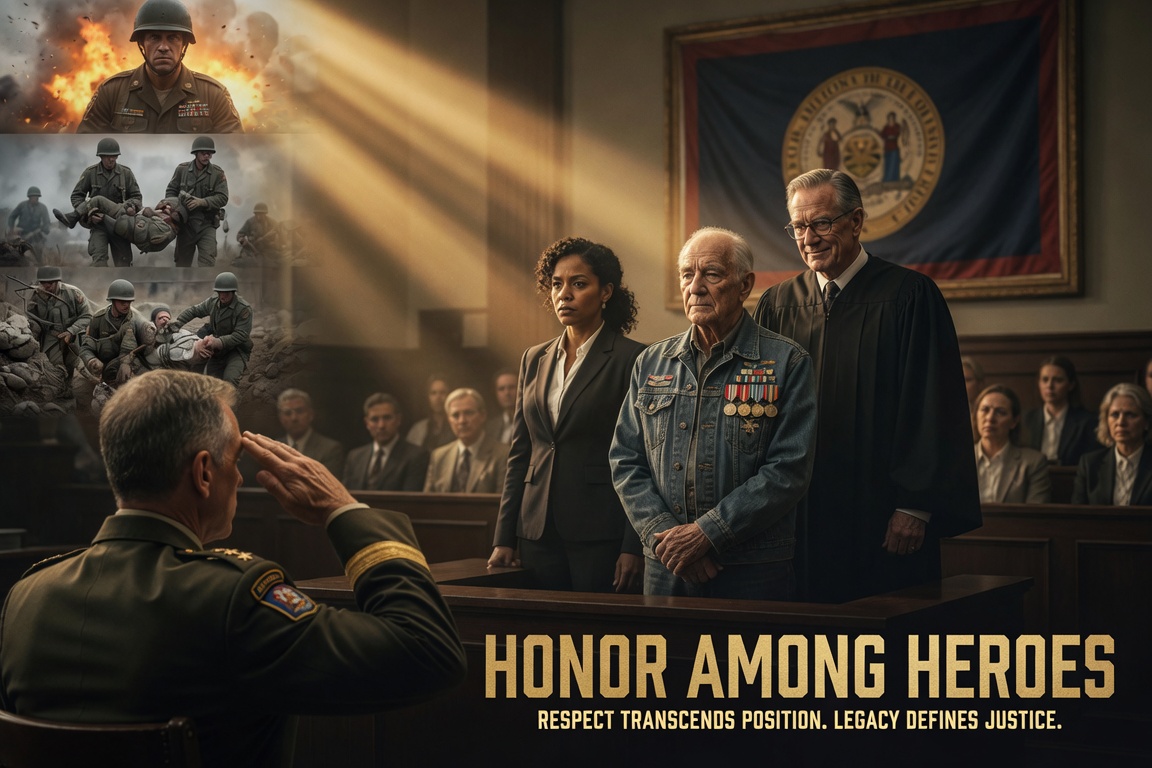
The old man stood alone at the defense table.
Seventy-nine years old.
Five feet ten after age had taken an inch from his spine.
White hair combed back with water.
A scar curved from his left ear toward the base of his throat.
His name was Elias Mercer.
His traffic citation said he had failed to stop at a red light, obstructed his license plate, and refused a lawful vehicle search.
The courtroom saw only the medals.
Whispers moved through the wooden benches.
A teenager lifted a phone before the bailiff ordered him to put it away. Two off-duty deputies exchanged smiles. A woman waiting on a parking appeal leaned forward for a better look.
Outside the tall courthouse windows, January rain blurred the brick buildings of Briar County into gray shapes. Wet coats steamed beneath old radiators. The room smelled of floor polish, paper, and the bitter coffee cooling beside the judge’s hand.
Adrian Voss adjusted his black robe.
At fifty-eight, he had the posture of a man who believed slouching encouraged disorder. His silver hair ended precisely above his collar. His glasses rested low on a narrow nose, allowing him to look over them whenever disappointment required an audience.
“Mr. Mercer,” he said, “this is traffic court.”
Elias nodded.
“I’m aware.”
“Then explain the costume.”
The room changed.
Not loudly.
A few people laughed because the judge had made laughter feel permitted.
Elias looked down at the jacket.
“My suit no longer fits.”
“That is not what I asked.”
“No, sir.”
Voss’s mouth tightened.
He disliked being called sir by defendants. It sounded respectful while reminding the courtroom that respect did not belong exclusively to the bench.
He pointed his pen toward Elias’s chest.
“Those decorations. Are they yours?”
“Yes.”
“Did you serve?”
“Yes.”
“Branch?”
“Army.”
“Dates?”
“Long enough ago that the paperwork has probably learned to drink.”
A second wave of laughter moved through the benches.
This time it did not come at Elias’s expense.
Judge Voss tapped the pen against his desk.
“Humor is a poor substitute for verification.”
Elias said nothing.
“Do you possess discharge records?”
“Not with me.”
“Military identification?”
“No.”
“Proof that you were awarded any of those medals?”
Elias’s eyes moved briefly toward the blue ribbon.
“No.”
The judge leaned back.
“There it is.”
A clerk near the wall lowered her head.
She had seen the same expression on Voss during stolen-valor hearings. The moment suspicion became certainty and certainty demanded performance.
“Briar County has an unfortunate history,” Voss said, “of individuals using false military claims to avoid fines, gain sympathy, and solicit charitable support.”
“I haven’t requested sympathy.”
“You wore decorations into my courtroom.”
“I came from a funeral.”
The answer thinned the air.
Voss paused.
“Whose?”
“Command Sergeant Major William Boone.”
“Relative?”
“Brother.”
A woman in the gallery whispered, “They don’t have the same name.”
Elias heard.
“So that means friend,” he said.
Voss studied him.
“Were you instructed to wear these medals at the funeral?”
“No.”
“Then you chose to display them.”
“Yes.”
“Why?”
Elias rested one weathered hand against the defense table. A faint tremor traveled across two fingers.
“Boone asked.”
“The deceased asked you to wear them?”
“He was organized.”
A few smiles appeared, but nobody laughed aloud now.
Judge Voss looked toward the citation.
The document had been generated by Deputy Owen Pike at 7:18 that morning. Elias’s pickup had passed through a red light near the courthouse, its rear plate partially covered in mud. When Pike requested permission to search the locked metal case in the truck bed, Elias refused.
A routine encounter.
Except the deputy had written three words in the remarks field:
Possible stolen valor.
Voss had built part of his reputation on punishing that phrase.
His father had once claimed two Purple Hearts and a Silver Star he never received. For twenty years, Harold Voss had spoken at schools, veterans’ banquets, and charity dinners. He collected donations for a rehabilitation center that existed only on paper.
When federal agents exposed him, Adrian was twenty-six and beginning his legal career.
His father hanged himself in a motel bathroom before trial.
The scandal left Adrian with a lifelong disgust for men who converted uniforms into shelter from judgment.
He looked at Elias and saw another old man expecting symbols to outrank evidence.
“Bailiff,” Voss said, “please remove the decorations.”
The bailiff hesitated.
Elias raised his head.
“Why?”
“Because unverified military honors will not be used to influence this proceeding.”
“They’re pinned to my jacket.”
“And your jacket is in my courtroom.”
“I’m still inside it.”
The bailiff’s hand remained at his side.
Voss’s voice cooled.
“Mr. Mercer, the unauthorized wearing of certain military decorations may violate federal law.”
“The law concerns fraudulent benefit.”
“Are you offering legal instruction?”
“No.”
Elias looked at him.
“I’m offering you the chance not to touch them.”
The courtroom went silent.
The judge’s fingers stopped against the citation.
“Is that a threat?”
“No.”
“What would you call it?”
“Courtesy.”
Voss leaned forward.
“Mr. Mercer, you entered this court charged with a minor traffic offense. Your refusal to cooperate has expanded the matter. Your attitude is now risking contempt.”
Elias’s tremor worsened.
He folded the hand against his stomach.
The judge noticed.
Fear, he thought.
Not injury.
“Remove the jacket,” Voss ordered.
Elias did not move.
The bailiff approached.
At the rear of the courtroom, the doors opened.
A woman entered wearing a rain-darkened Army overcoat.
Four silver stars shone on each shoulder.
Every uniformed person in the room came to attention before understanding why.
The deputies straightened.
The bailiff stopped.
Judge Voss rose halfway from his chair.
The woman removed her cap.
General Miriam Ward was sixty-three, Black, six feet tall, with closely cropped silver hair and a face familiar from congressional hearings and military funerals. She served as the Army Vice Chief of Staff. Two military police officers entered behind her, followed by a federal attorney carrying a sealed black case.
General Ward’s gaze crossed the room.
It settled on Elias.
He looked tired rather than surprised.
She walked down the center aisle.
Her boots struck the floor in measured beats.
When she reached the defense table, she stopped in front of the old man and raised her hand.
The four-star general saluted.
Elias closed his eyes.
Only for a moment.
Then he returned it.
Nobody in the courtroom breathed normally.
General Ward lowered her hand and faced the judge.
“Your Honor, stop this proceeding.”
Voss regained enough composure to stand fully.
“General, this is a county court.”
“Yes.”
“You have no authority over my docket.”
“No military authority.”
She looked toward the federal attorney.
“But you are holding a protected federal witness under a citation generated through a compromised state database.”
The judge’s face tightened.
“This man ran a red light.”
“This man’s vehicle registration has been sealed since 1989.”
She placed a document on the clerk’s desk.
“Someone accessed it through a terminal assigned to your chambers.”
Whispers broke across the gallery.
Voss looked toward his court administrator.
She shook her head.
General Ward continued.
“The decorations you called costume jewelry are authentic.”
Her eyes moved to the blue ribbon.
“Every one of them.”
The federal attorney opened the black case.
Inside lay a presidential citation bearing Elias Mercer’s name.
Judge Voss stared at the heading.
MEDAL OF HONOR
Color drained from his face.
General Ward’s voice remained level.
“Command Sergeant Major Elias Mercer received the Medal of Honor for actions during Operation Lantern Ridge.”
The judge looked at Elias.
The old man had not changed.
Same worn jacket.
Same trembling hand.
Same silence.
Only the courtroom’s opinion had moved.
Voss swallowed.
“Why is his identity sealed?”
General Ward looked toward the locked metal case listed on the citation.
“Because the public record of Lantern Ridge is false.”
A second federal agent appeared at the courtroom door and whispered into her ear.
The general’s jaw tightened.
“What?”
“The evidence case is gone.”
Elias’s head snapped up.
General Ward turned toward him.
“It was removed from your truck before our agents reached the impound lot.”
Judge Voss stared between them.
“What was inside?”
Elias touched the medals on his jacket.
“Proof that the men named heroes were not the only people who saved us.”
The courthouse lights flickered.
A fire alarm began to ring.
Then the clerk’s computer screen went black.
White letters appeared:
MERCER SHOULD HAVE LET THE DEAD KEEP THEIR HONOR.
Chapter Two
The Citation Beneath the Mud
The courthouse was evacuated into freezing rain.
People crowded beneath stone arches and plastic umbrellas while firefighters entered through the main doors. Reporters arrived before the first engine shut down. News traveled quickly when a four-star general saluted an old man in traffic court.
Elias stood beneath the portico.
Water darkened the shoulders of his denim jacket.
General Ward removed her overcoat and placed it around him.
He gave it back.
“You outrank the weather,” he said.
“Only administratively.”
“You always did confuse paperwork with power.”
The smallest smile touched her mouth.
Then disappeared.
A black federal vehicle waited at the curb. Military police formed a barrier between Elias and the growing cameras.
Judge Voss emerged from the building without his robe.
In a charcoal suit, he looked thinner. Less protected.
He walked toward General Ward.
“Fire department found no fire.”
“We know,” she said.
“The alarm was triggered through the courthouse system.”
“We know that too.”
Voss looked at Elias.
The old man did not help him.
“I owe you an apology,” the judge said.
Elias watched rain collect along the courthouse steps.
“For which part?”
Voss’s jaw tightened.
“The remarks about your medals.”
“The contempt threat?”
“That also.”
“The bailiff?”
“Yes.”
“The assumption that age and bad clothes meant I needed your permission to be who I was?”
General Ward glanced toward Elias.
The judge absorbed the question.
“Yes.”
Elias nodded once.
“Start there.”
Voss waited.
No forgiveness arrived.
He looked toward the federal vehicle.
“Someone used my chambers to access the registration?”
“Your judicial credentials,” Ward said. “Three nights ago.”
“I was at a bar association dinner.”
“Your terminal was active.”
“My clerk?”
“Her credentials were not used.”
Voss folded his arms against the cold.
“You think I arranged the citation.”
“I think someone wanted Mr. Mercer brought into your courtroom.”
“Why mine?”
Elias answered.
“Because you would make a spectacle.”
Voss flinched.
The old man did not sound cruel.
That made it harder.
General Ward opened the vehicle door.
“Your Honor, until we determine whether the breach came through your staff or your equipment, your chambers are a federal crime scene.”
“You cannot close a state court.”
“The chief administrative judge already has.”
His phone vibrated.
He looked at the notification.
The day’s docket had been reassigned.
For a man who controlled rooms through procedure, removal arrived like a physical wound.
“I need to see the access logs.”
“You need counsel.”
“I did nothing.”
“Then counsel will enjoy the simplicity.”
Elias climbed into the vehicle.
Judge Voss caught the door before it closed.
“What was in the stolen case?”
General Ward answered from the opposite seat.
“Original field records from Operation Lantern Ridge.”
“Why keep them in a pickup?”
“Because federal archives have been breached twice,” Elias said. “And nobody expects history to travel under a rusted lawn mower.”
Voss looked toward the impound lot across town.
“Who knew you had it?”
“Four people.”
“Names?”
Elias met his eyes.
“One died this morning.”
William Boone.
The funeral.
Voss’s expression changed.
“Was his death natural?”
“No,” General Ward said.
The judge’s hand fell from the door.
The vehicle pulled away.
Maya Mercer watched from beneath a red umbrella across the street.
She had arrived too late for the hearing and early enough to see a general place her coat around the grandfather she had not spoken to in eleven months.
At thirty-seven, Maya worked as a public defender in Richmond. Her dark curls had escaped beneath the hood of her raincoat. A leather case hung from one shoulder. She had inherited Elias’s brown eyes and her late father’s habit of pressing her tongue against the inside of her cheek whenever anger needed somewhere to wait.
She crossed the street.
The federal vehicle stopped at the corner for traffic.
Maya slapped one hand against the rear window.
Elias turned.
Surprise opened his face.
The door unlocked.
She climbed inside, wet and breathing hard.
General Ward recognized her.
“You’re Daniel’s daughter.”
Maya stared.
“You knew my father?”
The general’s eyes moved to Elias.
He looked out the window.
Maya followed his gaze.
“Oh, no. You don’t get to disappear into the scenery.”
“Maya—”
“I received a voicemail from the courthouse saying you were being held for contempt. Then I arrived and watched the Army Vice Chief escort you out like the President had misplaced you.”
She looked at the medals.
“Why are you wearing those?”
“Funeral.”
“Whose?”
“Boone.”
Her anger paused.
She had met William Boone twice as a child. A massive man with gentle hands who carved wooden animals and told jokes so slowly she forgot the beginning before he reached the end.
“He died?”
“This morning.”
“I’m sorry.”
Elias nodded.
The vehicle turned through downtown.
Maya looked toward General Ward.
“And you are?”
“Miriam Ward.”
“I know who you are.”
“That makes introductions efficient.”
“Why do you know my family?”
Ward waited.
Elias remained silent.
Maya laughed without humor.
“Wonderful. Two decorated professionals conducting a classified competition to see who can avoid a sentence longest.”
General Ward leaned forward.
“Your grandfather is a Medal of Honor recipient.”
Maya stared at her.
Then at Elias.
“No.”
He did not answer.
“My grandfather repairs tractors.”
“I still do.”
“You told me you left the Army as a sergeant.”
“I did leave as a sergeant.”
Ward corrected him.
“Command sergeant major.”
“Eventually.”
Maya’s breathing changed.
Her father, Daniel Mercer, had spent years accusing Elias of hiding behind war stories he never told. After Daniel’s death, Maya discovered boxes of unanswered letters between them. She blamed Elias for allowing pride to outlive his son.
Now the old man beside her possessed the nation’s highest military decoration and had hidden that too.
“Dad knew?”
“Yes.”
“Did he know the citation was sealed?”
“Yes.”
“Did he know what happened?”
“Not all of it.”
“Of course.”
She pulled the door handle.
It remained locked.
“Let me out.”
“We’re moving,” Elias said.
“I noticed.”
“Maya.”
“You let me believe Dad resented you because you were absent. He resented you because everything in this family had a locked door.”
The driver slowed.
General Ward touched a control.
The doors unlocked.
Maya did not leave.
Rain passed across the windows.
“What was Operation Lantern Ridge?” she asked.
Elias looked at his medals.
“A rescue people wanted remembered incorrectly.”
Ward opened a tablet.
A photograph appeared.
Nine young soldiers stood beside a helicopter in a jungle clearing. The image had faded to green and brown. Elias was twenty-four, lean, unsmiling, one hand resting on the shoulder of a Black medic.
William Boone.
Beside them stood a young Vietnamese woman wearing a white shirt darkened by rain. She held a folded map and stared into the camera without smiling.
“Her name was Linh Tran,” Ward said. “Interpreter, nurse, and intelligence courier. She was omitted from the official report.”
“Why?”
“Because she proved American forces had entered a location the government denied existed.”
Maya looked at Elias.
“What did she do?”
“Saved all of us.”
“And Boone?”
Elias’s voice lowered.
“Saved more.”
Ward changed the image.
A typed citation appeared, describing Elias holding a defensive position alone while evacuating wounded soldiers from Lantern Ridge.
“The citation says Mr. Mercer acted alone,” Ward said. “He did not.”
Maya looked at the Medal of Honor.
“Then why accept it?”
Elias closed his eyes.
“Because they offered Boone’s family benefits if we stopped asking questions.”
Maya’s anger lost direction.
The vehicle entered a secure federal garage beneath a government building.
General Ward’s phone rang.
She listened.
“Where?”
Her face hardened.
She turned toward Elias.
“William Boone’s body is missing.”
Maya stared.
“How does a body go missing?”
Ward lowered the phone.
“The funeral home received a military transfer order with authentic credentials.”
Elias looked toward the ceiling as though listening to something far away.
“They’re looking for the key.”
“What key?” Maya asked.
He touched the nicked bronze medallion on his jacket.
The edge shifted beneath his thumb.
Not damage.
A concealed hinge.
Elias opened it.
Inside the medal lay a narrow strip of metal engraved with eight numbers.
Maya stared.
“You hid a key inside a decoration?”
“No.”
He looked at the empty compartment.
“Boone did.”
A ninth number should have been present.
The strip had been broken.
The missing section was with the body.
General Ward reached for her phone.
Before she could dial, the federal garage doors slammed shut.
The vehicle’s dashboard went dark.
An engine started somewhere beyond the concrete pillars.
Then a man’s voice came through the car speakers.
“Command Sergeant Major Mercer, Judge Voss signed the order giving us your farm.”
Elias went still.
The voice continued.
“The dead have carried enough. Give us the key, and Mr. Boone can finally be buried.”
Chapter Three
The Judge’s Arithmetic
Adrian Voss returned to his empty courtroom after midnight.
Federal investigators had removed the computers.
Evidence tape crossed the chamber door.
His robe remained folded over the chair behind the bench, the sleeves hanging down like empty arms.
He entered anyway.
The courthouse had never felt large while occupied. Without clerks, defendants, lawyers, or the movement of paper, it became a tomb designed for authority.
He stood where Elias Mercer had stood.
The defense table carried a faint circle from the old man’s wet hand.
Voss placed his palm over it.
Cold wood.
Nothing mystical.
No sudden understanding.
Only the knowledge that he had looked at a genuine Medal of Honor and seen his father’s lie.
The chamber door opened.
His younger brother entered.
Marcus Voss used two carbon-fiber prosthetic legs and walked with a measured rhythm that made strangers admire him before he spoke. At fifty-three, he had retained the square shoulders of the Marine officer he had once been. A bombing in Iraq took both legs below the knee and killed three men in his vehicle.
He returned home to a county that praised his sacrifice and denied payment for the rehabilitation equipment he needed to climb stairs.
Marcus built Haven Ridge Veterans Network from a borrowed church basement.
It now operated four clinics, two housing centers, an addiction program, and a legal trust for elderly veterans.
Adrian had signed its incorporation papers.
Donated half his salary.
Defended it whenever reporters asked how a local nonprofit grew so quickly.
Marcus looked toward the dark bench.
“You shouldn’t be here.”
“Neither should you.”
“The night custodian called.”
“Of course he did.”
“He’s worried.”
“No. He reports to Haven Ridge.”
Marcus’s expression tightened.
“Everyone who accepts help from us is not an employee.”
“Did your people access my terminal?”
“No.”
“Did you know Elias Mercer would appear in my court?”
Marcus stopped.
That was enough.
Adrian stepped closer.
“You knew.”
“I knew a traffic citation had been issued.”
“Why?”
“Because Mercer’s farm is involved in a guardianship dispute.”
“There is no dispute. He never appeared before me.”
“You signed an emergency preservation order three days ago.”
Adrian stared.
“I signed eighty-two orders during the winter docket.”
“One concerned the Mercer property.”
“On whose petition?”
“Haven Ridge Adult Protection.”
The judge’s stomach tightened.
Emergency preservation orders allowed temporary control over property belonging to elderly adults believed to be cognitively impaired or exploited. Adrian signed them when delay risked foreclosure, theft, or predatory transfer.
He had trusted Haven Ridge’s evaluations.
“How long have you been trying to take his farm?”
“Protect it.”
“Use human language.”
Marcus’s jaw flexed.
“Acquire the mineral rights before Aurelius Systems files condemnation.”
Adrian laughed once.
“You are taking land from an elderly man to save him from someone else taking it.”
“His farm sits above a decommissioned military site. Aurelius has federal support. Once the site is declared contaminated, Mercer receives nothing.”
“You knew he was a decorated veteran?”
“I knew he served.”
“A Medal of Honor recipient.”
Marcus’s face changed.
He had not known.
Adrian saw the news wound him differently.
The old hierarchy of sacrifice remained alive inside men like his brother. Rank and medals still rearranged moral attention even when they knew better.
“You would have taken the farm if he wore no ribbon,” Adrian said.
“I would have transferred it into trust.”
“Without consent.”
“He refuses every meeting.”
“Perhaps because your legal department has been declaring veterans incompetent.”
Marcus’s hands closed around the handles of his cane.
“Haven Ridge has prevented forty-seven foreclosures.”
“How many properties did the trust keep?”
Silence.
Adrian stepped closer.
“How many?”
“Eleven.”
“And sell?”
“Six.”
“To Aurelius?”
Marcus looked away.
The answer moved through the empty courtroom.
Adrian felt the bench behind him like a witness.
His signature sat beneath every emergency order.
“Why does Aurelius want Mercer’s farm?”
Marcus moved toward the windows.
Rain painted the glass black.
“There is an Army installation beneath it.”
“General Ward called it Lantern Ridge evidence.”
“She told you?”
“No. She told the courtroom enough.”
Marcus stared at his reflection.
“Aurelius believes the installation contains field records from a chemical-exposure program connected to Operation Lantern Ridge.”
“And you?”
“I know it does.”
Adrian’s mouth went dry.
“How?”
“Daniel Mercer told me.”
The name struck harder than accusation.
Daniel had been Elias’s only son and Maya’s father. Twelve years earlier, his car went through the guardrail above Briar Creek. Police called it driver fatigue.
Adrian had spoken to him four hours before the crash.
That conversation had haunted him because Daniel sounded frightened, and Adrian had chosen procedure over urgency.
“He called me,” Adrian said.
“He called both of us.”
“What did he tell you?”
“That he found medical records beneath the farm. Soldiers exposed to an experimental nerve agent. Villagers listed as hostile casualties. Boone and Linh kept names.”
Adrian remembered Daniel’s voice.
Judge, I need to know whether a guardianship trust can take property without the owner understanding what sits beneath it.
Adrian thought Daniel was asking a hypothetical legal question.
He gave a technical answer.
Then advised him to retain counsel.
He had not asked why.
“What happened to him?” Adrian whispered.
Marcus gripped the window ledge.
“I told him to give me the records.”
“And when he refused?”
“I sent Caleb Rusk to speak with him.”
“Your security director.”
“Yes.”
“Speak?”
Marcus’s face tightened.
“Rusk was supposed to persuade him.”
“His car went off a mountain.”
“I did not order that.”
“Did Rusk?”
“He said Daniel panicked and drove away.”
“Did you investigate?”
“I protected Haven Ridge.”
The words entered the courtroom and remained.
Marcus turned.
“Daniel wanted to expose everything immediately. The clinics would have been frozen. Federal agencies would call every donor transaction evidence. Veterans would lose medication, housing, treatment.”
“So you covered up my friend’s son’s death.”
“I covered uncertainty.”
“You built an empire from euphemisms.”
Marcus’s face hardened.
“And you built a courtroom where certainty wears your robe.”
The blow landed because it was deserved.
Adrian looked toward the bench.
For years, he had converted suspicion into punishment quickly because he believed delay allowed liars to prosper.
His father had escaped accountability through charm, medals, and hesitation from people afraid to challenge a veteran.
Adrian had vowed never to hesitate.
That vow had become another form of blindness.
“Who accessed my terminal?” he asked.
“Rusk has court-system credentials through the protection program.”
“You gave him access?”
“You approved Haven Ridge integration.”
Adrian remembered the document.
Electronic coordination to protect vulnerable adults.
Useful.
Efficient.
Dangerous in ways he had never examined.
“Where is Rusk now?”
Marcus checked his phone.
No signal.
The courthouse windows reflected movement behind them.
Adrian turned.
Caleb Rusk stood inside the doorway.
Sixty years old.
Former Army intelligence.
Dark suit beneath a raincoat.
A pistol held low against his thigh.
“Mr. Voss,” he said to Marcus, “you should not have come here.”
Adrian looked at his brother.
Marcus’s face had gone pale.
Rusk closed the door.
“You killed Daniel Mercer,” Adrian said.
Rusk’s expression did not change.
“He found material capable of collapsing a defense contract, a county economy, and every Haven Ridge program.”
“That is not an answer.”
“It is the answer adults use after consequences become larger than one person.”
Marcus stepped between them.
“I never authorized murder.”
“No.”
Rusk looked almost disappointed.
“You authorized preservation. I completed the requirement.”
Adrian’s gaze moved toward the evidence tape.
“You stole Mercer’s case.”
“Not yet.”
“Boone’s body?”
“Necessary.”
Marcus’s voice broke.
“You took a dead man from his funeral.”
“The final key fragment is implanted beneath his old shrapnel scar.”
Adrian stared.
“Implanted?”
“Boone did not trust banks.”
Rusk lifted the pistol.
“Judge, I need an order validating the Mercer property transfer before dawn.”
“You already forged one.”
“A forged emergency order attracts review. A signed permanent order ends it.”
“And if I refuse?”
Rusk looked toward Marcus.
The brothers understood at the same time.
Haven Ridge was not Marcus’s institution anymore.
It was leverage.
Rusk smiled faintly.
“Then the organization your brother built becomes evidence of a criminal conspiracy, and every patient learns which Voss destroyed their care.”
Adrian looked toward the dark bench.
For decades, he had believed power lived in making decisions.
Now he understood how often power belonged to the person who designed the choices.
He raised his eyes.
“Bring me the order.”
Marcus turned sharply.
“Adrian.”
The judge did not look at him.
“I’ll sign it.”
Rusk’s pistol lowered slightly.
Adrian walked toward the bench.
He took his seat.
The robe remained folded behind him.
For the first time in his career, he felt honest without it.
He opened the blank emergency order.
Then pressed the courthouse panic switch beneath the desk.
Nothing happened.
Rusk smiled.
“You always did trust systems more than people.”
The side door opened.
Maya Mercer stepped into the courtroom holding the broken half of her grandfather’s medal key.
She looked at Adrian.
“My father trusted you once.”
Rusk turned the pistol toward her.
Maya raised her phone.
Its screen showed a live federal broadcast.
“Try deciding what consequence is acceptable while the whole country watches.”
Chapter Four
The Medal Citation That Lied
The federal garage attack lasted ninety-one seconds.
Long enough to destroy two vehicles.
Long enough for Maya to learn that General Miriam Ward carried a pistol beneath her dress uniform.
Long enough for Elias Mercer to disappear.
The attackers breached the garage through a maintenance tunnel. They used smoke, directional lights, and a recording of gunfire to split the federal team. Their objective was not killing.
It was extraction.
When the smoke cleared, the old man and the medal key were gone.
Maya found the broken fragment beneath the vehicle seat.
General Ward found a blood smear along the tunnel wall.
Not Elias’s.
One attacker had learned that age reduced speed more reliably than accuracy.
Elias had fought.
The trail led toward the courthouse.
Maya arrived through a lower records passage Daniel once showed her during summer internships. She reached the courtroom in time to hear Rusk demand the judge’s signature.
Her live broadcast was a bluff.
The phone had no signal inside the sealed building.
Rusk studied the screen.
One blue icon pulsed.
He believed it.
That gave Judge Voss three seconds.
He lifted the heavy wooden gavel and threw it.
Not at Rusk.
At the courtroom lights.
Glass burst.
Darkness swallowed the chamber.
The pistol fired.
Maya dropped behind the witness rail.
Marcus drove one prosthetic foot into Rusk’s knee. The security chief struck the floor, fired again, then disappeared through the side door before emergency lights activated.
Judge Voss stood behind the bench, breathing hard.
Blood darkened his left sleeve.
Maya crawled toward him.
“You’re hit.”
“Grazed.”
Marcus leaned against the defense table.
“Rusk has Elias.”
“Where?” Maya asked.
“He needs the farm.”
“Then that’s where he’s going.”
Adrian wrapped a clerk’s scarf around his arm.
“You said Daniel trusted me.”
“He did.”
“I failed him.”
“Yes.”
No comfort.
No cruelty.
Only the fact.
Maya looked toward Marcus.
“Did you kill my father?”
His face changed.
“I sent Rusk.”
“That wasn’t what I asked.”
“No.”
“Did you cover it up?”
“Yes.”
The word shook.
Maya stepped closer.
“What did Dad find?”
Marcus looked toward the emergency exit.
“Medical film. Personnel rosters. Exposure logs. Lantern Ridge was not only a rescue.”
General Ward entered with federal agents.
Rain covered her uniform. Her eyes settled on Marcus.
“Haven Ridge founder?”
He nodded.
“You’re under arrest.”
“Then arrest me after we reach the farm.”
Ward’s jaw tightened.
“You do not negotiate.”
“If Rusk opens the underground site incorrectly, he destroys it.”
Maya held up the broken key fragment.
“He needs this.”
Marcus stared.
“Where did you get it?”
“Grandpa left it in the vehicle.”
“No. Boone carried the ninth sequence. Elias’s medal contains eight.”
“This fragment has four digits.”
General Ward took it.
The engraved numbers did not match the first strip.
Maya understood.
“Dad had another key.”
Marcus nodded slowly.
“Daniel separated the sequence. He believed no single person should control the archive.”
“Where was his half?”
“In the car when he died.”
Rusk had taken it twelve years earlier.
Now he possessed Daniel’s fragment and Boone’s.
He needed Elias’s eight numbers to complete the code.
General Ward ordered vehicles prepared.
Maya blocked her.
“I’m coming.”
“No.”
“My grandfather is missing.”
“You’re a civilian.”
“I’m a former Army JAG officer with federal litigation experience and the only person Elias may listen to if your plan involves sacrificing him for evidence.”
Ward’s face hardened.
“You know nothing about my plan.”
“That is the problem.”
The general looked toward Adrian.
The judge had removed the blood-soaked scarf and replaced it with a pressure bandage.
“You are suspended from judicial duty,” Ward said.
“I’m aware.”
“You remain a potential subject.”
“I’m becoming accustomed to disappointment.”
“You’re not coming.”
Adrian looked at Maya.
“Daniel called me the night he died.”
“I know.”
“I may know where he hid a duplicate.”
“Where?”
“Your grandfather’s barn.”
Marcus shook his head.
“We searched it.”
Adrian faced his brother.
“You searched like a land company. Daniel thought like a lawyer.”
He looked toward Maya.
“He asked what object on a farm receives legal protection despite appearing worthless.”
She thought of fixtures, deeds, burial sites.
Then:
“A boundary marker.”
Adrian nodded.
“The old veterans’ cemetery stone beside the barn.”
Maya had played near it as a child.
A granite marker bearing the names of three soldiers whose remains were never recovered from Lantern Ridge.
Elias cleaned it every Memorial Day.
General Ward went still.
“You knew about the marker?”
“Yes.”
She looked toward Elias’s medal citation inside the federal case.
The official record named three missing Americans as dead.
If their names appeared above Daniel’s duplicate key, the memorial itself was an admission that remains or evidence lay beneath the property.
The convoy left for Mercer Farm at 2:13 a.m.
Maya rode beside General Ward.
Judge Voss and Marcus traveled under guard in another vehicle.
The rain had become sleet. Ice gathered along guardrails. Pine forests closed around the road as Briar County’s lights disappeared behind them.
Maya looked toward Ward.
“You knew Daniel was investigating.”
“Yes.”
“You knew he died.”
“Yes.”
“Did you know Rusk caused it?”
“No.”
“Did you investigate?”
“Classified review found insufficient evidence.”
“Human words.”
Ward’s eyes moved toward her.
The phrase had been Daniel’s favorite whenever government language began hiding responsibility.
“We did not push hard enough,” the general said.
“Why?”
“Operation Lantern Ridge connected to an active defense program.”
“You protected it.”
“Yes.”
Maya looked through the windshield.
“Everyone keeps saying that as though honesty after exposure is courage.”
Ward accepted the blow.
“Your grandfather agreed.”
“To what?”
“To keep the records sealed until the program ended.”
“When?”
“Thirty-seven years ago.”
“And the program?”
“Expanded.”
Maya laughed bitterly.
“So his temporary silence became permanent.”
“Yes.”
“Did you use the traffic citation to draw Rusk out?”
Ward did not answer.
Maya turned.
“You knew Grandpa would be brought into court.”
“We detected the database access but allowed the citation to proceed so we could identify the terminal chain.”
“The judge humiliated him while you watched?”
“We were three minutes away.”
“You let it happen.”
The general’s jaw tightened.
“Yes.”
Maya stared.
General Ward was not the clean authority who entered and corrected everything.
She had allowed the courtroom harm because the operation seemed larger.
The pattern continued through uniforms, judges, charities, and families.
Maya looked ahead.
“If Elias dies—”
“He won’t.”
“Don’t insult me with certainty.”
Ward’s hand closed around the seat belt.
After a moment, she nodded.
“You’re right.”
The convoy turned onto Mercer Road.
A glow appeared above the trees.
Orange.
Moving.
Maya’s stomach dropped.
The farmhouse was burning.
Flames climbed through the roof. The barn stood open. Tire tracks crossed the frozen field toward the old cemetery marker.
Federal agents spread through the property.
Maya ran past them.
“Elias!”
No answer.
The barn smelled of smoke, wet hay, and diesel.
The granite marker had been pulled from the ground.
Beneath it, a steel hatch stood open.
Judge Voss reached the edge.
Cold air rose from the darkness.
On the inside of the hatch, Daniel Mercer had written a sentence in permanent ink:
IF YOU FOUND THIS, SOMEONE DECIDED THE TRUTH WAS TOO EXPENSIVE AGAIN.
A gunshot echoed from below.
Then Elias’s voice:
“Maya, don’t come down.”
She looked at General Ward.
The four-star officer drew her weapon.
Maya took one from the federal agent beside her.
The general stared.
“Former JAG?”
“Before law school, military police.”
Another shot sounded.
Maya entered the shaft.
“Families really should update one another’s résumés.”
Chapter Five
Lantern Ridge
The installation beneath Mercer Farm had once been called Station Covenant.
The name remained stenciled above a rusted blast door thirty feet underground.
Concrete corridors extended beneath the fields. Emergency lights flickered along the walls, powered by a generator someone had recently started. Dust hung in the air with the dry smell of old paper, machine oil, and metal sealed too long from weather.
Maya descended with General Ward, two federal agents, and Judge Voss.
Marcus remained above under guard until he revealed a second entrance through the grain silo. Ward brought him down in restraints because the tunnel controls had been installed by a company Haven Ridge later purchased.
The deeper they went, the colder it became.
Old Army medical symbols appeared on doors.
Not storage.
Testing rooms.
Maya saw restraints bolted to one examination table.
General Ward stopped.
She had reviewed photographs.
The room itself removed the distance those photographs allowed.
“What happened here?” Maya asked.
Elias answered through the dark.
“People learned what obedience costs when nobody plans to admit the test existed.”
He emerged from a side corridor.
Blood covered one side of his face. His denim jacket was gone. The medals remained pinned to his white funeral shirt, some hanging crooked where fabric had torn.
He held a length of broken pipe.
Maya lowered her weapon.
“Grandpa.”
Relief moved through her so violently it became anger.
“You told me not to come down?”
“It seemed clear.”
She crossed the corridor and held him.
Elias remained stiff for one second.
Then one weathered hand touched the back of her head.
“I’m sorry,” he whispered.
“For which year?”
“Most of them.”
A shot struck the wall.
Ward pulled them behind a concrete pillar.
Caleb Rusk’s voice echoed through the station.
“General, the archive chamber is wired. Any attempt to breach the eastern corridor destroys the records.”
Elias looked toward Marcus.
“Your man?”
“Not anymore.”
Rusk continued.
“Command Sergeant Major, I have Boone’s key and Daniel’s fragment. Bring me the medal strip.”
Maya looked at Elias.
“He killed Dad.”
“I know.”
“You knew?”
“Not until tonight.”
Rusk’s voice returned.
“Five minutes.”
Judge Voss examined the corridor map mounted on the wall.
“The eastern chamber has a judicial seal notation.”
Elias nodded.
“Army lawyers locked it after the investigation.”
“Mechanical?”
“Three-key sequence and a living witness authorization.”
Maya looked toward the old man.
“You.”
“Yes.”
General Ward faced him.
“What exactly is inside?”
“The original Lantern Ridge film. Exposure logs. Names of soldiers and civilians. Orders authorizing Field Trial Nine.”
Marcus’s face tightened.
“What agent?”
Elias looked toward the medical rooms.
“Neurobehavioral compound designed to reduce panic and increase compliance.”
Judge Voss stared.
“They tested obedience chemically?”
“On villagers first. Then soldiers assigned to guard them.”
Maya felt cold spread beyond the air.
“Lantern Ridge?”
“A field laboratory across the border,” Elias said. “Our squad was sent to destroy it after command learned foreign intelligence had found the site.”
“Boone?”
“Discovered prisoners still alive.”
“And Linh?”
“Worked inside the clinic. She gave us the patient list.”
Elias looked at the medals on his shirt.
“Orders said burn the laboratory and withdraw. Boone refused. Linh opened the cells. We evacuated thirty-two villagers and six American soldiers used in the trial.”
“The citation says you held off enemy forces,” Maya said.
“There were enemy soldiers.”
“But?”
“Most of the shooting came from an American security team ordered to prevent witnesses leaving.”
General Ward lowered her weapon slightly.
Her father had been one of the six rescued soldiers.
He spent the rest of his life believing an enemy prison had drugged him.
She had never told him otherwise.
“My father was in the trial,” she said.
Elias nodded.
“He asked me once whether he volunteered.”
“Did he?”
“No.”
Ward’s face changed.
The general who entered court as unquestioned authority became a daughter learning her father’s shame had been manufactured.
“Why wasn’t Boone decorated equally?” Maya asked.
“He was Black, already under investigation for disobeying a superior, and refused to sign the official statement.”
“Linh?”
“Declared an enemy collaborator after she requested evacuation for her family.”
“What happened to her?”
Elias looked away.
“She disappeared into a relocation program.”
General Ward closed her eyes.
“I know where.”
Everyone turned.
“She became Dr. Linda Tran,” Ward said. “Army epidemiologist. Died six years ago.”
“Did she have family?” Elias asked.
“A daughter.”
His shoulders lowered.
For fifty years, he had not known whether Linh survived.
Maya touched the Medal of Honor.
“They gave you this to simplify the story.”
“Yes.”
“And you accepted.”
“Yes.”
“Why?”
“Boone had a wife and three children. Army prosecutors threatened him with desertion and murder charges. They offered immunity and benefits if I accepted the citation and validated the report.”
“You could have refused.”
“Yes.”
The answer arrived without defense.
“I told myself the medal protected Boone.”
“Did it?”
“For a while.”
Maya’s eyes burned.
“What did it cost Dad?”
Elias’s hand trembled.
“He grew up seeing strangers call me a hero while I refused to explain why I could not attend his school concerts or sleep through thunderstorms. When he learned the citation was false, he thought the whole service was a lie.”
“You let him hate you.”
“Yes.”
“Why?”
“Because telling him the truth endangered everyone in the records.”
“No.”
Maya’s voice sharpened.
“You believed carrying his hatred was noble.”
Elias looked at her.
The accusation landed.
He nodded slowly.
“Yes.”
A warning light appeared above the eastern corridor.
Rusk’s timer.
Three minutes.
Marcus stepped forward.
“Rusk needs the archive to sell it.”
“To Aurelius?” Ward asked.
“No. To the government.”
Judge Voss stared at his brother.
“Blackmail.”
Marcus’s jaw tightened.
“Permanent funding.”
“For Haven Ridge,” Maya said.
“For every patient the government abandoned after creating the conditions that injured them.”
“There it is again,” Elias said.
Marcus looked at him.
“The arithmetic?”
“No.”
Elias touched the blue ribbon at his throat.
“The belief that people helped by your silence owe you the silence.”
Marcus’s face tightened.
“Haven Ridge is real.”
“So were the Boone children.”
“Without those property transfers, clinics close.”
“Then let them close honestly and rebuild without theft.”
“You say that because you have a medal and a general standing beside you.”
Elias laughed softly.
The sound held no warmth.
“This medal never paid a grocery bill without taking something first.”
The timer reached two minutes.
Judge Voss studied the map.
“There is a drainage corridor behind the judicial archive.”
“Collapsed,” Elias said.
“Officially?”
“Yes.”
The judge looked toward Maya.
“Government buildings and courthouses share one principle.”
“What?”
“Every sealed route exists because someone important wanted an exit.”
They found the passage behind a row of medical cabinets.
Narrow brick.
Standing water.
One rusted ladder leading behind Rusk’s position.
General Ward sent an agent first.
Elias caught her arm.
“He expects military movement.”
“You have a better idea?”
“Send the judge.”
Voss stared.
“I have no tactical training.”
“Exactly.”
Adrian removed his suit jacket.
Blood had soaked through the bandage along his arm.
Maya objected.
“He’s injured.”
“So is everyone,” Voss said.
He entered the passage.
Marcus watched his brother disappear.
For the first time, fear replaced calculation.
Rusk’s timer reached forty seconds.
Adrian emerged behind the archive chamber.
He saw Rusk standing over William Boone’s body, laid across a metal table with the funeral suit opened along the old scar.
A steel fragment rested beside his hand.
The final key.
Rusk held a detonator.
Judge Voss raised no weapon.
He carried the wooden handle of an old emergency axe.
Rusk turned.
“You signed thousands of orders without reading the cost,” he said.
Adrian looked toward Boone’s body.
“Yes.”
“Do you know how many veterans Haven Ridge kept alive?”
“No.”
“Three thousand, four hundred and eighteen.”
“Do you know their names?”
Rusk’s jaw tightened.
“Most.”
“Then stop using them as a number.”
Rusk lifted the detonator.
Adrian swung the axe.
Not at him.
At the steam pipe above the archive door.
Boiling vapor exploded through the corridor.
Rusk recoiled.
The detonator fell.
Maya and Ward entered from the opposite side.
Rusk reached for his pistol.
Marcus stepped between them.
The shot struck Marcus beneath the ribs.
He collapsed against the archive door.
Rusk stared at the man he had claimed to protect.
Something like regret crossed his face.
Then Elias hit him with the broken pipe.
Rusk fell.
General Ward secured the detonator.
Maya knelt beside Marcus.
Blood spread beneath her hands.
He looked toward Adrian.
“I built something good.”
The judge reached him.
“Yes.”
“I did.”
“Yes.”
“Don’t let them call all of it criminal.”
Adrian’s face broke.
“I won’t lie for you.”
Marcus closed his eyes.
“No.”
His voice weakened.
“Just don’t lie about the people we helped.”
Maya pressed harder against the wound.
“You can say it yourself at trial.”
He almost smiled.
“Public defender optimism.”
“Occupational defect.”
Federal medics rushed into the corridor.
Marcus remained alive.
Rusk was handcuffed beside Boone’s body.
Elias gathered the three key fragments.
He approached the archive door.
Eight digits from his medal.
Four from Daniel.
One from Boone.
The system requested living witness authorization.
Elias placed his thumb against the reader.
A final question appeared:
DO YOU ACCEPT RESPONSIBILITY FOR PUBLIC RELEASE?
General Ward read it over his shoulder.
“If you open this, active defense programs may be exposed.”
Maya looked at her.
“Still protecting them?”
Ward’s face tightened.
“I am identifying consequences.”
Elias stared at the question.
For fifty years, other people had decided which truth the country could survive.
His hand trembled above the confirmation key.
Then Judge Voss spoke.
“Mr. Mercer.”
Elias turned.
The judge stood beside his wounded brother, his own sleeve dark with blood.
“Before you press it, tell us what happens.”
“Investigations. Lawsuits. Programs frozen. Careers ended. Families learn people they loved were used.”
“Anything else?”
“Some defense technology may become vulnerable.”
“Will people be hurt?”
“Possibly.”
Voss nodded slowly.
“Then name that too.”
No clean truth.
No clean silence.
Elias looked toward Boone.
Then pressed the key.
The archive door opened.
Inside, film canisters and paper files waited beneath cold white lights.
The first box carried three names:
ELIAS MERCER
WILLIAM BOONE
LINH TRAN
Beneath them:
SUBJECTS DEMONSTRATED UNAUTHORIZED MORAL RESISTANCE.
Maya read the phrase twice.
The experiment had not failed because the compound did not control people.
It failed because some people resisted anyway.
General Ward lifted the first file.
A red alert began flashing.
“What now?”
Elias looked toward the ventilation gauges.
“Station purge.”
The government had installed a final protection.
Not Rusk.
Not Aurelius.
The archive itself had been designed to kill the witnesses if opened without federal containment.
Steel doors slammed shut around them.
Gas hissed through the ceiling.
Chapter Six
The People Who Were Not Supposed to Resist
The gas had no smell.
That frightened Elias more than smoke would have.
He knew Field Trial Nine by smell.
Sweet metal.
Wet soil.
Copper at the back of the tongue.
The air entering the archive carried nothing, which meant Station Covenant’s purge system used a different agent.
General Ward tore an emergency detector from the wall.
“Carbon dioxide displacement.”
“Not poison?” Maya asked.
“No. It removes oxygen.”
Judge Voss looked toward the sealed doors.
“How long?”
“Six minutes before cognitive impairment. Less for Boone’s body, though I assume his objections have ended.”
Elias touched William’s shoulder.
“Not all of them.”
Federal agents tried the blast doors.
Locked.
Marcus lay on a field stretcher while the medic maintained pressure against his wound. Rusk sat restrained against the wall, blood running from his nose.
He laughed softly.
“The archive was always a tomb.”
Ward turned.
“You knew?”
“I knew Aurelius installed a zero-recovery protocol.”
“Aurelius did not build this system,” Elias said.
He recognized the manual valves.
The old Army Corps design came from decades earlier.
The purge had been original.
The government never intended public release.
Maya searched the files.
“There has to be a shutdown procedure.”
“Outside the chamber,” Ward said.
“Of course.”
Judge Voss sat beside his brother.
Marcus opened his eyes.
“You signed it?” Adrian asked.
“What?”
“The Mercer transfer.”
“I prepared it.”
“That wasn’t my question.”
Marcus breathed through pain.
“Yes.”
“Using my credentials?”
“Rusk did.”
“And you let him.”
“Yes.”
The brothers looked at each other.
The old pattern remained: Marcus acted, Adrian legitimized, both called it protection.
Maya opened a maintenance binder.
“External ventilation can be rerouted through the field laboratory.”
“Controls?” Ward asked.
“Manual.”
“Location?”
“Medical Room Three.”
Beyond two sealed doors.
Elias looked toward the ceiling vents.
The purge system had six intake channels.
During Lantern Ridge, Boone taught him that ventilation systems carried messages if you struck the pipes correctly. Prisoners had tapped warnings through clinic walls.
He took the broken metal strip from his medal and hit the vent.
Three short.
Two long.
Three short.
Wait.
Nothing.
He repeated.
A faint knock answered.
Everyone looked up.
Someone remained aboveground.
Judge Voss understood first.
“The bailiff?”
“No,” Maya said. “Federal agents sealed the farm.”
Elias tapped again.
A woman’s voice came through the ventilation shaft, distorted by metal.
“Elias?”
He froze.
The voice was older.
But memory recognized what years changed.
General Ward looked toward the speaker grille.
“Dr. Anna Tran.”
Linh’s daughter.
Ward had called her during the drive. Anna was a retired Army toxicologist and the only living person who understood the Lantern Ridge compounds. Federal agents brought her to the farm after discovering the archive.
She had entered the laboratory through the silo passage when the purge began.
“Anna,” Elias said.
“You took your time.”
Her mother’s humor.
His eyes closed.
“What do you need?” she asked.
“Manual oxygen bypass in Medical Three.”
“Found it.”
“Red valve, then two brass wheels counterclockwise.”
“There are three wheels.”
Elias looked toward the old schematic.
The third had been added later.
Rusk lifted his head.
“Aurelius override. Black wheel first.”
Ward faced him.
“Why help?”
Rusk’s smile disappeared.
“Because I intended to sell records, not suffocate in a room beside them.”
“Humanity through self-interest,” Judge Voss said.
Rusk looked at him.
“Most humanity arrives that way.”
Anna turned the black wheel.
The vents stopped hissing.
Oxygen levels continued falling.
“Red valve locked,” she said.
“Break it,” Elias answered.
“With what?”
“Your mother once opened an armored medicine cabinet using a rifle sling and a spoon.”
“I have neither.”
Maya glanced toward Adrian.
“Every judge carries something unnecessarily heavy.”
He removed the ceremonial brass seal from his evidence bag. Investigators had taken it from his chambers for fingerprint comparison.
Maya pushed it into the transfer slot near the floor.
Anna used the seal to strike the valve.
Metal cracked.
Air rushed through the vents.
Ward watched the oxygen detector climb.
Twenty percent.
Twenty-one.
Nobody cheered.
Relief arrived quietly when death withdrew without apology.
The blast doors reopened.
Anna Tran entered.
She was sixty-eight, slight, with straight white hair ending at her chin. She wore a field respirator around her neck and carried Judge Voss’s dented seal in one hand.
Elias stared.
He had met her once as an infant in a relocation apartment outside Seattle. Linh allowed him to hold the child for less than a minute before federal officers separated them.
“You look like her,” he said.
Anna’s eyes moved to the medals.
“You look like the photograph she hated.”
He nodded.
“She had reason.”
Anna approached Boone’s body.
“My mother spoke of him every year.”
Elias swallowed.
“Did she speak of me?”
“Yes.”
He waited.
“She was furious with you.”
“That sounds right.”
“She also said you returned after everyone important ordered you not to.”
The words cut through him.
For fifty years, Elias had remembered leaving Lantern Ridge with survivors and being told Boone had been captured behind them.
He went back.
Not alone.
Linh guided him through the drainage channel.
The official citation described him conducting a solitary rescue under enemy fire.
It erased the woman who carried the map and the medic who held the gate.
Anna opened a folder.
Inside lay Linh’s written statement.
The first line read:
No person in Lantern Ridge was rescued by one man.
Elias lowered himself into a chair.
Maya stood beside him.
“Will you release all of it?” Anna asked Ward.
The general hesitated.
Then looked toward her father’s file.
“Yes.”
“Without redacting the embarrassing parts?”
“Operational details that place living people at risk will be protected.”
Anna’s face hardened.
“That phrase buried my mother.”
Ward accepted it.
“Then an independent court will review every redaction.”
Judge Voss looked up.
“Not mine.”
“No,” Maya said. “Definitely not yours.”
A faint smile crossed his face.
The crisis had not erased humor.
Good.
People often became most dangerous when they believed suffering had purified them.
Federal teams began removing the files.
Rusk watched.
“You think disclosure fixes it?”
“No,” Elias said.
“Programs collapse. Veterans lose care. Foreign governments exploit the records. Your medal becomes evidence of a cover-up.”
“Yes.”
Rusk’s jaw tightened.
“And you still open the door.”
Elias looked toward Boone.
“We spent fifty years calling silence protection.”
His eyes moved to Maya.
“It protected the decision-makers best.”
Maya touched his shoulder.
The tremor in his hand continued.
She covered it with hers.
Above them, morning light entered through the open shaft.
The farm burned.
The court had collapsed.
The medals remained authentic.
Nothing about them was simple anymore.
Chapter Seven
The Second Hearing
Judge Adrian Voss returned to Courtroom One six weeks later.
He did not sit behind the bench.
He sat at the defense table.
The state judicial commission had suspended him for reckless conduct, failure to review guardianship petitions, and permitting Haven Ridge access to confidential court systems.
Federal prosecutors had not charged him with conspiracy.
Not yet.
His attorneys advised silence.
He requested a public hearing instead.
The room filled before sunrise.
Veterans sat beside reporters. Families from Haven Ridge occupied two rows. Some carried photographs of relatives whose treatment had continued because of the organization. Others held copies of property deeds transferred without informed consent.
The consequences refused to choose one side of the aisle.
Maya entered with Elias.
He wore a dark suit altered to fit his thinner frame.
No denim jacket.
No medals.
People turned anyway.
Six weeks earlier, they would not have recognized him without decoration.
Now cameras followed every step.
Elias disliked both conditions.
General Ward sat behind the witness rail beside Anna Tran. William Boone’s widow, Ruth, occupied the front row with her three adult children.
Boone had finally been buried with full military honors.
His role in Lantern Ridge remained under formal review.
The Army had promised a corrected citation.
Ruth Boone said promises were simply delays wearing polished shoes.
The commission chair opened the hearing.
Adrian rose.
“My name is Adrian Voss. I served as a judge in this county for nineteen years.”
His voice sounded different without elevation beneath it.
“I signed emergency orders affecting one hundred and twelve veterans through Haven Ridge petitions.”
A screen displayed names.
“Forty-seven avoided foreclosure or financial exploitation.”
The Haven Ridge families nodded.
“Twenty-two lost control of property without adequate notice. Six properties were sold to Aurelius Systems. Eleven remain inside Haven Ridge trusts.”
He looked toward Elias.
“One belonged to Command Sergeant Major Mercer.”
The chair asked, “Did you review the supporting evaluations?”
“Not sufficiently.”
“Why?”
“I trusted the organization submitting them.”
“Because your brother founded it?”
“Yes.”
“Did you benefit financially?”
“No.”
“Politically?”
Adrian paused.
“Yes.”
The answer moved through the room.
Haven Ridge endorsed his veterans-court program. Marcus appeared beside him during campaigns. Photographs with wounded soldiers softened the image of a judge known for severe sentences.
Adrian had not taken money.
He had accepted moral authority.
Sometimes that purchased more.
“Why did you mock Mr. Mercer’s medals?” the chair asked.
Adrian looked toward Elias.
“My father falsely claimed military decorations. I built part of my identity around exposing people like him.”
“Mr. Mercer gave no indication of fraud beyond arriving without documents.”
“No.”
“You assumed.”
“Yes.”
“Why?”
Adrian’s fingers tightened against the table.
“Because contempt felt like vigilance.”
The courtroom became still.
He continued.
“I believed hesitation allowed deception. I stopped distinguishing careful judgment from delayed punishment.”
Elias watched him.
No pleasure.
The judge’s confession did not return the moment before the general entered. It did not erase the bailiff’s approach or the laughter Adrian permitted.
Consequences were not time machines.
The chair looked toward Elias.
“You requested to testify.”
He approached without medals.
The clerk asked him to state his name.
“Elias Nathan Mercer.”
“Military rank?”
“Retired command sergeant major.”
“Decorations?”
He looked toward the empty place on his lapel.
“Not relevant to the traffic citation.”
A few people smiled.
The chair did too.
“Were the decorations worn during the original proceeding authentic?”
“Yes.”
“Why did you not provide proof?”
“I had just buried my friend. I was tired. And the judge asked as though dignity belonged to whoever produced paper fastest.”
Adrian lowered his eyes.
“Do you accept his apology?”
“No.”
The answer surprised the room.
Elias continued.
“I accept that he made one.”
Adrian looked up.
“Forgiveness is not proof of rehabilitation,” Elias said. “It is not a receipt people earn by confessing where cameras can see.”
The chair nodded.
“What consequence do you believe appropriate?”
“I’m not the court.”
“You are the person harmed.”
“I’m one person harmed.”
He gestured toward the families.
“Ask everyone whose signature he treated as less important than his own.”
Adrian’s face tightened.
Not from resentment.
Recognition.
Maya watched her grandfather step away.
He had once accepted a medal because powerful people told him one public hero would protect many private lives.
Now he refused to become the single victim whose forgiveness could simplify a judge’s accountability.
General Ward testified next.
She acknowledged the Army had known about irregularities in Haven Ridge acquisitions for eight months. Investigators delayed intervention because they wanted to identify Aurelius buyers and recover the Lantern Ridge archive.
“Did that delay expose veterans to property loss?” the commission asked.
“Yes.”
“Did you permit the traffic citation against Mr. Mercer to proceed?”
“Yes.”
“Why?”
“To trace the courthouse breach.”
“Did you know Judge Voss might publicly humiliate him?”
“No.”
“Did you consider the possibility?”
Ward looked toward Elias.
“Not enough.”
“Did Mr. Mercer consent to being used as bait?”
“No.”
The general’s four stars did not protect her from the answer.
“Would you make the same decision again?”
She took time.
“No.”
“Even if early intervention allowed conspirators to escape?”
“I would inform the person carrying the risk.”
The chair leaned forward.
“And if he refused?”
“Then the government would need to find a strategy that did not convert his ignorance into an operational advantage.”
Elias’s eyes met hers.
Something old and difficult moved between them.
Respect without obedience.
Anna Tran read her mother’s statement.
Linh described Lantern Ridge, the trial subjects, Boone’s refusal, Elias’s return, and the American security team ordered to prevent escape.
She named all thirty-eight people rescued.
Some had lived full lives under false identities.
Some died without families knowing what happened to them.
The statement ended:
The government will praise courage when courage protects the official story. It will call the same act betrayal when courage protects a human being from the government. Record the names before deciding which word is convenient.
No one moved after Anna finished.
The commission adjourned.
Outside, reporters crowded the courthouse steps.
One shouted toward Elias.
“Sergeant Major, will you wear the Medal of Honor again?”
He stopped beneath the same portico where rain had fallen six weeks earlier.
Maya stood beside him.
General Ward waited several steps behind.
Elias looked toward the cameras.
“Yes.”
“When?”
“At the ceremony correcting the record.”
“Do you believe your medal should be revoked because the citation was false?”
Elias touched the empty lapel.
“The action happened.”
“But not as described.”
“No.”
“Then who deserves the honor?”
Elias looked toward Ruth Boone and Anna Tran emerging from the courthouse.
“All of us deserve the truth.”
The answer was too complex for a headline.
Several reporters tried to simplify it anyway.
As they walked toward the street, Maya slipped her arm through his.
“You told the commission most of the truth.”
“Most?”
“You still haven’t explained the traffic light.”
Elias glanced at her.
“I ran it.”
“Why?”
“Boone’s hearse was ahead of me.”
“That is not a legal defense.”
“I was following.”
“It was red.”
“He hated waiting.”
Maya laughed.
The sound startled both of them.
For the first time since Daniel’s death, their laughter did not feel like disloyalty to grief.
Then a federal vehicle stopped at the curb.
An agent handed General Ward a sealed message.
She read it.
Her expression hardened.
Maya saw.
“What now?”
Ward looked toward Elias.
“Aurelius Systems has activated a destruction clause at three former Haven Ridge properties.”
“Meaning?”
“Underground sites.”
Elias’s face tightened.
“More archives?”
“More test subjects.”
The case had not ended beneath Mercer Farm.
Lantern Ridge was one station in a chain.
General Ward opened the vehicle door.
Elias did not move.
“You’re retired,” Maya said.
“Yes.”
“You’re still going.”
He looked at her.
“I know where the old sites were hidden.”
Maya folded her arms.
“Then this time, you tell the family before disappearing into a classified hole.”
He almost argued.
Stopped.
“That seems inefficient.”
“It is nonnegotiable.”
General Ward waited.
Four stars.
Federal vehicles.
An urgent mission.
For most of Elias’s life, those things had outranked every personal promise.
He looked at Maya.
“Come with us.”
Her eyebrows rose.
“You’re asking?”
“Yes.”
She studied him, suspicious of progress.
Then nodded.
The three entered the vehicle together.
No one called ignorance protection.
Chapter Eight
The Honor They Could Not Pin on One Man
Aurelius Systems fell slowly.
That disappointed the public.
People preferred corruption to collapse in a single arrest, preferably beneath bright lights with handcuffs visible.
Instead, it came apart through subpoenas, contract suspensions, property audits, testimony, and thousands of pages read by people whose names never appeared on television.
Caleb Rusk was convicted of Daniel Mercer’s murder, kidnapping, evidence theft, conspiracy, and obstruction. He defended the killing until the final day.
“I protected institutions serving more people than Daniel Mercer could understand,” he told the court.
Maya answered during sentencing.
“My father understood exactly what you were doing. That is why you killed him.”
Rusk received life imprisonment.
Marcus Voss survived the gunshot.
He pleaded guilty to conspiracy, fraudulent guardianship transfers, and obstruction relating to Daniel’s death.
His cooperation preserved Haven Ridge’s legitimate clinics under an independent trust. Some closed. Others merged with public hospitals. Property owners received restitution from seized Aurelius funds.
Marcus was sentenced to eleven years.
Before entering prison, he visited his brother.
Adrian came without attorneys.
They sat across a metal table divided by glass.
“I thought helping people made the foundation mine to protect,” Marcus said.
Adrian looked at the phone receiver in his hand.
“I thought punishing liars made every suspicion mine to trust.”
“We were Father’s sons after all.”
Adrian’s mouth tightened.
Their father had invented medals.
His sons invented necessity.
Both used public service to control what others were allowed to question.
Adrian resigned before the judicial commission removed him. He lost his pension after admitting deliberate neglect in several Haven Ridge petitions.
He later worked as an unpaid legal researcher for a veterans’ property-rights clinic.
Some praised the work as redemption.
Adrian refused interviews.
“Useful is enough,” he told Maya when she asked why.
She recognized Elias’s influence.
She did not mention it.
General Miriam Ward testified before Congress regarding Lantern Ridge, the chain of testing sites, and the Army’s delayed intervention. Her retirement was moved forward by six months.
She retained her rank.
Lost a nomination for Chairman of the Joint Chiefs.
When reporters asked whether she regretted exposing the Army’s failures, she answered:
“I regret waiting until exposure became unavoidable.”
Anna Tran led the independent historical commission.
The revised Lantern Ridge report took fourteen months.
It named Linh Tran as the operation’s principal civilian organizer.
It recognized William Boone for disobeying an unlawful order and providing medical care under fire.
It documented Elias Mercer’s return through the drainage tunnel, his defense of the evacuation, and his acceptance of a false citation under coercive terms.
The report did not call any of them perfect.
Linh had withheld information from rival groups, knowing retaliation might follow.
Boone had threatened an American officer at gunpoint.
Elias had remained silent for decades.
Human beings entered history with contradictions intact.
That was the correction.
The ceremony took place on a cold March afternoon at Fort Myles.
No stadium.
No political rally.
Families gathered beneath bare trees beside a small memorial plaza. Soldiers stood in formation while wind moved through rows of flags.
Elias wore his blue dress uniform.
It had been reconstructed from records because his original no longer existed.
The Medal of Honor rested at his throat.
He touched it only once.
Ruth Boone sat in the front row.
Anna Tran beside her.
Maya stood behind Elias with a photograph of Daniel inside her coat.
General Ward approached the podium in uniform for the last time.
“Fifty-three years ago,” she said, “the United States recognized one soldier for actions at Lantern Ridge.”
She looked toward Elias.
“That recognition described real courage through a false story.”
The Army awarded William Boone the Distinguished Service Cross posthumously and approved a rare civilian valor recognition for Linh Tran.
Some argued both deserved the Medal of Honor.
Laws, citizenship rules, and historical standards complicated the awards.
Ruth Boone disliked the explanation.
“So bureaucracy remains undefeated,” she whispered.
Anna smiled.
“My mother would be furious.”
“Good.”
When Elias’s turn came, an aide carried the revised citation.
Elias raised one hand.
“No.”
The aide stopped.
General Ward looked at him.
Elias faced the families.
“I do not want it read by one voice.”
He invited Ruth and Anna forward.
Maya joined them.
Together, they read the citation in sections.
Boone’s name.
Linh’s name.
The prisoners.
The soldiers who resisted the compound.
The villagers who carried wounded strangers through the tunnel.
Elias’s part came last.
Not because it was smallest.
Because it was no longer permitted to cover the others.
Afterward, a boy approached him near the memorial wall.
Twelve years old.
William Boone’s great-grandson.
He looked at the medal.
“Is that the real one?”
Elias crouched slowly.
His knees complained.
“Yes.”
“Judge said it was fake.”
“He was wrong.”
“Did the general make him believe you?”
Elias looked toward Miriam Ward.
She stood beneath a tree speaking with Maya.
“No.”
“What did?”
“The record.”
The boy frowned.
“But everybody believed after she saluted you.”
Elias understood the question.
The courtroom had changed when authority recognized him.
People who laughed became ashamed because someone more powerful told them whom they had misjudged.
It made a satisfying story.
It was also the wrong lesson.
“The salute proved she knew my rank,” Elias said.
“What should they have known before?”
“That an old man still deserves not to be mocked.”
The boy considered this.
“Even without medals?”
“Especially then.”
The child ran back toward his family.
Maya approached.
“You’re becoming philosophical.”
“Age damages the filter.”
She stood beside him before the memorial wall.
Daniel’s name did not appear there. His death happened decades after Lantern Ridge.
Maya had insisted on a smaller plaque near the archive exhibit:
DANIEL MERCER
HE ASKED WHO PAID FOR THE SILENCE
Elias touched the engraved letters.
“I should have told him.”
“Yes.”
“I thought keeping the secret kept him safe.”
“Yes.”
“I was wrong.”
Maya looked toward the families gathering for photographs.
“Also yes.”
He glanced at her.
“You could soften one answer.”
“I’m preserving historical accuracy.”
He smiled.
Then the smile faded.
“Do you forgive me?”
Maya took time.
She had learned not to offer absolution because a ceremony wanted completion.
“Some days.”
Elias nodded.
“That seems fair.”
“Other days I understand you.”
“That sounds worse.”
“It often is.”
They stood together as the wind lifted the flags.
General Ward joined them.
She wore no overcoat despite the cold.
“Command Sergeant Major,” she said, “the official photographer wants one final picture.”
Elias looked toward the platform.
Army leaders.
Decorations.
The revised citation.
A carefully arranged image waiting to become tomorrow’s proof that institutions could correct themselves.
“Later,” he said.
Ward raised an eyebrow.
“You are declining a four-star request?”
“You retire next week.”
“Still four stars.”
“Temporary condition.”
Maya smiled.
General Ward did too.
They walked away from the platform.
No helicopter waited.
No emergency interrupted.
No judge required a general’s entrance to understand who stood before him.
Elias had once believed honor lived inside what people were willing to carry silently.
Boone taught him that silence could become obedience.
Linh taught him that rescue meant naming everyone who escaped.
Daniel taught him that protection without truth eventually resembled betrayal.
Maya taught him that returning did not count if nobody was allowed to know he had left.
At the edge of the plaza, Elias removed the Medal of Honor from his neck.
Maya watched.
“What are you doing?”
“It’s heavy.”
“That is metaphorically convenient.”
“It is physically heavy.”
He placed it inside its case.
Not hidden.
Not discarded.
Put away until there was a reason to wear it.
Then he offered Maya his arm.
She took it.
Behind them, soldiers saluted.
Elias did not turn immediately.
For most of his life, he had responded to every salute as though the gesture demanded another piece of him.
This time, he looked first at his granddaughter.
“Ready?”
“No.”
“Good.”
They turned together.
Elias returned the salute.
Then he went home before the uniform could become another place to disappear.


