Chapter One
The Woman Inside the Glasses
The technician paused the recording three seconds before my wife died.
He did not ask permission.
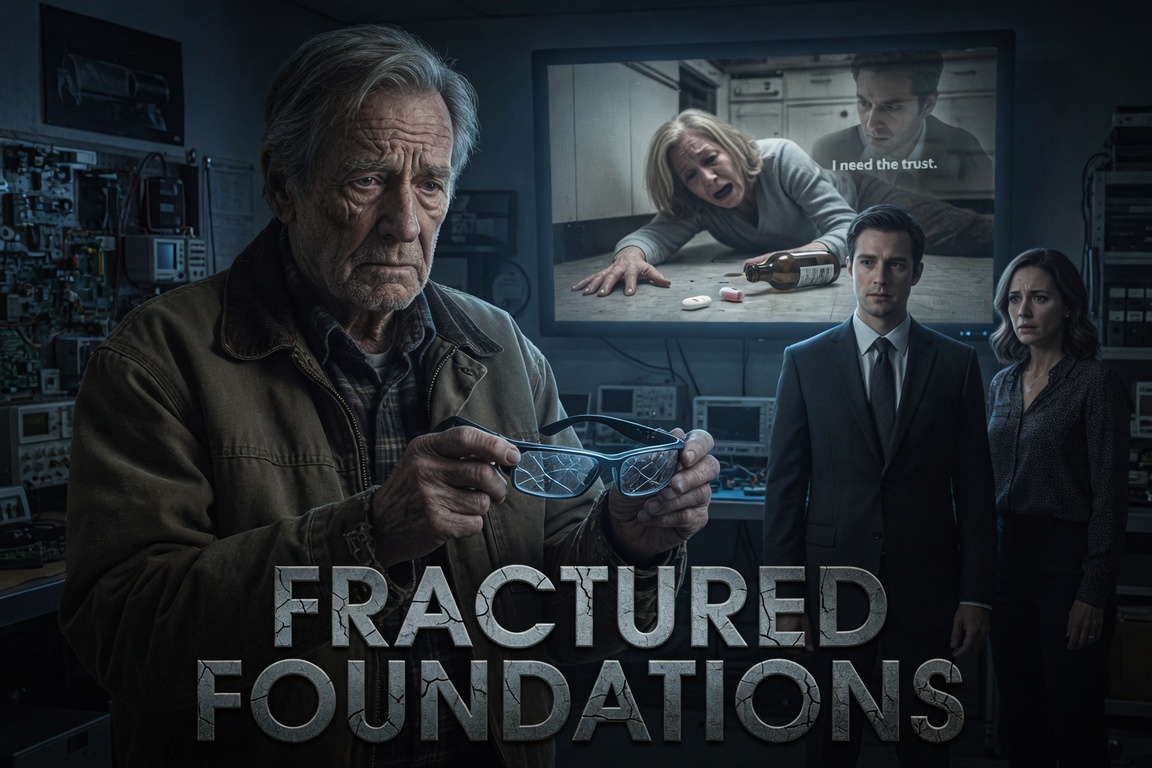
His hand simply lifted from the keyboard, and the image froze on the monitor: Martha on the kitchen floor, one palm pressed against her chest, the other reaching toward a silver pill case near my son’s shoe.
Derek was looking down at her.
His wife, Rachel, was closing the pill case.
Outside the repair shop, rain rattled against the metal awning. A bus sighed at the curb, brakes hissing like an animal trying not to cry. Somewhere in the back room, a printer continued feeding out a receipt no one had asked for.
The technician swallowed.
“Mr. Caldwell…”
“Play it.”
He was twenty-six, perhaps twenty-seven. A thin young man named Luis Ortega with a silver ring through one eyebrow and a grease mark along the side of his thumb. He had spent the last forty minutes explaining corrupted memory clusters and optical storage recovery in the careful language people use when they believe an old man may not understand them.
Now he understood I had heard every word.
“There’s more,” he said.
“Play it.”
He pressed the key.
The image moved again.
Martha’s smart glasses lay on their side beneath the kitchen table. The left lens was cracked, giving the recording a slanted, fractured view of the room. Sunlight crossed the hardwood floor. The refrigerator hummed. A kettle screamed on the stove.
My wife’s breathing came in short, wet pulls.
“Derek,” she whispered.
My son did not kneel.
He was forty-four years old, tall, broad through the shoulders, and dressed in the charcoal suit I had bought him for his first presentation to the Caldwell Engineering board. Gray had begun at his temples, though he colored it before public events. In the recording, his face looked younger and older at once.
Terrified.
Resolved.
Rachel crouched beside Martha.
At forty-one, Rachel had the calm hands of someone who never wasted movement. She had worked for eleven years in hospital administration before leaving to help Derek launch his property development firm. I had always admired her efficiency.
In the recording, she held Martha’s heart medication between two fingers.
“Where is Thomas?” Rachel asked.
My wife tried to breathe.
“Site inspection.”
“How long?”
“Two… hours.”
Rachel glanced at Derek.
The look passed between them so quickly that, five months earlier, I might not have understood it.
Now it split my life in two.
Derek turned toward the kitchen window.
“Mom,” he said, “you should have left the accounts alone.”
Martha’s fingers scraped across the floor.
“You stole from him.”
“I borrowed against assets that were going to be mine anyway.”
“They were never yours.”
The kettle shrieked.
Rachel rose and switched off the burner. Even in murder, she could not tolerate unnecessary noise.
Martha reached again for the pill case.
Derek moved his shoe.
The case slid six inches farther away.
“Please,” Martha said.
My wife had never begged me for anything in forty-six years.
She had asked. Argued. Demanded. Once, during the winter of 1987, she had thrown my office keys into the Monongahela River because I refused to leave a construction site after three nights without sleep.
But she had never begged.
Not until our son stood above her and watched her heart fail.
“I was going to return it,” Derek said.
“You moved nine million dollars.”
“I had investors.”
“You had gamblers.”
“I had a project.”
“You had a hole.”
His jaw tightened.
Even on the floor, even with her lips turning pale, Martha could still find the load-bearing weakness in a man’s argument.
She had learned that from living with me.
Rachel looked at the clock above the stove.
“We’re out of time.”
Derek’s eyes remained on his mother.
“She was going to tell him.”
“She already copied the records,” Rachel said.
Martha’s hand stopped moving.
For one second, Derek bent toward her.
I leaned closer to the monitor.
This was the moment I had imagined during every sleepless night after the funeral—the impossible second in which a child remembers he is a child and reaches for the woman who once held him through fever, broken bones, and fear.
His hand descended.
Martha looked at him.
Then Derek picked up her phone.
He placed it on the counter beyond her reach.
“I’m sorry, Mom.”
The recording shook as Martha’s body struck the table leg.
Her glasses fell.
The image became darkness.
But the audio continued.
Rachel’s voice: “Check her pulse.”
Silence.
Then Derek whispered, “It’s too soon.”
“No. It only feels that way.”
“She’s still breathing.”
“Not for long.”
A sound left my wife.
Small.
Almost embarrassed.
Then nothing.
Luis stopped the recording.
The rain outside seemed louder now.
I sat very still in the plastic chair beside his workbench. On the wall behind him hung a poster of a mountain range under the words EVERYTHING WORTH SEEING REQUIRES DISTANCE.
My hands rested on my knees.
The knuckles were swollen from age. A pale scar crossed my right thumb, earned beneath a collapsed steel beam in 1979. I had spent forty years studying pressure, fatigue, hidden fractures, and catastrophic failure.
Yet I had slept beside a murder for five months and called it grief.
“Can this be authenticated?” I asked.
Luis stared at me.
“Yes.”
“In court?”
“I think so. The system logs match the date. The file was written automatically when the glasses detected a fall. There’s location data, biometric readings, environmental audio…”
“Can it be copied without altering the original?”
“Yes.”
“How many copies?”
“As many as you want.”
“Make three.”
He hesitated.
“Shouldn’t we call the police?”
“Not yet.”
His face changed.
Not suspicion.
Fear.
“For what it’s worth,” he said, “that is exactly what people say in movies before doing something terrible.”
“I am seventy years old, Luis. My knees hurt when it rains, my cholesterol frightens physicians, and I cannot open a jar without striking it against the counter. Whatever you think I am planning, I assure you it will involve paperwork.”
That almost made him smile.
Almost.
I removed my wallet and placed my attorney’s card on the workbench.
“Call Evelyn Price. Tell her exactly what you found. Do not call anyone else. Do not take these glasses home. Do not connect them to the internet.”
“You think they’ll come for them?”
I looked at Martha’s frozen image on the monitor.
“No,” I said. “I think they’re coming for me.”
My phone rang.
Derek’s name appeared on the screen.
I answered.
“Dad,” he said warmly, “Rachel and I were thinking about stopping by tonight. We’re worried about you being alone.”
Across the workbench, Luis went pale.
I watched the rain slide down the glass.
“That’s kind of you,” I said.
“We’re family.”
“Yes,” I replied. “That is what worries me.”
Chapter Two
Hairline Cracks
Derek arrived carrying soup.
Rachel brought legal documents.
They entered my house at seven fifteen, shaking rain from black umbrellas onto the limestone floor. The old Caldwell residence sat above the Allegheny River in Fox Chapel, all dark timber, narrow windows, and hand-cut stone. Martha had called it a fortress with plumbing.
That night, it felt like one.
Derek kissed my cheek.
“You look tired.”
“I am seventy.”
“You looked better at sixty-nine.”
Rachel touched my arm.
Her fingers rested exactly where a nurse might check for weakness.
“We’ve been concerned since the funeral,” she said.
She smelled faintly of bergamot and hospital soap.
The same scent had clung to Martha’s pillow after Rachel helped prepare the body for the funeral home.
I stepped away.
“What documents?”
Rachel placed a leather folder on the dining table.
“Nothing urgent.”
People rarely carry leather folders for unimportant matters.
She removed a power-of-attorney form, a medical authorization, and a petition allowing Derek limited access to my investment accounts in the event of cognitive decline.
Derek unpacked containers of lentil soup in the kitchen.
Martha had hated lentils.
He knew that.
Perhaps that was why he brought them.
“We’re not saying you’re incapable,” Rachel continued. “This is protection.”
“From whom?”
“Anyone who might exploit you.”
The chandelier reflected across the polished table, breaking into twelve small circles of light.
I opened the medical authorization.
The first physician listed was Dr. Alan Corbett.
I knew the name.
He had spoken with me after Martha’s death, gently suggesting that grief could accelerate confusion in older adults. Two weeks later, he recommended I stop driving at night. A month after that, he asked whether I had misplaced important documents.
I had considered him attentive.
Now I noticed his clinic shared an address with a medical consulting firm Rachel had once managed.
Derek entered with three bowls.
“You’re reading too much into it, Dad.”
“I am reading exactly what is printed.”
“That’s not what I meant.”
“It rarely is.”
His spoon struck the bowl harder than necessary.
Rachel gave him a glance.
There.
The tiny correction.
The same look from the recording.
Derek lowered his voice.
“You’ve forgotten meetings.”
“I canceled them.”
“You accused the groundskeeper of moving Martha’s roses.”
“He did.”
“You drove to the old office at two in the morning.”
“I have done that since 1982.”
“You called me by Uncle Stephen’s name.”
“You were behaving like him.”
My younger brother Stephen had sold our mother’s jewelry before her body was cold.
Derek pushed his bowl away.
“This is exactly the problem.”
“What problem?”
“Everything becomes a trial with you.”
“No. Trials permit evidence.”
Rachel folded her hands.
“We are trying to help.”
I looked at her.
Five months earlier, she had stood beside Martha’s casket in a black wool coat, one arm around my son. Her mascara had run. Her lips had trembled when she told me Martha had loved me until the end.
Had that been performance?
Or had some part of her mourned the woman she helped kill?
No one is entirely made of one material.
Even concrete contains air.
“What happens if I refuse?” I asked.
Derek leaned back.
“Nothing.”
Rachel did not answer.
I turned to her.
“What happens?”
Her gaze remained steady.
“If concerns about your health continue, someone on the board may request an independent evaluation.”
“Someone?”
“The company carries obligations. Your decisions affect four thousand employees.”
“I retired from daily operations three years ago.”
“You retain controlling shares.”
“My shares.”
“For now,” Derek said.
The words escaped before he could stop them.
The room cooled.
Rainwater moved through the gutters with a steady metallic rush.
Derek’s face tightened.
“That came out wrong.”
“No,” I said. “It came out early.”
Rachel gathered the documents.
“We should leave.”
“You brought soup.”
“You don’t seem hungry.”
“I am not.”
Derek stood, then paused beside my chair.
For a moment, something uncertain crossed his face.
Guilt, perhaps.
Or calculation.
“Take care of yourself, Dad.”
He squeezed my shoulder.
The pressure of his fingers lingered after he walked away.
I waited until their car disappeared through the gate.
Then I carried the soup into my workshop.
The room occupied the old carriage house behind the main residence. Martha had allowed me to fill it with drafting tables, structural models, testing equipment, and half-finished repairs she described as “metal objects waiting to become tetanus.”
I poured the soup into three sterile containers.
At midnight, Evelyn Price arrived.
She was sixty-two, with silver hair cut close around her ears and a voice that could make senior judges check their paperwork. She had served as my attorney for twenty-eight years and disliked surprises unless she had prepared them.
Luis came with her.
So did Dr. Miriam Shah, a forensic toxicologist Evelyn trusted.
We watched the recording together.
No one spoke during Martha’s final minute.
When it ended, Miriam removed her glasses and pressed the bridge of her nose.
Evelyn stared at the dark monitor.
“Thomas,” she said, “I need you to tell me what you intend to do.”
“Prove it.”
“The recording may prove neglect or deliberate withholding of medication. Murder will require motive, medical evidence, and a clear causal link.”
“I have motive.”
I placed copies of bank records on the table.
Five months before Martha died, she had begun tracing transfers from the Caldwell family investment trust into shell corporations connected to Derek’s unfinished development project.
The project was called The Meridian: a forty-two-story luxury tower rising over downtown Pittsburgh.
Or supposed to be rising.
Construction had stopped at the nineteenth floor.
Investors had withdrawn after cost overruns, a cracked foundation slab, and allegations that cheaper steel had been substituted in two structural zones.
Derek needed money.
Not to become wealthy.
To avoid becoming publicly ruined.
“He moved nine million dollars?” Evelyn asked.
“Possibly more.”
“And Martha found out.”
“She managed the family trust with me.”
Miriam examined the soup containers.
“Why are these here?”
“I believe they may be drugging me.”
Evelyn’s jaw tightened.
“Believe based on what?”
“Three weeks ago, I became disoriented after dinner at Derek’s house. Last Sunday, I slept fourteen hours after Rachel brought herbal supplements. My housekeeper says I have been repeating questions. I remember each conversation.”
Miriam opened her case.
“I can test the soup and anything else you’ve consumed.”
“What are they trying to create?” Luis asked.
“A pattern,” I said. “Confusion. Poor judgment. Dependence.”
Evelyn walked slowly around the workshop.
“Derek petitions for emergency guardianship. Rachel supports the medical claim. Dr. Corbett provides an assessment. The board suspends Thomas’s voting authority.”
“And my son gains control of the trust,” I said.
Miriam looked toward the monitor.
“They let Martha die for nine million dollars.”
“No.”
I turned the smart glasses over in my hand.
“They let her die because she stood between them and forty.”
Evelyn stopped walking.
“You said you wanted proof. What exactly would satisfy you?”
“A confession.”
“People do not confess because we arrange chairs properly.”
“They confess when every alternative feels worse.”
“And how do you propose to accomplish that?”
I looked toward a scale model on the far table.
The Meridian tower stood in unfinished miniature, nineteen white floors rising from a black base. Derek had given it to me at the groundbreaking ceremony.
He had smiled for cameras that day.
Martha had whispered that the building looked like a knife without a handle.
“His birthday is in three weeks,” I said.
Evelyn’s eyes narrowed.
“He’s hosting it at The Meridian.”
“On the completed sky lobby.”
“The building is under investigation.”
“Derek obtained a temporary occupancy permit for the event. He wants investors to see progress.”
Luis stared at me.
“You’re going to confront him in an unfinished skyscraper?”
“No.”
I touched the miniature at the nineteenth floor.
“I am going to give him everything he wants.”
Chapter Three
The Inheritance Dinner
The following Sunday, I invited Derek and Rachel to dinner.
Martha’s chair remained empty.
I had not moved it since the funeral. The walnut arms carried shallow marks from her rings. A faded blue cushion supported the back. Derek looked at it twice before sitting opposite me.
Rachel brought wine.
I did not drink it.
The roast chicken steamed beneath the chandelier. Wind pressed against the western windows, and the river below reflected a bruised violet sky.
“I have been unfair,” I said.
Derek stopped cutting his food.
Rachel’s fork remained halfway to her mouth.
“I have treated age as if it were a personal insult,” I continued. “I have refused assistance because I mistook dependence for failure.”
Derek glanced at Rachel.
She lowered her fork.
“What are you saying?” he asked.
“I will sign the medical authorization.”
His breathing changed.
Not enough for anyone unfamiliar with him to notice.
But I had once watched him stand on a diving board for twenty minutes at age eight, pretending he was not afraid of the water.
The breath was the same.
“I will also grant you temporary voting control of my shares,” I said.
Rachel leaned forward.
“Temporary?”
“Six months. If the transition goes well, permanent control can follow.”
Derek’s knife slipped against the plate.
Metal scraped porcelain.
“You’re serious?”
“I should have trusted you sooner.”
The lie tasted worse than the wine.
His eyes filled.
That surprised me.
He stood, walked around the table, and embraced me.
My son’s face pressed against my shoulder. For one dangerous second, memory replaced evidence.
Derek at six, asleep on my chest during a thunderstorm.
Derek at sixteen, holding a trophy from a bridge-design competition.
Derek at twenty-seven, waiting outside the operating room during Martha’s first cardiac procedure.
I almost pushed him away.
Instead, I placed one hand between his shoulder blades.
His heart beat quickly.
“Thank you,” he whispered.
Rachel watched us.
Her expression did not soften.
She was counting.
After dessert, I showed them a new estate plan.
Forty million dollars in property, investments, patents, and company shares would pass primarily to Derek. A smaller philanthropic allocation would establish a cardiac care program in Martha’s name.
Rachel read each page.
“You reduced the charitable portion,” she said.
Derek looked at her.
“Why does that matter?”
“It doesn’t. I’m clarifying.”
The original plan had directed twelve million dollars toward public safety engineering and women’s cardiac research.
The new draft allocated two million.
Rachel’s thumb rested on the page.
“You should sign this before the birthday event,” she said.
“Why?”
“Public celebrations can be exhausting. You’ve had episodes.”
“I have?”
Derek’s eyes flickered.
Rachel smiled.
“Moments of confusion.”
“I remember them differently.”
“That is common.”
The room became very still.
Then I laughed.
Not warmly.
Not coldly.
Just enough.
“Perhaps you are right.”
I reached for the blue glass beside my plate.
Rachel had poured the water herself.
I raised it.
She watched.
I touched it to my lips but did not drink.
Derek looked away.
Later, after they left, Miriam collected the glass.
The laboratory found a sedative in the water.
Not enough to incapacitate me.
Enough to impair balance and short-term concentration.
A crack designed to grow under repeated pressure.
Two days later, I signed the medical authorization in Evelyn’s office.
What Derek and Rachel did not know was that the document had been altered.
It gave Dr. Corbett access to selected medical files but no authority to determine competence. The voting transfer contained a trigger clause. Any attempt to use medical coercion, fabricated evidence, or undisclosed financial conflicts would automatically suspend Derek’s rights and shift control to an independent trust.
Evelyn called it elegant.
I called it a load transfer.
In structural engineering, when one support fails, weight must move somewhere else before the entire system comes down.
We were moving the weight.
Luis embedded secure transmitters in my reading glasses, cuff links, workshop clock, and the leather portfolio containing the estate documents.
Miriam prepared harmless capsules that resembled my regular medication. My actual prescriptions moved to a safe deposit box.
A retired homicide detective named Samuel Reed joined us.
Sam had investigated industrial deaths for the city before becoming a private investigator. His left leg dragged slightly from a fall through a warehouse roof. He trusted no one with polished shoes.
He studied Derek’s financial records.
“The son is desperate,” he said. “The wife is disciplined. Desperation makes noise. Discipline cleans it up.”
“Which is more dangerous?” Luis asked.
“The person who thinks silence means innocence.”
Sam found three private loans tied to The Meridian. If the tower failed to receive full financing within thirty days, Derek would lose his company, his house, and personal guarantees totaling eleven million dollars.
Rachel had mortgaged property inherited from her father.
They were not merely chasing my fortune.
They were running from collapse.
“People become reckless when they believe disaster is behind them,” Sam said.
“In engineering, disaster is usually underneath,” I replied.
One week before the birthday party, Derek came to my workshop alone.
Snow had begun outside, thin white lines crossing the windows. He stood among the drafting tables with his hands in his coat pockets.
“You still build models?” he asked.
“Models reveal mistakes before concrete makes them permanent.”
He approached The Meridian miniature.
“You never liked it.”
“I never trusted the foundation redesign.”
“You approved the concept.”
“I approved the concept before you replaced the geotechnical firm.”
His mouth tightened.
“They were overbilling.”
“They warned you about settlement.”
“They were protecting themselves.”
“Most warnings sound insulting to the person who needs them.”
He stared at the unfinished miniature.
Then he said, “Mom was going to destroy me.”
The words entered the room without warning.
I did not move.
“She found the transfers,” he continued. “She called me a thief.”
“Were you?”
“I was trying to save the project.”
“With trust money.”
“I intended to replace it.”
“From where?”
“The completed tower.”
“The tower that could not be completed without the money you stole.”
His jaw flexed.
“You made mistakes.”
“Yes.”
“Bigger ones.”
“Yes.”
“And people still respected you.”
“No one had evidence.”
That stopped him.
Wind moved around the carriage house, pushing a low whistle through the roof vents.
Derek looked toward the door.
“Are you recording this?”
“No.”
The cuff link at my wrist transmitted every word.
He exhaled.
“Rachel thinks you’re pretending.”
“Pretending what?”
“To need us.”
“Do you?”
His face shifted.
For the first time, the polished heir disappeared.
“I don’t know.”
The answer was almost honest.
I stepped closer.
“Did you love your mother?”
His eyes reddened.
“You don’t get to ask me that.”
“I just did.”
“You were gone half our lives. She covered for you. Every missed anniversary. Every delayed vacation. Every dinner she reheated while pretending she wasn’t angry.”
“She deserved better.”
“She chose you.”
“She chose us.”
“No. She chose your work and called it marriage.”
His voice cracked.
He looked away quickly.
There it was—the moral structure he had built to live inside his crime.
Martha had betrayed him by siding with me.
The money had been promised by sacrifice.
Her death had become, in his mind, an acceleration of something already owed.
“I hope the tower survives,” I said.
He stared at me.
“Why?”
“Because if it fails, you will blame the foundation.”
His mouth opened.
Before he could answer, Rachel appeared in the doorway.
She had approached without either of us hearing her.
“Derek,” she said, “we should go.”
He turned.
She looked past him at me.
Her face was calm.
But her right hand was clenched around a small empty syringe.
Chapter Four
What Rachel Believed
Rachel said the syringe belonged to a vitamin injection.
She produced a prescription the next morning.
Dr. Corbett confirmed it.
Miriam examined the syringe recovered from the workshop floor after Rachel left. It contained traces of the same sedative found in my water, combined with a compound capable of causing irregular heart rhythm in someone with my medical history.
Not immediately fatal.
Not in a single dose.
The kind of poison designed to look like age.
Evelyn wanted the police to arrest them.
Sam agreed.
I refused.
“You have the recording of Martha,” Evelyn said. “You have the drugged water, the syringe, the financial motive, and multiple recorded statements.”
“We have enough for charges. Not enough for the complete truth.”
“What truth is left?”
“Who planned Martha’s death.”
Evelyn removed her glasses.
“They both participated.”
“One of them drove it. The other followed.”
“Does the distinction matter?”
“It will matter in court.”
“It matters to you.”
“Yes.”
The word left me harsher than intended.
Evelyn studied my face.
“You are hoping Derek can be separated from what he did.”
“I am hoping nothing.”
“That is not true.”
I turned toward the workshop windows.
Snow gathered along the sill.
Martha had always known when I was lying to myself. She would have waited silently until the lie became embarrassed and left on its own.
“I need to know whether my son is a murderer who regrets it,” I said, “or a coward who will murder again.”
Evelyn’s voice softened.
“And if he is both?”
“Then the law will have him.”
Sam located Rachel’s former colleague, a hospital compliance officer named Denise Ward.
Denise met us in a diner beside the Pennsylvania Turnpike. Neon light painted the windows red. Coffee burned on a warmer behind the counter.
Rachel, Denise explained, had been forced out of hospital administration six years earlier after manipulating billing records to obtain emergency treatment for uninsured patients.
“She saved people,” Denise said. “Then she changed the records so the hospital couldn’t collect.”
“That sounds charitable,” I replied.
“It started that way.”
“What changed?”
“Her mother died after an insurer delayed approving a procedure. Rachel decided systems were only moral when they produced the outcome she wanted.”
Denise stirred sugar into her coffee.
“She stopped seeing rules as rules. They became obstacles created by people with money.”
“People like me.”
“Yes.”
“And Derek?”
“She believed your son had spent his whole life trapped inside your approval. She used to say he was an employee pretending to be an heir.”
I looked through the window at trucks moving along the wet highway.
Rachel did not think she had corrupted Derek.
She thought she had liberated him.
The distinction was monstrous.
It was also human.
Three days before the birthday celebration, Rachel visited my house alone.
I found her in Martha’s dressing room.
Nothing had been moved since the funeral. Perfume bottles stood in a row. A silk scarf rested across the vanity. Morning light touched the silver brush Martha had used every night.
Rachel held one of her earrings.
“You should have asked,” I said.
She returned it carefully.
“I gave these to her.”
“For your twentieth anniversary.”
“You remember.”
“She wore them to Derek’s wedding.”
Rachel looked at herself in the mirror.
“We did love her.”
The plural caught in the room.
“Love without action is decoration,” I said.
Her eyes met mine in the glass.
“Is that what you told yourself while you worked every night?”
“No.”
“What did you tell yourself?”
“That providing was loving.”
“And was it?”
“Sometimes.”
She turned.
A tremor moved through her lower lip, then disappeared.
“Derek worshipped you,” she said. “You never noticed because worship looked too much like obedience.”
“I noticed.”
“You rewarded him when he copied you. You ignored him when he became himself.”
“Is that why Martha died?”
Her face emptied.
“Grief is making you cruel.”
“Grief is making me precise.”
She walked toward the window.
Beyond the glass, the winter garden lay beneath snow. Martha’s rose trellises stood black and bare.
“She was going to send him to prison,” Rachel said.
The sentence was quiet.
“She was going to call the district attorney, freeze the accounts, and announce the theft to the board. The Meridian would have collapsed. Hundreds of workers would have lost jobs.”
“She offered Derek forty-eight hours to return the money.”
“He couldn’t.”
“He could have confessed.”
“To you?”
“Yes.”
Rachel laughed once.
“You would have destroyed him.”
“I would have stopped the project.”
“That was his life.”
“No. It was a building.”
“You have never understood the difference.”
She moved closer.
For the first time, I saw exhaustion beneath her control. Gray shadows under her eyes. A small patch of skin rubbed raw beside her thumb.
“What do you want, Rachel?” I asked.
“For Derek to become more than your unfinished son.”
“And what do you want for yourself?”
Her expression hardened.
“To never again watch someone with power decide whether my family deserves to survive.”
“You watched Martha die.”
“She had already chosen.”
“My wife chose to live.”
“She chose you over her son.”
“That was not the choice.”
“It became the choice when she copied the bank records.”
I looked at the woman standing among Martha’s things.
No one is entirely evil.
But some people build moral systems so elaborate that cruelty becomes duty.
Rachel believed she had protected her husband.
She believed Martha had attacked first.
She believed my fortune represented stolen years, withheld affection, and a rigged world correcting itself.
And because she believed it, she could kill again without calling it murder.
She lifted her purse.
“You should take your medication.”
“I already did.”
Her eyes moved to the bottle on the vanity.
It was a replica.
She walked past me.
At the door, she stopped.
“Derek’s birthday matters to him.”
“I know.”
“He has spent his entire life waiting for you to say you are proud.”
“I intend to say much more than that.”
She left.
I waited until her car disappeared.
Then I opened the perfume cabinet.
Behind the bottles, a tiny camera continued blinking.
Rachel’s confession had not been complete.
But she had given us something more useful.
She had given us her logic.
Now we knew exactly which weight to apply.
Chapter Five
The Nineteenth Floor
The Meridian rose above downtown Pittsburgh like a sentence interrupted halfway through.
Its lower floors were wrapped in pale stone and bronze glass. Above the nineteenth level, exposed steel columns pierced the winter sky. Tarps snapped in the wind. Construction cranes stood motionless, their booms disappearing into low clouds.
Derek’s birthday celebration occupied the sky lobby on the nineteenth floor.
He had invited investors, board members, city officials, architects, journalists, and every person whose admiration he could not afford to lose.
A string quartet played beside the unfinished eastern windows.
Portable heaters pushed dry air across the room. Champagne moved through the crowd. The scent of cedar planks mingled with fresh paint and cold steel.
At the center of the lobby stood a scale model of the completed tower.
Forty-two floors.
A rooftop garden.
A glass bridge connecting two penthouses.
A future more stable than the building beneath it.
I arrived at eight thirty wearing a midnight-blue suit and Martha’s wedding ring on a chain beneath my shirt.
Derek met me near the elevators.
He looked magnificent.
That is not sarcasm.
My son had always possessed presence. His face sharpened beneath pressure. His voice steadied when others panicked. In another life, with a different father and fewer lies, he might have led something worth following.
“You came,” he said.
“You invited me.”
“I wasn’t sure.”
“I gave you my word.”
His eyes searched my face.
“Are you feeling all right?”
“Better than expected.”
Rachel appeared beside him in a black dress.
A diamond pin that had belonged to Martha glittered at her shoulder.
I looked at it.
Rachel touched the pin.
“Derek said she would have wanted me to wear it.”
“She would have wanted you to ask.”
A shadow crossed Derek’s face.
Rachel smiled.
“Tonight should be happy.”
“Tonight will be unforgettable.”
At nine, Derek took the stage.
Behind him, the city burned through glass—bridges strung with light, headlights moving along the rivers, red warning lamps blinking from distant towers.
He spoke about endurance.
About rebuilding.
About families whose names become skylines.
Then he raised a glass toward me.
“My father taught me that structures do not stand because of what people see. They stand because of what is buried beneath them.”
Applause moved through the lobby.
I wondered whether he understood the sentence.
“Dad,” he continued, “would you join me?”
I walked onto the stage.
The crowd shifted forward.
Evelyn stood near the front. Luis operated the presentation system from a booth behind the musicians. Sam remained beside the west stairwell. Three detectives waited one floor below.
The trap was not the recording.
It was the choice.
I took the microphone.
“When Derek was nine,” I said, “he built a bridge from two chairs, six books, and one of Martha’s serving trays.”
Laughter.
Derek smiled.
“He tested it with a dictionary. Then a toolbox. Then our cat.”
More laughter.
“The cat never forgave him.”
Derek’s eyes shone.
This was what he had waited for.
Not the money.
Not only the money.
Recognition.
“I knew then that my son understood something important,” I continued. “A structure reveals its truth only under load.”
Behind us, the screen changed.
The completed tower disappeared.
Bank transfers appeared.
Nine million dollars moving from the Caldwell trust into shell companies.
The room fell silent.
Derek’s smile remained for half a second too long.
Then it died.
Rachel looked toward the control booth.
Luis locked the system.
“What is this?” Derek asked.
“The load test.”
I described the transfers.
The false invoices.
The substituted steel.
The private debt.
People stepped away from Derek as if financial ruin were contagious.
He reached for the microphone.
I moved it beyond his hand.
“This is not the worst thing my son did.”
Rachel turned toward the elevators.
Sam blocked her path.
The screen went dark.
Then Martha appeared on the kitchen floor.
A gasp moved through the lobby.
Derek staggered backward.
“No.”
The recording played.
Martha begging.
Rachel closing the pill case.
Derek moving it away.
The kettle screaming.
“I’m sorry, Mom.”
Every word traveled through the unfinished building.
When the image became darkness, no one applauded.
No one breathed.
Derek looked at me.
His face had lost all color.
“Where did you get that?”
“Her glasses.”
Rachel’s composure fractured.
“She was already dying.”
The microphone captured her voice.
Heads turned.
“She had a cardiac event,” Rachel continued. “We panicked.”
“You took her medication,” I said.
“She had threatened Derek.”
“With the truth.”
“She was going to ruin him.”
Derek grabbed Rachel’s arm.
“Stop.”
She pulled away.
“No. He wants a spectacle. Let him hear it.”
Rachel faced the crowd.
“This man built an empire by abandoning his family. He controlled every dollar, every choice, every mistake. Derek spent forty years earning what was already his.”
A board member whispered, “My God.”
Rachel’s eyes flashed.
“Do not stand there and pretend wealth is innocent. Thomas Caldwell made a religion out of withholding. Martha knew what exposure would do. She chose punishment.”
“You chose death,” I said.
“She chose the consequence.”
Derek stared at his wife.
“You said we were buying time.”
Rachel turned.
“We were.”
“You said Mom would recover if we called after a few minutes.”
Her face changed.
The room seemed to narrow around them.
“You knew her condition.”
“I knew she was strong.”
“You told me the medication had a window.”
“There was a window.”
“How long?”
Rachel said nothing.
Derek stepped toward her.
“How long?”
“Derek—”
“You knew she would die.”
Her eyes moved toward the crowd.
Toward the detectives entering from the stairwell.
Toward the city beyond the glass.
Then she whispered, “I knew she might.”
Derek’s mouth opened.
No sound came.
I had seen men watch bridges collapse.
There is a particular expression when the mind understands that something trusted has already failed and the body is only waiting to fall.
My son wore that expression now.
Rachel reached for him.
He moved away.
“You told me to take her phone.”
“Yes.”
“You told me not to touch the pills.”
“Yes.”
“You said calling sooner would expose the transfer.”
“It would have.”
“You said she had done this to herself.”
“She did.”
“No.”
The word came from somewhere deep inside him.
“No, she didn’t.”
Rachel’s face tightened.
“Do not become weak now.”
“My mother was on the floor.”
“She was taking everything from us.”
“She was dying.”
“And you watched.”
The words struck him.
Rachel stepped closer.
“You want to pretend you were manipulated? You moved the medicine. You took the phone. You checked her pulse.”
Derek’s shoulders folded.
The crowd blurred behind him.
“I know.”
“You wanted the money.”
“I wanted her to stop looking at me like that.”
“Like what?”
“Like she could see what I had become.”
Rachel’s voice softened.
“She could.”
Derek began to cry.
Not elegantly.
Not quietly.
His knees gave slightly, and he caught the edge of the stage.
I felt no victory.
Only the terrible accuracy of what we had built.
Detective Harris approached Rachel.
“You are under arrest.”
She did not resist.
As another detective moved toward Derek, he looked at me.
“Dad.”
One word.
The same voice he had used at eight years old when he woke from nightmares.
I stood three feet away.
My arms remained at my sides.
“I’m sorry,” he said.
“You said that to your mother.”
His face crumpled.
The detectives placed his hands behind his back.
Guests moved aside as they escorted him toward the elevators.
Rachel walked with her head high.
Derek did not.
At the elevator doors, he turned.
“Was any of it real?”
I knew what he meant.
The dinner.
The new estate plan.
My promise to trust him.
My words onstage about his childhood bridge.
“Yes,” I said. “That was the part you destroyed.”
The elevator closed.
The room remained silent.
Then a deep sound moved through the building.
Not music.
Not thunder.
Steel.
A low metallic groan rolled beneath the floor.
The champagne glasses trembled.
One of the eastern windows cracked from corner to corner.
Chapter Six
The Failing Tower
Panic moves faster downward.
The first guests ran toward the elevators. Others froze. A waiter dropped a tray. Glass shattered across the concrete floor.
I grabbed the microphone.
“Do not use the elevators.”
The crowd stopped.
Another groan moved through the structure.
Dust fell from an exposed ceiling joint.
Sam limped toward me.
“Settlement?”
“Possibly differential movement along the east core.”
“You know this building.”
“I know the original plans.”
A security alarm began pulsing.
I ordered the guests toward the west stairwell in groups of twenty. The detectives took control. Evelyn guided people away from the cracked windows.
Rachel stood in handcuffs near the stage.
For the first time, fear broke through her face.
“The building is safe,” she said.
I looked at her.
“How do you know?”
“Derek said the foundation review was political.”
“Derek says many things when frightened.”
The floor shifted.
Only half an inch.
Enough.
The scale model slid from its pedestal and shattered.
Forty-two perfect miniature floors broke across the unfinished lobby.
Derek’s tower collapsed before our eyes while the real one decided whether to follow.
I entered the service corridor with Sam and the project superintendent, a man named Calvin Pierce whose forehead shone with sweat.
“The east monitoring sensors went offline two weeks ago,” Calvin said.
“Why?”
“Derek ordered the alerts suppressed during the financing review.”
“Settlement rate?”
“Last recorded movement was nine millimeters.”
“Over what period?”
“Six days.”
My stomach tightened.
Nine millimeters did not sound dramatic.
Neither did a hairline crack.
Failure rarely announces its scale to people who do not understand it.
“Where is the temporary bracing?” I asked.
“Removed for the event.”
“Who authorized that?”
Calvin looked toward the elevators carrying my son downward in handcuffs.
Of course.
Derek had removed visible supports because investors might mistake them for weakness.
We reached the structural control room.
Screens flashed red.
The eastern core had shifted.
Not enough for immediate collapse, but enough to overload connections weakened by substituted steel.
“Can we stabilize it?” Sam asked.
“Not tonight.”
“Can we get everyone out?”
“If the west stair remains clear.”
The radio crackled.
A detective’s voice reported that the seventeenth-floor stair door would not open.
Calvin swore.
Construction materials blocked the landing.
More than a hundred guests were still above it.
I pulled the original plans from a cabinet.
Derek had changed the layout, but he could not change where the old service shaft ran.
“There is a temporary maintenance stair inside the mechanical spine,” I said.
Calvin shook his head.
“It stops at eighteen.”
“It stopped at eighteen in the revised drawings. The original stair continued to fifteen.”
“Why would it still be there?”
“Because contractors rarely demolish useful steel when drywall can hide it.”
We broke through a gypsum wall with a fire axe.
Behind it stood the old stair.
Rusty.
Narrow.
Alive.
Guests descended through dust and darkness.
I remained on the nineteenth floor until the last group entered the shaft.
Rachel was still there with Detective Harris.
“You should go,” I told them.
The detective moved her toward the opening.
Rachel stopped beside the broken tower model.
“You knew the building might fail,” she said.
“I knew Derek ignored warnings.”
“You still came.”
“Yes.”
“Why?”
“To make certain he could not bury the truth.”
A siren wailed below.
Wind pushed through the cracked glass.
Rachel looked at the miniature wreckage.
“He only wanted to prove he could build something without you.”
“He could have.”
“You never believed that.”
“No,” I said. “And that was my failure.”
She stared at me.
For a moment, the hatred left her.
What remained was grief.
“He loved her,” Rachel whispered.
“I know.”
“He loved you.”
“I know.”
“He just wanted one thing that was his.”
“He had his life.”
“You made it feel borrowed.”
The accusation landed because it was true.
Then the building groaned again.
Detective Harris pulled Rachel toward the stair.
We descended.
Outside, snow swept between emergency vehicles. Guests huddled beneath blankets. Television crews gathered behind barricades. The unfinished tower rose above us, its top disappearing into cloud.
Derek stood beside a police car.
His hands remained cuffed.
When he saw me emerge, his shoulders dropped with relief.
Even after everything, he had feared I was inside.
I walked toward him.
The detectives allowed us one minute.
“Is it going to fall?” he asked.
“Not tonight.”
“Can it be saved?”
“Perhaps.”
He looked up at the tower.
“My whole life is in there.”
“No.”
He turned toward me.
“Your life is standing here,” I said. “What you built is in there.”
His lips trembled.
“I did love her.”
“I know.”
“I thought we had more time.”
“That is what people say when they spend someone else’s.”
The officer opened the car door.
Derek bent to enter, then stopped.
“What happens to the fortune?”
“The new trust activated the moment you tried to declare me incompetent.”
His eyes closed.
“So I get nothing.”
“You receive what the court permits after restitution.”
“And the rest?”
I looked toward Martha’s ring beneath my shirt.
“It will build something your mother would have trusted.”
The officer placed a hand above Derek’s head.
My son entered the car.
Blue lights moved across his face.
Then he was gone.
Chapter Seven
The Cost of Justice
The trial lasted eleven weeks.
Rachel’s attorneys argued that Martha’s death had resulted from an unpredictable cardiac event. They called the recording incomplete, the bank transfers misunderstood, and my investigation the obsession of a grieving husband determined to punish his son.
Derek pleaded guilty before testimony began.
His agreement required him to describe everything.
He told the court that Rachel had discovered Martha copied the financial records. He admitted they visited the house intending to frighten her into silence. He admitted Rachel had altered Martha’s medication schedule over the preceding week, increasing the likelihood of a cardiac episode.
He admitted moving the pill case.
He admitted taking the phone.
He admitted waiting twelve minutes before calling emergency services.
Twelve minutes.
An engineer learns to respect numbers.
Load limits.
Deflection tolerances.
Wind speeds.
Twelve minutes became the measurement of my son’s moral collapse.
Rachel was convicted of second-degree murder, conspiracy, attempted poisoning, financial fraud, and exploitation of a vulnerable adult.
Derek was convicted of manslaughter, conspiracy, theft, and attempted guardianship fraud.
The judge sentenced him to sixteen years.
Rachel received thirty-two.
At sentencing, she declined to apologize.
“I did what weak systems force people to do,” she said.
The judge answered, “You did what you chose to do.”
Derek wept.
I did not.
Not there.
I cried later in Martha’s closet while holding the blue dress she had worn to our fortieth anniversary dinner.
Grief does not care whether justice has been served.
It does not read verdicts.
It does not count years.
It simply enters the quietest room and sits down.
The Meridian tower was eventually demolished to the eleventh floor and rebuilt under new ownership.
Investigators found fourteen structural violations, six falsified inspections, and extensive material substitutions. No criminal charge could prove Derek knew the building was in immediate danger, but his name became attached to the failure.
He had wanted a skyline.
He became a warning.
The Caldwell estate changed too.
I sold my remaining interest in the engineering company to an employee trust.
Thirty-four million dollars funded the Martha Caldwell Center for Women’s Cardiac Health and Patient Advocacy.
The center occupied a renovated brick hospital overlooking the river. It offered diagnostic care, emergency medication grants, insurance appeals assistance, and legal support for families denied treatment.
Rachel had built her morality around her mother’s death.
I built Martha’s legacy around preventing another one.
Not because suffering automatically makes people noble.
It does not.
Pain is material.
People decide what to construct from it.
Luis became director of digital evidence systems at the foundation. He refused the title twice before accepting.
Evelyn joined the board and continued correcting my documents in red ink.
Sam inspected every contractor we hired and terrified them into honesty.
On the center’s opening day, a bronze plaque was installed beside the entrance.
It did not mention my company.
It did not mention the fortune.
It read:
MARTHA ELAINE CALDWELL
SHE BELIEVED CARE DELAYED WAS CARE DENIED.
Beneath it, smaller:
MAY NO ONE HAVE TO BEG FOR THE MEDICINE ALREADY WITHIN REACH.
I stood before the plaque while patients and staff entered behind me.
A woman touched my sleeve.
She was perhaps fifty, thin, with a surgical scar visible above her collar.
“My sister met Martha once,” she said.
“Where?”
“At a charity auction. My sister couldn’t afford her procedure. Martha called three people from the restroom and found a program.”
That sounded like her.
Martha had always treated bureaucracy as a locked door that had forgotten she owned a hammer.
“She never told me,” I said.
The woman smiled.
“She told my sister not to tell anyone.”
I looked toward the river.
Even after death, I continued discovering rooms inside my wife’s life that I had never entered.
Two years after the trial, I visited Derek.
The prison sat three hours east beneath a flat gray sky. The visiting room smelled of coffee, bleach, and damp winter coats.
Derek entered wearing khaki.
He had lost weight. His hair was completely gray now.
We sat across from each other.
“You look like Granddad,” he said.
“So do you.”
“That wasn’t a compliment.”
“It never was in our family.”
A faint smile touched his mouth.
Then disappeared.
“I saw the center on television.”
“Did you?”
“They showed Mom’s plaque.”
I nodded.
He folded his hands.
“I keep hearing the kettle.”
I said nothing.
“In dreams,” he continued. “Sometimes I reach the stove. Sometimes I pick up the pills. Sometimes I call immediately.”
“But?”
“I always wake before I know if she lives.”
His eyes lifted.
“Do you hate me?”
The question had taken him two years to ask.
“No.”
His face tightened.
“That’s worse.”
“Sometimes.”
“Do you forgive me?”
“No.”
He looked down.
I allowed the answer to remain between us.
Then I said, “But I no longer wake every morning wishing I had no son.”
He looked up.
His eyes filled.
“What changed?”
“I understood that wishing you away was another way of refusing what happened.”
He pressed his lips together.
“I don’t deserve to be part of your life.”
“Deserving is not the only measure.”
“Then what is?”
“Truth. Effort. Time.”
He laughed bitterly.
“Time.”
“Yes.”
“We were always bad at that.”
“We can improve.”
His fingers trembled.
“Why?”
“Because your mother loved you.”
“That didn’t stop me.”
“No. Love does not stop people from becoming terrible. Sometimes it gives them one reason to return.”
“I can’t return.”
“Not to who you were.”
He stared at the scratched tabletop.
“I blamed you for everything,” he said. “Even when I moved the pills, I was thinking about you. How you would look at me if she exposed the money.”
“I gave you reason to fear my judgment.”
“You didn’t give me reason to kill her.”
“No.”
He nodded slowly.
It was the first time neither of us tried to take too much responsibility or too little.
A guard announced five minutes remaining.
Derek wiped his eyes.
“Dad?”
“Yes?”
“Were you ever proud of me?”
I looked at my son.
The easiest answer would have been mercy.
The cruelest would have been revenge.
I chose accuracy.
“I was proud when you built your first bridge.”
His mouth trembled.
“I was proud when you stayed beside your mother after her surgery. I was proud when you paid your employees during the first recession. I was proud many times.”
“Why didn’t you tell me?”
“Because I thought praise would make you soft.”
He laughed once through his tears.
“And withholding it made me strong?”
“No.”
The guard approached.
I stood.
Derek remained seated.
“I am proud of one thing now,” I said.
He looked up.
“You told the truth in court when lying might have reduced your shame.”
“It didn’t save me.”
“It was not supposed to.”
The guard opened the door.
“I’ll come next month,” I said.
Derek nodded.
This time, neither of us called the visit forgiveness.
It was simply a beam placed where emptiness had been.
Chapter Eight
The Foundation
On the third anniversary of Martha’s death, I returned to the kitchen.
I had avoided it for years.
The room remained mostly unchanged. Morning light crossed the hardwood floor. The kettle sat on the stove. The silver pill case rested inside a glass cabinet, preserved as evidence and later returned to me.
Martha’s smart glasses lay beside it.
The cracked lens had never been repaired.
Luis offered.
I refused.
Some fractures should remain visible, not because healing is impossible, but because history becomes dangerous when restored too perfectly.
I placed the glasses on the table and sat in Martha’s chair.
Outside, spring rain tapped against the windows.
The house was quieter now.
Too large for one man.
I had decided to donate it to the foundation as residential lodging for families of cardiac patients. The workshop would become a training center for young engineers studying structural ethics and forensic failure.
Evelyn called the idea excessively symbolic.
That was how I knew she approved.
I opened Martha’s final journal.
On the last written page, dated four days before her death, she had described confronting Derek.
Thomas will blame himself, she wrote. He always believes he could have prevented failure if only he had inspected the structure earlier.
She knew me.
Beneath that line:
But a family is not a bridge. Love cannot be calculated into obedience. A child is not safe merely because a parent has provided every material support.
I stopped reading.
Rain moved down the glass in slow vertical lines.
The greatest mistake of my life was not raising a son who betrayed me.
It was believing money, education, opportunity, and inheritance could substitute for presence.
Derek chose his crime.
Rachel chose hers.
Nothing I did made those choices inevitable.
But foundations influence what is built upon them.
That truth belonged to me.
The front door opened.
A group of foundation volunteers entered with boxes for the move. Their voices traveled through the hall. Someone laughed. Someone complained about the weight of my engineering books.
Life entering a house built around ghosts.
A young woman named Kayla stepped into the kitchen.
She was twenty-two, an engineering student receiving the first Martha Caldwell scholarship.
“Mr. Caldwell?”
“Yes?”
“We found a locked cabinet in the workshop.”
“The key is above the northern drafting table.”
“We checked.”
“Inside the blue model bridge.”
She smiled.
“You hide keys inside bridges?”
“I hide important things inside structures people underestimate.”
After she left, I picked up Martha’s glasses.
The frame was light.
Almost weightless.
Yet inside it had rested enough truth to bring down a family, expose a crime, redirect a fortune, and save people my wife would never meet.
Value does not always announce itself in gold, land, or stock certificates.
Sometimes it waits inside a broken object everyone assumes is useless.
Sometimes it survives in a voice.
Sometimes it is twelve minutes of darkness recorded by accident.
Sometimes it is the truth an old man still has time to use.
I carried the glasses to the hallway.
Workers had removed the family portraits, leaving pale rectangles on the walls. At the end of the corridor hung one final photograph.
Martha stood beside me at the opening of the Fort Duquesne pedestrian bridge. Wind pressed her dress against her legs. I was looking toward the camera.
She was looking at me.
For years, I had mistaken that photograph for proof that she stood beside my success.
Now I understood.
She had been waiting for me to turn toward her.
I removed the frame from the wall.
Outside, the rain stopped.
Sunlight broke across the river, catching steel bridges one by one until they seemed to ignite above the water.
I stepped onto the porch with Martha’s photograph beneath my arm.
Behind me, strangers carried boxes into the rooms.
Ahead of me, traffic moved across the bridges I had helped build.
They were never permanent.
Nothing is.
Steel weakens.
Concrete cracks.
Fortunes change hands.
Families fail beneath pressures no engineer can completely predict.
But failure is not always the final shape of a structure.
Sometimes what remains can be examined.
Reinforced.
Repurposed.
Made honest.
My son had come for my fortune and lost his freedom.
Rachel had tried to turn grief into justification and lost the future she believed money would protect.
I had built the perfect trap.
That was what newspapers called it.
They were wrong.
The trap was not perfect.
A perfect trap would have saved Martha.
A perfect trap would have reached backward through time, placed the medicine in her hand, and forced my son to remember who he was before fear hollowed him out.
What I built was justice.
Justice arrives late.
It cannot revive the dead.
It cannot return innocence.
It cannot make a family whole.
It can only hold the surviving weight and prevent the damage from spreading.
At seventy-three, I had finally learned that this was enough.
Not victory.
Not revenge.
Enough.
I walked down the stone steps toward the waiting car.
In my pocket, Martha’s broken glasses touched my hand with every step.
The smallest object I had ever inherited.
The most valuable thing I had ever owned.