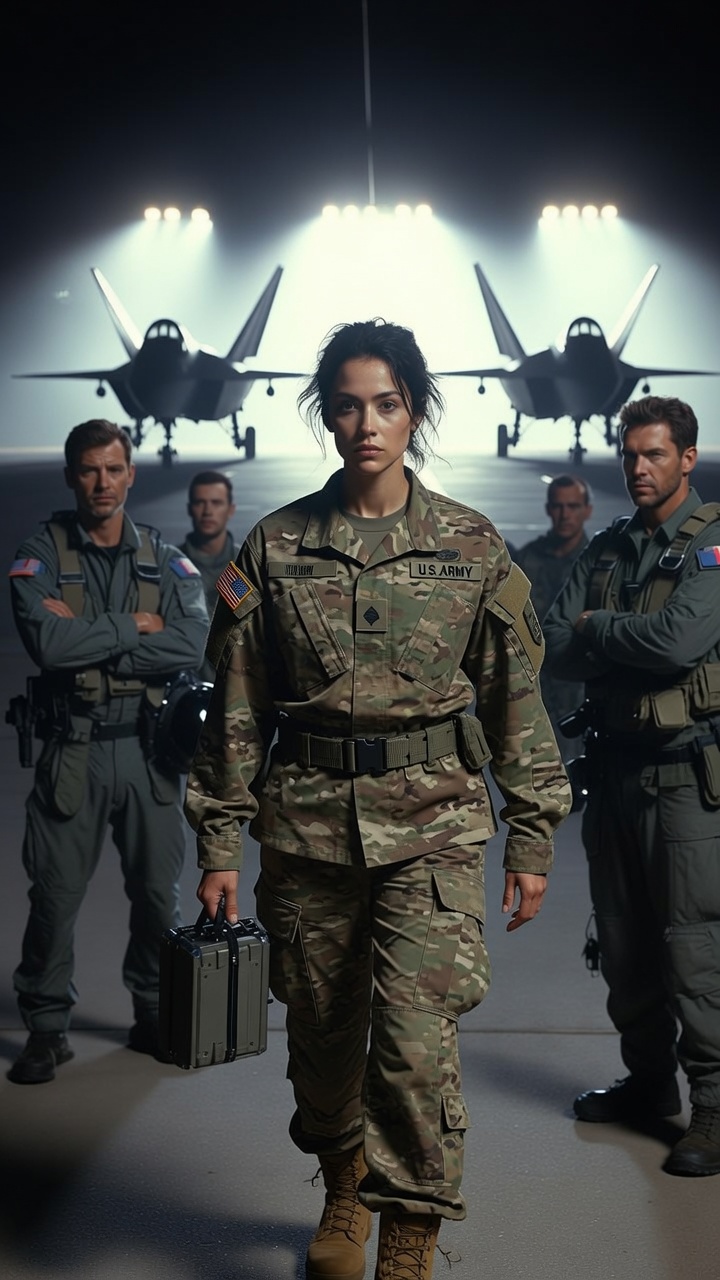
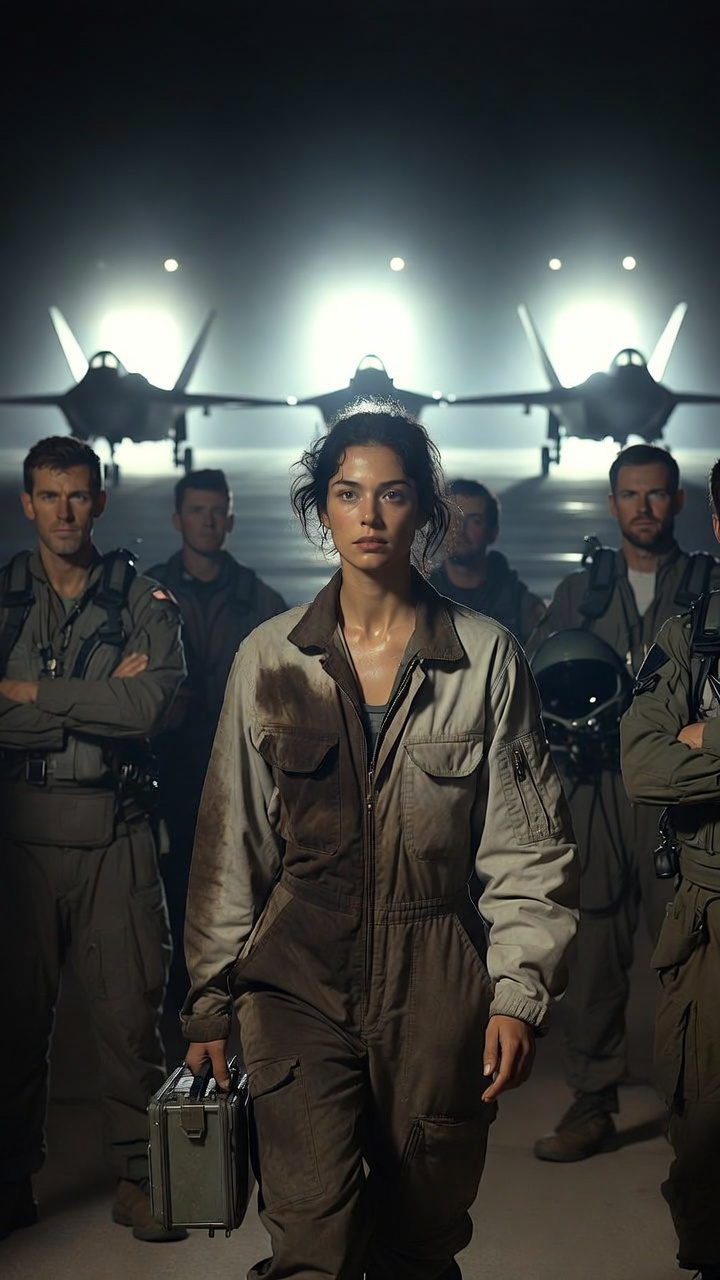
The F-22 had been grounded for six days when the woman in the oil-stained coveralls walked onto the flight line carrying a toolbox smaller than a pilot’s helmet.
Nobody looked impressed.
Three aircraft sat under the white glare of maintenance lights, their sharp silhouettes cutting across the concrete like machines waiting for permission to breathe. Around them, pilots, crew chiefs, avionics specialists, and software technicians moved with the exhausted frustration of people who had already tried everything they knew.
The squadron was less than forty-eight hours from a major readiness exercise.
And its lead aircraft could not complete a startup diagnostic.
Every attempt ended the same way.
The cockpit displays would initialize. Hydraulic pressure would rise. The avionics bus would begin its internal checks.
Then a string of maintenance warnings would flood the screens.
Synchronization fault.
Command priority conflict.
Navigation matrix failure.
The system would freeze, reset, and shut itself down.
No one could explain why.
They had replaced two control modules, reloaded the approved software package twice, inspected the wiring harnesses, reviewed maintenance logs, and brought in specialists from another unit.
Nothing worked.
By the sixth morning, patience had disappeared.
Captain Derek Holt stood beside the lead aircraft with his helmet tucked under one arm and anger written across his face.
He was one of the squadron’s most experienced pilots, respected for his precision in the air and feared for his temper on the ground.
He watched the woman approach and looked toward the maintenance supervisor.
“This is who they sent?”
The supervisor hesitated.
“She has authorization to inspect the aircraft.”
Holt looked her up and down.
She appeared to be in her late thirties. Her dark hair was pulled back carelessly. There was grease on one sleeve, a small scratch across the metal clasp of her toolbox, and no visible rank on her coveralls.
She looked less like a high-level specialist and more like someone who had been called in to replace a damaged panel.
One of the younger pilots leaned toward Holt.
“Maybe she can tighten a few screws while the real engineers figure it out.”
A few men laughed.
The woman heard them.
She gave no sign that she had.
She stopped several feet from the aircraft and studied the maintenance display positioned beside the ladder.
Her eyes moved across the scrolling codes without hurry.
Lieutenant Mason Cole, standing near the nose gear, folded his arms.
“Do you even know what a correct F-22 startup sounds like?”
The question was loud enough for everyone nearby to hear.
The laughter came faster this time.
She continued reading.
Cole glanced at the others.
“I’m serious. These systems don’t exactly work like a pickup truck.”
The woman finally looked up.
Not at Cole.
At the aircraft.
Her expression did not change.
She seemed to be listening to something no one else could hear.
Holt climbed the ladder and dropped into the cockpit for another attempt.
“Clear the area,” he called.
The ground crew stepped back.
The auxiliary power sequence began. Cooling fans spun up. Displays flashed to life. The aircraft emitted a low mechanical hum that grew steadily louder.
For ten seconds, everything looked normal.
Then the warnings returned.
One after another.
Red text filled the central display.
A caution tone sounded inside the cockpit.
The avionics bus dropped offline.
The hydraulic indicators turned amber.
Then the entire aircraft went silent.
Holt ripped off one glove, climbed down, and threw it onto the concrete.
“Get me someone who actually understands the firmware.”
No one answered.
“We have pilots scheduled, command watching, and an aircraft that thinks every system is fighting every other system. I don’t need another mechanic with a scanner. I need someone who knows the architecture.”
The woman closed the maintenance log.
“Everyone step away from the aircraft.”
Her voice was quiet.
But it carried.
Several people turned toward her.
Holt stared at her as if he had misheard.
“What did you say?”
“I said step away from the aircraft.”
Cole laughed once.
“You planning to intimidate it?”
She walked past him.
“Move.”
There was nothing aggressive in the way she said it.
That was what made the word effective.
Cole stepped aside before he seemed to realize he had done it.
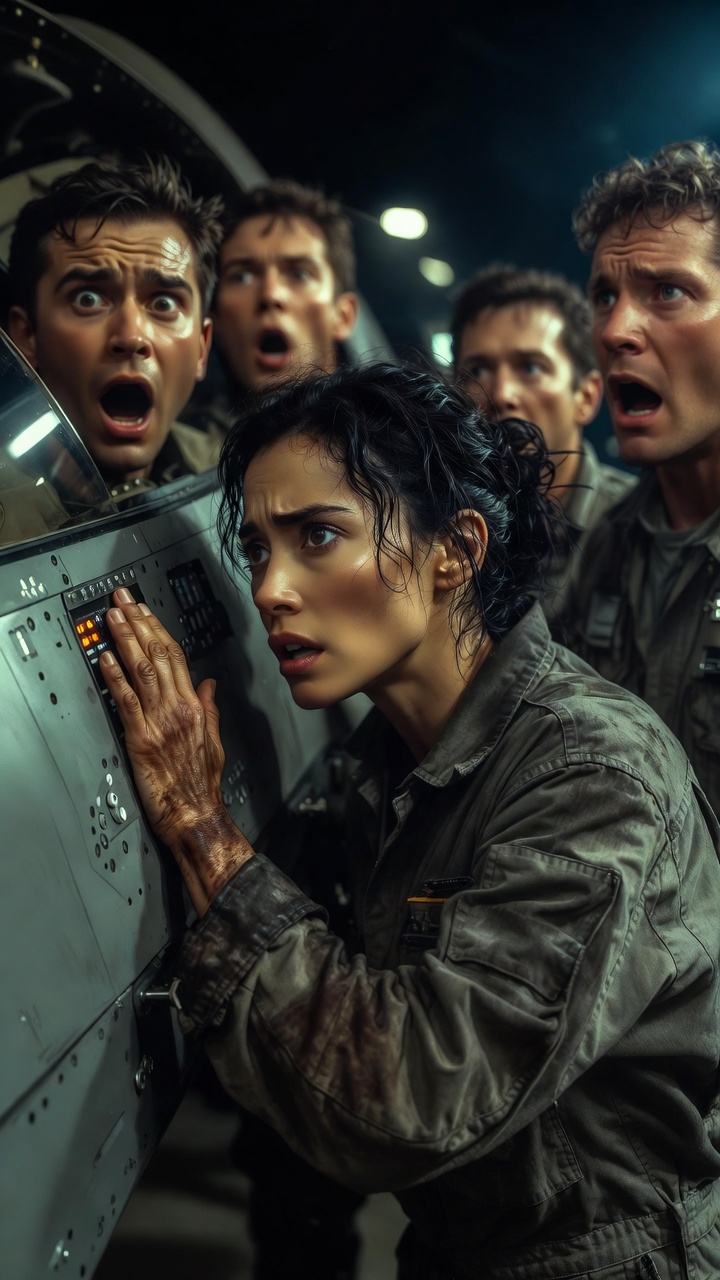
The woman approached the left side of the aircraft near an access panel behind the cockpit. She placed her toolbox on the concrete, removed one glove, and rested her palm flat against the fuselage.
Holt looked toward the maintenance supervisor.
“What is she doing?”
No one knew.
The woman leaned closer to the panel.
Then she spoke four words in a tone barely above a whisper.
“Wake sequence. Architect authorization.”
For half a second, nothing happened.
Then the aircraft came alive.
Not gradually.
Instantly.
Internal fans spun up. Exterior status lights flashed. The cockpit displays illuminated without anyone inside. Hydraulic pumps activated, and the diagnostic console beside the ladder began moving through screens faster than any technician had ever seen.
Nobody spoke.
Holt’s face changed first.
The anger vanished.
“What did you do?”
The woman did not answer.
She moved her hand several inches along the panel.
“Confirm voiceprint.”
A soft electronic tone sounded from inside the cockpit.
Then a synthetic voice responded through the maintenance interface.
“Voiceprint confirmed.”
Cole unfolded his arms.
His mouth opened slightly, but no words came out.
The diagnostic system began clearing alerts that had remained active for nearly a week.
Navigation bus online.
Flight control interface online.
Hydraulic status normal.
Sensor fusion network initializing.
One of the avionics technicians stepped closer to the display.
“That’s voice authorization.”
Holt looked at him.
“So?”
The technician’s face had gone pale.
“So we don’t have voice authorization.”
The aircraft continued its startup sequence.
The technician lowered his voice.
“That function isn’t in squadron-level documentation.”
A cold silence spread across the group.
The woman walked toward the rear of the aircraft, examining each panel with the familiarity of someone moving through her own home.
She stopped near a service access point.
“Who recalibrated the synchronization module?”
A staff sergeant raised one hand slowly.
“My team did.”
“You aligned it using the external reference mark.”
“Yes, ma’am.”
“The reference mark is not the command centerline.”
The sergeant frowned.
“It was within tolerance.”
“It is three degrees outside priority tolerance.”
“That’s impossible.”
She turned to him.
“The physical module is within mechanical tolerance. The command chain is not.”
No one laughed now.
She crouched beside the panel and opened her toolbox.
Inside were only a few tools, a compact diagnostic device, and a black wrist case.
She removed a narrow probe and connected it to a recessed port.
The maintenance display changed immediately.
A new menu appeared.
TIER ZERO ACCESS
The avionics technician took an involuntary step backward.
Holt noticed.
“What is that?”
The technician kept staring at the screen.
“Tier zero unlock.”
“And?”
“It means the aircraft is operating below field-level restrictions.”
Holt looked toward the woman.
“Can anyone here do that?”
The technician shook his head.
“Not without program command authorization.”
The woman entered no password.
She tapped the port twice with the probe.
The aircraft reset.
Every display went dark.
Then they illuminated again in sequence.
This time, no warnings appeared.
She stood.
“The synchronization module was not the original failure,” she said. “It was the first bad correction.”
The staff sergeant looked confused.
She pointed toward the diagnostic display.
“When the initial navigation fault appeared, someone adjusted the module without understanding command priority architecture. The adjustment changed the timing relationship between the sensor fusion bus and the flight control interface.”
She glanced toward Holt.
“The aircraft interpreted every new correction as a competing authority.”
Holt said nothing.
“For six days,” she continued, “you have been trying to force a command chain into accepting instructions in the wrong order.”
Cole looked at the aircraft and then back at her.
“How do you know what it interpreted?”
She met his eyes for the first time.
“Because that is what it was designed to do.”
Before he could respond, a vehicle stopped at the edge of the maintenance area.
Colonel Marcus Vale, the squadron commander, stepped out before the driver could open his door.
He crossed the concrete quickly, his expression already tense.
“Why is this aircraft powered without cockpit authorization?”
No one answered immediately.
Vale looked from Holt to the maintenance crew.
Then he saw the woman.
He stopped walking.
The change in him was immediate.
His shoulders straightened.
His jaw tightened.
The anger in his face was replaced by something far more unsettling to the people watching.
Recognition.
“Dr. Elena Ward.”
Holt looked at the woman.
Then at his commander.
Vale approached her carefully.
“We were not informed that you had arrived.”
“You were informed yesterday.”
Vale glanced at his operations officer.
The officer looked down.
The colonel’s voice hardened.
“Clear this area. Now.”
The pilots moved back without argument.
Vale turned to the woman again.
“We should have arranged an escort.”
“I did not need one.”
“No, ma’am.”
Holt stared at his commander.
He had never heard Colonel Vale address anyone in oil-stained coveralls that way.
Ward opened the black case attached to her wrist.
Inside was an encrypted identification card and a thin authorization disc marked with a series of program-level symbols.
The maintenance supervisor saw the clearance indicator and went still.
Black-level access.
Higher than anything normally seen on the flight line.
Colonel Vale looked toward the pilots.
“Dr. Ward served as one of the principal control-architecture engineers for this platform’s avionics modernization program.”
Nobody moved.
Vale continued.
“She wrote significant portions of the command-priority firmware you have spent the last week attempting to repair.”
Cole’s face lost its color.
The sentence he had spoken earlier seemed to hang over the group.
Do you even know what a correct F-22 startup sounds like?
Ward closed the wrist case.
“I did not write all of it.”
Vale nodded quickly.
“No, ma’am.”
“I rewrote the part that kept failing.”
The colonel gestured toward the cockpit ladder.
“Do you require assistance?”
“No.”
She climbed the ladder.
At the top, she pressed two fingers against a biometric strip near the canopy frame.
The canopy released automatically.
Again, no code was entered.
No switch was touched.
She lowered herself into the cockpit and placed a lightweight headset over one ear.
For several seconds, she sat completely still.
The squadron watched from below.
She was not looking at the warning logs.
She was listening.
Then she spoke.
“System override. Architect channel.”
The central display changed.
“Alpha vector calibration sequence.”
The flight control surfaces moved in a precise pattern.
“Reset stealth-envelope navigation matrix.”
The maintenance screens flickered as multiple modules disconnected and reconnected in a controlled cascade.
The aircraft’s internal systems began cycling through tests the squadron had not even known were available.
Ward watched the sequence without touching the primary controls.
A yellow warning appeared briefly.
She leaned toward the left display.
“There you are.”
Holt looked at the avionics technician.
“What does she see?”
The technician shook his head.
“I don’t know.”
Ward issued another command.
“Isolate legacy translation layer. Remove unauthorized patch set.”
The cockpit displays went dark for one second.
Then every system returned.
Green.
All of them.
The aircraft completed its diagnostic sequence for the first time in six days.
A final status line appeared on the external console.
MISSION SYSTEMS READY
No one cheered.
The silence was too complete.
Ward powered down the aircraft and climbed out of the cockpit.
Colonel Vale waited at the bottom of the ladder.
His voice was lower now.
“We should have recognized the software conflict.”
“You should have followed program procedure.”
“Yes, ma’am.”
“The initial fault was minor. Your team made it critical by installing an unapproved patch.”
Vale looked toward the operations officer.
The officer’s face tightened.
Ward continued.
“The patch bypassed a translation layer that exists for a reason. Once that happened, every manual recalibration increased the conflict.”
Holt stepped forward.
“Dr. Ward.”
She looked at him.
His earlier confidence had disappeared.
“We were under operational pressure.”
“So was the aircraft.”
The answer was not sarcastic.
That made it worse.
Holt lowered his eyes.
“We treated the warnings as separate failures.”
“You treated symptoms as enemies,” she said. “They were messages.”
Behind him, Cole stood perfectly still.
Ward closed her toolbox.
“The aircraft is serviceable. Do not modify its firmware again without authorization from program command.”
“Yes, ma’am,” Colonel Vale said.
The others repeated it quietly.
For the first time that morning, the pilots sounded like students.
Vale hesitated.
“Would you consider staying to brief the squadron on the architecture?”
Ward lifted the toolbox.
“I don’t train pilots.”
The colonel gave a small, embarrassed nod.
“Then who do you train?”
She looked back at the F-22.
“I train the aircraft.”
Nobody smiled.
Nobody mistook the sentence for a joke.
Ward walked across the flight line toward the vehicle that had brought the commander. Her steps were unhurried. She did not look back at the pilots, the technicians, or the aircraft that had responded to her voice as if recognizing the person who had taught it how to think.
When she was gone, the squadron remained silent.
Cole finally spoke.
“I asked her if she knew what the startup was supposed to sound like.”
No one rescued him from the admission.
He looked at the aircraft.
“She built the system I trust with my life every time I leave the ground.”
Holt picked up the glove he had thrown earlier.
For once, he had no order to give.
In the days that followed, the investigation confirmed everything Ward had said.
An unauthorized software adjustment had been loaded during an earlier troubleshooting attempt. The change had not damaged the aircraft physically. It had disrupted the hierarchy through which its systems decided which commands to trust.
The fault had been small.
The arrogance around it had made it dangerous.
The squadron completed its readiness exercise.
But the event changed more than the maintenance procedures.
Pilots began asking technicians what they saw before telling them what they had missed. Senior officers stopped assuming that rank and expertise always wore the same uniform. Young maintainers noticed that questions were heard more carefully when they raised them.
Months later, a framed photograph appeared in the squadron briefing room.
It showed the lead F-22 at sunrise, its canopy reflecting the first light over the runway.
Beneath the photograph was a small metal plaque.
It contained only three words.
RESPECT THE BUILDERS.
Dr. Elena Ward never returned to that base.
There was no ceremony in her honor. No speech. No photograph of her standing beside the aircraft.
She did not need one.
Her work remained every time the jet powered up, every time its systems aligned, and every time a pilot trusted the machine enough to take it into the sky.
Somewhere else, on another runway, another complicated machine may already be refusing to cooperate.
And perhaps another quiet expert is approaching it with a small toolbox, an ordinary uniform, and no interest in explaining who she is.
The most capable person in the room is not always the one giving orders.
Sometimes, she is the one everyone laughed at before the machine recognized her voice.