On the evening of May 1, 1945, six children were prepared for bed inside the bunker beneath Berlin’s shattered Reich Chancellery.
Their names were Helga, Hilde, Helmut, Holde, Hedda, and Heide.
The youngest was four. The oldest was twelve.
Above them, Soviet artillery shook the walls. Adolf Hitler was already dead. The empire their parents had promised would last a thousand years had survived barely twelve.
But the children were not being protected from the approaching army.
They were being prepared to die.
Their mother, Magda Goebbels, had spent years presenting herself as the ideal woman of Nazi Germany: elegant, loyal, fertile, and devoted to the Führer. Photographs of her smiling family had appeared in newspapers and propaganda magazines across the country.
Now, as the regime collapsed, she decided that her children would not be permitted to live without it.
They were sedated. Cyanide was placed into their mouths.
By the end of the night, all six were dead.
Hours later, Magda and her husband, Nazi propaganda minister Joseph Goebbels, also killed themselves. The woman once treated as the unofficial “First Lady” of the Third Reich ended her life beneath the ruins of the system she had helped glorify.
But Magda Goebbels was not the only woman standing beside the men who built Nazi Germany.
There were wives who enjoyed confiscated mansions while Jewish families were forced from their homes.
There were lovers who accepted jewels, private villas, servants, and protection while millions of people disappeared into ghettos and concentration camps.
There were aristocratic admirers who crossed borders to sit near Hitler and tell him what he wanted to hear.
When the regime finally fell, some of these women died violently.
Some lost everything.
And some escaped with consequences so small that the truth is more disturbing than any execution.
Eva Braun had met Hitler long before the world knew her name.
She was seventeen when she began working for Heinrich Hoffmann, Hitler’s personal photographer. Hitler was more than twenty years older, already rising through Germany’s political system and carefully constructing the image of a leader who belonged entirely to the nation.
A public wife would have damaged that image.
So Eva remained hidden.
She lived close enough to enjoy access, comfort, and privilege, but far enough from public view that ordinary Germans rarely knew she existed. At Hitler’s mountain residence near Berchtesgaden, she filmed guests relaxing on terraces, eating meals, playing with dogs, and enjoying the scenery.
The home movies looked almost painfully normal.
That was what made them so chilling.
While Nazi officials planned deportations and mass murder, Hitler’s inner circle sunbathed, drank tea, watched films, and laughed for the camera. The victims were kept outside the frame.
Eva was not known to have helped design Nazi racial policy or military strategy. But she was not imprisoned beside Hitler. She was not trapped by guards. She repeatedly chose to remain in his protected world.
In April 1945, she made her final choice.
With Berlin surrounded and the Third Reich collapsing, Eva traveled into the city and joined Hitler in the bunker. People around her still had chances to flee. She stayed.
Shortly after midnight on April 29, Eva Braun became Eva Hitler.
The marriage ceremony took place underground while enemy shells landed nearby. After years of secrecy, she had finally received the title she had waited for.
She would hold it for little more than a day.
On April 30, Hitler and Eva entered a private room. Eva took cyanide. Hitler killed himself beside her. Their bodies were carried outside, covered with fuel, and burned as Soviet troops closed in.
Her transformation from hidden mistress to official wife had lasted less than forty hours.
Magda Goebbels followed a different path.
She had not been hidden from the German public. She had been displayed before it.
Tall, composed, and socially polished, Magda was useful to the regime. Hitler was unmarried, and Nazi propaganda needed a woman who could appear at public functions, receive foreign visitors, and embody its ideal of motherhood.
The Goebbels children became part of that performance.
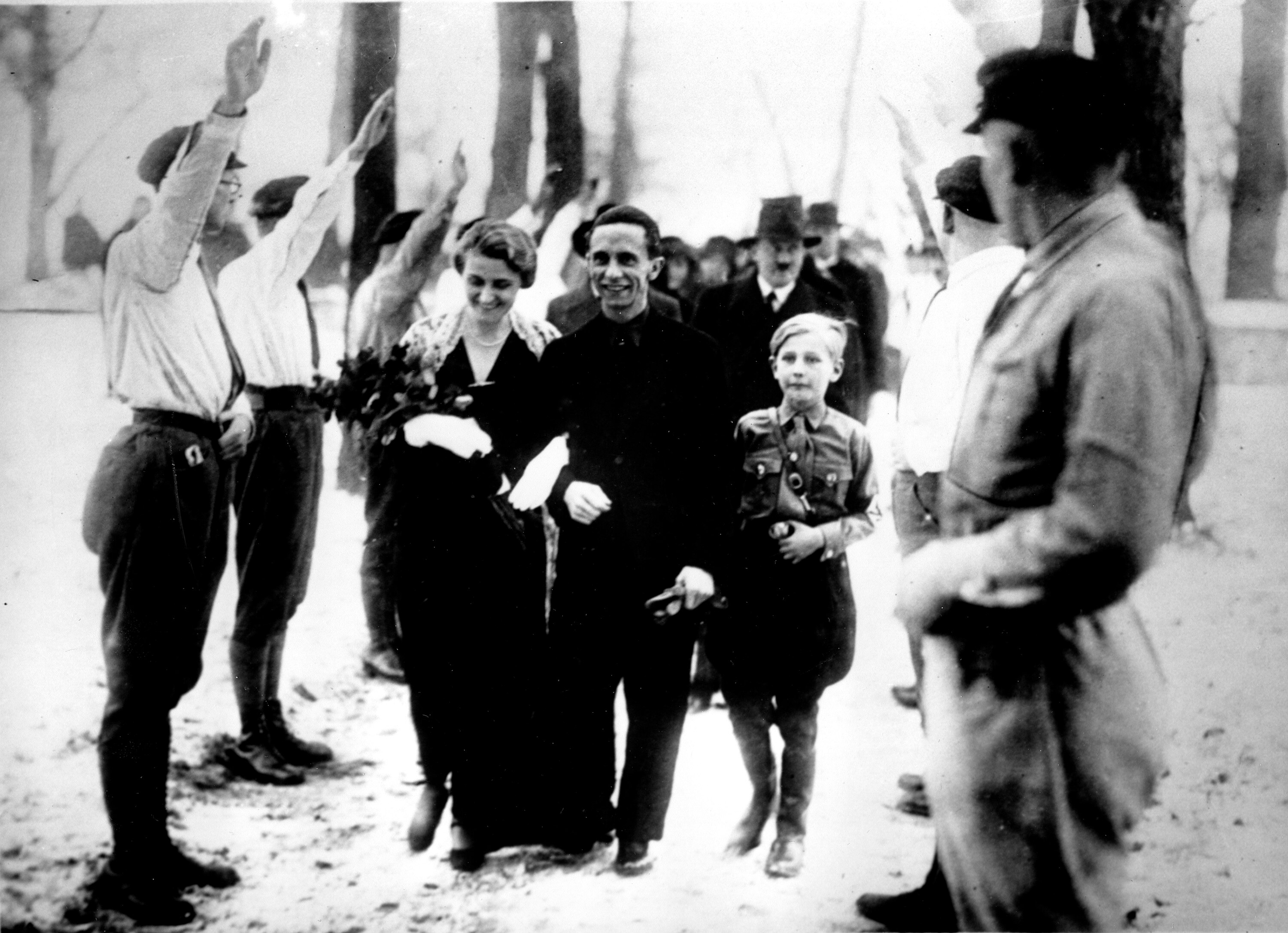
They were photographed in coordinated clothing. They appeared in carefully arranged family scenes. Their home life was presented as proof that Nazi leadership represented order, health, and traditional values.
Behind the photographs, Joseph Goebbels conducted repeated affairs.
Magda knew enough to understand the man she had married. She also knew the nature of the regime surrounding her. She remained not merely because of personal affection, but because her status, identity, and worldview had fused with National Socialism.
When defeat became unavoidable, friends and officials reportedly offered ways to remove the children from Berlin.
Magda refused.
In a farewell message to Harald Quandt, her surviving son from an earlier marriage, she explained that the younger children should not grow up in a world without National Socialism.
That sentence revealed the final corruption of the regime.
The children were not killed by enemy bombs.
They were killed because their mother considered life after Hitler worse than death.
After the poison was administered, their bodies were left in their beds. Magda then climbed the bunker stairs with Joseph.
The exact details of the couple’s deaths remain disputed, but their burned remains were discovered outside.
The family once photographed as Germany’s model household had destroyed itself.
Yet even then, the smallest bodies in the bunker belonged to the only members of that family who had made no choices at all.
Beyond Germany, another woman had built her identity around Hitler.
Unity Mitford was not German. She was the daughter of a British aristocratic family, raised among wealth, servants, and social connections.
She became fascinated by fascism and moved to Munich in the 1930s, determined to enter Hitler’s world.
Unity placed herself where Hitler regularly ate. She waited, watched, and eventually gained his attention. What began as obsession turned into repeated access to the dictator and his circle.
She praised him publicly. She embraced antisemitism. She became a visible British supporter of Nazism at a time when Hitler’s intentions were becoming increasingly difficult to deny.
To Unity, proximity to power felt like destiny.
Then, on September 3, 1939, Britain declared war on Germany.
The two countries she had tried to connect through her personal devotion were now enemies.
Unity went to a Munich park and shot herself in the head.
She survived.
The bullet remained lodged in her skull because doctors considered its removal too dangerous. She was eventually returned to Britain, severely impaired and dependent on her family.
The confident aristocrat who had moved through Hitler’s social circle now struggled with the permanent consequences of the wound.
She never fully recovered.
In 1948, at the age of thirty-three, Unity Mitford died of meningitis associated with swelling around the bullet that had remained in her head for nearly nine years.
Then there was Emmy Göring.
Before marrying Hermann Göring, she had been an actress. After marrying him, she entered one of the most extravagant households in Nazi Germany.
Göring was not simply a military commander. He was a collector whose enormous holdings included art seized or purchased under coercive conditions from persecuted owners. His residences were filled with luxury while German forces plundered occupied Europe.
Emmy benefited from the world he created.
She hosted important guests and appeared at state occasions. She was addressed as Frau Reichsmarschall after her husband received one of the regime’s grandest titles.
Their daughter’s birth was celebrated with hundreds of aircraft flying over Berlin.
The message was unmistakable: this was not an ordinary family. It was a dynasty protected by the power of the Reich.
Then the uniforms lost their authority.
Hermann Göring was captured and placed on trial at Nuremberg. The man who had once surrounded himself with guards, stolen treasures, and military ceremony now sat beneath the eyes of Allied judges.
He was convicted and sentenced to death.
On the night before his scheduled execution in October 1946, he swallowed cyanide in his cell.
Emmy survived him.
She was arrested, interned, and brought before a denazification court. In 1948, she was classified as an active Nazi. She received a one-year sentence, which was considered already served, lost thirty percent of her property, and was banned from performing onstage for five years.
It was a dramatic fall from palaces and private boxes.
But it was not equal to the suffering from which her family’s wealth and position had benefited.
Emmy later published a memoir about her life beside Göring. Like many people from the defeated Nazi elite, she presented herself primarily through loyalty, marriage, hardship, and loss—not through the lives destroyed by the regime that had made her important.
And here is where the story takes its darkest turn.
It is tempting to believe that every woman close to a major Nazi eventually faced a terrible punishment.
That would make history feel cleaner.
It did not happen.
Lina Heydrich had married Reinhard Heydrich, one of the most feared men in Nazi Europe. He became a leading architect of terror, closely associated with the machinery that led to the Holocaust.
After he was assassinated in Prague in 1942, Lina continued living on an estate in occupied Czechoslovakia.
The property was not maintained by ordinary paid employees alone.
Jewish prisoners from the Theresienstadt ghetto were sent there as forced laborers. Later, prisoners from a concentration camp were also made to work on the estate. Survivor testimony described mistreatment under Lina’s authority.
After the war, one might assume that the widow of Reinhard Heydrich would have faced severe consequences.
Instead, Lina was cleared in West German denazification proceedings.
Czechoslovakia tried her in absentia and sentenced her to life imprisonment, but she did not serve that sentence.
Then she fought the West German government for a widow’s pension.
The government had resisted paying because of her husband’s central role in Nazi crimes. Lina took the dispute through the courts—and won the right to receive payments based on Heydrich’s status as a police general killed during the war.
The widow of a man whose name had terrified occupied Europe was financially supported under the legal system of postwar Germany.
She later ran a guesthouse.
In 1976, she published a memoir and continued defending her husband’s reputation, attempting to minimize or deny the true nature of his involvement in mass murder.
Lina Heydrich lived until 1985.
There was no bunker.
No cyanide capsule.
No execution chamber.
No lifelong prison sentence.
She had outlived millions of people whose destruction her husband’s machinery had helped organize.
That is the part of the story many people do not expect.
The fates of the women surrounding Nazi leaders were not determined by a perfect system of justice.
Some chose death rather than face a world without power.
Some killed their own children before killing themselves.
Some survived physical ruin.
Some lost titles, homes, careers, and portions of their wealth.
And some lived for decades, wrote books, collected pensions, and tried to reshape public memory.
Their lives also expose a dangerous myth: that people who stand beside powerful criminals are always ignorant, helpless, or politically irrelevant.
Not every wife knew every operational detail.
Not every lover signed an order.
But ignorance can become a carefully maintained shelter.
They saw the servants.
They saw the confiscated art.
They saw neighbors disappear.
They heard the language used against Jews and other persecuted groups.
They watched their husbands rise through a system built on exclusion, imprisonment, theft, and violence.
And they continued enjoying the view from inside the gates.
When those gates finally collapsed, cameras captured women carrying suitcases, hiding jewelry, searching for missing husbands, or insisting that politics had never interested them.
The titles disappeared overnight.
The privileges did not always disappear with them.
That may be the most brutal truth of all.
History did not deliver equal punishment to everyone who benefited from the Third Reich. Justice arrived unevenly—swiftly in some rooms, weakly in others, and far too late for the millions already dead.
The wives and lovers of Nazi leaders did not share one fate.
But they shared one question that still matters today:
When cruelty is buying your comfort, how long can you stand beside it before silence becomes participation?